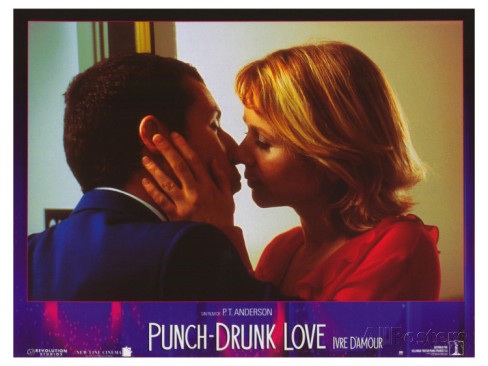
Will Larroca’s stock as a director has been as volatile as Nic Cage’s acting career. Though critically acclaimed in some quarters, his first picture, The Monster, was uneven.  It was followed up by a skilled but off-kilter homage, Will Will Kill. Thereafter, the word on the street was that he was working on a frightening script, House of Blood, which was even touted in promos by Larroca’s studio, PJ SmoothIson.

And then . . . Larroca was tied to a trippy, bizarre The Hugginns Movie, and then a weirdly religious but shockingly effective parable, Commandments Revamped. House of Blood disappeared from the trades, replaced by talk of production of an as yet untitled American gangster opus, which is rumored to start filming shortly.

And now, we have The Ballad of Chad Big Bucks, with Larroca clearly in front of the camera. But how much of him was behind it?  This seems like a production-for-hire, and while there is no shame in making a corporate buck (documentarian Errol Morris is the genius behind Taco Bell’s new “I am Ronald McDonald” ad campaign), it’s harder to discern where Larroca shows up on this endeavor, which is sold to us at the outset as someone else’s film.

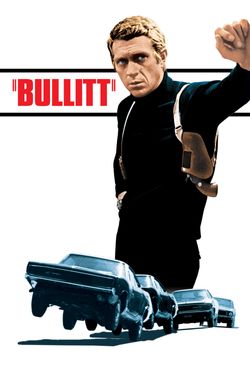
Much of the good in Big Bucks clearly carries his stamp. The chase scene in the middle of the picture takes the fury and speed of Bullitt or The Seven Ups and turns it on its head. The super slo-motion is riveting, somehow making the violence of the action even more unbearable. I’ve watched the scene numerous times and find myself on pins and needles each one. Larroca’s use of the elements is also adept. The rain is borderline elegiac, and the operatic voiceover narrative, a sing-songy minstrel tune, brilliantly alternates between mournful and mocking. Finally, the film bravely ignores religious implication until the end of the picture, and it is still unclear whether Larroca is rejecting the idea of a higher power or endorsing it.

Much of the flick, however, is haphazard. What the heck is Spiderman doing at the outset?  What is occurring with the almost purposeful rough edits, where actors turn to and acknowledge the camera?  The line between the film story and filmmaking has always been malleable in Larroca’s films, but sometimes, sloppy is just that and no more. And why does the minstrel voiceover start screaming when the main protagonist is cycling in the streets ala’ Butch Cassidy & The Sundance Kid?  And would Jordan Belfort really be walking around a leafy suburb?  Larroca is clearly comfortable shooting in the same location, and there certainly are financial pressures in a young auteur using his own studio, but it’s time to leave his familiar surroundings and see the world.

While newcomer BGrimms is a standout (his anger and fall are heartbreaking), Larroca’s continuing fealty to Zeb Dempsey and Reid Brown is questionable. His devotion to these young actors is to be commended, but Brown’s mumblemouth approach (think Benicio del Toro in The Usual Suspects) has run its course, and Dempsey’s overacting compares unfavorably to the last films of Rod Steiger. One wants to see new faces as well as new places. Perhaps that’s why Larroca himself jettisoned his own persona in favor of homages to Nicolas Cage and Leonardo DiCaprio. The selections are apt, but the time has come for Larroca to move from parody to depth as an actor, and from provincial to worldly as a director.

We shall see what the summer brings.

I normally watch this during the holidays, but it is now on the HBO rotation, and I’ve been enjoying it in segments. Based on Nick Hornby’s novel (Hornby was also one of the screenwriters), this is a fine story of a charming but vacuous and intentionally isolated rich guy (Will, played by Hugh Grant) who corrals a neighborhood boy into playing his son in the hopes it will impress a romantic target. He is soon brought into the boy’s world, against all his selfish instincts.

This is a very funny film.  The comedic set pieces (including a harrowing talent show, the death of a park swan, and awkward support groups) are masterful.  The narrative is punctuated by voiceovers from Marcus or Will, and their observations are either hilarious or sentimental. The message is A Christmas Carol – no man is an island, and we are defined by how we treat each other, but for every sweet note, there is an arch counterpoint. My favorite is Will’s voiceover upon meeting Marcus’s earthy, liberal, disapproving mother, Fiona (Toni Collette) over lunch, where he lords his non-vegan ways by ordering steak while, in his mind, deriding her Yeti-like sweater.

About a Boy – 5 stars | filmvetter

Grant is usually reliant on an affected, stammering, faux-shy schtick (his performances in Notting Hill and Love Actually are of this stripe; cloying and relentlessly puppydog). But here, he’s pretty much a dick, playing Will as someone who enjoys a relationship only to the extent it provides him an opportunity or the solace of being kind-hearted. Once there is heavy lifting, he is out, as Grant explains:

Grant is really quite good in the role, especially upon the realization that he is worth nothing in this world. Nicholas Hoult plays Marcus with a sweet perseverance that never once smacks of child-actor manipulation, and Collette is truly vulnerable as Marcus’ crunchy, depressed mother, who is oblivious to the needs of Marcus, his desperation to save her, and the burdens she places on his shoulders.

It’s also heartening to know that poor, sweet Marcus

has grown up to date

Justice.

300, but with less homoerotic tension, thanks in part to the contributions of Eva Green, a vicious, smoldering twist of an invader, who turns in one of the more ridiculous yet strangely intoxicating love scenes in the history of cinema. Before and after this scene, it’s just a lot of slo-mo spears and swords, a comic-book Spartacus-meets-Gold’s Gym.

On reflection, Eva Green’s mating style is remarkably similar in Dark Shadows:

dark shadows johnny depp gif | WiffleGif

Anchorman 2's Ron Burgundy: Five Funniest Viral Marketing Stunts - Variety

Seemingly improvised throughout, the sequel is alternately lazy and uproarious, but by the end, more the former. The Channel 4 news gang (Will Ferrell, Steve Carell, David Koechner, and Paul Rudd) have reunited, moving from San Diego to New York City, to take the helm of the graveyard shift on the first 24 hour cable news channel. Soon, Ferrell’s Ron Burgundy is back on top, discarding his friends, cementing his fall (he is even stricken blind), only to return triumphant.

In the first film, Ferrell’s bosses (Fred Willard and SNL alum Chris Parnell) held their own as comedians, contributing to the fun. Ferrell’s new boss is the sassy, Pam Grieresque Meagan Good, who is placed in the film for a painful scene where Ferrell visits her family and tries to “act street.” She’s not funny, but she’s not alone.  Harrison Ford, Drake, Kanye West, Tina Fey, Amy Poehler, Jim Carrey, Sacha Baron Cohen and others appear, most for a reprise of the first film’s news team rumble, but the melee is woefully disappointing. Gone are the unexpected trident and grenade, the scores from Star Trek and West Side Story, replaced by celebrities who just wanted in. Sure, Ford turning into a werewolf is pretty cool, and who doesn’t laugh at an unexpected minotaur, but these guys aren’t very funny.  And Liam Neeson and Marion Cottilard? Zzzzzzzzzzzzzz. Will Smith?  He wasn’t even funny in The Fresh Prince of Bel Air. Even Vince Vaughn’s return as Wes Mantooth is a little dull. Speaking of dull, Kristen Wiig as Steve Carell’s love interest is Sominex.

Director Adam McKay also tries to deliver a lesson about the degradation of the news. He usually appends his simplistic political tracts to the end of his goofy movies, so you could walk out of The Other Guys or The Campaign while the credits rolled and he lamented Wall Street greed or the Citizens United decision.

Other bits fare better, including Ferrell’s interactions with his young son and his bottle feeding of a baby shark; Carell’s panic at the loss of his legs on a green screen; and especially, the news team’s smoking of crack on the air.

Raging Bull (1980) - IMDb

Martin Scorsese’s film is visually captivating and anchored by Robert De Niro’s mythic performance as the tortured pugilist Jake LaMotta. The feel of 40s and 50s New York is made more authentic by Scorsese’s use of black-and-white, and as boxing movies go, there is none better at conveying the bloody brutality of the sport. All these gifts, however, come with the stench of a major character who is, through and through, a dim, vicious brute. A recent film with a similar infirmity is Paul Thomas Anderson’s The Master, which had myriad other problems, but which also asked the audience to invest in Joaquin Phoenix, a jet fuel slurping, brainless, dypso thug who comes under the sway of a charismatic. Who cares? Similarly, in an otherwise brilliant film, Scorsese asks us to engage with an animal, a one-note beast. After the fourth scene of LaMotta becoming violent and/or obsessively compulsive over the fidelity of his blond bombshell of a wife (Cathy Moriarty), the yawns become harder to stifle. It’s a testament to the charms of the picture that you happily stick with it.

Francis Ford Coppola’s take on the Dracula story is wild, campy, and brisk.  It also has a few scares, but one gets the sense Gary Oldman’s operatic Transylvanian count is not to be taken too seriously.

After all, Oldman appears in, by my count, 7 guises, including a nifty pile of rats, and he is just short of hammy in all.  Not to be outdone, Anthony Hopkins’ Dr. Van Helsing is near giddy in his thirst for scene-chewing and vampire heads.

In its first half, the picture feels very Baz Luhrmann meets Saturday-at-the-movies serial. It settles into a more leisurely pace in the middle, as Dracula attempts to take root in London and his opposition grows.  The picture is a gas, and Coppola’s rejection of an overly serious, brooding vampire is welcome. Perhaps it is not quite a rejection, as Oldman tries so hard to be otherworldly and tortured, he may be the last one in on the joke.

The film is also surprisingly erotic, as is evidenced by poor Jonathan Harker’s seduction at the hands of Dracula’s babes and the complete, sensual overload delivered to Winona Ryder and Sadie Frost as they fall under Dracula’s sway and then use all of their wiles to get at necks.

Speaking of, Harker is played by Keanu Reeves, who was then fresh off of two Bill and Ted’s Excellent Adventure movies.  If you thought Kevin Costner had problems with an English accent in Robin Hood, you have to check out this performance (both Costner and Reeves are listed in the Top Five Most terrible British Accents, and rightfully so.  Reeves can hold his accent – barely – for one line, and then, he’s one syllable away from San Dimas and “duuuude.” Then, he’s back to a dramatic and unconvincing “Carfax Abbey” only to drop it again, as if he knows how silly he sounds. Ultimately, Reeves appears so uncomfortable, he retreats into the implacably unaffected stoner no matter what Oldman and Hopkins throw at him, a treat all in itself.

Great, grandiose soundtrack as well.

The trend away from gore porn and toward chilling, moody scary movies remains welcome.  Oculus is a worthy fingers-over-the-eyes addition, in the mold of The Conjuring, and sporting a clever storyline that tracks, and intersects, the childhood trauma of two kids whose house was haunted by a spooky mirror and their attempts as adults to destroy it.  The execution is crisp and even ingenious, and the child actors (Annalise Basso and Garret Ryan) are superb.  As to the flaws, there is one, and it is a rather big one, but I can’t reveal it without telling too much.  Suffice it to say that it falls under the “Well, if X, then why the hell would they do Y?” variety.  It’s a testament to the skill of writer/director Mike Flanagan (born, I shi** you not, in Salem, Massachusetts) that I was able to shelve the issue and just sit back and enjoy the film.

Alexander Payne’s black-and-white portrait of a geriatric mid-westerner (Bruce Dern) intent on getting from Montana to Nebraska to collect a sham $1 million sweepstakes prize is patient, lyrical and loving.  The film evokes David Lynch’s The Straight Story in its pathos, but it also contains a wry sense of humor, largely provided by Dern’s suffering younger son (SNL alum Will Forte) and his brutal, loudmouth but ultimately protective wife (June Squibb)  Lesser films would have played up the wackiness of the extended family, who now believe Dern is flush and are making their claims, or they would have provided Dern the platform to release his Korean war demons or his crushed dreams to his son on their journey.  There is none of that easy bull here.  Instead, Payne presents an authentic portrait of a stoic rural family (Dern seems to have 7 brothers, all of whom watch the NFL with nary a quiver) steeled by time and want, with the very true message that most people don’t really know much about their parents, and that their pasts grow more foreign to us every day.  This film is a lesson in restraint, and Payne (The Descendants, Sideways, Election, Citizen Ruth) has cemented his place as a writer/director with a unique, American voice.

I was surprised to see several things in my recent re-viewing of Martin Scorsese’s classic, including Albert Brooks as the exact same character he has been playing for nearly 40 years; Scorsese himself making a Hitchcockian appearance in the background, but then taking a significant one-scene role as a lunatic in the back of Travis Bickle’s (Robert DeNiro) cab, suggesting he changed his mind about how much time he would spend in front of the camera; and the effectiveness of the score, which was Bernard Herrmann’s last one.

That aside, it holds up as the classic it is considered (47 on AFI’s Top 100). Scorsese’s New York is a modern hell.  He shoots the city so it almost reeks. Steam pulses out of the grates, rot is everywhere and kindness is non-existent (I couldn’t get a fantastic book, “Ladies and Gentlemen, the Bronx is Burning” out of my mind).  The viewer is immediately in kinship with Bickle’s voiceover, “All the animals come out at night – whores, skunk pussies, buggers, queens, fairies, dopers, junkies, sick, venal. Someday a real rain will come and wash all this scum off the streets.” Bickle is a Vietnam vet who can’t sleep and teeters on the edge of sanity. When he falls for a campaign worker (Cybill Shepherd) merely by viewing her through a plate glass window, it seems creepy only until he approaches her, and then there is charm and hope. He is similarly touching with teen prostitute Iris (Jodie Foster), passionately replying to her taunt that he is a square: “Hey, I’m not square, you’re the one that’s square. You’re full of shit, man. What are you talking about? You walk out with those fuckin’ creeps and low-lifes and degenerates out on the streets and you sell your little pussy for peanuts? For some low-life pimp who stands in the hall? And I’m square? You’re the one that’s square, man. I don’t go screwing fuck with a bunch of killers and junkies like you do. You call that bein’ hip? What world are you from?”

But they are from the same world. Bickle is not wired right, he sabotages himself with Shepherd, and soon, he retreats into the mode of a dangerous and unstable assassin, one who has gone from observer of the inferno to an extinguisher. Ahead of its time, Bickle’s would-be John Hinckley gets a Bernie Goetz makeover, cementing Scorsese’s theme that in the jungle, there’s often but a hair between hero and lunatic, moral beacon and dysfunctional threat. Woody Allen’s Blue Jasmine doesn’t seem a natural comparison to Taxi Driver, but in essence, when it ends with Cate Blanchett in rumpled clothes, talking to herself in the park, the directors are exposing the same reality.

The Silence of the Lambs - July 11th, 2020 at Lefty's Drive In!

My son is headed off with his pals to see The Silence of the Lambs tonight, courtesy of AMC theaters’ occasional screenings of older films. I saw it with him a few weeks back and I think he’s looking forward to watching it again in the theater as much as witnessing the reaction of his friends.

Jonathan Demme’s masterpiece is one of the few films that focuses on the serial killer but doesn’t give way to excess. What we know about Hannibal Lecter (Anthony Hopkins) is simple: he is locked up for eating people; he is brilliant and fascinating; and he is lethal. When a serial killer, Buffalo Bill (Ted Levine) starts to plague the Ohio, Pennsylvania, West Virginia area, FBI profiler Jack Crawford (Scott Glen) sends a trainee, Clarice Starling (Jodie Foster), to elicit any advice from Lecter. Starling and Lecter use each other for their own ends, engaging in a thrilling psychological dance that is one part therapy and one part mental combat; she seeks to stop Buffalo Bill while he waits for a slip-up.

The Silence of the Lambs is so well-paced and taut that on occasion, you are near-breathless. There is only one pause in the film’s very serious, unrelenting tone (when Starling is “hit on” by two geek entomologists with whom she is consulting). The pressure is not only from Lecter and Buffalo Bill, but from Starling’s lack of experience, harrowing childhood, and even her gender and diminutive physicality.  The odds seem uncomfortably stacked against her.

The exchanges between Hopkins and Foster are electrifying. You can see just how dangerous Lecter is and near curse yourself for being charmed by him. Yet, you root for the seemingly overmatched Starling, and when she stumbles, you feel the sting of her awkwardness. When Lecter so easily assesses her background and her sexual desires, it is excruciating. Yet Starling comes up to speed and achieves a plausible parity.  Levine is also expert as the tortured, frightening Buffalo Bill, and his transformation to “normal” when he is questioned is a chilling addition to this “monsters among us” story.

The picture is one of only three to win Academy Awards in all the top five categories: Best Picture, Best Actor, Best Actress, Best Director, and Best Writing (Adapted Screenplay), and deservedly so.