Not as funny as the first one, mainly because it is too self referential and a great deal messier, but plenty funny anyhow. The plot is the same – Channing Tatum and Jonah Hill have to crack a drug ring, only this time, they’re at college. Highlights include Hill’s turn as a Hispanic gang member and later, his impromptu def jam poetry performance at a coffee house, as well as Channing’s bromance with the college quarterback. For better or worse, and mainly better, these guys may be the next Benny and Hope. Downsides include too much Ice Cube and a surprisingly leaden performance from the usually hilarious Jillian Bell (Workaholics, East Bound and Down). You could see this in the theater and get your money’s worth or wait for video and enjoy all the more with the extra $25 in your pocket.
Dreadful. The script is so bad that after yet another disaffected, psychotic right winger (Secret Service chief James Woods) tells liberal prez, cool kat Jamie Foxx that the pen is not mightier than the sword, Prez Foxx jabs a pen in his neck (a total rip-off of a Bob Dole move), and then, just to make sure we got it, actually says, “I choose the pen.” Foxx plays the role like he has a plane to catch, and Channing Tatum, as the Secret Service presidential detail wannabe who saves the day, appears to be stifling laughter on more than one occasion. The CGI is atrocious (attack helicopters maneuver around the offices of downtown DC like Mini Coopers in The Italian Job and grenade explosions that do not knock over lecterns and desks in the rooms where they occur produce fireballs visible 10 blocks away). Finally, the double-double at the end is as implausibly stupid in construction as in resolution – both villains are the only two powerful men in Washington who still use pagers. Busted!
Space aliens called mimics (lethal, metallic, whirring Battling Tops) have landed in France and after checking their advance at Verdun, a global force plans a knockout punch in a D-Day redux. Tom Cruise is unexpectedly assigned to that landing and upon his near immediate death on the beach, wakes up ala’ Groundhog Day to relive the event, again and again. The hero of Verdun, Emily Blunt, recognizes the potential and together, they train, re-live and work to gain the advantage.
Doug Liman’s (Swingers, The Bourne Identity) film is clever, straightforward in concept, and for sc-fi, plausible. Cruise is refreshing playing a reluctant if not cowardly cad thrust into the role of mankind’s savior and Blunt is a convincing, modern Joan of Arc. The blend of London and Paris with CGI is expert and the alien force is intricate and scary.
The picture also sports a sly, muted sense of humor, which Cruise delivers alone, as Blunt takes on the role of the tortured, stoic warrior. Naturally, it tries to establish a deeper connection between the leads, an attempt that largely fails (Cruise is still cursed with a 100% to 0% charm to romance ratio), but Liman doesn’t stubbornly force the issue. The end is also unsatisfyingly upbeat. Minor complaints.
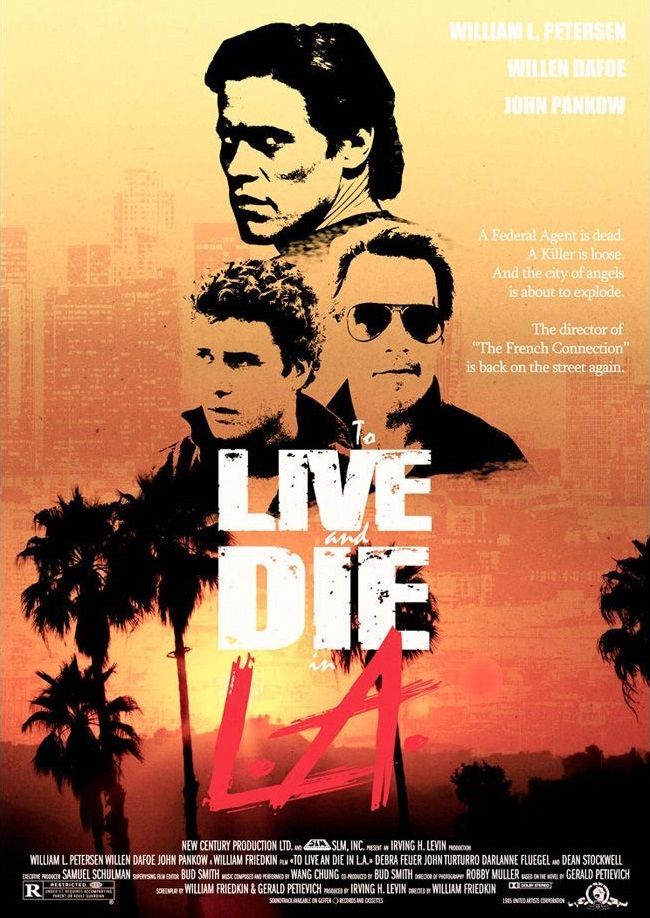
During AFI’s recent LA Modern series, we were hoping to see William Friedken’s picture on the big screen, but schedules wouldn’t permit, so we settled for a Netflix rental. Friedken’s modern crime noir tracks Secret Service agents William Peterson and John Pankow as they hurtle through a maelstrom in an effort to bag master counterfeiter and killer Willem Dafoe. Their zeal seals their doom.
It’s a more than competent thriller, with a few problems. Peterson’s adrenaline junkie character is too one-dimensional, and the screenplay (written by a former Secret Service agent and Friedken) can be awkward in its reliance on hyper machismo, tough guy patter (“You want bread? Fuck a baker!”) or even hackneyed (“I’m getting too old for this shit”).
But the second half of the movie overcomes a lot of the weaknesses of the first, as Peterson and Pankow are revealed to be screw-ups in the ultimate clusterfuck. As they dig deeper, Pankow enlists the aid of Dafoe’s own lawyer, a confident but slightly oily Dean Stockwell, and it is a revelation to see the portrayal of a cop who is probably took weak for the job. Meanwhile, Dafoe proves less efficient than his stylish demeanor suggests and his errors eventually become too much to bear. Dispensing with super cops and criminal masterminds results in a much more satisfying picture.
Friedken also includes a boffo car chase after a heist gone bad in homage to his own The French Connection, and all of his action scenes are non-stylized and immediate (my son observed that the flick has to hold the record for guys shot in the face at 3). Notably, and in keeping with its inclusion in the AFI series, the locations are almost exclusively sun-bleached and bleak industrial LA, a rarity.
Finally, if you were a Wang Chung fan, this is your movie.
My wife and daughter had been badgering me to see this Disney pic for some time, and I finally got a chance over the holiday weekend. I suspect it was as much of a pleasant surprise to Disney as to me. With a relatively modest budget of $150 million (Disney’s much less successful Tangled sported a budget of $250 million) and a voice cast sporting the lesser known Kristen Bell, Idina Menzel and Josh Gadd, the film was the highest grossing of 2013 and has gone on to make $1.2 billion worldwide. It’s clear why. The story, based on Hans Christian Anderson’s The Snow Queen, is solid; you get two princesses for the price of one; and the songs (written by Robert Lopez and Kristen Anderson-Lopez, the former of whom was a co-creator of The Book of Mormon) are captivating, in particular, the Oscar winning “Let it Go”, which has a Wicked-esque quality and has become this ubiquitous:
The film is also economical (hello, parents of the two leads, this is a Disney film, so your presence will not be required for long) and visually stunning, blending CGI and hand-drawn animation to create a Fjordic, Nordic wonderland. Gadd’s clueless but loyal snowman is a tribute not only to Frosty but to my favorite Disney sidekick ever:
My only nit is that the villain is sprung on the audience, when it would have been better to have him seduced into the role.
Ryan Murphy’s (Glee, American Horror Story) adaptation of Larry Kramer’s semi-autobiographical play about the outbreak of AIDS in New York City circa 1981 is a mixed bag, often poignantly moving but more often numbingly repetitive. The film does not shy away from the cruelties of the disease and the inaction that followed its introduction, echoing the source material, an urgent polemic written before there was even a test and the disease was called GRID (Gay Related Immune Deficiency). It is an activist story for a perilous time (the play was produced in 1985) and the immediacy of the stage. Under Murphy’s direction, Mark Ruffalo, as New York City writer Ned Weeks, is largely utilized in a series of stem winders and broadsides against the Koch and Reagan administrations, the insouciant gay community and in particular, his fellow board members of a nascent advocacy and care group. Weeks’ passion is noteworthy but by the end of the picture, you fully understand the frustration of his compatriots. His tactics (a combination of haranguing, attacking and outing) are such that they can’t get a hotline set up without Weeks sneering or warning about the next Dachau (Kramer himself would end up being instrumental in the founding of Act Up, which was decidedly more confrontational and, to be fair, effective). A missed opportunity of an actual exchange, for example, is the fact that Weeks is affluent, making his offering of the livelihoods of all of his co-activists (one of whom is in the military) a rather cheap and easy proposition. This factor is unexplored beyond a toss-off comment.
Ruffalo is joined by several other notables (including Julia Roberts as a doctor on the frontlines and Taylor Kitsch as his more measured activist friend), all of whom have their own speeches, all movingly delivered but all awkwardly stagey. When they occur, we are meant to listen respectfully to the sermons, which are heartfelt, often spoken to bigots and/or bureaucrats (poor Dennis O’Hare, who, after this and Dallas Buyer’s Club, is a cottage industry of unsympathetic pencil pushers in AIDS dramas) or screamed at the heavens, and wholly devoid of nuance. As noted by Frank Rich in his review of the play back in 1985, “the playwright starts off angry, soon gets furious and then skyrockets into sheer rage . . . Some of the author’s specific accusations are questionable, and, needless to say, we often hear only one side of inflammatory debates. But there are also occasions when the stage seethes with the conflict of impassioned, literally life-and-death argument. … The writing’s pamphleteering tone is accentuated by Mr. Kramer’s insistence on repetition – nearly every scene seems to end twice – and on regurgitating facts and figures in lengthy tirades. Some of the supporting players … are too flatly written to emerge as more than thematic or narrative pawns. The characters often speak in the same bland journalistic voice – so much so that lines could be reassigned from one to another without the audience detecting the difference. If these drawbacks … blunt the play’s effectiveness, there are still many powerful vignettes sprinkled throughout.” Murphy’s film is nothing if not faithful to Rich’s evaluation.
When Murphy moves away from the politics of the disease and human relationships, the picture is much stronger. The relationship between Weeks, who is reticent about intimacy and the gay world’s sybaritic nature, and his lover Felix, played by Matt Bomer, is an exchange that offers a view into the difficulties growing up and being gay. The scene where Ruffalo demands that his straight and supportive brother (Alfred Molina) accept that they are essentially the same is the best one of the film, as each character is given a voice. And The Big Bang Theory‘s Jim Parsons delivers a beautiful eulogy for a friend and by extension, for all the “plays that will not have been written, dances that will not be danced” that is heartrending. Sadly, these scenes are the exception rather than the rule, and the watching of The Normal Heart eventually lapses into a very unfortunate place for entertainment – duty, a film you “should” see rather than one you would necessarily want to.
The good: the clever set-up of the origins of the beast incorporated into the opening credits; Bryan Cranston, as the obsessed Area 51 type who devotes his life to revealing those origins and the threat; the avoidance of the evil military-industrial tropes that often infect disaster movies; the destructions of cities other than NYC and LA; an ominous, moody score; and the monster battles, which are realistic, haunting and classic instead of computer-dizzying, antiseptic and deadening. And at just over 2 hours, it is the perfect length.
The bad: the script is banal. Anything the scientists (a barely intelligible Ken Watanabe and an absolutely pointless Sally Hawkins) contribute is mush, and when they object to the military’s plan to lure other monsters from the Godzilla family with nuclear weapons (which the eat like Chicklets), Hawkins merely shakes her head, like, you know, come on . . . that’s soooooo crazy, and Watanabe produces the pocket watch his father carried . . . in Hiroshima. Heavy.
Military commander David Staitharn is merely low grade concerned throughout, with an almost “Well, thank God this ain’t no 9-11” air about him. Aaron Taylor Johnson (Kick Ass), in a role made for Channing Tatum, is as evocative as a hot dog bun sopped in tap water (The Atlantic’s Christopher Orr said it better: “As for Taylor-Johnson’s performance as Ford, the movie’s central human protagonist, it was so dutifully generic that I forgot it even as I was watching it. I have no lasting impression of him whatsoever”). There is also a child actor who is child actory, better utilized to sell Underoos than terror at the loss of his mother and/or father. Finally, this is Godzilla. I don’t need Seth Rogen toking on a bong and yukking it up, but this film has almost zero sense of humor, depicting a world that perhaps deserves a good stomping.
Will Larroca’s stock as a director has been as volatile as Nic Cage’s acting career. Though critically acclaimed in some quarters, his first picture, The Monster, was uneven. It was followed up by a skilled but off-kilter homage, Will Will Kill. Thereafter, the word on the street was that he was working on a frightening script, House of Blood, which was even touted in promos by Larroca’s studio, PJ SmoothIson.
And then . . . Larroca was tied to a trippy, bizarre The Hugginns Movie, and then a weirdly religious but shockingly effective parable, Commandments Revamped. House of Blooddisappeared from the trades, replaced by talk of production of an as yet untitled American gangster opus, which is rumored to start filming shortly.
And now, we have The Ballad of Chad Big Bucks, with Larroca clearly in front of the camera. But how much of him was behind it? This seems like a production-for-hire, and while there is no shame in making a corporate buck (documentarian Errol Morris is the genius behind Taco Bell’s new “I am Ronald McDonald” ad campaign), it’s harder to discern where Larroca shows up on this endeavor, which is sold to us at the outset as someone else’s film.
Much of the good in Big Bucksclearly carries his stamp. The chase scene in the middle of the picture takes the fury and speed of Bullitt or The Seven Ups and turns it on its head. The super slo-motion is riveting, somehow making the violence of the action even more unbearable. I’ve watched the scene numerous times and find myself on pins and needles each one. Larroca’s use of the elements is also adept. The rain is borderline elegiac, and the operatic voiceover narrative, a sing-songy minstrel tune, brilliantly alternates between mournful and mocking. Finally, the film bravely ignores religious implication until the end of the picture, and it is still unclear whether Larroca is rejecting the idea of a higher power or endorsing it.
Much of the flick, however, is haphazard. What the heck is Spiderman doing at the outset? What is occurring with the almost purposeful rough edits, where actors turn to and acknowledge the camera? The line between the film story and filmmaking has always been malleable in Larroca’s films, but sometimes, sloppy is just that and no more. And why does the minstrel voiceover start screaming when the main protagonist is cycling in the streets ala’ Butch Cassidy & The Sundance Kid? And would Jordan Belfort really be walking around a leafy suburb? Larroca is clearly comfortable shooting in the same location, and there certainly are financial pressures in a young auteur using his own studio, but it’s time to leave his familiar surroundings and see the world.
While newcomer BGrimms is a standout (his anger and fall are heartbreaking), Larroca’s continuing fealty to Zeb Dempsey and Reid Brown is questionable. His devotion to these young actors is to be commended, but Brown’s mumblemouth approach (think Benicio del Toro in The Usual Suspects) has run its course, and Dempsey’s overacting compares unfavorably to the last films of Rod Steiger. One wants to see new faces as well as new places. Perhaps that’s why Larroca himself jettisoned his own persona in favor of homages to Nicolas Cage and Leonardo DiCaprio. The selections are apt, but the time has come for Larroca to move from parody to depth as an actor, and from provincial to worldly as a director.
I normally watch this during the holidays, but it is now on the HBO rotation, and I’ve been enjoying it in segments. Based on Nick Hornby’s novel (Hornby was also one of the screenwriters), this is a fine story of a charming but vacuous and intentionally isolated rich guy (Will, played by Hugh Grant) who corrals a neighborhood boy into playing his son in the hopes it will impress a romantic target. He is soon brought into the boy’s world, against all his selfish instincts.
This is a very funny film. The comedic set pieces (including a harrowing talent show, the death of a park swan, and awkward support groups) are masterful. The narrative is punctuated by voiceovers from Marcus or Will, and their observations are either hilarious or sentimental. The message is A Christmas Carol – no man is an island, and we are defined by how we treat each other, but for every sweet note, there is an arch counterpoint. My favorite is Will’s voiceover upon meeting Marcus’s earthy, liberal, disapproving mother, Fiona (Toni Collette) over lunch, where he lords his non-vegan ways by ordering steak while, in his mind, deriding her Yeti-like sweater.
Grant is usually reliant on an affected, stammering, faux-shy schtick (his performances in Notting Hill and Love Actually are of this stripe; cloying and relentlessly puppydog). But here, he’s pretty much a dick, playing Will as someone who enjoys a relationship only to the extent it provides him an opportunity or the solace of being kind-hearted. Once there is heavy lifting, he is out, as Grant explains:
Grant is really quite good in the role, especially upon the realization that he is worth nothing in this world. Nicholas Hoult plays Marcus with a sweet perseverance that never once smacks of child-actor manipulation, and Collette is truly vulnerable as Marcus’ crunchy, depressed mother, who is oblivious to the needs of Marcus, his desperation to save her, and the burdens she places on his shoulders.
It’s also heartening to know that poor, sweet Marcus
300, but with less homoerotic tension, thanks in part to the contributions of Eva Green, a vicious, smoldering twist of an invader, who turns in one of the more ridiculous yet strangely intoxicating love scenes in the history of cinema. Before and after this scene, it’s just a lot of slo-mo spears and swords, a comic-book Spartacus-meets-Gold’s Gym.
On reflection, Eva Green’s mating style is remarkably similar in Dark Shadows: