Archive

Rating

Jane Austen has been treated well and often by Hollywood, but – with the exception of the recently humorous but underwhelming Pride and Prejudice and Zombies – she has been treated with a reverence which also brings with it a certain torpidity.  How often have we seen that same dour, tortured Mr. Darcy; the loyal, suffering Elinor Dashwood; or the quick-witted but headstrong Elizabeth Bennet?  Don’t get me wrong.  I love them all, but their portrayals tend to be so bleeding earnest, and of the same stripe, that it begins to feel very rote.

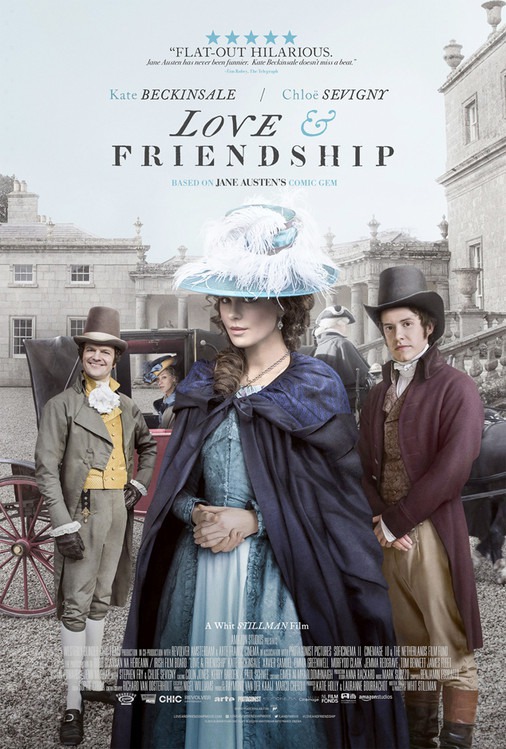
Whit Stillman has written and directed three modern Austenian pictures- Metropolitan (essentially, Mansfield Park), Barcelona, and The Last Days of Disco.  When he gets his hands on an actual Austen short story, it is no surprise that Stillman shakes it all up with an original and witheringly funny adaptation.  Rather than dally with dialogue establishing the Austen archetype – handsome rogue, lovestruck hysterical wife, scheming social climber, etc . . . – he gives us the actors in poses, drawing upon the audiences’ presumed familiarity with Austen, so as to get the ball rolling more quickly.

And in the hands of the most vicious and hilarious of all Austen protagonists, Lady Susan Vernon (Kate Beckinsale), what a ball it is.  An elegant bloodsucker, Lady Vernon flits from household to household, leaving each in tumult as she wheedles her way into the most advantageous social position she can find.  Her dexterity when she encounters obstacle is noteworthy and her aplomb when thwarted is near winning.  In Beckinsale’s hands, Austen’s wit crackles, and the repartee is fast and furious.  I won’t ruin any of the fun, save to offer my favorite line from the film:  “Americans really have shown themselves to be a nation of ingrates, only by having children can we begin to understand such dynamic.”

Austen’s work always delivers us a fop, a fool, or both, but Beckinsale is almost upstaged by Tom Bennett who plays the unflappable, cheery, and utterly clueless James Martin, one of Lady Vernon’s many targets.  I laughed out loud in all of his scenes.

One of my top five for the year thus far.
The Nice Guys Blu-ray Release Date August 23, 2016 (Blu-ray + DVD)

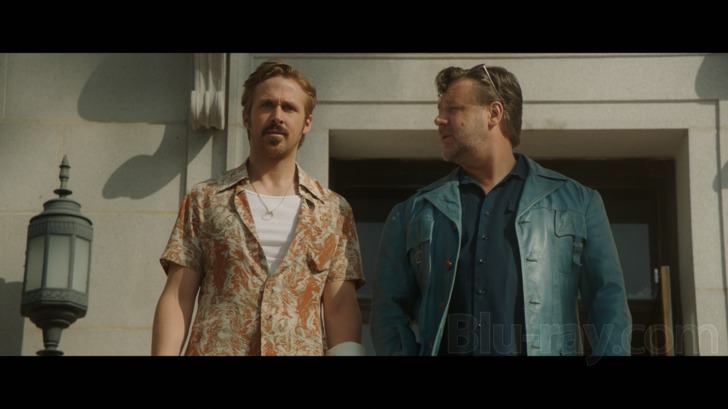
It sounds silly to say, but I’m compelled – they just don’t make movies like this anymore.  Shane Black’s (Kiss Kiss Bang Bang, Iron Man 3) noir-ish 70s buddy crime comedy pays homage to the genre by faithfully adhering to many of its precepts while updating the form in ways that are progressively more clever.  It’s late 70s LA.  Russell Crowe is a burnt out “enforcer” making his dough in the protection racket with brass knuckles and dogged determination.  Ryan Gosling is a private investigator rip-off artist with a drinking problem, a mouthy (but not precocious) pre-teen daughter, and an air of intelligence, if not actual smarts.  Crowe is hired to beat up the person or persons (one of whom is Gosling) looking for a young femme fatale, and the two team up as the semi-serious, but not really serious plot – which melds porno and corporate skullduggery – thickens.

The banter is first rate, the look primo, and the tone just right.  Black writes cynical yet hopeful, and while he makes all his station stops on time, the rides in between are a gas, made even more enjoyable by his crackling script and brilliant physical comedy.  Gosling is particularly adept at slapstick, giving Leonardo DiCaprio’s turn in The Wolf of Wall Street a run for its money.

The chemistry between Crowe and Gosling is so strong that I hope the broad hint of a sequel at the end of the film is genuine.  I was reminded of Nick Nolte and Eddie Murphy in 48 Hours , Alan Arkin and James Caan in Freebie and the Bean, and Robert DeNiro and Charles Grodin in Midnight Run.  These guys are having a blast together

Yet, Black never fully commits to the “buddy pic” requirements.  When Crowe, in a moment of reflection, reveals his tender side or Gosling seemingly rises to the occasion by exhibiting theretofore hidden mental gifts, the payoffs are unexpected and laugh out loud funny.  A dream sequence is inserted that is truly ingenious, and there are more than a few other moments when Black’s detours enhance the humor.   One of the best films this year.

Image result for Maggie's Plan

A charming, light romantic comedy about a young New Yorker (Great Gerwig) who has an affair with an older would-be fiction writer/academic (Ethan Hawke) married to an even more prestigious academic (Julianne Moore). Hawke leaves Moore for Gerwig, but Gerwig soon realizes she has upset the natural order of things. What follows is her “plan” to rectify her error, which is breezy, funny and blessedly bereft of skin-searing indictments about betrayal, trust and commitment. It drags a bit at the end, but ultimately, the film delivers as a sweet, semi-screwball slice of life. It’s also satisfying to see such a product from writer-director Rebecca Miller, whose The Ballad of Jack and Rose a decade ago was as heavy, dreary and miserable a film about relationships as you could imagine. Perhaps she’s in a better place.

Image result for Keanu cat

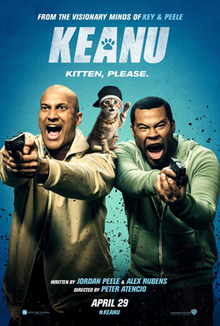
Key & Peale skit that goes on about an hour and 35 minutes too long, made even more tedious by the immobile camerawork of director Stephen Hawk . . . .er . . . Peter Attencio, whose resume’ consists of . . . directing Key and Peale episodes.

Alternative reviews, considered but rejected–

Kean-poo!

Keanu tell me if this movie sucks? Yes, I ke-an.”


Sisters - Rotten Tomatoes

Tina Fey’s foray as a film lead has been nothing short of disastrous. Other than the tolerable Date Night (where Steve Carell helped with the lifting), her movies have been execrable. Her attempts to re-brand the Liz Lemon character that served her so well for a time in 30 Rock have failed.  In Admission and Whiskey Tango Foxtrot, it was hard to determine what was less convincing: Fey’s stabs at being thoughtful or her attempts to fill the garters of a romantic lead.  For introspection, Fey rarely can provide more than a smirking Hamlet-lite, asking the audience “is this a macaroon I see before me?”  And when Fey is asked to fill the shoes of a sexual being, as she was In This is Where I Leave You (former high school loose girl) and this film (former and current), it’s like asking Richard Dreyfus to play Rocky Balboa.  Some of her limitation is attributable to run-off from the Lemon character, a neutered geek who substituted sex –which she approached as if it were vampirism – with food.  But Fey is many years away from that character, and the fact is, she simply exudes no sex.  Not appeal, interest or even curiosity.  In Whiskey Tango, which is ostensibly a romantic comedy, she could only bed Martin Freeman when she was near wasted, the coupling looking more like two cats in a bag, and the morning after, she looked at Freeman with the disgust of someone who “can’t believe they ate the whole thing.”

Yet, in Sisters, she’s supposed to be the wild, sexually adventurous one.

Oooph.

Fey’s other huge problem is that she is wholly unlikeable.  In 30 Rock, she was parceled out in little bits as part of an ensemble, and she made herself the butt of every joke, which was endearing and at times, very, very funny.  But she’s lost that gift and now, she’s re-presented as a different woman and no matter what she does, she comes off as condescending.  Indeed, Fey as corporate pitchwoman for American Express is damn near insufferable in a 30 second ad (her quippy, snide, self-absorbed shopper rings of the person who is most amused by their own cleverness) and that tells us all we should know about her freshness as a film actress.

It’s not just Fey, however, that sinks Sisters.  The film has no real humor; it’s just a “last party” flick where folks who aren’t even characters say things meant to be zany and hilarious.   The set-ups (drugs that look like sugar!  A glop of hair gel on the floor that will factor prominently later!) are asinine, and when Fey and her film sister Amy Poehler get in trouble, they riff.  The riffing is painful, and frankly, given Fey’s attacks on other comics who do not meet her exacting cultural standards, watching her “do black” (repeatedly) when she appears to be struggling is a strange mix of uncomfortable and satisfying.  I imagine she’ll avoid the pitchforks from the p.c. Brown Shirts, but she should step lightly.  They just took a pelt off of Lena Dunham!

The script, such as it is, has the odor of weak improv. Avoid this dog.

I watched this documentary on Monday night, after Anthony Weiner’s final on-line transgression resulted in the announcement of his separation from his wife, Hillary Clinton handler and confidante Huma Abedin.  The documentary shadows Weiner during his run for the New York City mayoralty, a run he made after resigning from Congress when he was busted for sending a dick pick to a young girl.  The ignominy of that act was exacerbated by the facts of Weiner’s lying about the incident (he was hacked, it might not be his junk, forces opposed to him were at play, “”Maybe it did start being a photo of mine and now looks something different or maybe it is from another account”) and his unfortunate name.

But come back he did, and as relayed by the documentarians, he returned with verve and passion.  Until he got busted again, this time sexting under the nom de plume “Carlos Danger” with a sad, grasping, soon-to-be porn star named Sydney Leathers (the scandal is notable as much for its bizarre nature as the silly names of its participants).  This unfolds before our very eyes, and it is often difficult to watch.  After this second humiliating revelation, Weiner opts for an aggressive, charge forward “this is what we do“ approach, as if to keep moving is to delay facing up to the consequences of his actions.   But you can see him harden and crack, in contentious interviews and encounters with voters.  Abedin, a beautiful, stoic woman, also becomes more brittle, but she retreats inward.  When the camera catches her watching Weiner desperately prattle on, a look not so much of disgust as disbelief is on her face.  The campaign staff, all young and committed to Weiner, are rattled, and you feel for their predicament.

The documentary also illuminates a few other aspects of this entire farce that merit comment.  First, even with all the drama and pain of Weiner’s relationship with Abedin, there is an intimacy between the two that is undeniable, making this national joke a bit harder to laugh at.  The revelation of real love in what you cynically presume is a marriage of convenience is quite unexpected.  Additionally, Weiner and Abedin evince a certain cynicism of their own in the way they operate politically.  It seems perfectly natural to them when Weiner monitors her fundraising calls to friends or uses their child as a shield-in-a-stroller, or she engages in strategic musings to keep his campaign afloat.  But it feels grubby and sad.   Also, the media comes off as nothing short of vile.  Their glee and faux moralizing actually engenders sympathy for Weiner, which, given his hubris and recklessness, would seem impossible.   When Weiner becomes unspooled after being baited by the likes of MSNBC dimwit Lawrence O’Donnell, it’s hard to determine who comes off worse.  At least, for me and Weiner.  There is a  charming moment when Weiner looks back at Abedin after re-watching his interview with O’Donnell and imploringly asks who got the worst of it.  She replies unequivocally that Weiner was loser of the exchange, a fact he can’t quite grasp.   Frankly, to me, it was a close call, but the unctuous O’Donnell was not running for office.   The crazed Weiner was.

Ultimately, what I liked most about the documentary is it didn’t portray Weiner as tragedy.  He is not presented as some promising wunderkind undone by his excesses and a vicious press corps.  While in post-campaign crater sit-down interviews with the filmmakers, Weiner looks beaten, emaciated, like a recently released hostage . . .

image

. . . sad as he looks, you don’t feel that something grand has been lost.  He’s just a guy with a persistent fetish in the wrong business.


image

Paul Rudd lost his young son in an accident and compensates by taking a 6 week caregiving course for the disabled. His first client is a plucky, wheelchair bound Brit named Trevor, who suffers from muscular dystrophy and an over-inflated sense of his own cleverness. For example, to shock Rudd, he pretends he’s choking or having a seizure, a real gut buster. Rudd later pretends he has misplaced Trevor’s lifesaving medicines, so . . . relationship established.

Both parties learn life lessons, but to better cement them, they–

A). Make love
B). Take a road trip
C). Join a white supremacist sect
D). Enter into a suicide pact

Of course the answer is B), but the other answers would have made for a better film, for those options would not have resulted in their meeting bad girl hitchhiker Selena Gomez. How do we know she is bad? She–

A). Smokes
B). Curses
C). Is a white supremacist
D). Smokes while cursing

Oh, if it had only been C).

Gloppy, lazy, hackneyed gruel.

Nick Kroll is a pretty big deal in New York City until his Google-glassish innovation goes busto and he loses all his money and all the money of his so-called friends, so he seeks solace by retreating to the icky suburbs and his childhood home in New Rochelle, NY, currently inhabited by his harried sister (Rose Byrne), her swarthy, down-to-earth home builder husband (Bobby Cannavale) and their charmless 3 year old boy.  There, Nick becomes intertwined in their lives, much like Bill Hader in The Skeleton Twins, who went home to Nyack, NY after a trauma.  Kroll discovers Cannavale is having an affair, much like Hader’s sister Kristen Wiig in The Skeleton Twins.  Coincidentally, in The Skeleton Twins, Wiig was cheating on her husband Luke Wilson, who was also a blue collar guy, just like Cannavale.

Crazily, Kroll reveals the fact of the affair to Byrne, again, like Hader to Wilson in The Skeleton Twins.  And that results in a heartfelt discussion about how Kroll ran out when their mother was dying of cancer, and the discussion is reminiscent of the recriminations and regrets of Hader and Wiig about their father, also dead by suicide.   In The Skeleton Twins.

For a few easy laughs, the town is populated by faintly ridiculous folk from high school who Kroll can look down upon.  Much like Hader in The Skeleton Twins.  And there are places that inexplicably have Christmas lights up even though it is not Christmas.  Just like the town in The Skeleton Twins.

And Kroll grows, growth which is signaled by the fact he chooses the welfare of his sister’s son over his new job.

Just like James Caan in Elf.

Torture that at its best is mildly diverting.

Review: In 'Midnight Special,' on the Run With a Highly Unusual Child - The  New York Times

No one does Americana better than Arkansan writer-director Jeff Nichols. Shotgun Stories and Mud are monuments to understatement and authenticity. He has a unique ability to convey the lazy currents rural life as well as its plain-spoken and direct dialogue. None of it comes off as a posture or a condescension.

These qualities are found in Midnight Special, a story of a boy kidnapped by his father (Michael Shannon) away from the clutches of a religious compound in Texas. Soon, however, the federal government gets involved, and that’s where Nichols loses his way. The story morphs into the supernatural, the genesis of which is never fully explained, and the visual payoff – a world within our own that arises in Louisiana – is jarringly cheesy (I was reminded a little of The Abyss, James Cameron’s gripping underwater yarn, which was undone by the silliest representation of aliens you ever saw).

Still, I recommend the picture for the quiet moments and the care Nichols takes with both characters and milieu.

image

Given the subject matter – reporter Tina Fey gets out of her rut in NYC by going to cover the war in Afghanistan circa 2003 – it’s amazing they managed to make such a boring film. The first error is casting Fey, who can barely get one inch past her Liz Lemon character from 30 Rock. She’s little more than a smirk and a wink, so any transformation in or development of her character is simply impossible, and when she starts an affair with photographer Martin Freeman, she seems as put-off by the experience as the audience. Their love scene is akin to two kangaroos boxing, and further suggestions of coitus are shown the morning after, where Liz Lemon is hungover and horrified she may have slept with Griz.

Taxing her limited dramatic abilities further, the filmmakers ask her to try her hand at being an “action junkie.” You can almost hear the voices in Fey’s head imploring her, “act, damn you, act!”

So, we are left with a culture clash flick, with Fey repeatedly doing things most people in Afghanistan would not like, such as walking around without headcover, and holding hands publicly with Freeman, and filming things surreptitiously under her Islamic garb. Also not very good.

Although it does have the value of being surprisingly politically incorrect – the indigenous folk are primarily used as pratfall props while the Westerners are amused and snide, and in what has become the cardinal sin of Hollywood, non Afghanis are (gasp!) cast as locals – none of it rings true, which is a particular problem with a film based on a true story.

The film closes with a violent lurch to a Bin Laden type rescue of Freeman, orchestrated by the plucky Fey, to “Can’t Live” by Badfinger (or Harry Nilsson) and a treacly visit to a maimed Marine for whom she feels responsible but whose aplomb helps her become more grounded.  It’s just godawful.

The film has two directors, neither of whom knows what he is doing, which they demonstrate repeatedly over the picture’s excruciating two hours.

Billy Bob Thornton is the only saving grace as a gruff Marine officer who shepherds Fey around, but his screen time is limited.