Archive

5 stars

image

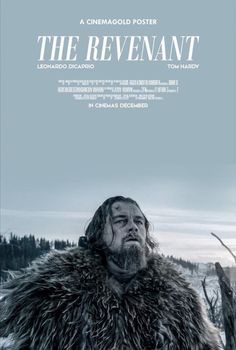
Like Birdman before it, there are scenes in this movie so visually audacious, I gasped. But where that picture hit you like a ton of bricks based on the cumulative effect of its dizzying pace and construction in the close confines of a Broadway theater, Alejandro Inarritu’s The Revenant – which is essentially a lone survivor/revenge flick, with a little spiritual mumbo jumbo thrown in for good measure – presents dazzling set pieces interspersed with awesome portraits of the vastness of nature. The year is 1823, and Leonardo DiCaprio is a guide for a fur trapping expedition in South Dakota beset by a brutal Indian attack, and in escorting the survivors back to the safety of their fort, he is viciously mauled by a bear, a scene so expertly rendered I could not believe it had not happened, yet, of course it had not. DiCaprio seems a committed actor, but no one is that zealous.

After the attack, DiCaprio has many more hurdles before him, including a suspicious and dangerous member of the surviving group (Tom Hardy, channeling Tom Berenger in Platoon, a compliment) and pretty much every calamity the brutal world of the wilderness can provide.  DiCaprio has little to say, but he brings all the physicality he mustered in The Wolf of Wall Street, only this time, during his infirmity, he exudes animalistic fury instead of stoned near-paralysis.

This is one of the most thrilling, visually stunning films I’ve ever seen. Inarritu used natural light and subjected the actors to enormous rigors (some say, “a living hell“).  Like George Miller in Mad Max: Fury Road, Inarritu dispensed with CGI, remarking, “If we ended up in greenscreen with coffee and everybody having a good time, everybody will be happy, but most likely the film would be a piece of shit … When you see the film, you will see the scale of it, and you will say, ‘Wow.'”

Wow indeed.  It all pays off in making the picture visceral, authentic and epic.  My only nits are a bit of anachronistic, stale “you have stolen everything from us” dialogue from the primary Indian and one depiction too many of DiCaprio hallucinating his Pawnee wife welcoming him to death ala’ Russell Crowe in Gladiator. But these are very minor criticisms. This is a great film and certainly one of the best of the year.

image

When Noah Baumbach makes movies about miserable people, they tend to be miserable experiences. Ben Stiller was a depressed, egocentric bundle of nerves in Greenberg. In Margot at the Wedding, Nicole Kidman was a near hysteric mother, so casually cruel to her teen son it set your teeth on edge. And Jeff Daniels’ insecure, superior father in The Squid and the Whale was a textbook narcissist and a gasbag academic to boot. While talent is evident in these films, they are neither enjoyable or incisive. Rather, they are merely intricate portraits of unpleasant people doing awful things to themselves and those around them.

But Baumbach has a breezier side, one that was shown in his writing of Wes Anderson’s The Life Aquatic and Fantastic Mr. Fox, and of late, his films seem less like autopsies and more like entertainment. In Frances Ha and While We’re Young, Baumbach could not quite leave the realm of the neurotic, but at least we had characters to semi-root for. In Mistress America, we have an unqualified heroine, Greta Gerwig (who dates Baumbach and co-wrote the script), a whirling dervish of a climber, all idea and no follow-through, who latches on to a lonely college freshman (Lola Kirke), lifts her spirits and serves as her muse. What follows is a hilarious social and then drawing room comedy, which has a bit of a Whit Stillman nostalgia, but is decidedly more modern in its literate and canny observation of academia, money, status and success. Gerwig is truly a force of nature, and Kirke is genuinely touching as a child adrift in the cold realm of college and New York City. I laughed out loud throughout, one of the best films of the year.

image

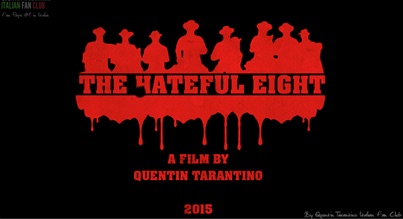
Key Largo melded with Quentin Tarantino’s bravura scenes in Inglorious Basterds and his crackling dialogue in Reservoir Dogs. I had the pleasure of watching this picture on Christmas Day in 70mm at the AFI Silver Theater, complete with an overture and an intermission. The latter occurred after 1:46 minutes, and I remarked to my son that the film was flying by, particularly so because almost all that had occurred was conversation. Obviously, a Tarantino film cannot subsist on talk alone, but when the violence occurs, it is supported by the rich, if broad, characters developed beforehand (unlike in Django, where the carnage at the end felt like an indulgent spasm, revealing an insecurity at what came before).

It’s one of the best films of the year and it’s also one that should not be in any way spoiled by a plot summary or any other commentary that could lessen the fun. Accordingly, I’ll make my review brief and non-specific in the form of a few notes.

First, Spike Lee once disrespected Samuel L. Jackson when the latter was a working character actor and the former was the auteur du jour. Lee is also made apoplectic by Tarantino, who wades into race with a daring and incisiveness that obliterates Lee’s rote and easy observations. As it turns out, Lee and Jackson have achieved a rapprochement (they do commercials together), but any rift between Lee and Tarantino is settled by Jackson (“Spike saying, ‘I’m not going to see Django because it’s an insult to my ancestors’? It’s fine if you think that, but then you have nothing else to say about the movie, period, because you don’t know if Quentin insulted your ancestors or not,”).

Also, Jackson should receive an honorary Oscar for this alone:

This is an ensemble picture but it’s Jackson’s picture (though costars Walter Goggins and Jennifer Jason Leigh give him a run for his money).

Second, Tarantino masterfully blends genre, history, comic books and violence, but sometimes, it is to the detriment of his narrative. Not here. When the necessary resolution explodes, it’s almost a disappointment because you know there will be less talk. Tarantino’s script is razor-sharp, hilarious, suspenseful and a brilliant mix of modern pop culture and historical grievance.  It’s really something.

Third, I generally do not read any reviews or commentary about a film before seeing it or writing my own review, and I did not do so here. But I presume there is the same hullabaloo about Tarantino’s liberal use of racial and sexist insults. All I can say is that he uses them beautifully, like David Milch in Deadwood.  This is how you would expect low, dangerous comic book characters who steal and murder to parlay.  Any objection is likely coming from the same humorless prigs or their progeny who objected to the hyenas in The Lion King because they were villains voiced by minorities. In fact, in creating a movie depicting a roomful of lethal people who must sleep with one eye open as they brave a blizzard and their own treachery, opprobrium aside, it’s one of the most egalitarian rooms you’ll find in film.

image

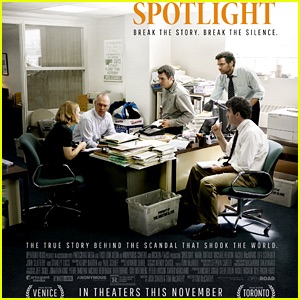
This is a gripping but measured film, a reportorial procedural and a meditation on the impact of the sexual abuse scandal that rocked the Catholic church in Boston, as reported on by The Boston Globe in 2002. “Spotlight” refers to an investigative team of the paper (Michael Keaton, Mark Ruffalo, Rachel McAdams, Brian d’Arcy James) who, under the direction of a new editor (Liev Schreiber) takes on the case. As they dig deeper, the breadth of the scandal widens (the number of culpable priests balloons from 13 to 87) and the institutional protections surrounding the church become more evident and intrusive. The story also takes its toll on the team, all some form of Catholic (cultural, lapsed, etc . . . ) at the time of the investigation.

The film is economical and direct and it stubbornly avoids cliche’ and histrionics. It is also a rare “based on true events” movie that feels authentic throughout, not jumped up or glamorized.  It is very similar to A Civil Action, another Boston based movie that tackles a legal case (water contamination in Woburn) by analyzing the city and its institutions. Like that film, Spotlight packs its biggest punch during scenes of interviews with the survivors of abuse, which are nothing short of heartrending.

If you want a gripping movie about the mechanics of taking on a story like this, this is it, and if you want a companion piece that shows exactly how an individual molester operates, I recommend Doubt. Watching this film, as with Doubt, stirred my own memories on the subject, having been educated by the Catholic church for eight years of grade school and by the Jesuits for four years of high school. I saw the picture with my kids and tried to explain how what is now an indelible black mark on the church wasn’t exactly a deep, dark secret by the time I reached high school, yet somehow, was not a full-fledged scandal. I explained that we had a religion teacher who was very charismatic, but who you just kind of knew not to be around. Why? It’s hard to say. It could have been my own sense of it, or the fact that my brother or his friends imparted some decent advice, or the fact that after gym, when you were showering, he could sometimes inexplicably be seen in the locker room.

Whatever the impetus, you learned not be around Father Bradley, but I guess I just assumed that all boys shared the same sense of something being off and were similarly self-protective. That wasn’t the case, and in 2007, I was one of thousands of recipients of a mass email detailing the misdeeds of this priest at our high school, and at other places where he taught afterwards, encouraging us to report if in fact we had any knowledge of his abuse. Without the work of The Boston Globe on the story, that email may never have come to be.  In that manner, this film is a testament to solid, door-knocking, pavement pounding reporting.

If you’re interested in the priest who plagued my school, the story is here.  The original Boston Globe story can be found here.

When my grandmother started to lose it, she was ingenious in masking it. If you asked her who was president, she’d say, “that fool in the White House.” If you asked her about something topical, she’d reply, “Who has time for such things?” It was her game face as her memory began to fail her.

At the beginning of I’ll Be Me, this is where we find Glen Campbell, recently diagnosed with Alzheimer’s. He is vague, folksy and stubborn in attempting to defend himself from a world ever more foreign to him. He leans heavily on his wife, who acts as his lifeline to his past, but we see his true state when he watches old home movies, and asks “who is that?” It’s achingly painful to hear his wife’s reply, “That’s you, silly.”

Campbell’s diagnosis came on the eve of his final tour, and in an effort to increase awareness about the disease, he went public and allowed a documentary crew along for the ride. The result is a bittersweet retrospective of his work (I had no idea just how big a star he was) and an examination of what it is to suffer this disease through the eyes of his family (three kids are in his touring band). I feared that this might become exploitative and was heartened to see that not only was it not, but that Campbell’s wife acknowledged the concern, explaining that they weighed the costs and benefits and decided to go forth. I also feared that it would be altered to create a “triumph of the spirit” vibe, but director James Keach (an actor in his own right and Stacy’s brother) presents Campbell and the disease in sober fashion; when Campbell’s issues become acute, it is almost too much to bear, and when they evince on stage (as is shown on the clip above), it is not sugar-coated. But the audience is with him, so are we and the fact that his music is so ingrained in him it triumphs over the disease, for a time, is a wonder to watch.

Currently on Netflix Streaming.

Director-writer John Maclean has crafted a hypnotic fable, an ingenious tweak on the western that bundles the innocence of Wes Anderson, the sly cynicism of the Coen Brothers, and the quiet, stunning visuals of Terence Malick. Maclean has us follow a Scottish naif (Kodi Smit-McPhee, presenting more Australian than Scottish, but no matter) as he travels through the Colorado territory, clueless and not long for the world until he is taken under the wing of an experienced gunman (Michael Fassbender). Smit-McPhee is on a quest to find his true love and Fassbender is in it for the cash, but as they wend their way through an expanse that is vast, surreal and sporadically lethal, they develop a bond that seals their fates. The cinematography is stunning, and Maclean’s confidence and patience are all the more impressive given this is his first feature. There are times you feel the scene has near been painted, until Maclean shatters it with violence. I was surprised to see many critics hail the picture as a revisionist western or an action film. It dabbles a little in both, but the heart of the picture is in the dreamy world of child’s myth and unrequited love. This is a beautiful, patient picture, to be watched on a large screen with no interruption. Available on Amazon Prime streaming.

image

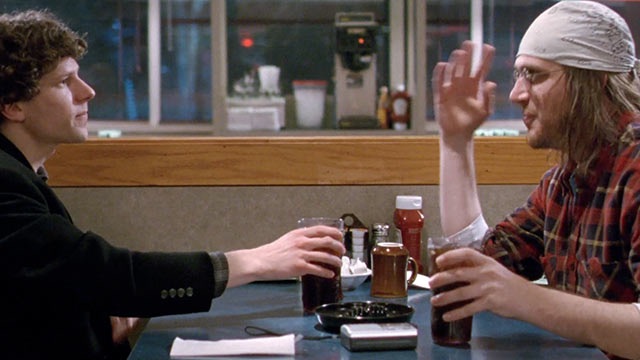
The film is a flawless meander over a few days with an enigmatic and at times debilitatingly insecure novelist.  Jason Segal’s turn as author David Foster Wallace is soul-deep, a particularly impressive performance given that it is from a light comedian. As a film about a doomed man (Wallace hung himself 12 years after the events depicted), the picture is also refreshingly light on foreboding. We are not here to observe the clues that led to Wallace’s demise.  Rather, we are here to enjoy the mind of the author, while being made privy to some of the demons within him, as he is interviewed by a Rolling Stone writer, played by Jesse Eisenberg. We are allowed to hang out with two writers as they discuss their craft, their fears, and America; fence over their different viewpoints and goals through the interview process; and eventually, form a fleeting friendship. Thankfully, the movie is so self assured it doesn’t feel the need to provide the expected big reveal or the emotional paroxysm.

But perhaps what is best about this film – a film about a writer where we do not hear him recite his prose – is the fact that you’ll become affected enough to go read his work after the movie is over. I generally do not read fiction, I have never read Wallace (with the exception of a few magazine pieces), but on the strength of this very personal and intriguing film will read one of his novels.

Image result for Red Army movie

This a great time capsule documentary, providing insight into the post WW II Soviet Union cult of supremacy as manifested in its hockey program. The Soviet military actually ran the tryouts at the Red Army school, winnowing out of the weak and fusing sport with propaganda. The result was a juggernaut that came of age right at the moment it ran into the American team in 1980 at Lake Placid. After that ignominy (the Russians had just beaten the Americans in an exhibition 10-3), the team did not lose a game for the two years prior to Sarajevo, where they won gold, and again, in 1988.

However, the toll on the players was brutal. They spent their time in hockey camps 11 months of the year, and the coach, Viktor Tikhonov, would not even allow a player see his dying father. Perestroika loosened some of the restrictions, but still, Tikhonov, would not permit his best defenseman, Slava Fedisov, to go to the NHL.   Fedisov quit over the prohibition, made his displeasure public, and was ostracized for his impunity.  On the light side, he was denied training facilities. On the harsher, the police in Kiev picked him up, beat him, and then called Tikhonov to pick him up. Eventually, the Soviets allowed the players to play in the NHL, but they took half their salaries (Fetisov said no and was the first Soviet hockey player to get his full check) .

The footage – especially of the fluidity of the Soviet team – is dazzling, and the interviews of any number of direct but impatient Russians are sharp and revealing. The documentarian, Gabe Polsky, is to be commended for including footage of his broad questions, where he stretches to get a response on larger geopolitical issues, only to get a “stupid question” from the “suffer no fools” Fedisov. In fact, it was a stupid question, but we learn more in Fedisov’s curt comment than had he answered the stupid question.

Image result for ex machina

Writer director Alex Garland has written several very distinct dystopian films (28 Days Later, Dredd) and his directorial debut is assured and not unexpectedly, unique. Oscar Isaac is Nathan, a Steve Jobs-esque reclusive titan who invites Caleb (Domnhall Gleeson), a coder at his web service monolith, to his retreat deep in the mountains to conduct the testing of an artificial intelligence being (Alicia Vikander) he has created. While Nathan and Caleb start off in an awkward forced friendship hampered by their employer-employee dynamic, and the fact that the reason for Caleb’s selection seems flimsy, they soon become adversarial – with Nathan chastising Caleb for his unscientific approach and Caleb increasingly distrustful of Nathan’s methods. It then becomes unclear exactly who is being tested, Eva, Caleb or Nathan, as the three negotiate their roles while strategizing to achieve their aims.

Expertly paced and beautifully photographed, there is a little bit of Her and Spielberg’s A.I. in here, but ultimately, the film that best captures the ethos of this picture is Mousetrap. This is an intelligent, absorbing and imaginative sci-fi thriller which rejects shocks for a slow dance and smartly realized  dawning at the end.

image

Rory Kennedy’s Academy Award nominated documentary opens with American Captain Stuart Herrington asking, “The burning question. Who goes and who stays?” When it went bad, Herrington took his South Vietnamese friends out surreptitiously (Americans were not allowed to bring South Vietnamese out without authorization), but the move was not expected nor planned for.  As Herrington explains, as do others, after the Paris Accords, the presumption of most in-country Americans was that peace was at hand, and the Americans would be in South Vietnam for a long time.

This film shows the feel on the ground for the last denizens of Saigon, while adding insight on a geopolitical level. For example, the North Vietnamese took very seriously the threat of Nixon bringing back American air power after execution of the accords – as one interviewee states, the North Vietnamese thought Nixon was a madman – but after Watergate and the “madman’s” self-inflicted wound, they were naturally emboldened. “Overnight, everything changed. Hanoi suddenly saw the road to Saigon as being open.”

With 16 divisions bearing down on Saigon, Herrington recounts how Ambassador Graham Martin wouldn’t countenance plans for evacuation because it was defeatist and he feared a panic (Martin is a tragic figure who lost his only son in combat in Vietnam, and while he is criticized for his intransigence, he also saved hundreds of South Vietnamese by refusing to leave the embassy until more civilians were evacuated).

At the end, there were 6,000 Americans still in country, and Martin held firm even after he returned to the United States to watch President Ford’s $722 million request for an evacuation voted down.  At this juncture, embassy staff began to risk their careers to get South Vietnamese compatriots out in makeshift airlifts to the Philippines, and at the very end, in any other way they could find.  Their stories are harrowing.

There is no political agenda here.  Kennedy’s documentary is about people, not policy, and their stories are engrossing.  One Vietnamese evacuee recalls his father, a pilot in the South Vietnamese, picking his family in a Chinook and heading out to sea (“when I heard the Chinook, I knew my Dad was coming to get me”).  When it couldn’t land on an American vessel, the occupants jumped out to be fished from the water.

Much of the footage is simply jaw-dropping. A scene of a modern World Airways passenger jet taking off with its on-board stairs lowered, hustling panicked South Vietnamese on as it hurtles down the runway, is indelible.  Another is footage of the pick-up points (Americans knew when to go to them; the code was the playing of “White Christmas” on the radio”) as South Vietnamese press the buses for entry to helicopter evacuations, one of the last options available after the North Vietnamese closed down the airport with artillery fire.  Or the American naval vessels that became deposit points for South Vietnamese helicopter pilots, who had flown from their air bases to pick up their families and then headed to sea hoping for the best.  The ships could only accommodate one helicopter at a time, so when one landed, and its passengers disembarked, the crewmen pushed it over the side to make room for the next.

A must see.