Archive

5 stars

Rocky is Not a Sports Story (But Wow, What a Love Story). | elephant journal

Sylvester Stallone wrote this gem and wisely insisted on starring (possible replacing, if you can imagine, Ryan O’Neal, Burt Reynolds or Robert Redford), leading to many more Rocky movies, and some Rambos, and a dozen other mumbling portrayals.  Say what you will about what it spawned, but Rocky is near flawless.

Rocky is a busted up club fighter living in the bleak hell that is mid 70s Philadelphia. He’s a sweet guy, but he is an admitted bum, getting a fight every few weeks and paying the rent by collecting for a local loan shark. We meet Rocky after a sixth round knockout of another bum nets him $40, and he’s just been unceremoniously evicted from his gym by its manager, Burgess Meredith. His best friend is a meat packing cretin (Burt Young) who lives with his paralyzingly shy sister (Talia Shire), who Rocky is sweet on. Rocky’s fortunes change, however, when the champion, a Muhammad Ali figure named Apollo Creed (Carl Weathers), has a ranked contender drop out from a well-promoted fight. Creed fixes on a gimmick – give a nobody – the “EYE-talion Stallion” – a shot at the title.

This is often heralded as the quintessential boxing movie, but boxing is secondary to a moving, beautiful love story between Shire and Stallone, and the portrayal of a Philadelphia so cruel and cold that Rocky seems like its only validation.

Shire is so withdrawn, a character taunts Rocky, suggesting she is “retarded.” She is not, but she is painfully muted. Rocky’s persistence, and the innate sweetness in him, pulls her out. The scenes of their first encounters, and particularly, the scene where he takes her on a first date, are realistic, poignant and heart wrenching. As they come together, you can see that each provides the other a confidence and support they’d never known. Stallone and Shire share a haunting chemistry of losers, and their story really is the movie.

As is the city. Director John Avildsen uses the gritty corners and grimy haunts of poor and working class Philly and the verisimilitude contributes heavily to the drama. Rocky lives in a hell, where folks sit on the cold streets, trash is strewn everywhere, and it is not enough to ignore someone – you must abuse them. So, Rocky’s loan shark boss has a driver who mocks Rocky mercilessly. When Rocky tries to tell a neighborhood girl to get off the streets or she’ll get a “rep,” she responds, “Screw you, creepo” and when he is kicked out of his gym, Burgess Meredith humiliates him publicly.

Of course, when Rocky gets his shot, Meredith, hat in hand, comes to help. The result is one of the most beautiful scenes in Hollywood history:

The picture received 10 Oscar nominations, including ones for Stallone, Shire and Meredith, and it deservedly won Best Picture.

The only fault is the fight itself, which is hampered by fighters who look buff and have some moves (Weathers simulates a nice stinging jab), but unrealistically degenerates into a clumsy brawl. While Avildsen does the best he can with the budget (a mere $1 million shot in less than a month), his interspersing of stock arena footage cannot save the fact that the Rocky-Apollo fight looks very small indeed, and you can see empty seats in the background of various shots of the fighters.  Given the budget and the quick pace of filming, these weaknesses are easily overlooked.
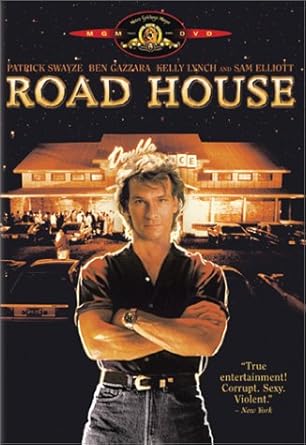
Image result for Roadhouse

A small town is run by the ruthless Ben Gazarra, who shakes down the local businesses to support his decadent lifestyle.  He lives in the gaudiest mansion, and he is surrounded by a thick, loyal squad of yokel goons.  He also has a few 80s trashy blondes in his coterie, like Julie Michaels–

Image result for Roadhouse Julie Michaels

Interesting note on Julie.  Roadhouse was her debut.  In her subsequent roles, these were the names of her characters:  Naran Anie, Professor, Professor (uncredited), Accident Victim, Accident Victim (uncredited), Sandy, Mom, French Patron (uncredited), California Blonde, California Blonde (uncredited), Pedestrian, Female Bar Patron #2, Barrista, Fashion Show Patron, Florist, Slutty Woman, Female Fan, Julie Mermaid mother, Harem Girl (uncredited), Groupie (uncredited), Female Club Goer, Maggie, Woman on Bike, Laundry Wife, Marilyn Monroe #2, Catherine Moore, Caitlin’s Sister, Frat Girl, Woman (uncredited), Vampire, Jane (uncredited), Catherine, Tami, Sillicate UC, Cage Dancer, Agent Elizabeth Marcus, Susan, Irene, Waitress, Waitress (uncredited), Amy Cutler, Freight Train, Susie Q, Cinnamon.

I digress.

One business won’t knuckle under to Gazarra – The Double Deuce.  Instead, bar owner Kevin Tighe calls in a zen master bouncer with a degree in philosophy (not joking – the script references that the professional bouncer has a degree in philosophy from NYU). That bouncer is Dalton (Patrick Swayze) who stands up to Gazarra, calls in a bouncer compadre (Sam Elliott), cleans up the bar and the town and says all of the following:

“Pain don’t hurt.”

“Nobody ever wins a fight.”

“My way… or the highway.”

“All you have to do is follow three simple rules. One, never underestimate your opponent. Expect the unexpected. Two, take it outside. Never start anything inside the bar unless it’s absolutely necessary. And three, be nice.”

“Take the biggest guy in the world, shatter his knee and he’ll drop like a stone.”

“You’re too stupid to have a good time.”

“It’ll get worse before it gets better.”

Roadhouse also features Kelly Lynch, the emergency room physician who patches Dalton up.

The year this picture came out, she was in Drugstore Cowboy. I wonder which film she is most proud of?  Regardless, I’ve had stitches like 5 times and there’s never a Kelly Lynch at the emergency room.  Ever.

By now, Roadhouse has become a cult classic, but when I saw it, I knew it was something special taken at face value, no sniggering. To this day, I can’t stop watching it.  It’s an awful film, and the inquiry should end there, but there is such earnestness in the effort that at 2 am, having just had 5 beers and a half bag of gummy bears, when Swayze says

“I want you to be nice until it’s time to not be nice.”

I’m like, “Hell, yea. Dalton. That’s some heavvy ass shi**!”

And now, every punch in the face in the movie!

Otto Preminger skillfully presents Allen Drury’s Pulitzer Prize winning political potboiler (published in 1959), the story of  a senatorial nomination (Henry Fonda, who is tapped to be Secretary of State)  gone bad under the weight of McCarthyite tactics, vicious blackmail, and a dying president.  The story is intricate, but Preminger, ever the pro, handles it with ease.  For example, if there is an issue of senatorial procedure, it is cleared up in a clever discussion with foreign tourists, who receive a crisp and unobtrusive explanation as to parliamentary procedure and the role of the vice president in American government.

It is decidedly not an all-star cast, but it is a very good one.  Franchot Tone, as the tough and dissipated president, wields his waning power with as much vigor as he can muster.  He has a wonderful scene where first he tries to smooth-talk the chair of the subcommittee handling the nomination (Don Murray) into reporting it out and when the senator does not budge, his flash of anger is actually a little terrifying.  Walter Pidgeon plays the Senate Majority leader, tasked with shepherding the nomination through, and Charles Laughton hams it up wonderfully as the Strom Thurmonesque senator who opposes the nominee.  Lew Ayres, as the in-over-his-head vice president, is a perfect combination of insecure and decent.

Having been born in Washington, D.C., the shots of the nation’s capitol in a more innocent and uncluttered time are worth the viewing in and of themselves.  And look close, because Will Geer (Grandpa Walton) plays the Senate minority leader and Betty White also has a role in that august body.

Image result for advise and consent betty white

With only five films to his credit (Metropolitan, Barcelona, The Last Days of Disco, Damsels in Distress, Love & Friendship) and all but one of them in the same milieu (upper class young people in comedies of manners), Whit Stillman is overlooked in discussions of  great American filmmakers who are still working.  This despite the fact that Stillman has written and directed all five of his films, and all have been critically acclaimed.  

Barcelona, Stillman’s second picture, reprises two actors from Metropolitan as different characters.  Taylor Nichols plays Ted, a neurotic salesman in 1980s Barcelona. Chris Eigeman plays his cousin, Fred, a naval officer and freeloader sent ahead of the Sixth Fleet in the midst of a wave of anti-Americanism.  Both negotiate their acrimonious relationship, borne of childhood injuries inflicted by Eigeman, a truly obnoxious sort who as a visitor begins to stink after a day (unlike, as Nichols observes, the fish who takes three).  They discuss religion, women, anti-Americanism, sales, history and shaving, all the while falling in and out and in love with various Catalan women.

Nobody writes quite like Stillman. His dialogue is distinct and erudite, but his characters have such a surface forthrightness that what could seem contrived comes out as wholly honest and fresh. Stillman is particularly impressive in presenting a funny, incisive culture clash between the mildly ugly Americans and the bemused, mildly antagonistic Spanish. Both treat each other as curious, and even hostile interactions over politics are amusing and revealing.

Again, Stillman has no bad films on his resume’,  a rare honor.  Paul Thomas Anderson comes close. Though the second half of Magnolia is bad, the sheer perfection of the first half of that film and its overall audacity generally gets him a pass, but The Master is a long, very hard slog.  Scorsese is a great, but Gangs of New York and Shutter Island are very, very bad films, and his later sycophantic rock documentaries are downright embarrassing.  Coppola has some late career dreck (Jack, The Rainmaker) and have you even heard of his last three efforts (Youth Without Youth, Tetro, Twixt)?  Eastwood has his share of humdrum work (J. Edgar, Bloodwork, Space Cowboys).  Try as I might to suggest otherwise, Wes Anderson’s The Life Aquatic is haphazard at best.  Even the Coens, David Fincher, Gus van Sant, David O. Russell, Richard Linklater, and Steve Soderbergh have at least one dog (see A Serious Man, Alien3, Psycho, I Heart Huckabees, Bad News Bears, Solaris).

Woody Allen is closer to Stillman in style but Allen also makes some really horrific pictures (less so now that he’s not acting in them as much), redeeming himself with a great surprise just when you’ve written him off.  Take this list of Allen movies – Hollywood Ending (2002), Anything Else (2003) and Melinda and Melinda (2004).  All pretty bad.  Ballgame, right?  But then, Allen offers a smart Hitchcockian crime movie, Match Point (2005), and he is resurrected.  Two more sh** sandwiches follow in 2006 and 2007 (Scoop, Cassandra’s Dream), but in 2008, Allen comes off the canvas again with the charming and seductive Vicky Christina Barcelona.  And last year, after another pair of clunkers (Whatever Works, You Will Meet a Tall Dark Stranger), the best original screenplay Oscar goes to Allen for Midnight in Paris, a movie I hated, but I defer to the Academy. 

Stillman deserves better.

Moonrise Kingdom

Wes Anderson’s Moonrise Kingdom is the best film of the year and the best of Anderson’s career.  Anderson writes and directs fables, where child-like adults attempt to grapple with the expectations of a grown-up world.  In Bottle Rocket, Owen Wilson’s Dignan wants to be a mythical man of the big heist, not a Texas service worker.  In Rushmore, Bill Murray wants to be young again, to erase his choices and capture a tenth of the wonder and promise of Jason Schwartzman’s Max Fischer.  Gene Hackman’s Royal Tenenbaum won’t grow up but demands the fealty of a family he has abandoned and when it is not forthcoming, he fakes a fatal illness to win them back.  In all of Anderson’s films, the protagonists are stubbornly fleeing from responsibility while demanding the respect accorded responsible people, creating funny and bittersweet scenarios.

Anderson also creates beautiful love stories between those who cannot be together.  Luke Wilson falls immediately in love with the motel worker in Bottle Rocket, yet she cannot speak English. In Rushmore, neither Murray or Schwartzman can have the love of their life, as Murray is too old and Scwartzman too young, and in The Royal Tenenbaums, Gwyneth Paltrow is loved by childhood friend Owen Wilson, who aspires only to be a Tenenbaum; stepbrother Luke Wilson, who exiles himself to lessen the pain; and her husband, Murray, who can only analyze her.  In The Life Aquatic, Murray cannot be with Cate Blanchett, as she sees his b.s. and realizes he can never shed it.  In all his films, Anderson shows us the absurdity of love but he never mocks it or gives in to cynicism.

At root, all Anderson’s films are children’s films for adults, up to and including The Fantastic Mr. Fox.  Moonrise Kingdom is similar but has as its leads two children who meet in the summer of 1964, fall in love and defiantly plan an escape from the confines of their New England island in the summer of 1965.  The girl (Kara Hayward) is the troubled daughter of emotionally estranged lawyers Frances McDormand and Murray.  The boy (Jared Gilman) is an unpopular orphan attending scout camp under the supervision of Edward Norton.  In pursuit are McDormand, Norton and Murray as well as the entire scout troop (a moveable, hilarious “Lord of the Flies” troupe), island police chief Bruce Willis, Tilda Swinton (who has come to retrieve the boy so he can be sent to reform school) and Schwartzman, who is helping the young lovers on the lam (he’s the King Rat of the scout camp).  The film is charming, comic, and often beautiful.  It brings back the childhood moments of a first kiss, escape and adventure.  The scenes between Hayward and Gilman are poignantly funny and then almost heartbreaking, but Anderson also gives us tender scenes between Murray and McDormand as they confront their distance; Willis and the boy as the former explains his loneliness; and Norton and his tape recorder, as he confesses his inadequacies in scoutmaster logs.

The picture features many of Anderson’s touches, including an inspired soundtrack (courtesy of Devo’s Mark Mothersbaugh), a set that presents as a stage play (as in Rushmore, the movie contains an actual stage play), and a narrator (Bob Balaban), though unlike Alec Baldwin in The Royal Tenenbaums, Balaban is on-screen delivering a funny turn as a documentarian.

What transpires is an exciting children’s adventure that will have the same effect on you the adventure book you read under covers with the aid of a flashlight and may transport you to some magical moment in your childhood.  It speaks to those who had a backwoods fort, summer camp spook stories, a secret love to whom you sent letters without a single “LOL” or “OMG”, hidden treasure or, if you were lucky, all of the above.

Life is Beautiful (La vita è bella) – Film Review | Ashley Manning

Roberto Begnini’s Academy Ward-winning fable is in two parts.  First, the love-at-first-sight courtship of a sweet and funny man and a beautiful schoolteacher, followed by a tale of a father’s love for his wife and son and the lengths to which he will go to spare them the cruelty of a Nazi concentration camp.  Both halves of the film seamlessly meld, and the picture travels a road from sunny to tense to dire, with Begnini at the heart, lending dignity as he dances faster and faster.

Begnini’s film is neither historically accurate or particularly reality-based.  Indeed, the half of the film occurring in the concentration camp could have taken place over a period of months, weeks or days, and Begnini’s character essentially creates a daily circus to shield his boy from the horrors that surround them, behavior not even Colonel Kilnk would have allowed.  For this reason, Life is Beautiful came in for criticism from some quarters who believe that a Holocaust movie should not necessarily be the backdrop for a comedy, however bittersweet, and/or that Begnini trivializes and historically mutated the reality of Italian Jews during World War II.

Nuts.  The overarching theme of the film is a father’s attempt to protect his son from death, both physical and spiritual, effectively conveyed in a respectful manner.  Complaints of inaccuracy or improper tone are misplaced and rigid, as if there is some politically correct blueprint for a Holocaust film.  Conservative film reviewer John  Podhoretz recently followed this line, attacking the latest X-Men movie – which traces Magneto’s powers and philosophy to his treatment at the hands of the Nazis – thusly: “Genocide and supernatural powers don’t mix”.

Nuts to him too.

Shoah has been made.  So too Schindler’s List and The Wansee Conference. Go see them, I implore you, and make your own judgments (and while you are at it, check out Enemies, A Love Story, which actually mines a Holocaust survivor’s post-trauma love triangle for a couple of chuckles).  But don’t stilt artistic vision in the name of grim devotion to past horror.

These criticisms smack of paternalistic preaching that might make The Catholic Standard proud.  Tarantino and Stone “glorify” and thus perpetuate violence.  Lolita makes child molestation all the more probable.  And Begnini’s work, according to Slate‘s David Edelstein, similarly offends: “Imagine Harpo Marx giving the hot foot to a pompous official, who takes out a machine gun and blows him away: That’s how cheap Benigni’s hash of farce and tragedy is.  It’s a gas, all right.”

Edelstein earned his “I’m A Sensitive Keeper of the Grim Tenor of Concentration Camp Flicks” ribbon.  And with that award goes a free ticket to Showtime’s offering, The Devil’s Arithmetic – Kirsten Dunst is transported from modern day history class, where she passes notes and ignores the teacher’s recitation of the the extermination, to a WWII-era Poland.   Or The Twilight Zone, where Vic Morrow’s modern day bigot was carted off in a train headed, presumably, to Treblinka.

Controversy aside, the film begins in brilliant color but mutes to near-black and white as the story continues its necessarily sorrowful pace.  I can say little about the direction as my eye was trained on Begnini.  His performance as an unserious man at the most serious of times mirrors Chaplin (another person we could criticize – how dare he benefit from physical comedy while aping the creator of the concentration camp, Adolf Hitler). His carefree and whimsy is tested as he becomes separated from a rich life, his wife is torn from him, and every day becomes a struggle to personally survive and protect his son.  Everyone else is quite good and the son is particularly affecting (the Italians get me every time – see Cinema Paradiso).

Paul Thomas Anderson’s opus chronicles the American porn industry in the late 70s via the story of a loose family of weaklings, caught up in the speed, confusion and excitement of sex, drugs and fleeting fame in the bleaching sun of Los Angeles (Anderson took some license here, as the porn industry started in San Francisco and NYC, but his film requires that feel of promise and wasteland that is LA).

The patriarch is porn director Jack Horner (Burt Reynolds), and the story revolves around his LA retreat, a gaudy ranch-styled haven for his coterie of misfits.  There are the young rejects: porn star and mother Amber Waves (Julianne Moore), her teen charge Rollergirl (Heather Graham), studs Reed Rothschild (John C. Reilly) and Buck Swope (Don Cheadle) and lesser stars Jessie St. Vincent (Melora Walters) and Becky Barnett (Nicole Ari Parker); the film crew (William H. Macy, Ricky Jay and Phillip Seymour Hoffman); the money men, The Colonel (Robert Ridgely) and Floyd  Gondolli (Phillip Baker Hall); and a host of hanger-ons (club owner Luis Guzman and troublemaker Thomas Jane).

Boogie Nights GIFs | Tenor

Into this world comes Mark Wahlberg, a young kid who works at Guzman’s nightclub and comes to the attention of porn director Horner after Rollergirl has an encounter with him and reports back his massive endowment.  Horner offers the boy a place in the family.  Wahlberg becomes Dirk Diggler, porn superstar, escaping from a toxic home to the warm embrace of pseudo-stardom in fuck films.  In the world of porn, he finds acceptance, friendship and a certain form of celebrity.

Diggler is based on famed porn star John Holmes, and while Anderson doesn’t take Dirk Diggler down Holmes’s exact path of The Wonderland Murders and AIDS, the trip tracks close enough.  Hubris and drugs take Diggler from the safety of Horner and his new family to the street, where he ends up turning tricks, beaten by punks, desperate to score drugs and nearly murdered by a psychotic drug dealer (Alfred Molina).

To a person, these people are none-too-bright, but they cleave together in a life that mirrors celebrity, though it is gaudy and flimsy, glitz on the cheap.  They briefly flourish in a fantasy world within a fantasy world, where their work is deemed art, and their talent is certified as genuine.  Despite the self-delusion, Anderson shows how the family actually provides support to these outcasts never found elsewhere.

The film is visually audacious and features several flowing scenes without a cut for long stretches, including a 3 minute opening scene which introduces most of the characters.  Anderson’s filming of two separate parties at the Horner house is boundless and reminiscent of Altman’s opening scene in The Player as well as Scorcese’s casino scenes in Casino.  The effect meshes with Wahlberg’s entrance on the scene, as he steps into a world where he is the golden child.  You see the wonder – beautiful young people drugs, a swimming pool! and despite better instincts, you become intoxicated along with Dirk.

The screenplay by Anderson is authentic and resonant, evoking David Mamet, but without the showiness.  A prime example is the discussion between Horner and Floyd Gondolli on the changing business of porn:

The music by Michael Penn is evocative of the time as well, and the cuts chosen for each scene are spot on, from Andrew Gold’s “Lonely Boy” (revealing Amber Waves as a mother) to the Beach Boys “God Only Knows” providing the coda for the characters, to “Sister Christian”, which now serves as a sinister song, as used in the film’s most harrowing scene, much like “Stuck in the Middle with You” after Reservoir Dogs.

Finally, the performances are uniformly stellar.  Julianne Moore was nominated for best supporting actress (she was beat out by Kim Basinger in LA Confidential, a great film and a fine performance, but still, Moore was robbed).  Burt Reynolds was also nominated and rightly so.  Interestingly, after seeing a rough cut of the movie, Reynolds fired his agent for casting him in Boogie Nights, but Burt’s artistic choices have never been stellar.  Wahlberg stands out, exuding the perfect blend of charm, wonder, cluelessness and want.  Anderson is lucky Leonardo DiCaprio turned down the role to work on a little picture called Titanic.  DiCaprio’s a fine actor, but he’s a little too savvy and wary.  Wahlberg was perfectly open, trusting and innocent.  The scene where his mother berates him as worthless and stupid, forcing him out of the house, is heart-wrenching.

This is a classic film of America sprawl, ascent, decay, and fall.  One of my favorites and one of the top 20 ever made.

Walter Hill is a workmanlike director.   He makes some decent and intriguing films (The Warriors, Southern Comfort, Geronimo), and a fair amount of bad ones (Red Heat, Last Man Standing, Extreme Prejudice) and good or bad, the pictures are little more than macho shoot ’em ups where brawn and bullets win the day.  Hill’s commercial pinnacle was probably 48 Hours, the buddy-cop film that vaulted Eddie Murphy into the stratosphere.

The Long Riders is his masterpiece.   The story of the James-Younger (and Miller) gang, Hill cast the Keaches as Frank and Jesse James, the Carradines as the three Youngers, and the Quaids as the Millers (he also throws in the Guest brothers as the duo who eventually shoot Jesse).  It comes off not in least bit gimicky.  Hill comfortably alternates the mythic and the mundane about the brothers, and there is a naturalness to the interplay between the men that makes every scene easy and true.  Brothers in life portray convincingly as brothers in film.

Hill also provides a rich facsimile of Peckinpah-style screen violence, while setting forth a keen depiction of rural tradition and family loyalty . His scenes in the Missouri woods, while the gang hides out, are well-crafted and authentic, his Texas bar fight by Bowie knife is inspired Western legend, and the Northfield, Minnesota bank debacle is unforgettably haunting.  Hill shoots high speed escape by horse interspersed with slow-motion shots of the gang being shot up, commensurate with an eerily slow-soundtrack that purports to track the actual bullet and its impact above the slooooooow distorted sounds of hoof beats, screams, horse whinnies, and thuds. The scene is bravura, a milestone in action filmmaking.

The tensions between the gang, and the brothers, are summed up in the woods outside of Northfield, where Frank and Jesse -w who can move – and the Youngers, who are too shot up to escape, say their bitter yet still faithful farewells, most of it non-verbally.

The best feature is Pamela Reed as Belle Starr.  She steals the movie from the brothers, presenting as of the time.  Reed is not beautiful by a long shot, but her strength is undeniably alluring.  Her exchanges with Robert Carradine are memorable, especially the second one, as she sits, dressed to the nines on her carriage in the street, uninvited to a Younger wedding.

I love this picture because it has one foot in the myth of the West and another in its grimy, brutal reality, it is at once entirely unsentimental and yet, through the understated depictions of the family, moving.