Archive

4 stars

Klute' Dramatizes the Exploitation of Women | Cinema Faith

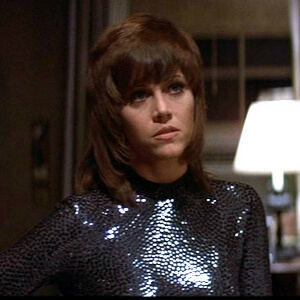
Alan Pakula’s sexual thriller is still a little jarring in its frankness, even today.  In the age of “sex tape as career move”, very little can astound or shock, but Jane Fonda’s electric and vulnerable turn as a call girl hunted by a killer gives the viewer entrée not only into the precariousness of her world, but in her own vulnerability.  She plays Bree Daniels, a struggling actress who considers her sexual exchanges mini-dramas, where she gets control, something she clearly needs desperately, even if it is self-destructive.  When we see her in action, she’s powerful and pitiable, all the while exhibiting how effective and alluring a good call girl can be.

Daniels is saved on more than one occasion by a laconic John Klute (Donald Sutherland), a police officer turned p.i. who is investigating the disappearance of a businessman who may or may not be her stalker.  Naturally, they develop a relationship.

Pakula (The Parallax View, All the President’s Men) has a keen eye for the shadows and menace in otherwise humdrum, pedestrian environs.  He also has great patience, which results in very understated, moving scenes, such as when Fonda flips through the catalogue of homicide photos of dead prostitutes, and her character and the viewer see her face in all of them.  The scenes where Fonda attempts to seduce Sutherland in order to establish control are similarly subtle, and Pakula places you directly in the dilemma of not wanting to be played but being enticed all the same.

There are problems.  Fonda is so good (she won Best Actress) I thought the scenes of her in therapy were unnecessary.  She’s strong in them, but she’s better expressing her foibles and fears in the context of the story.   As the detective, Sutherland runs into the opposite problem.  He is fully unexplored, a quiet mechanism for Fonda’s growth and nothing more.  I  wanted to know more about him.  Not tons, but something.

Still, this a very strong picture that holds up well, especially given the subject matter.
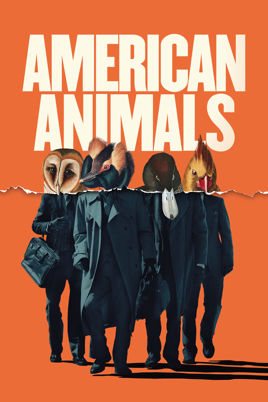
Image result for American Animals

First time feature writer/director Bart Layton’s true story of four Kentucky college kids who decide to steal rare books from the archives of Transylvania University is a gem.  At root, it’s a heist picture, but this is no Oceans 4.  Layton hilariously juxtaposes the theft in the minds of the boys with the much less smooth, cool and seamless aborted and actual boosts.  Layton also captures the ennui and disassociation of the kids, which has them yearning not so much for the money but for an authentic experience, a stamp.  He does not sugarcoat their selfishness, or make “woe to the disaffected suburban affluent” excuses.  Instead, he makes what seems rather incredible understandable, if perplexing.

Layton’s approach is phlegmatic and innovative without being showy.  His vision of the inertia and isolation of the boys melds perfectly with their amenability to the caper.  He films their surroundings darkly, sparsely and uninviting.  While everyone else seems to be communing just fine, they are off-kilter, uncomfortable.

I can’t believe Layton doesn’t have a promising future in Hollywood.  I only hope he isn’t immediately jammed into The Avengers: Super Mega-Explosion.  My only nit is the failure to properly account for the motivations of two of the four conspirators, most egregiously, with the last addition to the group.  The short-shrift given the characters was noticeable and a little distracting.

The film owes a debt to Richard Linklater’s Bernie in its use of interviews of the actual participants, but rather than high comic recollections from the would-be thieves and gentle reproaches from their family and friends, he captures the criminals as reflective, remorseful and even grasping to explain how they got to their deed.  As for the families, they are disheartened and confused, not enamored of their band of merry kids now that time has passed.

Layton saves his best interview for last, that of the librarian who is most directly and viscerally affected by the robbery.  You can interpret her state of mind in many ways, but she has been affected by the experience, and in what is the film’s best message, her pain seems permanently etched on the faces of the quartet.

Image result for Obit movie

A charming, old-fashioned documentary about the obituary writers who work for The New York Times, the picture is a tight and compelling look at a particular craft, revealed in interviews with the craftsmen.

I love obituaries from the Times, and there is a certain sadness in watching picture documenting an art form whose biological clock is ticking.  Their work is substantial, and it is a treat to see them tell us about what they do and how they go about it.  But it is bittersweet, because the dusk approaches.

I only had one criticism.  While the obit writers freely regale us with their worst errors, the tricks of the trade, and the challenges of an often-time sensitive endeavor, director Vanessa Gould never inquires too deeply.  For example, we hear about the conflict of deaths (Farrah Fawcett passing the same day as Michael Jackson) but nary a word as to how these writers deal with figures with controversial pasts (I would love to have had the obit writer discuss the decisions he made with Jackson’s piece).  Also missing is whether famous folks who die have pressure exerted on their behalf by their handlers and/or family.

Still, a fascinating documentary.  Available on DVD (I still get one a month from Netflix).


02B1BEE6-2DA4-4B9F-9402-1A9E8425D54F

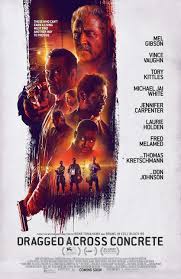
A solid, slow potboiler of a crime caper, Mel Gibson and Vince Vaughn are cops suspended for excessive force (caught on IPhone) who, beleaguered by low pay and lack of support, decide to pull a heist of a heist. Their decision runs them smack into Tory Kittles, just out of prison and enlisted to be a wheelman, in over his head as a contractor for brutal thieves.

The film is expertly paced, if languorous, and engrossing.  Director-writer S. Craig Zahler can draw out the eating of an egg salad sandwich, the preparation for a bank job, and the tailing of a getaway vehicle with an exactitude and care that sucks you in to all three events.

The picture is also literate, sometimes too much so as the characters have a lot of time to jabber on stake out. There are some machismo clunkers as the officers weigh the morality of the endeavor, the unfairness of their lot and the contours of loyalty. But there’s mostly good in the script, particularly between Kittles and the boyhood friend (Michael Jai White) who hooked him into the heist as they reminisce and try and work themselves out of what becomes a hellish jam.  Zahler has a nice touch handling the easy banter of his characters.

The film has been slagged for its portrayal of allegedly racist characters and themes, which to your average movie reviewer means that the Gibson and Vaughn characters do not parrot ACLU pamphlets in discussion of their milieu or the tenor of the times.  I sense Zahler is in for the David Mamet treatment.

The criticism is a joke but what are you gonna’ do?  These folks are the types who lauded The Wire but likely understood none of it and are the progeny of Pauline “I live in a rather special world. I only know one person who voted for Nixon. Where they are I don’t know. They’re outside my ken” Kael.

Image result for Andrew Sweet photography miami

A retrospective of Miami Beach partially through the lens of photographers Andrew Sweet and Gary Monroe. This documentary is an interesting and economical time capsule of post war life there, as it became the haven for elderly Jews, eventually giving way to the Mariel influx, the drug wars and accompanying crime, with gentrification delivering the coup de grace. Joyous, poignant and a little depressing. A little uneven but definitely worthwhile.

On Netflix.

B05CE3EC-FDC5-4D44-8E8B-5F6EAE29E3D8

Comprised solely of contemporaneous archival footage updated via high resolution digital scans, there is no commentary or exposition for this documentary of the moon landing mission. It is contemplative and, at times, spellbinding, but can also be somewhat sterile. Still, rather than the standard commentators whinging on about the greater significance, I’ll take it. HBO is currently running a two part documentary on Muhammad Ali that is similar in approach – all archival footage and no commentary – and it too is very good. I hope this is a trend.

Image result for cell block 99

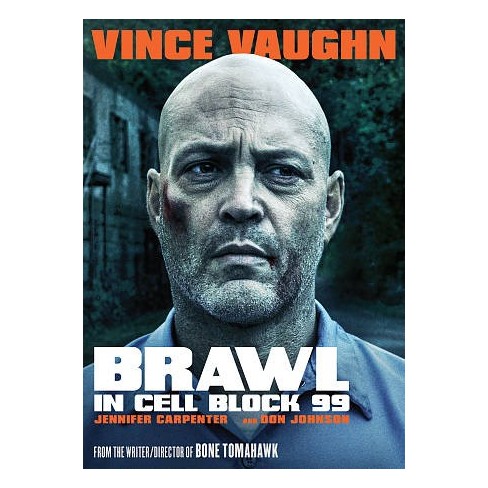
What to make of this film?  It starts off medium cool, with Vince Vaughn playing a rigid, introverted ex-addict and drug dealer trying to stay on the straight-and-arrow.  His temper is volcanic yet weirdly controlled – when he wants to kill his cheating wife (Jennifer Carpenter), he distances himself from her, maintaining an almost chivalric honoring of her being, and then dismantles her car with his bare hands.  He then comes into the house and they have a believably fruitful and mature discussion about where their relationship is headed.

When circumstances force him back into dealing, things go south, and he has to do a stretch in prison, leaving the pregnant Carpenter and their unborn daughter behind.  And then shit gets nuts, as the film shifts from sober prison fare to gonzo 70s grindhouse slaughter-fest.  Vaughn is transferred from a medium security facility, where he meets his mentor and  counselor in what threatens to be a film about his therapeutic journey from there on out, to a maximum security haunted house run by Don Johnson, a cheroot chewing warden straight out of the most lurid of comic books.

The dissonance is jarring, but it doesn’t turn you off.  You stay on the ride, happily, as it gets crazier and crazier.

Vaughn is really quite good, but people forget that before he took on the comic galoot character, he was trotted out as a believable villain (Psycho, Domestic Disturbance).  He has done mainly straight drama of late, from the execrably written Season 2 of True Detective to the stock sergeant in Hacksaw Ridge to the recent Dragged Across Concrete (written and directed by the writer-director of this picture,  S. Craig Zahler).  Here, he’s in total command and damn chilling.

Zahler knows what he’s doing behind the camera, but one wonders – to what end? I hope he rises above his pulpy material before he gets lost in it.

Currently on Amazon.


Image result for Private life

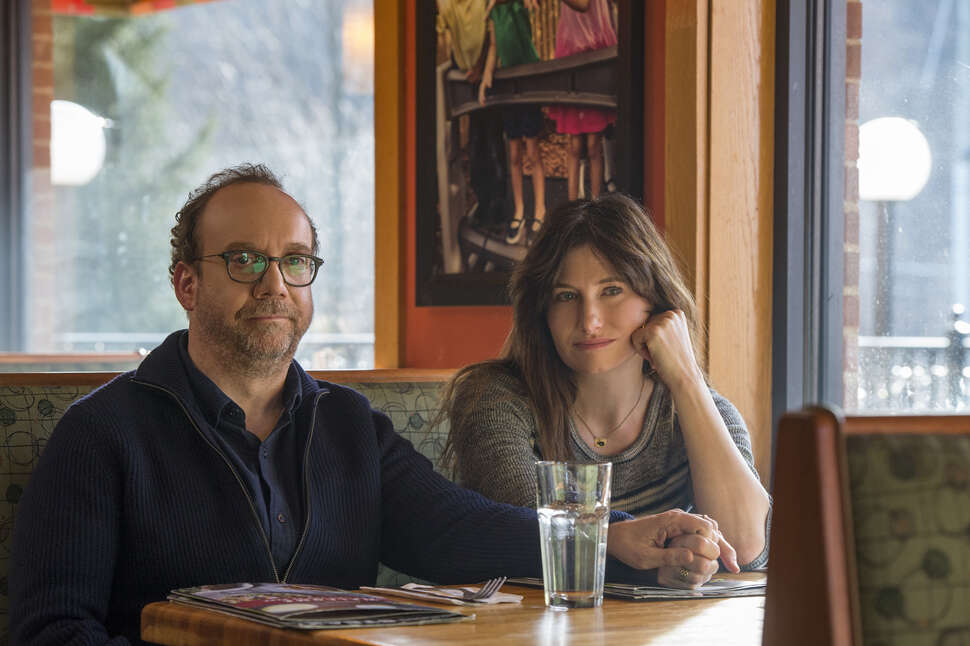
Writer-director Tamara Jenkins’ (The Savages, Slums of Beverly Hills) story of a driven couple (Kathryn Hahn and Paul Giamatti) struggling to have a child of their own is alternately heartbreaking and frustrating.  We see the two put through the wringer of in-vitro fertilization and surrogate scams, poked and prodded in clinics while investigated as to suitability for placement, and all of it voluntary,  a critical focus of the film, because rather than a “poor us” weeper, we see them as in many ways masochistic.

The couple is often unsympathetic, as their singular desire creates a fair amount of collateral damage.   They also suffer bouts of self-loathing as the fabric of their relationship is torn (a scene where Giamatti broaches whether he even wants a baby is piercing).  But when it gets bad for the two, Jenkins gives us a glimpse of who they were – and perhaps still can be – before their primal quest.

Eventually, the intercession of a sweet and guileless niece (Kayli Carter, who has the same commanding presence as Shailene Woodley in The Descendants and Jennifer Lawrence in Winter’s Bone) helps to remind them of the wages of their desperation.

Sometimes a tad talky and quaint, but for the most part, very strong.  On Netflix.

FC2209D5-D8AC-4A9A-9DEB-858C1B287A29.jpeg

Captain Fantastic was about a father who raised his kids in the woods because he did not trust modernity. It was a terrible movie, mainly because the grown man (Viggo Mortensen) wouldn’t shut up about his philosophy and how superior it was. This movie is about another father (Ben Foster) who insists on living off the grid with his teenage daughter. This is a better film, and the relationship between Foster and Thomason McKenzie is well developed.  But their circumstances suffer from too little explication.  Why are they off the grid? What brought them to this extremist situation? All we really know is that Mom is dead, Foster is introverted and plagued and that as much as he appears to love his daughter, he is really just making her share his demons.

McKenzie is accomplished as the girl torn between loyalty to her Dad and a need to connect with and be in the wider world.  Her desire to commune, to be a part of, is heart-rending.  Writer-director Deborah Granik’s Winter’s Bone put Jennifer Lawrence on the map and I can see this film doing the same for McKenzie.  Foster, as always, is stellar as the troubled father, economical and precise.  There is a scene where he is required to answer a computerized voice asking him true or false questions to determine his mental health that he handles beautifully.

There is also a thematic bright spot.  The duo are consistently helped by people who are outgoing, caring and supportive, and yet, Foster rejects all their assistance, underscoring just how near impossible it is to deal with many mentally ill people. The system and surrounding community are, for a change, not the villains. They’re the heroes. And for the most part, it ain’t enough.

On Amazon.


Related image

Barry Jenkins’ Moonlight was the best film of 2016, and his latest picture is of the same high quality, with the same dreamy, contemplative finish.  Told in flashback and forward, Jenkins’ script is based on a James Baldwin novel set in 1970s Harlem.  We meet childhood friends Tish (Kiki Layne) and Fonny (Stephan James) as young adults who have become lovers.  Fonny is imprisoned for a crime he did not commit, and a pregnant Tish, with her family and Fonny’s father, work to pay the legal fees and perform the legwork to free Fonny from prison.

While this film is about many things, at its core, it is a love story, and Baldwin lovingly melds the city and the courtship with great care.  There are scenes that seem almost like portraits, sensuous and evocative, such is the care he takes with his actors and the setting.

The film is also about race, and in this regard, it is subdued in its expression but forthright in its message.  Baldwin is not interested in a political discussion, but instead, a demonstration of how racism pervades the lives of his characters in the seams, adding just another weight to an already heavy institutional burden.  In the wrong hands, the theme would be overwritten and perhaps worse, overacted.  Not here.  The drag of the inequity is not sugarcoated but rather, presented as an open, inescapable legacy for the characters, which leaves a deep impression.

I have two criticisms.  First, Tish often speaks in voice over, which I am not opposed to in all circumstances, but which also suggests a little distrust in the narrative.  Given the ethereal nature of the picture, Jenkins likely felt it necessary to have Tish’s voice explicitly draw us back to the story, but I found it obtrusive and unnecessary.  Second, a racist cop sends Fonny away, and when we meet him, he is so gruesome, so cartoonishly evil, it almost felt as if he would twirl his mustache.  Perhaps that is what Jenkins was going for, to show the cop as the bogeyman the characters see, but I have to say, it was discordant.

Finally, all of the performance are impressive, but as Tish’s mother, Regina King is understated, yet commanding.  She is a veteran of many movies (Ray, Enemy of the State) and even more TV series where she’s mostly powerful and overt, but here, she transcends anything she has done before with a subtle, restrained, nuanced performance.