Archive

4 stars

This is a charming first love story, different in that the first love is Marilyn Monroe and her suitor is a third assistant director (a glorified gofer) on her 1957 picture The Prince and the Showgirl.  The picture co-starred and was directed by Laurence Olivier, who is played by Kenneth Branagh.  Branagh was fine and nominated, though I’m not sure deservedly so.  His primary posture is one of exasperation.

It is Monroe who exasperates Olivier, because she is tardy, skittish, unprofessional and seemingly over-handled by her method acting coach and her business manager.  Pills are used to control her.  Thus, she seeks companionship and escape with the gofer, played with wide-eyed innocence but occasional steel by Eddie Redmayne (Redmayne is a little distracting – he has lips that rival the collagen-induced monstrosities of Barbara Hershey, Meg Ryan, at al.)

Williams was nominated and deservedly so.  She’s a perfect confluence of beauty, sensuality, naivete’ and whore.  At times, she was so stunning that you could understand the entire Monroe worship.

Best, the story is sweet but not sugary, and economical.  It also has a great sense of time and sports some nice supporting turns by Dominic Cooper and Toby Jones as her weasel management and especially Julia Ormond as Olivier’s aging and jealous wife at the time, Vivien Leigh.  Leigh is obviously wary of Olivier working with Monroe which results in a great exchange with the smitten gofer:

VIVIEN

Of course, Larry would never leave me. (Pause) But, if anything were to happen, you would let me know, wouldn’t you?

COLIN

I’m sure he loves you very much.

There is a flash of sudden anger in her expression.

VIVIEN

Oh, don’t be such a boy!

COLIN looks shaken and she touches his hand in contrition.

VIVIEN (cont’d)

At least you still adore me, don’t you?

COLIN

Of course. Everyone does.

There is a wintry bleakness in her face for a second.

VIVIEN

I’m 43, darling. No one will love me for much longer. Not even you.

To the extent there is a weakness in the picture, however, it is implicit in the character of Monroe and not the film.  Monroe is so iconic as to be both beguiling and ridiculous.  Her end was tragic and elicits the syrup ladled out by Elton John’s “Candle in the Wind” (which can be dusted off and updated for a Princess Di and had Elton and she been friends, probably Anna Nicole Smith).  Luckily, we are spared the cruelties that lay in store for Marilyn, but the film does take for granted her absolute boundless and radiating talent.

It’s a tough sell.  Monroe was beautiful and seductive and had the ditzy blond bit down pat.  But had she not been such a notorious pain in the and piece of ass, vexing Olivier and Gable and bedding DiMaggio, Miller and two Kennedys, would she be the goddess of today or . . . Anna Farris?

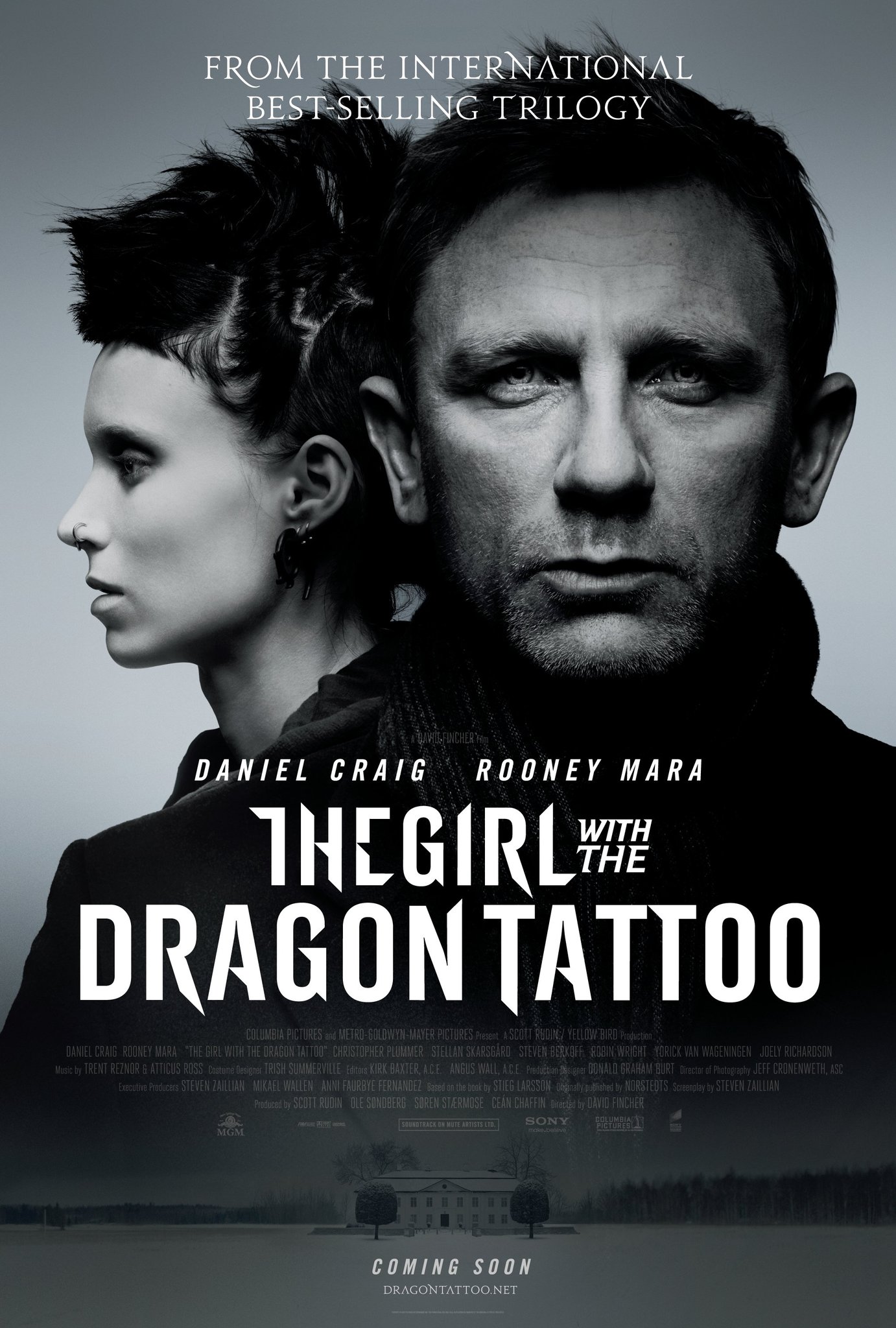
Image result for Girl with Dragon Tattoo

Harsh, unyielding and spooky, David Fincher’s adaptation of Stieg Larssen’s first of his best selling trilogy (adaptations of all three have been made in Sweden) is intricate, engrossing and decidedly chilly.  Daniel Craig plays a Swedish journalist who has just been convicted of libeling a financier.  Another corporate titan (Christopher Plummer) summons Craig after having his background checked by an investigative firm.  The firm’s investigator is a ward of the state (Rooney Mara) who ostensibly works as an office clerk, but, in fact, is a genius of surveillance and investigatory technique.  Plummer entices Craig to investigate the 50 year old disappearance of his niece, and Craig eventually enlists the loner and outcast, Mara, to assist him.

Fincher’s strongest milieu is psychological crime.  Seven gave us the mastermind of Kevin Spacey as he offed his victims using the seven deadly sins as a guide.  Zodiac was an intriguing take on a real life case, the Zodiac murders in Northern California during the late 1960s, early 1970s, and while it bombed at the box office, only two movies appeared on more critics’ top ten lists in 2007.  Fincher can deftly keep a lot of balls up in the air with great precision yet still tells a tale you can follow.  The book provided a family tree chart in the preface, and given the number of characters in the family, I found myself referring to it regularly.  Screenwriter Steve Zallian has smartly excised the plot of a few people, but not many, yet I never found myself confused.

Mara is genuine as a troubled, anti-social outcast who teams up with Craig to work on the mystery, and they produce a strong and convincing bond (her nomination for best actress is merited).  The close of the picture, when she realizes she cannot have perhaps one of the few people who has shown her affection, is a gut punch.

The ending, however, is muddled, tacking on a financial windfall/scam to the resolution of the mystery.  Once you’ve witnessed the solving of a string of gruesome ritual killings and a missing persons case that goes back decades, a coda of fraudulent financial transfers is hardly satisfying and robs crucial minutes away from further character study of the family, some of whom get short shrift given the sweep of the story.

Another distraction is Mara’s progressively expert investigatory skills, which by the end of the film near those of a super hero (as Christopher Hitchens noted about her literary character, she “is so well accoutred with special features that she’s almost over-equipped”).  The more La Femme Nikita she becomes, the less your investment in her.

Be warned.  Like Fincher’s Seven, this film is both brilliant and disturbing.  Gruesome murders, rape, animal mutilation, and what appears to be an unbearably cold Sweden all await.  Not for the faint of heart

Before The Hunger Games, and its depiction of a televised death match for teens, there was Network, perhaps the most prescient film ever made.  Released in 1976, Network foreshadows the gruesome future of television as it slides nearer and nearer to county fair freak show.  Caustic, incisive and at times frightening, if modern writers managed half of Paddy Chayefsky’s lines in Network, we’d all be better off for it.

The plot is simple.  A network is going down the tubes and in order to save it, the reckless, soulless and brilliant Faye Dunaway is given free reign over programming.  She forwards numerous efforts, the most popular being The Howard Beale Show, a nightly venue given to a network news anchor (Peter Finch) who is slowly going mad.

The script bogs down a bit in the last quarter, mainly, I think, because the medium of film does not handle monologues for two hours, and in between Chayefsky’s smart dialogue, this is essentially a film of well-delivered speeches.

The movie is filled with gems.  Finch making his mark with an on-air nervous breakdown (“I’m mad as hell and I’m not going to take it anymore!”) or corporate titan Ned Beatty thundering to Finch that he has meddled with “the forces of nature” after one of his on-air screeds affects an oil investment.  A scene that is unparalleled involves the activists from the Ecumenical Liberation Organization, a quasi-Symbionese Liberation Organization, upon which Dunaway is basing a “reality” show.  These revolutionaries for the proletariat are soon perverted by the influence of TV and begin squabbling as to points and percentages off the back end.   There are also wonderful pitch scenes for shows that in 1976 would have seemed outrageous, but would now be ho hum.

There are some weaknesses.  The romance between Dunaway and William Holden, the old network bull, is unconvincing.  It is easy to understand a older man-younger woman dalliance, but in this case, Dunaway plays as a frenetic shark.  Her character freely admits she is a lousy lay and then demonstrates as much with Holden.  Dunaway’s character is about power and moving up (when a young, non-powerful man kisses her shoulder, Dunaway’s sharp “Knock it off” tells you all you need to know), and the fact that Holden does not see it is problematic.

Perhaps it was Holden trying to understand the future, or he was waning and wanted a taste of youth.  It’s possible that Dunaway, like televison, is empty but still capable of beguiling Holden for a time, like Beale’s viewers.  But the relationship seems peculiar and off-kilter. That said, some of Chayefsky’s best lines are during their conversations, so the curious nature of the couple can be forgiven.

Network is deservedly ranked 64 on AFI’s Top 100 movies.

Modern political movies are a tough sell.  Last year, George Clooney provided the dry, obvious and somber The Ides of March (no one got stabbed – but boy, as dull as it was, it would have helped).  The American President was execrable, a love letter sent to suburban progressives who must not only follow but adore their leaders, preceding the advent of The West Wing and Martin Sheen as President Awesome.  The most recent good political movie was the rollicking Charlie Wilson’s War, which Mike Nichols directed.

Nichols must have a knack for it.  Primary Colors is Nichols’s cinematic mirror on the rise of the Clintons, an adept story of the tension between political values, electoral success and human frailty, all wrapped up in a big, fun yarn populated by larger than life characters (one of whom served as our regularly entertaining president from 1992 to 2000). There is no need to discuss the plot.  It tracks history loosely, but it will be familiar.

It is also an actor’s film and those actors are aided by a very tight, yet breezy screenplay.  The characters talk the talk of political campaign work, yet we are not burdened by the mundane or weighty.  Better, divergence into the philosophical is not stilted or preachy.  Adrian Lester, the true believer sucked into the expedience and fervor of a presidential race, serves as our somewhat wide-eyed guide.  He exudes the right amount of awe and moral ambivalence.  Billy Bob Thornton is James Carville, and he utters my favorite line about politicians to Lester:  “That’s what these guys do. They love you and then stop lovin’ you.”  Emma Thompson is the increasingly embittered and mercenary Hillary; she is determined, yet both fragile and icy.  Larry Hagman delivers a nice turn as a morally tainted dark horse challenger, and Kathy Bates keeps the fun in the picture as a political operative who knows the terrain of small town politics gone national.

Now, playing a president is a hard job.  Jeff Bridges was nominated for best supporting actor for his Clintonian president in The Contender, but he was so charming and wily as to feel false.   Michael Douglas was painfully self-pitying in the The American President and while Kevin Kline’s president in Dave wasn’t supposed to be realistic (if you’ll recall, Dave was a look-alike brought in to replace the real president, a heartless prick who I much preferred), he was so “aw shucks” Opie I found myself rooting against him.

Even harder is playing a president we know.  Kennedy does not count, because most filmgoers didn’t live through his presidency, and even if they did, JFK is difficult to separate from a Hollywood character (in fact, Kennedy is the only president to have a film released about him during his presidency, and you can rest assured that PT-109 did not show Jack screwing the pooch by letting his ship get rammed by a Japanese destroyer).  So, we are convinced by awesome hair and a few “Bahstans” and “Cubers.”  Oliver Stone gave us two grotesque caricatures — Anthony Hopkins made Nixon a sweating bundle of nerves and ambition in Nixon (Frank Langella’s Nixon in Frost/Nixon was so much better) and Josh Brolin as a clownish, frat boy/oaf in W (I’m still waiting for the casting of Gerald Ford in The Mayaguez Incident).

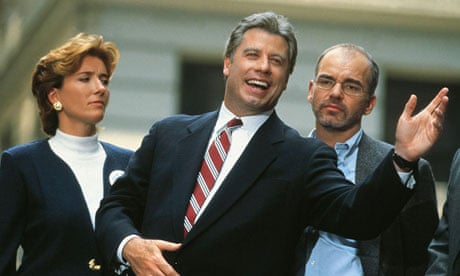
This leaves John Travolta as Clinton.  Granted, I have been spoiled by the real Clinton, a masterful communicator and tactician, and in my judgment, perhaps the greatest American retail politician.  But Travolta misses Clinton’s flashes and confluence of weakness and sincerity, warmth and opportunism, self-pity and bitterness.  It is a tall order to fill, Travolta does his best, but mimicry is often what he is forced to rely upon.  When he is adored by crowds in the movie, I thought, “Oh come on. How could they be buying this?”  Granted, I usually had those thoughts when the real Clinton spoke to adoring crowds.  But I rarely questioned the sanity of others who were thinking “Yes! He feels my pain” while I was rolling my eyes.

Still, Travolta does well enough, and Nichols smartly never gets you rooting for him or anyone else.  That is critical to the film.  You may like Travolta and Thompson, but you feel tarnished for doing so.  You may hate them, but you recognize their failures in yourself and politicans you admire.

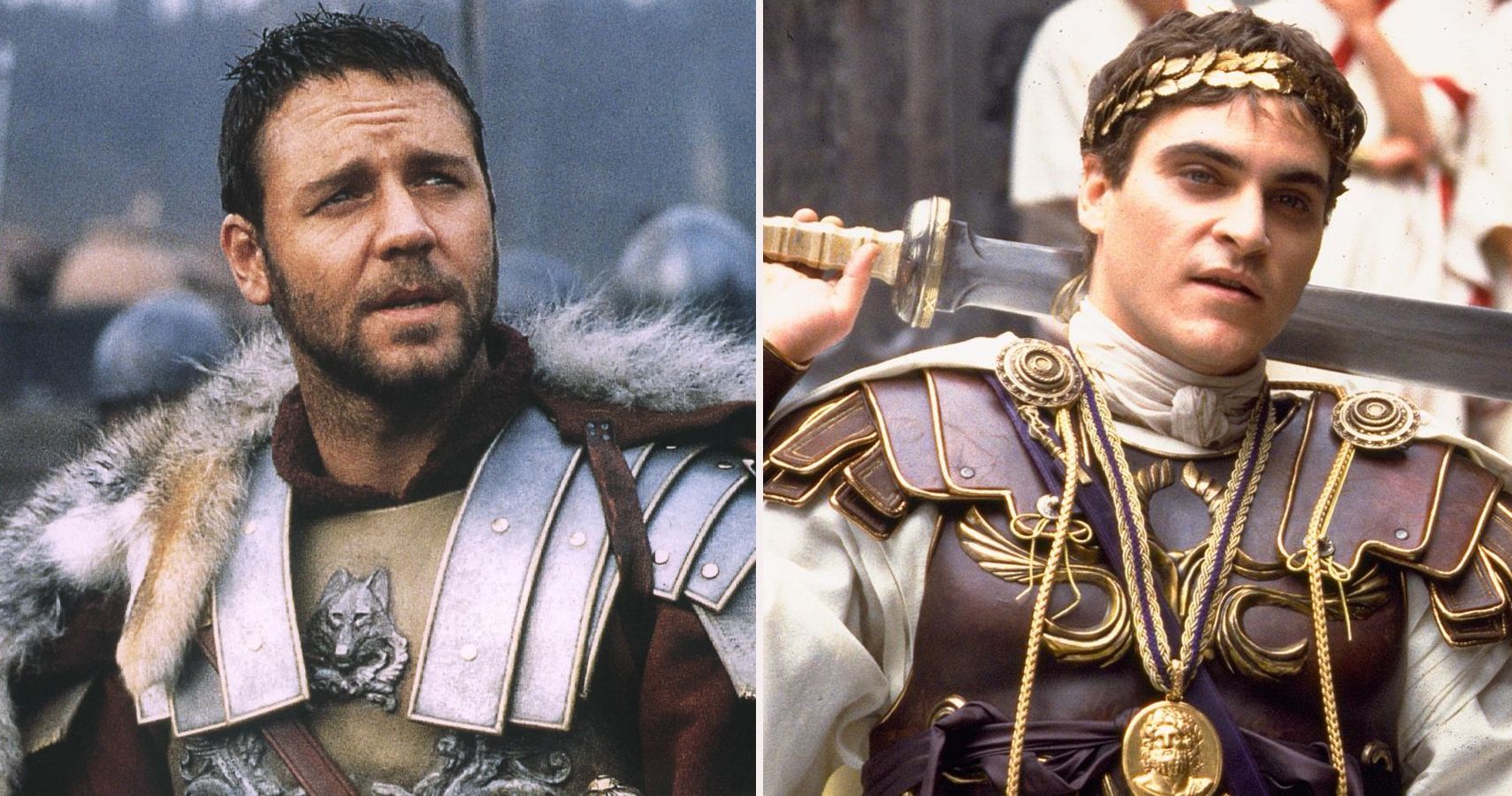
Are You Not Entertained?! 15 Most Iconic Quotes From Gladiator

Are you not entertained? You should be. While the script is cobbled together and shallow (it was being written during filming and it shows) and is reliant on the life breathed into it by the players, there is plenty of life, as Russell Crowe, Richard Harris, Derek Jacobi and Joaquin Phoenix do wonders for a leaden draft. Though Oliver Reed is bloated and battered as Crowe’s owner, he also gamely pitches in (he died in a Malta bar during filming).

All the action sequences are riveting. From an impressive opening battle sequence in Germania, to Crowe’s first gladiatorial experience, to a great Ben Hur-ish sequence where a troupe of over-matched gladiators under Crowe’s command exceeds expectations in their first visit to the Coliseum, to a nice one-on-one between Crowe and another famed fighter, with tigers thrown into the mix . . . all are thrilling. There’s also enough of a story to get us from action sequence to action sequence.

Crowe commands the movie and seems “in time” (obviously, I couldn’t possibly know if Crowe acted like a Roman, but I assure you, it feels more authentic than Tom Cruise as a Civil War veteran or Kirsten Dunst as Marie Antoinette). But it is Phoenix as the mad usurper who steals the movie in what could have been a throw-away performance, the weak son to the strong emperor. Instead, Phoenix is genuinely touching (when he seeks his father’s favor and is spurned) and frightening (when he seeks a different kind of favor from his sister, threatening the life of her son in the process). You almost feel for the guy when the mob turns on him.

Michael Mann’s crime opera clocks in at over 3 hours. It is too long, but not by much. The trimming of one plot line could have made this cool and intricate crime drama excellent. Instead, it is merely very good.

Robert De Niro and his crew of criminals (which includes Tom Sizemore and Val Kilmer) are master thieves in LA.  Al Pacino and his crew of cops (which includes Wes Studi and Mykelti Williams) are master thief busters. The criminals plan and execute three jobs, and the cops try and stop them, while juggling family, wives/girlfriends, and the hazards of the professions.

The opening and closing heists are brilliantly staged by Mann, especially a bravura bank job gone wrong in downtown LA.  De Niro’s crew tears through the police, making Swiss cheese of them in a several block, by-car and then on-foot getaway. I had always assumed the scene was based on a real-life North Hollywood shootout where 2 heavily armed men In body armor robbed a bank, were confronted by lightly armed police and injured a dozen of them before being shot down.  In fact, the real-life robbery came two years after the movie.

The story also smartly weaves the stories of a three secondary characters (a member of De Niro’s crew who was kicked out and seeks revenge; a crooked investor for drug interests who takes exception to being ripped of by De Niro’s crew; and, a recently paroled criminal trying to stay out of the game), all of whom intersect with and enhance the primary plot.  Pacino’s relationship with his third wife and her emotionally fragile daughter (Natalie Portman) is also handled well. The wife is not a stoic sufferer but a modern, divorced and frustrated character who is too focused on Pacino to the detriment of her child.

I have three complaints. First, Pacino goes a little too Scent of a Woman. He is so ferocious at times that it is hard to stifle a chuckle, and his accent is strangely southern, then it is not. He is either very good in the movie (his low-key confrontation over coffee with De Niro is one such moment) or he is cartoonish (the entire scene with his informant is bizarre; Pacino looks like he might start speaking in tongues and “Hoooooo-AHHHHHH” never seems far off).


ACTUAL STILL FROM THE PICTURE

Second, the attempt to humanize De Niro by introducing a forced love interest with Amy Brenneman is a mistake and it interrupts the pace. The relationship is unconvincing and as such, does not explain certain choices De Niro makes at the end.  Given the brutality of De Niro (by my count, he kills or wounds a dozen cops and orders the execution of a security guard), it is enough for us to root for him only when he is pitted against others of his ilk. But the attempt to make the audience empathize with his lonely life of crime is several bridges too far.

Third, Val Kilmer’s escape is unconvincing, making a police character we’d been led to believe was sharp look borderline incompetent.

Otherwise, this is a stylish, gripping picture.  And for music fans, Henry Rollins and Tone Loc get minor roles.  Also, it features a young Ashley Judd, who bravely allowed herself to look as worn and haggard as the wife of a brutal, volatile and uncommunicative criminal should.

The Artist. I was not excited to see a silent film, and it took a little while for me to warm up to it, but this is a natural, funny and beautifully shot picture, a riches-to-rags-to riches love story with enormous heart.

The movie is almost entirely dependent on its two leads, Jean Jujardin and Bérénice Bejo, both of whom are nominated for Academy Awards, and deservedly so. Dujardin is a silent film king who gives Bejo her big break, falling in love with her in the process. She ascends in the talkie era and he fades away. Particularly affecting is the scene of Dujardin in his last gasp movie, lost in quicksand:

Dejardin’s descent dragged a little bit, but that is the only criticism I have.

Dejardin and Bejo are aided by a plucky performance by a dog and the contributions of John Goodman as the studio mogul and James Cromwell as the loyal chauffeur. But they carry the film and their performances, which could easily have been big and over-the-top, are subtle and moving. The scene where they fall in love – a series of takes where Dujardin dances with then-extra Bejo, each take becoming more entranced – is captivating.

This is the favorite to win Best Picture tonight and it is the second best picture of the year.

Margin Call, nominated for best original screenplay, is still at the top of my heap.

I took my daughter and her friends to see this chiller. Daniel Radcliffe graduated from Hogwarts and has attained a position as a turn-of- the-century barrister in England. He’s recently widowed and is tasked with the unenviable assignment of winding up the estate of a recently deceased woman in the English countryside. The moment he gets in to town, he starts seeing creepy things and children start dying.

The plot is thin but serviceable, Radcliffe has some range (his recent stint hosting Saturday Night, Live was very good) and he’s helped by Ciaran Hinds, but most importantly, this movie scared the crap out of me.  There is one creepy and/or jarring visual after another, a constant sense of dread, and many inventive ways to get your skin to crawl.  The Woman in Black is half ghost story, half haunted house ride.   Best of all, no gore porn torture, just good, clean spooky fun.  More of a ride than a film. We had a blast.

While the story draws you in immediately, and the performances are uniformly solid, this film is really two virtuoso battle scenes bookending Steven Spielberg’s obvious story-telling, which is not helped by some leaden dialogue and a platoon of stock characters (sensitive medic, clueless bookworm, Italian tough, Jewish wisecracker, Irish tough, Southern Bible-Belt sharpshooter).

However, some films transcend criticism. Saving Private Ryan’s roundly lauded re-creation of D-Day is jarring and innovative. Spielberg brilliantly changes the vantage point of the viewer, and the speed and unearthly horror of mass battle is depicted in frightening detail. He tracks the advance on the beach, then moves to a hand-held camera, then to the view of a German gun nest, then back to the beach, with such swiftness that you lose your breath at times. The effect of the opening scene leaves you lost for the next ten minutes. In the theater, I was stunned that everyone was hunkered down in their seats.

When you do reorient, the film becomes a more conventional war film/morality play. Spielberg, as usual, has his characters pound away at his message for fear we won’t “get it.” His foreshadowing is also clumsy.

Still, the battle scenes that ensue after the landing remain true to history. The ingenuity of the GI’s – which might otherwise strike a viewer as contrived – is conveyed by Spielberg. The crucial role of firepower, the slap-dash organization of discombobulated soldiers, the treatment of German prisoners, and the heroic level of unit cohesion – all receive effective dramatization in the film.

In the end, however, Saving Private Ryan works as a particularly American film. Neither a rah rah polemic or a cynical anti-war tract, the movie communicates the basic truth that the loyalties of combat soldiers start (and often end) with fellow soldiers. Spielberg’s platoon is cleaved together as a unit, but the unit is not only threatened by the enemy, but by what seems a questionable endeavor – to save one private because all of his brothers have been killed. The grisly reality of slaughter of many for the saving of more, and the slaughter of more for the saving of one, is juxtaposed, creating the crisis for Hanks, the unit leader, and the audience.

Saving Private Ryan works on a different level as well. The movie transports the viewer to a time when the costs of everyday life were greater, and for higher purpose. In this manner, Ryan can be criticized for engaging in too much “greatest generation” nostalgia, but it is useful to compare the film to contemporaries.

The best film from the year before Ryan’s release was the comedy As Good As It Gets. It was about a spoiled, rich romance writer with OCD, which meant he could not refrain from gay-bashing his neighbor. His heroism was in learning to love while simultaneously not being cruel to anyone in proximity. I liked that movie. Nicholson was a crack-up. But I wonder how his character would have fared on Omaha Beach.

Postscript: in the wake of this film, Hanks and Spielberg partnered to produce Band of Brothers for HBO, a beautifully shot and much better written miniseries covering one unit from D-Day to Hitler’s Eagle’s Nest.

Image result for The Limey

Terence Stamp plays a just-released British convict who comes to Los Angeles to investigate the death of his estranged daughter.  Stamp is a tough guy, but not Bob Hoskins cockney and bluster, The Long Good Friday tough (thankfully, Stamp is more intelligible). He’s icy and removed, grimly determined to get to the bottom of his daughter’s death. His search opens several leads, the most promising being Peter Fonda, a record executive who made his bones in the 60s, and Barry Newman, Fonda’s dubious associate (Newman was a 70s American television staple as “Petrocelli” the lawyer).

As icons of the 60s, Fonda and Stamp are dinosaurs, two powerful men not quite at ease in the 90s, and Soderbergh uses them to insert a generational disconnect in a taut psychological crime thriller.

Stamp evokes the macho rage of an absent father well. His anger burns, even though his memories are but a few snippets and stories (he was in prison for a great period of her upbringing). His inner demon is not so much what he lost, but what he squandered, and he’s powerful.

Where Stamp is driven, Fonda is resigned. He senses that his time is past, and his desperation is palpable. His weakness is subtle (his conversations with a lover 30 years his junior are wonderfully pained, the scripted equivalent of a middle-aged man in a Porsche, a head mottled by Rogaine, and “The Byrds” on the CD, as he waxes about his past, only to be met with “Oh, I think you’ve told me that story”).

Solid noir.