Archive

4 stars

I took my daughter and her friends to see this chiller. Daniel Radcliffe graduated from Hogwarts and has attained a position as a turn-of- the-century barrister in England. He’s recently widowed and is tasked with the unenviable assignment of winding up the estate of a recently deceased woman in the English countryside. The moment he gets in to town, he starts seeing creepy things and children start dying.

The plot is thin but serviceable, Radcliffe has some range (his recent stint hosting Saturday Night, Live was very good) and he’s helped by Ciaran Hinds, but most importantly, this movie scared the crap out of me.  There is one creepy and/or jarring visual after another, a constant sense of dread, and many inventive ways to get your skin to crawl.  The Woman in Black is half ghost story, half haunted house ride.   Best of all, no gore porn torture, just good, clean spooky fun.  More of a ride than a film. We had a blast.

While the story draws you in immediately, and the performances are uniformly solid, this film is really two virtuoso battle scenes bookending Steven Spielberg’s obvious story-telling, which is not helped by some leaden dialogue and a platoon of stock characters (sensitive medic, clueless bookworm, Italian tough, Jewish wisecracker, Irish tough, Southern Bible-Belt sharpshooter).

However, some films transcend criticism. Saving Private Ryan’s roundly lauded re-creation of D-Day is jarring and innovative. Spielberg brilliantly changes the vantage point of the viewer, and the speed and unearthly horror of mass battle is depicted in frightening detail. He tracks the advance on the beach, then moves to a hand-held camera, then to the view of a German gun nest, then back to the beach, with such swiftness that you lose your breath at times. The effect of the opening scene leaves you lost for the next ten minutes. In the theater, I was stunned that everyone was hunkered down in their seats.

When you do reorient, the film becomes a more conventional war film/morality play. Spielberg, as usual, has his characters pound away at his message for fear we won’t “get it.” His foreshadowing is also clumsy.

Still, the battle scenes that ensue after the landing remain true to history. The ingenuity of the GI’s – which might otherwise strike a viewer as contrived – is conveyed by Spielberg. The crucial role of firepower, the slap-dash organization of discombobulated soldiers, the treatment of German prisoners, and the heroic level of unit cohesion – all receive effective dramatization in the film.

In the end, however, Saving Private Ryan works as a particularly American film. Neither a rah rah polemic or a cynical anti-war tract, the movie communicates the basic truth that the loyalties of combat soldiers start (and often end) with fellow soldiers. Spielberg’s platoon is cleaved together as a unit, but the unit is not only threatened by the enemy, but by what seems a questionable endeavor – to save one private because all of his brothers have been killed. The grisly reality of slaughter of many for the saving of more, and the slaughter of more for the saving of one, is juxtaposed, creating the crisis for Hanks, the unit leader, and the audience.

Saving Private Ryan works on a different level as well. The movie transports the viewer to a time when the costs of everyday life were greater, and for higher purpose. In this manner, Ryan can be criticized for engaging in too much “greatest generation” nostalgia, but it is useful to compare the film to contemporaries.

The best film from the year before Ryan’s release was the comedy As Good As It Gets. It was about a spoiled, rich romance writer with OCD, which meant he could not refrain from gay-bashing his neighbor. His heroism was in learning to love while simultaneously not being cruel to anyone in proximity. I liked that movie. Nicholson was a crack-up. But I wonder how his character would have fared on Omaha Beach.

Postscript: in the wake of this film, Hanks and Spielberg partnered to produce Band of Brothers for HBO, a beautifully shot and much better written miniseries covering one unit from D-Day to Hitler’s Eagle’s Nest.

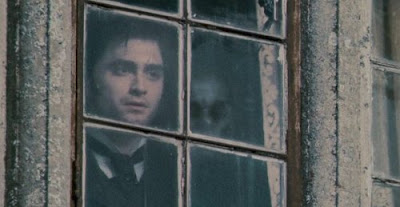
Image result for The Limey

Terence Stamp plays a just-released British convict who comes to Los Angeles to investigate the death of his estranged daughter.  Stamp is a tough guy, but not Bob Hoskins cockney and bluster, The Long Good Friday tough (thankfully, Stamp is more intelligible). He’s icy and removed, grimly determined to get to the bottom of his daughter’s death. His search opens several leads, the most promising being Peter Fonda, a record executive who made his bones in the 60s, and Barry Newman, Fonda’s dubious associate (Newman was a 70s American television staple as “Petrocelli” the lawyer).

As icons of the 60s, Fonda and Stamp are dinosaurs, two powerful men not quite at ease in the 90s, and Soderbergh uses them to insert a generational disconnect in a taut psychological crime thriller.

Stamp evokes the macho rage of an absent father well. His anger burns, even though his memories are but a few snippets and stories (he was in prison for a great period of her upbringing). His inner demon is not so much what he lost, but what he squandered, and he’s powerful.

Where Stamp is driven, Fonda is resigned. He senses that his time is past, and his desperation is palpable. His weakness is subtle (his conversations with a lover 30 years his junior are wonderfully pained, the scripted equivalent of a middle-aged man in a Porsche, a head mottled by Rogaine, and “The Byrds” on the CD, as he waxes about his past, only to be met with “Oh, I think you’ve told me that story”).

Solid noir.


Galaxy Quest is a consistently amusing film. Two or three laugh out loud lines and consistent good chuckles and/or smiles throughout. The smartest part of the movie is finding a good sight gag, i.e., the Thermians, who enlist a Star Trek-like crew of actors into a real space adventure . . . their walk and facial expressions are pretty darn funny (I was reminded of the sight gag of people falling out of the sky in Being John Malkovich – no matter how many times I saw it, I laughed, and the gag was used a lot). And one of the Thermians is none other than Rainn Wilson of “The Office” fame.

Dwight

The Winslow Boy. David Mamet’s period piece about an Edwardian scandal is sharp and deep. A proper, emotionally serene English family strives to clear the name of a family member from what they perceive as a slander (the youngest son is accused of the theft of 5 shillings and expelled from navy school). The father (Nigel Hawthorne of The Madness of King George) is an eccentric banker who sacrifices the family’s position (financial and otherwise) to clear his son’s name. His daughter (Rebecca Pidgeon) is a suffragette engaged to a military man. As the scandal envelops the family, her social life is shattered.

The family engages the services of Sir Robert Morton (Jeremy Northam), a leading barrister and politician who opposes women’s suffrage but finds himself inexorably drawn to the case and Pidgeon. What follows is a psychological study of the ties of family and the limits of honor as well as a satisfying courtroom drama.

The dialogue is understated, which is rare for Mamet, but it is still rhythmic. Mamet treats each character, major and minor, with dignity. There are no fops or fools. Everyone is multi-faceted and thus, interesting.

Tom Ripley's “Talent” Explained in Psychological Terms | by Martine Nyx |  Cinemania | Medium

Anthony Minghella’s The English Patient did not have the beauty (such is Italy versus the Middle East), the narrative strength or the strong characterizations of The Talented Mr. Ripley. While it won best picture, it can comfortably be catalogued in that big picture-big bore compendium of Gandhi, The Last Emperor, and Out of Africa. The somnambulate performances of Ralph Fiennes and Kristin Scott Thomas sealed the deal.

Not so in Minghella’s follow-up. Matt Damon plays, in his own words, a “nobody” named Tom Ripley who by chance and minor deception is hired to retrieve the wayward son (Jude Law) of a shipping magnate (James Rebhorn) in Italy. When he gets there, Damon insinuates himself into Law’s life, as well as the life of his fiance (Gwyneth Paltrow) through a mix of artifice and honest friendship. Damon immediately becomes entranced by Law and by Law’s life. His love-affair with both gives us entree into the mind of a malformed ego undergoing slavish adoration.

And Law is worthy of adoration. He is the energy of this picture, alternately charming, impetuous and cruel. As Damon keeps sidling up to Law, you feel for both if them. Damon is voracious but because Law is so captivating, Damon’s need to be near him and eventually to be him elicits understanding. This is a crucial component, for while the sexual undertones are strong, what Minghella does is make you a partner to Damon’s mental, rather than physical lust for Law.

This is the film’s triumph, as most psychological thrillers suffice to center on the madness within the sociopath, rather than lay a sympathetic base for why the sociopath becomes sociopathic.

Here, Minghella allows us to see the Damon-Law relationship through courtship, their bad moments, Damon at his most fawning and pathetic, Law at his most generous and spiteful. All with the backdrop of beautiful Italy, a locale Minghella makes almost dreamlike, the better to underscore Damon’s dizzying descent.

Damon manages the role very well, though he overrelies on a few tics (the weird, self-effacing grin, the penetrating stare). Still, his is a measured and affecting performance, certainly a worthy contrition for his “aw shuckism” of Saving Private Ryan. Everyone else is quite good, with special mention to Philip Seymour Hoffman as Law’s monied playboy friend from Princeton. His time on screen is limited, but he dominates every moment he has with a dry, smart rendering.

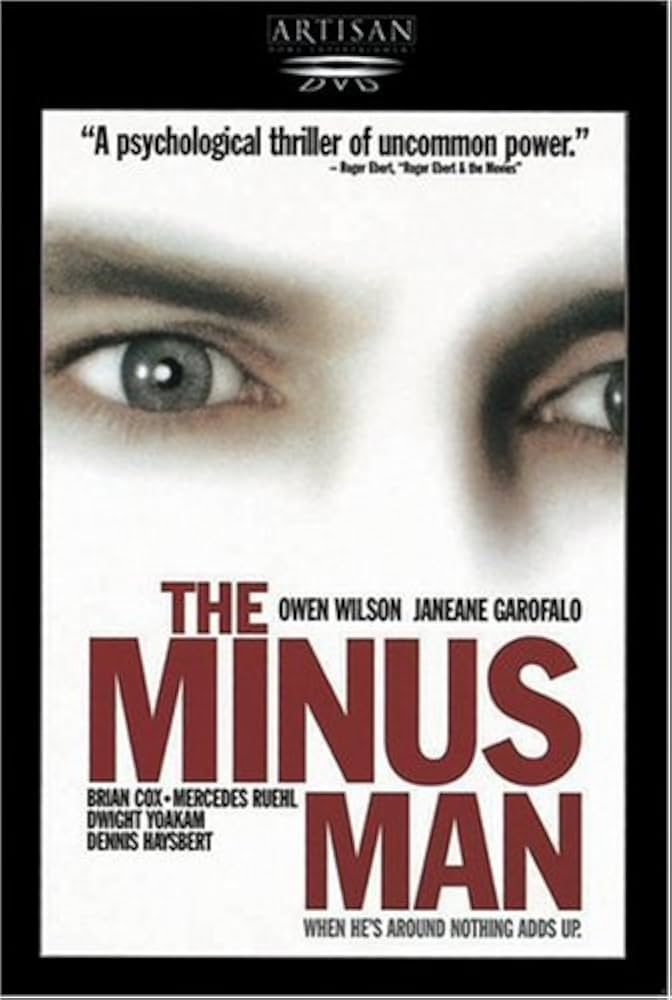
A sweet serial killer film, if such a thing is possible. Owen Wilson plays a drifter who poisons his victims. He is a gentle soul with a horrific secret, a man-child who comes into the lives of several characters in pain (in particular, Mercedes Ruehl and Brian Cox playing parents grieving the departure of what appaers to be their teenage daughter) and provides them what appears ito be support, all the while practicing his craft.

This is an offbeat, even sleepy picture, wholly reliant on Wilson’s quirky, dream-like performance, which I found riveting.

The Tao of Steve. It is a simple, engaging comedy about a serial one night stand artist in college, 10 years hence, who has now become fat kindergarten teacher, but remains a master at bedding women in the college town. His “Steve” is McQueen, at whose feet he prays. His technique and precepts are shaken when he meets a woman from his past.

Hamlet. I know when I think of Hamlet, Ethan Hawke comes immediately to mind because if there is one character who needs added slacker sensibility, it is Hamlet.

Actually, Ethan Hawke captures Hamlet as he would be were Elsinore a Manhattan hotel, Denmark a corporation, and Sam Shepard the ghost of a corporate titan now deposed. All the performances are very good, with special note to Liv Schreiber’s riveting Laertes and Bill
Murray’s effortless update of Polonious. You might think the modern, New York City locale would make this Hamlet clunky, but it does not.

Blood Diamond. A gripping political thriller that does not over-preach to us about the poor, misused Third World (unlike the tendentious The Constant Gardener). It could have been 20 minutes shorter, but the last 45 minutes is white-knuckle. Leonardo DiCaprio and Djimon Hounsou give fantastic performances (this film and The Aviator showed DiCaprio moving beyond peach fuzz) and there is great chemistry between DiCaprio and the stunning Jennifer Connelly.