This is a charming documentary about the first fan club president of The Beatles – Freda Kelly – who started out in a typing pool, sneaking off work to see the band at The Cavern Club, and worked her way in to become the assistant to Beatles manager Brian Epstein. Kelly provides nothing really new about “the lads” (Paul was always nice, John could be a handful), but her remembrances are touching and frankly, impressive. She took her job as correspondent for the band very seriously, and while in their employ, authored thousands of responses to fan mail, even going so far as to fire an employee for sending non-Beatle hair to a fan who had requested a strand. She even used her home address as the fan club address for a time, until her father complained that he couldn’t find his utility bills in the sacks of mail that arrived every day.
Kelly worked faithfully for the group until its demise, and then just moved on with her life. As the documentarian finds her now, she is a working secretary. The surviving Beatles and the estates of John and George must have given the filmmakers rights to the music, because Beatles tunes litter the film, and Ringo even gives a video goodbye to Freda during the credits. I will say, however, there’s a bit of a bad taste at the end. Freda is presented as a true gem, someone who tended to the band’s needs, kept their confidences, never once traded in on their fame for her own aggrandizement, and even became a companion to many of their parents. I don’t expect the Beatles to shower attention on all of the “little people” who helped their rise, but Freda seems a cut above, and so . . . what the fu**, Paul!
Nominated for Best Foreign Film, this Argentinian entry consists of several vignettes of revenge, the first being one of the best openings of a film I’ve ever seen. The stories that follow exhibit a sly and dark sense of humor, enlivened by writer-director Damian Szifron’s accomplished visual style. It’s difficult to criticize any of the decision-making that led to the massive hit that is Jurassic World. But that film is a charmless, forgettable visual mess, and I’ll never understand why such a project was given to a filmmaker whose last work, as much as I liked it, was on such a small scale. It’s a picture that should have been given to the likes of Szifron, who handles close-in dialogue and action, suspense and large-scale calamity with expertise and vision. If I have a a criticism, it’s that it was all too much. I needed a break.
Richard Donner’s devil picture was a big hit in 1976, and 40 years later, it’s easy to see why. Rejecting the dour, sinister tone of The Exorcist, The Omen also lacks that film’s intelligence and gravitas. In its stead, however, is schlock elevated by top-notch performances (Gregory Peck, Lee Remick and David Warner play it straight and true, and Billie Whitelaw is chilling as a modern Mrs. Danvers) and some truly terrifying scenes. A suicide by hanging at a child’s birthday party, an impalement of a priest, and poor Remick’s two falls are memorable, as is the demon child’s first visit to church (he is not happy) and his drive through a wild animal park (they are also not happy). But it also follows the rules of a mystery. Clues are given, investigation follows, and then, terrible dawning. Jerry Goldsmith’s Oscar winning original score rejects subtlety, and even as over-the-top as it is, heightens dread.
Best, any film that ends with Peck about to stab a child with ceremonial knives and an unmitigated win for the devil has a place in my heart.
Of Apocalypse Now, Director and co-writer Frances Ford Coppola famously told a room full of reporters, “”My film is not a movie. My film is not about Vietnam. It is Vietnam.” Putting aside the cockiness and disrespect of such a statement, it is fair to say the film (and it is merely a film) is about a certain concept of Vietnam, one unique at the time it was released. Most Vietnam films fall into three categories. The first uses Vietnam as a mere location for a story about man’s triumph over adversity (seeThe Hanoi Hilton, Uncommon Valor, Rescue Dawn, Bat *21). The second, in the tradition of The Best Years of Our Lives, hones in on the war at home and the effect of the conflict in a much-changed stateside (Rolling Thunder, Coming Home, Birdy, Jackknife, Gardens of Stone and even the ridiculous Forrest Gump). The third category shows the war in-country and orbits a central thesis; the war was not only a bad war, but it was a pernicious war, one where America lost its soul, to the jungle, militarism, hubris, the military industrial complex, or some combination of same. The Deer Hunter, Born on the Fourth of July, Casualties of War, Full Metal Jacket, and Platoon all fit this bill. Most of these films are well made . But none bear any resemblance to Apocalypse Now, a harrowing visual nightmare drawing from all three categories, paralleling a novel (Joseph Conrad’s Heart of Darkness) as interpreted by a macho right-winger (John Milius) and Coppola himself.
The film begins with a portrait of Captain Willard (Martin Sheen), an intelligence officer and assassin, as he endures a drunken nervous breakdown in a Saigon hotel. Coppola got Sheen wildly drunk for the scene, baiting him with verbal cues to elicit a reaction, and the effect is mesmerizing; Sheen even cut open his hand smashing a mirror, which perhaps should have been a portent for Coppola (later in production, Sheen suffered a heart attack that significantly delayed filming). Here, Willard has already been home to find his world changed, and he is back, hollowed out and estranged from his family, to take a new assignment.
That assignment, to “terminate the command” of a rogue American Colonel Kurtz (Marlon Brando) who has created his own army as a god-like figure in Cambodia, propels us forward, as we travel with Willard and his boat crew to a final confrontation. The trip is a grotesque menagerie. A thrilling and sickening helicopter attack on a VC area led by Lt. Colonel Kilgore (Robert Duvall) shows American ingenuity, power and recklessness. I’d never seen a battle re-creation so skilled and visceral until Spielberg’s rendition of the D-Day landing in Saving Private Ryan 30 years later.
Further up the river, Hollywood comes to Vietnam, as the USO brings in playboy bunnies for the entertainment of troops who are this point so on the edge, a near riot ensues. The scene is jaw-droppingly audacious, a brilliant representation of Willard’s observation, “the more they tried to make it just like home, the more they made everybody miss it.” Willard tell us that “[Charlie’s] idea of great R and R was cold rice and a little rat meat. He had only two ways home: death or victory.” Coppola’s juxtaposition?
The crew also searches a suspicious junk, and edgy and exhausted, opens fire on its passengers, almost all of whom die (one woman survives, briefly, but Willard puts her down with his pistol so his mission is not delayed). This is Coppola’s My Lai. Even further is the Du Lung Bridge, a stalemate where GIs either beg to be rescued by the boat or hunker down in a drug-induced haze, in a never-ending firefight with the VC (Willard asks a wired GI “Who’s in charge here?” and gets the response, “Ain’t you?”). Through it all, Willard provides a voiceover, which is half Sam Spade evaluating the situation, half epitaph for everything that went wrong for America in Vietnam.
Unfortunately, Willard’s mission ends. He finds Kurtz, distressingly played by Brando, who has shown up solely for the check. Brando was fat, unprepared, and uncooperative. In a 1979 interview with Rolling Stone, Coppola protected the actor, but only so much: “I shot Marlon in a couple of weeks and then he left; everything else was shot around that footage, and what we had shot with Marlon wasn’t like a scene. It was hours and hours of him talking . . . . Marlon’s first idea – which almost made me vomit – to play Kurtz as a Daniel Berrigan: in black pajamas, in VC clothes. It would be all about the guilt [Kurtz] felt at what we’d done. I said, “Hey, Marlon, I may not know everything about this movie – but one thing I know it’s not about is ‘our guilt’!” Yet Marlon has one of the finest minds around: Thinking is what he does. To sit and talk with him about life and death – he’ll think about that stuff all day long.”
Brando’s deep thoughts notwithstanding, there is no way around it; the last 20 minutes of the film near grind it to a halt, even with the addition of a frenetic Kurtz acolyte played by Dennis Hopper. It is a testament to Coppola’s gifts that he was able to utilize Brando’s ramblings in as coherent a form as he did.
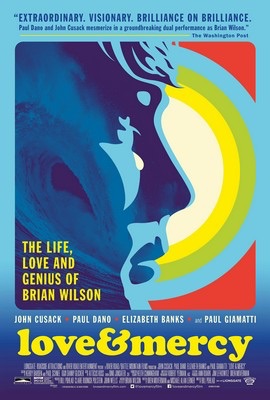
A competent biopic that smartly alternates between the rise of Beach Boys impresario Brian Wilson (played as a young man by Paul Dano) and his later life (during which he is played by John Cusack), where the ravages of mental illness, substance abuse and the dubious oversight of Svengali psychiatrist Eugene Landy (Paul Giamatti) have taken their toll. We meet the older Wilson as he tries to buy a Cadillac from saleswoman Melinda Ledbetter (Elizabeth Banks), revealing the only peace he can find, alone with her in the car at the dealership, while Giamatti and his associates hover on the other side of the glass.
The film spaces nicely, and the early pressures on Dano (fear of flying, his abusive and controlling father, the stress of touring, an aversion to conflict) are manifested in Cusack’s caged, distrusting performance, one of many really nice touches in the film. Near first time director Bill Pohlad delves into but doesn’t overplay Wilson’s demons, choosing to give equal access to his love of the art of pop music and visionary work in the studio. Nothing in the picture feels hackneyed or stale, a difficult feat in the face of traditional musical biopics like Ray and Walk the Line. Also, in the era where “Behind the Music” has left these stories vulnerable to the Dewey Cox treatment, the film feels fresh and immune to parody.
Banks and Cusack also radiate the wonder of first love, subordinating the “bio” aspect of the movie to a heartfelt romance. They have a convincing chemistry, which bolsters the efforts she undertakes to wrest Wilson from Landy.
As Landy, Giamatti is the weakest link. He is ferocious where he should be merely intrusive, maniacal instead of crafty. Landy may well have been that excessive, but he didn’t just walk off the street; he was a pop psychologist to many stars, from Alice Cooper to Rod Steiger. The performance is so over the top, you wonder how Wilson, even in his vulnerable state, could have succumbed to such a bully and how Landy could have had the smarts to set himself up so nicely.
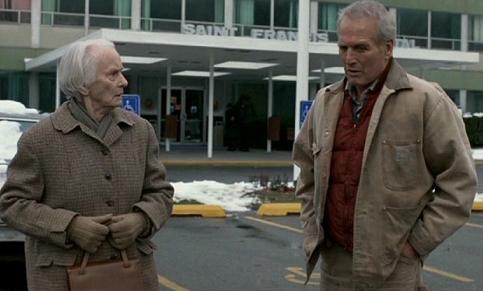
Robert Benton’s adaptation of this Richard Russo novel is centered in the wintry environs of North Bath, NY, where everyone knows each other so well they can be regular poker mates while simultaneously failing each other in any number of ways. Paul Newman plays Sully, an off again, on again employee of property contractor Bruce Willis (who he is suing in a personal injury claim) and the only tenant in an old Victorian owned by Jessica Tandy (in her last role before her death). Sully is woven into the fabric of the town, but he is at heart detached and cynical, and the only hint we get of any warmth are in his interactions with Willis’s wife, Melanie Griffith, who suffers her husband’s callous infidelities with a defiance that saps her verve. When Sully’s estranged son (Dylan Walsh) shows up in the midst of a marital and professional crisis, Sully becomes re-engaged, recognizing his role in the community and accepting the responsibility that comes with it, a George Bailey for the 1990s
The film is alternatively very funny and sneakily touching. Benton expertly captures the claustrophobia of a small town and even its collective ethos without letting eccentricity become cloying. Almost all of the characters are good, and Newman, who was rightly nominated for an Oscar, is perfectly suited to the material. Of Newman, David Thomson wrote:
As a young man, Paul Newman was so handsome he developed a sneer as if to frighten away the fans – the women, especially – who assumed he was ready and available. There were times when this arrogant manner seemed ready to dismiss not just most of his work, but anyone who took it seriously. He seemed to be saying, “Can’t you see – I’m not like this. I’m a real person, unfairly afflicted with movie looks. I’m Jewish!”
Newman was 30 when he first appeared in a movie; it meant he was a grown man, with hard-earned experience, before he started pretending in public. He had been three years in the Navy, as a radio operator; he had helped run his father’s store in Cleveland; he had been married and had children.
Later in life, the sneer fell away, along with the prettiness, until he was left a stoical old man with pain and losses, as well as the abiding perplexity that anyone should take him or acting that seriously. By then, he was one of the finest and most resolute old men in pictures – some achievement in a culture horrified by age.
The observation perfectly captures Newman in this picture. Newman communicates the pain and loss in Sully in barely perceptible ways, and when he does so, he doesn’t linger in a manner at odds with his core. He retreats to the crass aside or the blithe “oh well” and that’s that, making those moments of introspection and dawning even more affecting. It’s a sharp and knowing performance.
The film suffers a few missteps. Dylan Walsh, as Newman’s son, is badly miscast. He not only looks nothing like Newman, but he doesn’t share a teaspoon of his inner strength or mystery. Worse, when he arrives with family and children, they are played too broadly, with modern domestic woes and a miscreant younger child (who nicknames a child with a hitting problem “Whacker”?). So too is a very young Phillip Seymour Hoffman as the anal town deputy, and Josef Sommer as Tandy’s cowardly son. In a movie where every other character plays the line between comic and grounded beautifully, these turns are a shame, if easily overlooked.
It is a blessing to have children who like movies. We watched this classic John Huston film last night with my daughter, a movie I saw with my father in the theaters in the 70s. Based on a Rudyard Kipling short story, Michael Caine and Sean Connery are old vets in British India, cynical, loyal to each other and avarice. They make a compact to traverse Afghanistan to its upper northwest, into the wilds of Kafiristan, with provisions and weaponry to lend their talents as mercenaries. In doing so, they brave avalanches and the warring locals, and after allying with one in particular, Connery is deemed a god by virtue of an arrow that failed to pierce his heart and a Mason’s necklace. It all goes to his head.
The sweep of the film is broadly romantic, though, visually, it suffers in comparison to today’s epics due mainly to technical advancement. Caine and Connery are very well-matched, and though Connery’s seduction and their estrangement is a bit rushed, their bond at the end is actually quite moving. This is a throwback adventure film, deliciously retrograde in attitude; the Brits are charming rogues and everyone around them is a cowardly or fundamentalist savage. As Vincent Canby wrote at the time, “Gloriously old-fashioned in its approach – right down to the characters’ politically incorrect attitudes toward anyone who isn’t one hundred per cent British – The Man Who Would Be King is pure entertainment in the grand tradition of Gunga Din.” The film would never be screened on an American campus today, but oh what fun if it were.
This is a really fine action film, all the more impressive for its lack of CGI and enhanced by an intricate dystopian vision and some very bizarre, very cool, hard comic-book baddies. The plot is elemental. The world has gone to shit, and barbaric fiefdoms and clans reliant on gasoline have arisen from the ashes. Furiosa (Charlize Theron), a trusted lieutenant and gas runner of the chief bad guy, Immortan Joe (Hugh Keays-Byrne), takes something very precious from him and in the process, is assisted by Mad Max (Tom Hardy) and a fundamentalist acolyte of the heavy (Nicholas Hoult) who turns from the dark side. So, they are chased, and then, they double back through the dusty hell that is the future, and threaten all Immortan Joe possesses.
There isn’t much beyond action here, but it is inventive and exciting. Hardy and Theron are taciturn, eschewing even Eastwoodian comic understatement. They leave it to Hoult to provide most of the pathos, and he is an endearing motorized jihadist. Thankfully, the movie does not really try to communicate how the world came to be so barren and unforgiving, a blessing, because there is nothing quite so annoying in today’s dystopian films than the inevitable philosophical discussions masquerading as backstory, where we learn how we pissed it all away, and why the sufferers must keep suffering (seeSnowpiercer, Elysium, In Time).
A film that got away from me, perhaps because it gave off such an air of discomfort, I watched There Will Be Blood this weekend. The movie is very good, but my instincts were correct. It is a very difficult movie to endure.
Daniel Day Lewis plays a Charles Foster Kane-esque Daniel Plainview in Paul Thomas Anderson’s sprawling tale of an oil man who rose from a single claim prospector to a wealthy oil magnate through sheer will and a ruthless brutality that destroyed everything in its wake. Whereas Welles’ Kane, obsessed though he was, could enjoy the taste of his success and the fruits of his labor, Plainview cannot. He is a tortured, singular man, made dangerously distrustful the moment he gets close to anyone for fear of what that person will take. Worse, he cannot abide a slight, and when a young preacher (Paul Dano) fences with Plainview, forcing him to endure a humiliating baptism in exchange for the rights to a critical tract of land, the incident burns in Plainview. As played by the spellbinding Day Lewis, it damn near appears to eat his insides out. Anderson’s representation of California – be it the barren oilfields or the lonely mansion Plainview inhabits at the end of the movie – becomes more forbidding and cruel as Plainview descends into madness.
All well and good, especially near flawlessly rendered, and yet, this is a cold, one-note film, devoted near completely to a terrible, monochromatic character. What is Anderson telling us about ourselves, or, is he telling us anything? Many cite the picture as an evocation of the American experience, a “portrait of a young nation struggling to find itself, torn between religious and business values” or “a harrowing cautionary warning to a country with oil pumping through its veins, clouding its judgment and coarsening its soul.”
If only. Anderson’s vision is too personal and too specific to Plainview, and it is a testament to the director’s gifts and Day Lewis’s skill that such a narrow focus remains compelling. The result is a lot of blood and guts but no real heart, which keeps it from being great.
Inventive, scrupulous and at times, bone chilling, It Follows is yet another nail in the coffin of gore porn and a heck of a scary move to boot. The set-up is simple (stop reading if you don’t want to know even this much): a “thing” that can take many forms follows its target, and you become a target through having sex with someone the thing is following. If you have sex with someone else, it throws the follower off, until it gets that someone, and then it is back on your trail. No one can see the thing except its targets.
It Follows adroitly handles the revelation of the curse, and what ensues is a terrifying spook story in which Kelly (Lili Sepe) must run from what follows, with the assistance of her sister, friends and neighbor, while weighing the moral implications of buying herself more time.
Writer-director David Robert Mitchell knows his stuff; the film is a near homage to John Carpenter’s Halloween, with its dreamy sense of suburbia and techno-synthesized score. His actors approach the material in a studied, restrained manner, further emphasizing the hazy unreality of the entire endeavor. He also incorporates Detroit and its desolate environs, as near an urban haunted ruin as this country has. Finally, the film trusts your intelligence rather than being explicit, no mean feat in this genre. It gets a tad ragged in the end, but closes smart.
One of the charms of The Blair Witch Projectwas a nostalgic authenticity, which transported you back to a younger time and made the actions of the hikers seem like exactly the kind of hubristic, stupid thing you would do at that age. It Follows has the same trait: this feels like your childhood neighborhood, and evokes the times you looked out the window and saw something that seemed off, or something you were not supposed to see, or even something your fevered mind conjured after watching too many Kolchak The Night Stalkers.
I watched this flick with my son and 5 of his high school friends; they all agreed it would be significantly more effective as a sex-ed tool than what they were currently enduring.







 filmvetter