Archive

3 stars

Image result for dallas Buyer's club
Matthew McConaughey’s transformation from wiry homophobic cowpoke to frail, determined AIDS survivor in mid-80s Texas is riveting, and he is ably supported by Jared Leto as a young transvestite who becomes his business partner (the business being the importation of non-FDA approved drugs for AIDS patients as an alternative to the toxic AZT). I expect Oscar nominations for both actors for their understated and moving performances, when showy and overwrought was to be expected.

The first half of the film paints a portrait of Ron Woodruff’s (McConaughey) fast living, his “I ain’t no homo” denial of his diagnosis, and his determination to stay alive and flourish, and your investment in his fate is total. But that leaves half a film, and unfortunately, the picture then stumbles. McConaughey makes the jump from survivor to advocate and soon, his finger in in the face of the FDA, the presumably corrupt dispensers of AZT at the hospital, Big Pharma, and yes . . . the system.

The institutional corruption and failure story has been done to death, and it carries a feel wholly distinct from what has come before – inauthenticity. I’ve read a great deal about Woodroof, and much of his tale is corroborated, but in that corroboration, there is no confirmation of the most Hollywoody of the film’s vignettes, such as his attacking the evil doctor in the hospital or his crashing of Big Pharma roll outs of AZT. Perhaps these things occurred, but even if they did, their depiction in the film is cheap and easy. As a historical aside, the availability and affordability of AZT was demanded most vigorously by Act-Up, and its therapeutic value was significantly greater than shown in the film.

There are other problems. Jennifer Garner, as the doctor who McConaughey charms to his side of the drug fight, is a fictional character. She never should have been drawn, or at least, she should have been cast with a more compelling actress. Garner is no match for McConaughey. She gamely tries to communicate empathy and dawning but musters mere wet eyes and wonder.

The bad guys (Dennis O’Hare and Richard Barkley) are stock, almost sneering suits and what Steve Zahn is doing in this picture as a 3 foot ridiculously mustachioed sheriff escapes me.

Otherwise, Dallas Buyer’s Club is a serviceable platform for McConaughey and Leto which eventually succumbs to its own good intentions.

Horror Queers] The Villainous Cross-Dresser of 'Insidious: Chapter 2' -  Bloody Disgusting

This is certainly the summer of James Wan. The Conjuring cost $20 million and has thus far grossed $270 million worldwide, and Insidious 2 cost $5 million and opened at $41 million this weekend.

The Conjuring is a vastly superior film, but Insidious 2 is not altogether bad. It starts off halting and awkward, and its fealty to following up on Insidious is both admirable and clunky. We pick up on the story right after Josh Lambert (Patrick Wilson) has returned from The Further, having saved his son in the process.  As we learn at the end of the first film, however, it is not Wilson, but someone much more sinister who returned in his guise. The film then moves on three tracks – Wilson, in the house, a threat to his wife (Rose Byrne) and kids; his mother (Barbara Hershey) and her investigators, trying to identify the entity that has taken Wilson; and Wilson himself, stuck in The Further, helpless. This all takes some time to queue up, and the speed of it all makes the picture stilted. In particular, poor Byrne is reduced to actually having to try and convince Wilson of the continuation of the terror, and his “Oh, honey, you just have to ignore the evil!” rejoinders are unintentionally funny.

But once it gets rolling, the film regains its balance, delivering some very good scares along the way, and Wan’s weaving of Wilson’s childhood, the first picture and the events we are witnessing is pretty skillful.  To Wan’s credit, those scares remain bloodless and gore-free (although the film is too dimly lit).

The opening scene, where our beleaguered protagonist Duncan (Liam James) has to endure a numeric assessment from his mother’s new boyfriend (Steve Carell, who deems Duncan a “3” on a 1 to 10 scale for his layabout ways) reveals a great strength and a great weakness of the film.  James, as an awkward, inward 14 year old dragooned to Carell’s beach house with his mother (Toni Collette) for the summer, exhibits all the hideous hallmarks of the age. He’s ungainly, goofy and paralyzingly shy.  Carell also keenly occupies his type – an exact, sly bully who masks his menace in the cause of trying to be a father figure.  Everyone time he says “hey, buddy”, it presages a cut, an attack, and therein lies the problem with this coming of age tale.  With Carell identified as a villain from the get go, little that occurs next is unexpected or fresh.

That said, the script, from the Oscar winning writers of The Descendants (Nat Faxon and Jim Rash, who also co-direct) is assured.  The story of Duncan’s growth under the tutelage of Sam Rockwell, a comic guru who runs the local water park, takes pity on Duncan, and gives him a job, is the heart of the picture, and their banter is really very funny and often surprisingly touching.  As Duncan’s mother loses herself in Carell’s world, we know  Carell must be slayed.  While we wait for that inevitability, however, Faxon and Rash have a blast with the water park and all of its quirky characters (including both Faxon and Rash, who are both very funny as well).  Carell’s coterie at the beach are also well written, if not fully developed, with Allison Janney delivering the lion’s share of the killer lines, most of which are directed at her own son, who has a wandering eye she insists be covered up by a patch.

There is triumph and happiness at the end of the picture, as you knew there must be, but with a little more care and guts, the writers could have made a great film.  Instead, in the middle, they so vilify Carell that they do lasting damage to the story.  Duncan goes on a boat trip and Carell forces him to wear a ridiculous life vest while the much younger kid with the wandering eye is unburdened.  The cruelty is too much.  It robs Carell of any chance of being anything but a caricature, demeans Collette, and is so humiliating to Duncan that you start to lose sympathy for the kid.  I don’t think Faxon and Rash wanted Carell’s numeric assignment to find purchase with the audience, but that’s what they risked.

This film is a similar to, but not as good as Adventureland.

Image result for Burt Wonderstone

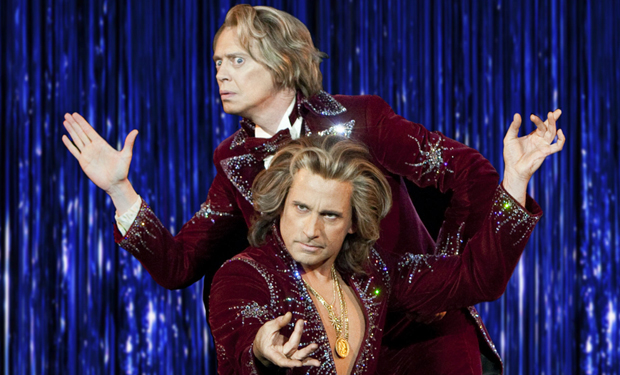
Not bad, not great, along the lines of Dodgeball, with a few good gags (in particular, Vegas magician Steve Carell freaking out 20 minutes after the start of his 7 day stunt stint in a box above The Strip).

This is a movie that answers the question: What would Michael Scott have been had he left Dunder Mifflin to become David Copperfield?

Two takeaways.

First, Jim Carrey plays Carell’s nemesis, and boy has he aged.  Cable Guy schtick doesn’t work so well from such a weatherbeaten vessel.

Second, I am a huge fan of Steve Buscemi.  He stood out in Miller’s Crossing, his dramatic work in Reservoir Dogs and Fargo was gritty, his season on The Sopranos was sublime, and his Nucky Thompson on Boardwalk Empire is rock solid.  But where did he get the reputation for comedic chops?  He’s been in 5 Adam Sandler vehicles, but having that on your resume’ isn’t exactly a recommendation.

Funny looking is not funny.

Tom Cruise plays a former military detective, a ghost drifter who is drawn into the role of lead investigator for the defense of an Iraq War sniper accused of a senseless shooting spree in Pittsburgh. As he digs deeper, he unravels the true motive for the killings and the web of intrigue surrounding them.

Jack Reacher is a competent thriller, and Cruise is convincing as a smart, tough ex-military hero. He exudes a certain intelligent menace despite his short stature (the Jim Grant books had him a lot bigger) and the story whips along. The bad guy, a disfigured Werner Herzog, is a treat, and the scene where he gives a man a chance to avoid execution is memorable.  There are also some sharp exchanges in the script which, if not Dirty Harry, is subversively conservative.

Still, the aim of the villains is weak (a construction company???); the late introduction of Robert Duvall as a sidekick for Cruise strains credulity; and the effort to mask the necessary killing in the cloak of a shooting spree is, upon reflection, wild overkill, the kind of gambit that would elicit the attention the bad guys sought to avoid.  These weaknesses are forgivable, but when Cruise drops his gun to go mano a mano with his nemesis, the film veers into Road House territory, if only for a moment.

Another from the factory of producer Judd Apatow, director Nicholas Stoller co-wrote the script with star Jason Segal, which tells the story of Segal and Emily Blunt, he a San Francisco chef and she a would-be psychology professor at the University of Michigan.  They fall in love but then endure the long stretch of pre-marriage, with its attendant insecurity, doldrums and misgiving.  While the stretch can be a little rough on the viewer, Blunt is charming and as he did in Forgetting Sarah Marshall and Get Him to the Greek, Stoller wisely populates the story with supporting characters who offer varied, funny bits.  In particular, David Paymer and Mimi Kennedy shine as Segal’s blunt, atypically private parents.  Alison Brie (Trudy from Mad Men) is also strong as Blunt’s happily married sister and she and Blunt pull off a hilarious conversation/confrontation in front of her young children in the guises of Elmo and The Cookie Monster, thus masking the seriousness of their subject matter.

Still, there are glaring problems.  Stoller and Segal over-rely on the easy laughs of adults using dirty words (though nothing quite so bad as Apatow’s embarrassing This is 40); the image of Segal’s bare ass or failing and/or harried while humping really isn’t all that funny; the replacement mates when Segal and Blunt break up (Rhys Ifans and Dakota Johnson) are gruesome, easy marks; and there’s nothing really new here.

There is also the problem of Segal, who is perhaps the only actor who makes Paul Rudd seem manly.  From his awful sitcom How I Met Your Mother to just about every film in which he’s carried the load, Segal is a tiny variation on the same persona – aw shucks, hapless, sweet and prone to self-pitying outburst.  Summed up, a huge pussy.  I’m happy to defer, but in a romantic comedy, he’s a natural best friend, not the lead.

It’s the height of audacity to incorporate your name into the title of your film. Imagine High Plains Clint or Reservoir Quentins? Eastwood and Tarantino aren’t exactly shrinking violets, but there are limits and there is etiquette.

Will Larroca dispenses with both in his sophomore feature, Will Will Kill.

The title not only suggests hubris, but an homage to Tarantino. He’s not quite there yet.

Still, this is leaps and bounds above Larroca’s first feature, The Monster. For several reasons.
First, The Monster provided us the chilling visage of Reid Brown as a crazed ghost. Here, he’s criminal mastermind Rico Brown, and he is again pretty damned chilling. Something about that shock of red hair makes it easy for you to put your guard down.

Second, the acting is generally first-rate, and Larroca smartly casts actors who look distinct.

Third, on a shoestring budget, I was impressed by the low-tech approach. It felt real. Visceral.

Finally, I was intrigued by the approach, derivative as it was.

Still, there are problems.

Why do Larroca’s characters always wear hoodies? Is this some kind of Trayvon Martin deal?

Why the finger in the camera? Is it amateurism or something else?

Why is Larroca’s vision of a clone-infested future so mundane? Is the future really as bad as all that? Does everyone wear shorts?

Why would a clone engage in a samurai fight with a hand in his pocket?

Who rides a train to Las Vegas?

Would Rico Brown really have a tag coming out of his shirt?

Again, the word is that Larroca is working with a bigger budget and should have a fall release of his third picture.

It better be special or he may go the way of David Caruso.

Another esteemed reviewer weighs in.

Image result for this is the end

The first third is sharp. Comic actor Jay Baruchel comes to LA to hang with his big star pal Seth Rogen and before long, they’re at a celebrity-studded party at James Franco’s house, where Michael Cera snorts coke and slaps Rhianna’s ass, Jason Segal tries to convey the pedestrian nature of his sitcom to Kevin Hart (Hart is genuinely cracked up by the scenario Segal bemoans), and Jonah Hill shows pictures of his new rescue dog, who is incontinent and doesn’t know how to bark.  There are scads of other notables revealed in their self-involved element, which is great fun when The Apocalypse begins and they are dispatched in hideous, hilarious fashion. Example: a gaping sinkhole takes stars galore to the fiery depths and as Aziz Ansari clings to the edge, Craig Robinson responds to his pleas with a cold calculation.

Unfortunately, the middle third, which features Baruchel, Rogen, Hill, Franco and Robinson holed up and survivalist, is ragged. Much of it feels like creaky improv, and the self-centeredness becomes tedious as the fellas bicker and crack under the strain.  There is a self-satisfied laziness, a “this is cracking us up, so that’s enough” vibe that bores. Andrew O’Hehir nailed it: “I’m all in favor of movie stars making jokes at their own expense, but an entire movie based on that premise starts to seem like a suspiciously large amount of upside-down vanity.”

You know you’re in the tall grass when an SNL bit about chewing food for someone else is shamelessly recycled. Worse, Danny McBride joins the group, his turn is singularly unfunny, and he compensates by cranking up the volume.

Luckily, McBride exits, Hill is possessed by a demon, and a laugh-out-loud exorcism gets the picture back on pace to its largely satisfying conclusion.  Good laughs, but wait for DVD and you’ll value it more.

The Last Stand is as formulaic as they come and is strangely populated by 5 characters sporting near-incomprehensible accents: Arnold Schwarzenegger (born in Thal, Styria, Austria), as a retired LA narcotics detective who is the sheriff of a small town on the Mexican border; Forest Whittaker (born in Longview, Texas), as the out-of-breath, over-salivating, beleaguered FBI agent who has lost a major cartel figure in an attempt to transfer him from Las Vegas to a super max prison; Eduardo Noriega (born in Santander, Cantabria, Spain), as that cartel figure, who is hurtling at 200 MPH in a tricked-out sports car, hoping to make the border; Peter Stormare (born in Arbrå, Gävleborgs län, Sweden), Noriega’s henchman, who is clearing the path for Noriega’s arrival by trying to kill Schwarzenegger and his motley crew of small town defenders (Stormare’s southern accent is hilarious, half ABBA, half Foghorn Leghorn); and Rodrigo Santoro (born in Rio de Janeiro, Brazil), one of those defenders, an Iraq and Afghanistan war veteran locked up on a drunk and disorderly, deputized to assist Schwarzenegger.

Since you can’t understand what most of the people are saying, the pedestrian script is mooted, leaving you free to enjoy director Kim Jee-Woon’s (born in Seoul, South Korea) impressive chase scenes and shoot ’em ups.

I’ve seen worse, and Schwarzegger maintains an irrepressible likeability that makes for an enjoyable ride.

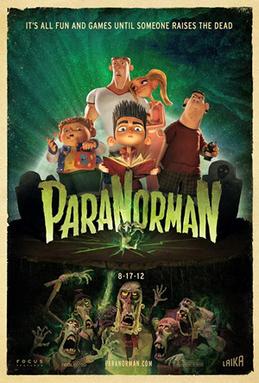
At its best, ParaNorman is a funny, clever and visually appealing stop-motion animated feature about a boy who must save his town from the emergence of zombies.  Unfortunately, the characters are a bit stock and thin (the zombies, who are cursed for having wrongly hung a witch back in the day, are the most realized of all the characters).  Worse, it bangs away “lessons” about bullying.  It also continues the recent trend of making almost all adults stupid, cruel and retrograde (Frankenweenie) and likening the world they have created to a gross, materialistic craphole (The Lorax, WALL-E, Happy Feet).

Mostly enjoyable, but the unsubtle p.c. preaching should stay in public schools where it belongs.