Archive

2 stars

Selma (film) - Wikipedia

Moving, didactic and unsurprising.  The film suffers from what I call the Milk syndrome, a heartfelt fealty to its subject so strong it obliterates any sense of authenticity.  Martin Luther King (David Oyelowo) is etched in marble, and marble is both beautiful and boring.  While the film is occasionally poignant, we are left with its one-dimensional hero, colorless acolytes (Coretta Scott King and everyone who works with King) and cartoonish villains (Tom Wilkinson’s LBJ and Dylan Baker’s Herbert Hoover are particularly ridiculous).

The film’s best moments come when King is not ennobled, but crafty, as when he explains to two Selma locals why he needs to elicit violent repression from the authorities for publicity purposes; King as tactician is just more interesting than King as emblem.

The worst moments come in quiet discussions, where the activists trade speeches littered with biblical passages and maxims like “eyes on the prize.” There are too many long sermons provided to educate an audience director-writer Ana DuVernay doesn’t trust (a conversation between Coretta and her husband about his infidelities has a reserved dignity that is otherworldly).

In a film punctuated by Oyelowo’s expert recitations of King’s actual speeches, the effect is tiresome.  The characters are in the middle of a pressure-cooker maelstrom, uncertain as to which road to take, hemmed in by any number of political and social forces, and beset by violence at any turn.  Yet, they are reduced to the roles of resolute and/or suffering nobles.  When one black man wants to go get his gun after the marchers have been brutally bloodied, he is met with a sermon on the foolhardiness of his instincts and its effect on their historic struggle.  After an ass-beating, it’s a rare man who can summon a soliloquy.

The film is beautifully photographed. Cinematographer Bradford Young (who, in A Most Violent Year, captured early 80s NYC) employs a lyrical, classic style he describes as a “period, Kodachrome-esque look.”  The effect creates memorable moments, some stunning.

But pretty isn’t enough.
image

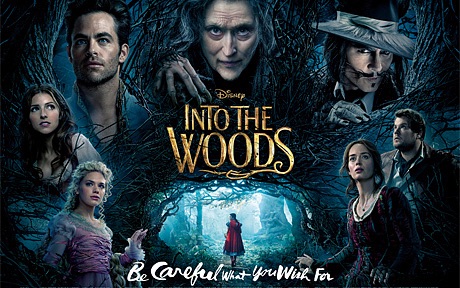
It can be clever, and the intersection of several fairy tales is occasionaly ingenious.  But there are no standout numbers (indeed, the movie appears to have cut the best song), and a musical rises or falls on its music.  The “Into the Woods” riff that snakes through the movie becomes tiresome, there are too few interesting exchanges between the characters, there is an entirely unnecessary and intrusive narration and the entire thing feels small.  It’s also not very funny, and from what I can see from the stage play, it’s supposed to be.

Though he’s been off his game of late, this project would have been better in the hands of Tim Burton.

Amazon.com: Snowpiercer: Movies & TV

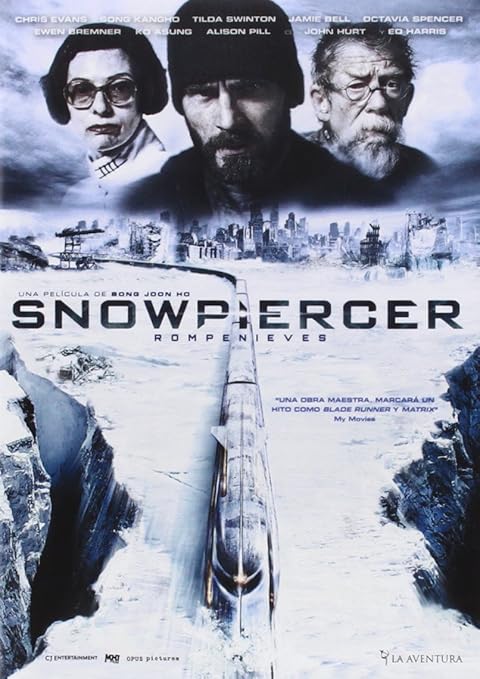
Mankind is threatened by global warming, and in an effort to turn the tide, introduces a cooling agent into the atmosphere. A deep freeze results and the only survivors live on a train run on perpetual motion that circles the earth, said train having been developed by a prescient bazillionaire (Ed Harris). The poor, led by Chris Evans (Captain America), eat mushy protein bars in the last car, while the rich are pampered with sushi, drugs, saunas and opulence in the front. Evans leads a revolt and the proletariat move from car to car to get control.

This is high concept, ambitious dystopia, but it is also unsubtle, mostly ridiculous, high concept dystopia, inadequately explained (a perpetual motion train?) and saddled with an unwieldy end (Harris shows up, like the wizard behind the curtain, to explain all). I’m all for ambition, but this is several trestles too far.

The film also contains a simplistic Have v. Have Nots political theme, which probably accounts for its appearance on so many top ten lists. For an example of the film tickling the right funny bone, one need go no further than The San Francisco Chronicle’s Mick LaSalle and his juvenile conclusion: “It’s a film that, in its own peculiar way, forces viewers to question their values and ask themselves how much they’re willing to sacrifice for a functioning society, and how much is too much.” If it takes the likes of Snowpiercer to force LaSalle to question his own values, I’m surprised he didn’t join a monastery after The Hunger Games.

The picture is also unwisely reliant on Evans, who lacks the gravitas of a dark, brooding action hero and the chops to handle the big, tortured soliloquy at the end. We’re supposed to be dazzled, but like most products of graphic novels, it’s a slick, empty endeavor with a few interesting parts. Tilda Swinton is also very funny as a bucktoothed toady for Harris.

Image result for Belle film

A promising period piece based on the true story of the illegitimate, black daughter (Gugu Mbatha-Raw) of a British naval officer, given to the care of his aunt and uncle (Tom Wilkinson and Emily Watson) as a child in the late 18th century. Dido Elizabeth Belle is raised with a foot in two worlds — with title, means (200 pounds a year) and support yet still divorced from full status (for example, she may not dine with the family when guests are present). Complicating matters is the fact that Wilkinson is the Earl of Mansfield and the Lord Chief Justice, deliberating over a fraud case in which slavers may have thrown their sickly human cargo overboard for the insurance proceeds.

The film is lush and has a Downton Abbey feel. Unfortunately, it’s about as subtle, anachronistic and schmaltzy as Downton Abbey.  Belle must contend with the easy racism of her time, racism represented by an odious, money grubbing family that includes scheming Miranda Richardson and her eldest son, Tom Felton (Draco Malfoy from The Harry Potter movies, who is really evil; you can tell because he was a member of Slytherin House and he sneers in every scene). Everything is spelled out for the audience, and there is no nuance to any character. Belle’s true love, played by Sam Reid, is the abolitionist son of a minister, so ardent and well-meaning you want to punch him. And as Wilkinson agonizes over his court decision and rails against the impudence of Reid, Watson reminds him that she once knew a young man who wanted to change the world.  Guess who that young man was?

The case at the heart of the picture is also decidedly and unnecessarily dull. So dull that in real life, the owners dropped the claim against the insurance company amidst a storm of bad publicity. Yet, the real Earl of Mansfield presided over a case much better suited to the film, that of a slave who had been brought to England, escaped, was caught and then was forced onto a ship bound for the West Indies. The slave owner argued his right over property, but the Earl set the slave free, judging that colony slave laws were of no force in England and concluding, “The state of slavery is so odious that nothing can be suffered to support it.”

Such an interesting life deserved a better picture.

After a promising start, this picture spins so wildly out of control it is almost impressive. Mild mannered Texas picture framer Richard Dane (Michael C. Hall) shoots a home intruder, earning the enmity of the intruder’s fresh out of prison father (Sam Shepard), but they soon learn there is something bigger than the both of them connected to the killing. The first half of director Jim Mickle’s movie is tense and effective. But then, the picture abruptly shifts course, veering into the implausible. Hall and Shepard improbably team up together with the assistance of Don Johnson as a Houston private investigator (Johnson delivers a jokey performance that undercuts the film’s dark feel) and we get a bit of a buddy movie. The awkward shift in tone is accompanied by nonsensical plot points and an ostentatiously arty, bloody end that utilizes slow motion and a synthesizer rich soundtrack reminiscent of The Terminator without a hint of irony.

Post Dexter, Hall is as good as he can be, but the writers give him absolutely no real reason to become a confederate with a man who not only threatened his life, but that of his wife and child. The critics gave this 85% on rottentomatoes.com while the audience posted a 69%. The audience got it right.

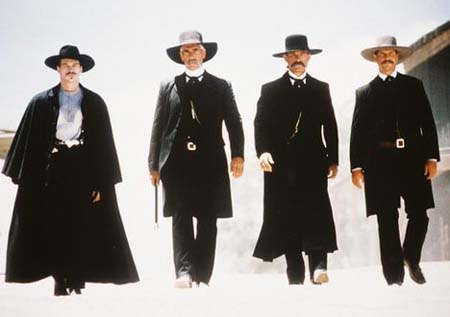
I only thought of this film because of Deadspin’s ode to Val Kilmer’s Doc Holliday, and on reflection, Kilmer’s performance is not only the best thing about this western, it’s the only good thing about it. Thus, to have one performance account for 2.5 stars – that’s really something. But Kilmer’s languid, dissipated Holliday is a treat to behold.  He is having a blast with the role, and while everyone else is somber or uncomfortable (or both), he chews and chews and chews.

Unfortunately, no one else (except perhaps Powers Boothe, who actually twirls his mustache as the evil leader of the redlegs, Curly Bill) is having any fun. The Earps (Kurt Russell, Sam Elliot, Bill Paxton) are dull as dishwater, particularly Russell as Wyatt, who decides that fury and blue eyes will see him through.  The villains, and there are scads of them from any number of sitcoms, look like they’re at cowboy camp. In fact, this whole movie has a certain slipshod, Eagles photo-shoot for Desperado quality to it.

The women are weak as well. As Kilmer’s moll, Joanna Pacula is just a hair shy of the cartoon Natasha, and Dana Delaney as Wyatt’s love interest lacks the lustful lure necessary to break down a rigid lawman. Delaney is a school marm, not a vamp; she doesn’t sizzle so much as reach room temperature.

Director George Cosmatos’ best efforts besides this leaden dog are Stallone vehicles, Cobra and Rambo: First Blood Part II. After Tombstone, he got one more feature (a Charlie Sheen vehicle) and that was that (he died in 2005). After Tombstone, which is a pedestrian, forgettable, script, writer Kevin Jarre penned The Devil’s Own and The Mummy and, again, that was that.

But oh what Kilmer does with what he’s given:

The charms of the character are legion.  As explained by Kilmer in a recent interview:

So Bob Dylan loves “Tombstone”, It turns out. I found out he was in New York so I called my friend and I said you know, I’d love to meet him, is there any chance and he says, “I don’t know, I’ll find out.” And the next call I got I thought was going to be my friend, but it wasn’t, it was Bob.

I was real excited, like a crazy fan, like a child; it was so great. Basically it was like nothing. It was like we were old friends, it was like “you want to come over?” and he was like, “yeah.” So, hangs up the phone, I was newly married and we had a baby and I went in and said “I think Bob Dylan’s coming over…I’m not sure, it could be a hoax…” 

He shows up and sits down and he wants to talk about “Tombstone”, but I just can’t, you know, nor can I talk about any of his stuff. Eventually he says, ‘ain’t you going to say anything about that movie?’ and I said, “do some ‘Blowing in the Wind’ and I’ll…” 

That’s what I said to him, basically I said no. I get like that sometimes. So I turned him down and, I thought, no one turns this guy down. Anyway, I felt like an idiot afterwards, well, yeah I could have said a few lines. They’re fun lines too, like people still ask me to say lines and now I’ll tell any schmo in the airport, I’ll say “I’m your huckleberry”, but I wouldn’t say it Bob Dylan! 

I felt so bad about it. I was like how could I make it up to him? So what I did was, I recorded “It’s Alright Ma, I’m Only Bleeding” but as Doc Holiday and I put in all of the big lines from the movie into the song and made him a little tape

Image result for barton fink

There’s not a scene in this Coen Brothers film I don’t like, and the story of a Clifford Odets-esque playwright’s (John Turtorro) introduction to the oily world of Hollywood is both visually striking and thematically ambitious.  But no matter the film’s look or intriguing interpretations (the mind of the writer, the dangers of solitude, the corruption of money), by the end, you feel trifled with, as if you watched a parlor trick perpetrated by a cast of broad, comic actors (John Goodman, John Mahoney, Michael Lerner) for no greater purpose than the goof.  Like The Hudsucker Proxy and Miller’s Crossing, Barton Fink has its joys, but the feel is sterile and your investment unrewarded.

300, but with less homoerotic tension, thanks in part to the contributions of Eva Green, a vicious, smoldering twist of an invader, who turns in one of the more ridiculous yet strangely intoxicating love scenes in the history of cinema. Before and after this scene, it’s just a lot of slo-mo spears and swords, a comic-book Spartacus-meets-Gold’s Gym.

On reflection, Eva Green’s mating style is remarkably similar in Dark Shadows:

dark shadows johnny depp gif | WiffleGif

Robert Altman’s send-up of Hollywood process and morality opens with an audacious 7 minute, no-cut scene that is a primer on economical, fluid exposition. We meet most of our characters, including the studio’s no. 2, the writer’s executive, Griffin Mill (Tim Robbins), and the tone is set.  Unfortunately, Altman cannot fulfill the promise of his introduction. Robbins’s star is falling and he is also being threatened via postcard by a writer he has brushed off. Unnerved, he sets up a meet with who he believes to be his stalker, accidentally kills him and then falls in love with the writer’s girlfriend (Greta Scacchi). The murder is implausible and the heat-of-the-moment relationship unconvincing (a love scene with Robbins and Scaachi is not so much hot as uncomfortable). Robbins is way too mannered and standoffish to elicit empathy, and the film swerves artlessly from suspenseful to broadly comic (Whoopi Goldberg is very funny as the investigating detective, but she’s too funny).

On the plus sides, we are treated to a whirlwind tour of LA, and Altman makes sure it is populated by just about every star, young or old, he can get his hands on. Also, the lingo of the pitch meetings can be very funny:

“It’s a TV star who goes on a safari.”

“A TV star in a motion picture?”

“A TV star played by a movie star.”

“A movie star playing a TV star.”

“Michelle, Bette, Lily.”

“Dolly Parton would be good.”

“I like Goldie.”

“Great, because we have a relationship.”

“Goldie goes to Africa.”

“She’s found by this tribe.”

“- of small people.”

“She’s found and they worship her.”

“It’s like The Gods Must Be Crazy.”

“except the coke bottle is an actress.”

“Right. It’s Out of Africa.”

“meets Pretty Woman.”

Still, the script is rather gentle on the town, and it never really succeeds as a thriller or a satire. In fact, the movie could have been done without any reference to the murder at all, which, ultimately, drags it down. The Player falls into the category of Movies You Thought Were Better at the Time (Altman was nominated as Best Director, as was Michael Tolkin for the script)

Shorter than The Wolf of Wall Street by 41 minutes, David O. Russell’s American Hustle felt longer and more ridiculous by a good stretch. Loosely based on the Abscam bribery stings of the late 1970s, Russell introduces four purportedly colorful characters: portly, combed-over con man Christian Bale; his sexy mistress and partner in crime Amy Adams; his loony wife Jennifer Lawrence; and a hyper aggressive, curly headed FBI agent Bradley Cooper. Cooper nails Bale and Adams, forces them to entrap others (including Jeremy Renner, as a New Jersey mayor desperate for development funds), a love triangle ensues, and after countless zooms, swift pans and other frenetic camera shots utilized primarily to divert our attention from the banal, repetitive script, we reach a tacked on and unconvincing resolution.

The closest thing to a character is Bale, and his performance is the only reason to see the picture. Unfortunately, he plays a man desperately juggling knives, and it feels as if he’s doing just that masking this thin script. Lawrence plays a decent wacky shrew, and the soundtrack has a few fun numbers from the 70s (I’ve always been a sucker for Steely Dan’s Dirty Work). That’s all of the good.

The bad is really bad, starting first with the preposterous characters played by Adams and Cooper. Unlike with Bale, Russell (who co-wrote) doesn’t bother to give us any sense of where these two came from. She is an impossibly sensuous cypher, in a 70s Enjoli perfume commercial sort of way. Cooper is so manic it suggests severe chemical imbalance, as if his character in Russell’s Silver Linings Playbook got a job in law enforcement. While these two concoctions flirt, and even disco dance (because this is the 70s), the aimless story plods along.

There are other problems. Who could keep a mere fraudster imprisoned for three days without access to a lawyer just to soften her up? Why would you cast Louis C.K. in a supporting role when he’s already demonstrated in one of his sitcom episodes the silliness of having stand-up comics dramatically act? How can a script this talky lack one memorable exchange? Where is this fucking film going and will it never end? Why is Lawrence singing “Live and Let Die” to the camera as she dusts? Does Russell really think he can get by on stealing that Paul Thomas Anderson trick and his camera work, kitschy 70s fashion and hairdos, a few well chosen tunes and the same cast from his last two films?

The answer to the last question is a 93% rating on rottentomatoes and 10 Oscar nominations. Only two are deserved: Bale and Hair.