Archive

1 star

This critically-acclaimed 2011 release purports to be a psychological study of its protagonist, Martha (Elizabeth Olsen), who becomes a member of an upstate New York commune/cult led by the charismatic John Hawkes (nominated for an Academy Award for his role in Winter’s Bone).   The film opens with Martha’s escaping the collective farm, though Hawkes and the other members of the commune (a motley assortment of women who serve him and a few young men) don’t do very much to stop her flight.  Martha ends up 3 hours away, at the Connecticut lake home of her wealthy sister and her new husband.  There, we learn of her ordeal through flashback (sexual abuse, violence, co-opting and subordination to the whole) while she struggles to adapt to life outside the cult.  She provides tension to her sister’s household as she brings bad habits from the commune with her (swimming nude, curling up in the bed of her sister and brother-in-law while they are having sex, condescending to them about their lifestyle) and undergoes post-traumatic stress that manifests itself in panic attacks, wetting herself and refusal to discuss what happened.

All of which makes for a frustratingly monotone of a movie.  Martha is treated with such sensitivity by her sister that you sympathize most with the husband, who has to endure a recalcitrant, moody weirdo in his midst without anyone ever saying, “What the hell happened?”  Worse, while it is clear that Martha undergoes trauma, her behavior after she endures it suggests a person who was under the sway of the commune since childhood.  In fact, Martha was there for two years.  Also, the key to a psychological study is an explication of why Martha was lured into the life, but we get no clue as to what Martha was looking for when she voluntarily allowed herself to be part of Hawkes’ crew and scant information on what the cult is really about.  Martha seemed shallow and dull in flashback and during present-day, she seems shallow, dull and jittery.  Moreover, Martha says some very terrible things about and to her sister (“You’re going to be a terrible mother”), who has the patience of Job, suggesting she was a first-class turd even before she went to the commune.  This is not conducive to empathy.  Finally, the picture reveals a Manson-esque quality to Hawkes very late, which is awkward and unconvincing.

Another problem is Olsen’s performance.  Yes, she does better work than her sisters ever did on television’s “Full House”, but it is still a one-note, amateurish turn.

The Bone Collector is a thriller about a police detective (Denzel Washington) who is paralyzed.  Unfortunately for New York City, a serial killer is on the loose and there is nothing Denzel can do except mentor a rookie cop during the investigation.  The killer dwells in the NYC subway system, so naturally, the rookie cop must be sent in its bowels, with an earpiece and camera, allowing the bedridden Washington to see what she sees and thus guide her.

As implausible as that may seem, try this on for size – the rookie cop is Angelina Jolie.

Those lips, those cheekbones, that gun!
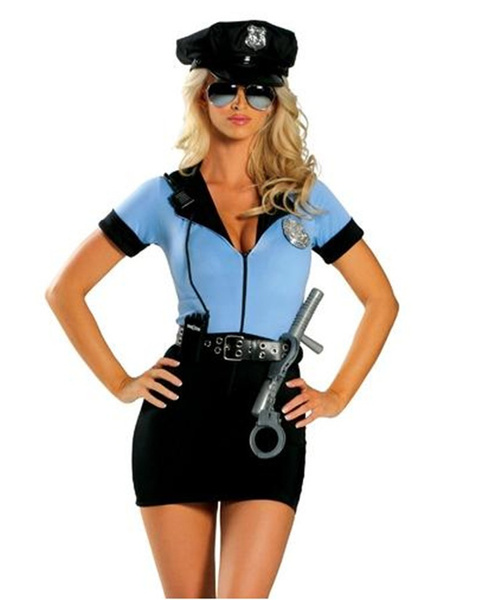
The choice was so inept that the scriptwriter actually wrote in the fact that she is an ex-model.  You half expect her to start disrobing, ala’

Blues, cop, Fashion, Cosplay

Truly, Jolie’s character should set the teeth of all modern womanhood on edge.  When she cries, all the men pat her on the back and tell her she is “terrific” (in fact, Mike McGlone and Denzel Washington actually call her “terrific” within 10 minutes of each other).  And then she bucks up with a pretty smile.  When she is upset, she huffs off the job, although she is a beat cop.  But then the men drop by to see if she is “all right.”

For some reason (and I am guessing “those lips, those cheekbones!”) the men don’t say, “Hey. Where the hell are you going, you piece of sh**.”

Anyone with a rudimentary knowledge of movies and a brain stem will have this figured out in a jif.  That said, New York City is very spooky in this film.  It gave me that same creepy, flesh crawl I felt in “Ghostbusters II.”  Hence the single star.

Matthew McConaughey plays a smarmy, slick, charming southern lawyer . . . in every single movie he makes.  He does it again here, inexplicably drawling his way through a role as a hotshot Los Angeles criminal attorney retained to defend Ryan Phillipe, a rich boy accused of a brutal rape.

The entire film rests on selling you the real possibility that Phillipe is innocent.  And there is not one moment when you believe that Phillipe is innocent.

Look at him.  Guilty, guilty, guilty.

Now that the story is hosed, we’re left with McConaughey’s schtick, a motley crew of character actors without character (dewy-eyed Marisa Tomei, as McConaughey’s ex-wife prosecutor; tough old cop Bryan Cranston; hippie P.I. William H. Macy; and the peripatetic bondsman John Leguizamo) and “twists” so implausible that Director Brad Furman must have assumed the audience had checked out by the time of the reveals.

1.  The Patriot‘s director, German born Roland Emmerich, is not quite a hack of Renny Harlin’s status, but his resume’ is filled with a boatload of crappy, excessive, ludicrous films such as 201210,000 BC, The Day After TomorrowGodzillaIndependence Dayand Universal Soldier.  And The Patriot.

2.  The Patriot is a revenge movie set during The Revolutionary War.  Revenge movies are fine.  But a revenge movie fails if the person upon whom revenge must be visited is blase’ about his own life or death.  In The Patriot, the villain (a British officer played by Harry Potter baddie Jason Isaacs) is a vicious killing machine with no desire to live other than to burn women and children alive.  So, short of having his skin peeled off, there can be no satisfaction in his demise.  And there is none.  Which, in the words of Donald Rumsfeld, makes this a very long, hard slog.

3.  The Patriot veers wildly from the manipulative (excess depictions of crying and/or dying children) to the sitcomish (Saving Private Ryan screenwriter Robert Rodat  uses tension-breaking quips between men-in-war and then expands them into broad cartoonish gag scenes worthy of “The Jeffersons”) to near-spoofs of beer commercials (the slow-motion as men high-five after winning the big battle is missing only the bosomy blondes and frothy pitchers of ale, and the scene where Gibson gets romantic with Joely Richardson is a replica of Corona commercials).

4.  The best part of the movie is when Gibson appears heroically, flag in hand, and all the militia scream “Huzzah!” but it sounds exactly like “Wazzzzzzzzzuuuuuuuuup!”

5.  The Patriot is predictable.  If you don’t know whose life the stoic black-man-fighting for his freedom will save; if you don’t know that the moment Gibson gives his daughter-in-law a necklace, it is proof of her death; if you don’t know the “trick” played on the Brits to gain the release of American militia; if you don’t know the fate of a warship off in the distance as the Brits live the high-life and General Cornwallis (Tom Wilkinson moans about his less-than-spectacular uniform), you are not very observant.

6  There are a few historical inaccuracies.  My favorite is the use of exploding cannonballs.  They hadn’t been invented yet, but you can just see Emmerich screaming “I vant it BIGGER!!!!!!”  And when Isaacs character burns an entire church filled with women and children, based on an incident from World War II when Nazi soldiers burned a group of French villagers alive, I’m sure Emmerich was there screaming, ‘I vant him MEANER!!!!!!”.

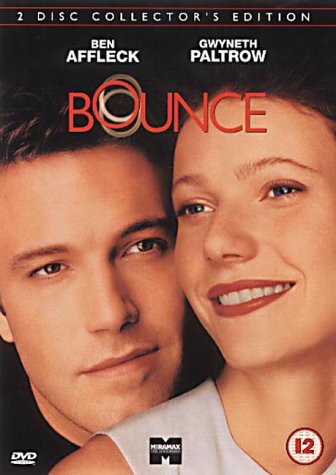
Bounce (2000) - IMDb

In 1998, Don Roos came out of the gate with The Opposite of Sex, one of the funnier comedies of the 1990s.  As a reward, he got to helm a big budget romance with a promising story.  A playboy gives his plane ticket to a husband/father so the husband/father can be a good Dad and the playboy can make a girl at the airport bar.  The plane goes down.  The playboy is affected and insinuates himself into the widow’s life.

First problems first.  The playboy is Ben Affleck.  Affleck has found his way as a director (Gone Baby Gone and The Town are excellent and fine, respectively). When acting, however, he is best in an ensemble – a little goes a long way.  But Bounce came out when they were trying to make Affleck a lead, which he is not.  He is a leaden, two-trick pony (the eyes welling with tears; the set jaw).  Affleck is the best friend, not the lead.  He can occasionally rise to the occasion, but he is no more than a big, good-looking light-stepper.

Paltrow, who prior to her strange incarnation as a country singer, could lead, is weighed down by a script that requires her to lament and panic at almost every turn.  She is less and less sympathetic as she veers into the territory of mentally unbalanced.  Perhaps this is because she is being stalked by Affleck, who has decided to change his debauched ways on the back of the husband’s death.  The effect is creepy and doesn’t lend itself to a love story.

The World Is Not Enough is the worst James Bond film ever made, worse than even late bad-fashion, Roger Moore duds A View To a Kill or Octopussy .  As camp and aged as Moore became at the end, Pierce Brosnan proved to be something worse – tedious.  He’s got two moves: a smirk and grim displeasure.

Still, Bond films are rarely deep character studies, so how hard can one be on Brosnan?  At least we get beautiful sights, jaw-dropping stunts, good gadgets, a certain clever patter, Bond’s ingenuity, gorgeous women and intriguing villains with grand designs.

The World Is Not Enough has none of these things.  It is set almost exclusively in the drab former Soviet Union (see exciting Azerbaijan and Kazakhstan!); the stunts are pedestrian (another ski chase, a ho hum boat chase, more travel in an oil pipeline); the gadgets are routine (Bond can make his car come to him like a dog); the repartee’ is awful; and, worst of all, Bond is no longer ingenious – most things just drop into his lucky lap.

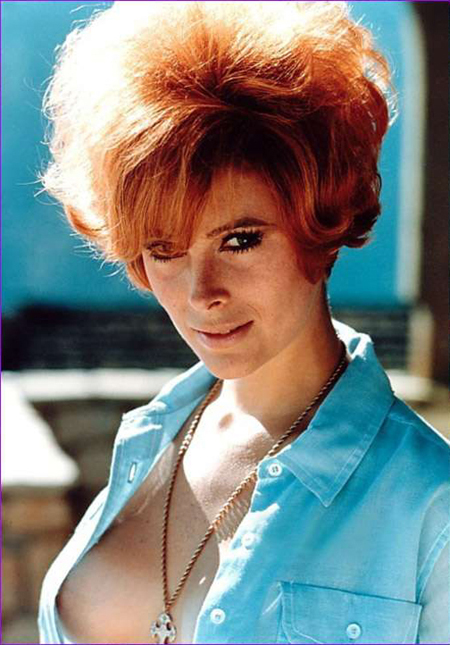
Unforgivably, the women are forgettable.  Sophie Marceau is grim and Denise Richards is so ridiculously Charlie’s Angels, she holds no interest – where the hell are Jill St. John and Barbara Carrera when we need them?

Now, that’s a Bond girl.

The villains have no design, other than financial mixed with some revenge (almost as bad as in Goldeneye, when the whole movie centered around Jonathan Pryce getting tv rights in China).  Worse, the picture is accompanied by a relentlessly cheezy Bond theme-meets-drum machine.

Finally, Bond is again emotionally involved with a woman (that’s two out of four for Brosnan), adding to the tiresome nature of the whole thing.  Bond’s attachment to a woman is rarely a good sign, On Her Majesty’s Secret Service notwithstanding.

Brosnan played the part one more time after The World Is Not Enough, demonstrating even more urgently that the Bond series needed a new face.  I had urged Jeremy Northam or Clive Owen, but the franchise knew better when it tapped Daniel Craig.

Stanley Kubrick’s last film opens with an affluent married couple – Tom Cruise, a doctor, and his wife, Nicole Kidman  – at a Christmas Party, during which he flirts with two models (and later revives the host’s prostitute girlfriend, who has overdosed) .  Meanwhile, Kidman gets tipsy in the hands of a mysterious foreigner who does his damndest to get her away for a quickie.  The experience leads to a later conversation, during which Kidman gets stoned and cruelly informs Cruise that she once was so overcome by desire for a stranger that she would have given away everything – husband, child, life – to be with the man.  Cruise is destabilized.  Stunned, he walks the streets of New York, bouncing from sexual odyssey to sexual odyssey.

Kubrick had no business making a film about modern sexual issues.  Having read a “Vanity Fair” piece on Kubrick shortly after his death, his disconnection with his subject matter is no mystery.  He appeared to have been a semi-recluse with no social skills, much less any romantic experience.  I was reminded of the incongruity of presumably celibate Catholic priests who advise young parishioners on marital issues.  Including sex.

Cruise and Kidman are like some 1950s couple dressed in 90s clothes.  After his wife’s revelation, Cruise is menaced by the recurring image of her being ravished by the stranger, as if a wife sharing her fantasy with her husband is some great cataclysm.  Yet, Cruise is strangely immune to the manner in which Kidman mocks and taunts him with her fantasy.  Her cold and unloving manner – she roils on the floor pointing at Cruise, doing her level best to castrate him with her secret – appears to be no problem for Cruise.  Rather, it is the image of someone sleeping with his wife that drives him batty.  As for Kidman, she’s just mean and icy. 

Then there is the plot, which is non-existent, thus making for a droning, tedious ride. Cruise does his best with what he’s given, and he is particularly effective early, when he performs the minuet of explaining to his wife why he would never bed the two models. She summarily shreds his rationale.  Kidman, however, is consistently awful throughout, forced to play drunk at the party, stoned during her humiliation of Cruise, and then, in a completely over-the-top bit, frightened by a sexual dream she experienced.  She hits all the wrong chords, her drunk being sloppy, her stoner being vicious, and her post-dream persona annoyingly overwrought.   This is a performance ruined by bad choices.

Kubrick’s other forays into the pastiche of modern sexuality are laughable.  The man who would get Kidman away for a tryst at the Christmas Party is an unintentionally hilarious Hungarian.  Any minute, you expect him to say, “I vant to suck your blood.”  Prostitutes who entice Cruise from NYC streets are Kate Moss hot, with hearts of gold to boot.  The famed orgy scene is chortle inducing (everyone wears goofy yet frightening masks).  I’ve seen more effective soft core on late night Showtime.

“ARE THERE ANY SNACKS AT THIS ORGY?”

If you were not inclined to laugh at certain parts, the film is accompanied by perhaps the most distracting soundtrack ever scored – a single note piano plinking that can destroy even the most stoic.

Visually, Kubrick is painfully reliant on one trick in his bag – an endlessly repetitive floating tracking shot.  On the plus side, he does make a passable New York City out of London.   But this was a bad way to go out. 

Image result for Hugo Scorsese

It won a slew of technical Oscars and was nominated for best picture, and it looks good. But it is  a long, hard slog. I’m certain there were quite a few kids who came out of this one realizing that 3-D ain’t all that.  I nodded off more than once. When I awoke, I was greeted with the same mundane dialogue and plodding story.

Martin Scorsese makes a Parisian train station the center of this “magical” tale of an orphan, a secret, and the movies, but after the magic of the imagery wears off, you’re still left with two hours of cloying depictions of the inhabitants of the station.

You’re also stuck with two of the least interesting child actors in film history.

This is the kind of children’s movie certain parents would love their children to love, along with trans-fatless cookies.  I’ll take Puss and Boots and Oreos any day.

The movie starts off trying your patience with an overlong introduction of clarinet music and scenes of modern Paris. We are then introduced to American screenwriter Owen Wilson and his nagging, dispiriting fiancee, Rachel McAdams. Wilson is nervous and nasally and a noodge. McAdams is flat out hostile to Wilson. The idea that these two would ever be engaged is absurd. I kid you not, McAdams says to Wilson, “You always take the side of the help.” So, Wilson is married to a monster, doesn’t seem to know it, and yet, Allen wants us to care about him.

Worse, McAdams travels with her ugly American parents, who are (gasp) Republicans, distrustful of the French and country club obnoxious.

Allen makes the modern so unpleasant you can’t wait for Wilson to be transported to the 1920s. Sadly, we have to go to the 1920s with Wilson. And he’s doing Woody Allen, but whinier. He meets F. Scott Fitzgerald, Cole Porter, Ernest Hemingway, Salvador Dali, and Gertrude Stein says, “I was just telling Pablo . . .”

The greats are condescending, self-satisfied characters and they lord their superiority over all. Allen does the same thing, hiding it in his puny, nebbish persona, so his portrayal of them makes sense.

This movie is terrible. Perhaps Allen can still make a good picture. Match Point (2005) was a revelation and Vicky Christina Barcelona (2008) was charming, but he’s about done, and the nomination of this movie as best picture is ridiculous. The nomination as best screenplay is an affront. Perhaps Allen’s digs at Bush and The Tea Party explain it, but if not, and the Academy wanted to give him an unwarranted accolade, isn’t that why the Irving Thalberg award was created?

Some gems: “How long have you been dating Picasso. I can’t believe I’m saying that.”

Hemingway: “Have you ever shot a charging lion . . . Who wants to fight!”

“I wouldn’t call my babbling poetic, though I was on a roll there.”

“500 francs for a Matisse? I wouldn’t mind getting five or six.”

“The present is unsatisfying because life is unsatisfying.”

Yeesh.

There are some funny moments when Wilson lapses into Seinfeldian chatter and the folks from the 1920s look at him funny. Adrien Brody is a hoot as Dali. The movie is also very pretty.

That’s not enough, notwithstanding the Academy and a 93% rating on Rotten Tomatoes.

John Frankenheimer’s Ronin was a primer on film car chases, equaling William Friedken’s set pieces in The French Connection and To Live and Die in L.A. and surpassing Peter Yates in Bullitt (though, The Seven Ups has the best car chase scene in film history).

In James Foley’s The Corruptor, you can see the worst car chase in all of film, a 25 mile per hour snorefest through the alleys of NYC’s Chinatown. One straight line, very low speed, back and forth, back and forth. One Adam 12 had wilder high speed pursuits.

The “chase” is indicative of Foley’s ineptitude with the action genre (Foley’s best work has been in the non-action category – Glengarry Glen Ross and After Dark, My Sweet. His principals – Mark Wahlberg and Yun Fat Chow – kill everyone in sight with handguns, loaded by their inexhaustible supply of clips. And if you are firing at Wahlberg or Chow with a machine gun, you will miss, but you will also break a lot of glass. Indeed, the opening action sequence is a shootout in a lamp and ceramic store.

So, the action is ham-handed and sadly, the script sucks. In a nutshell: Old vet meets young rookie, who has been assigned to Chinatown. Old vet tells young rookie, “You don’t change Chinatown. It changes you.” Or something like that, because Chow’s English is a little iffy, so the line may come across as follow: “Ru don chanse Chintown. It chanses ru.” Thereafter, we hear the patented “dow, dow, ding” of Chinese massage parlor music.

Chow’s principal strength is the ability to make his eyes go all crazy just before he’s about to shoot a bunch of guys.

Wahlberg, who can be effective when leashed very tight, merely sleepwalks through this muddle.