Archive

Romance

With only five films to his credit (Metropolitan, Barcelona, The Last Days of Disco, Damsels in Distress, Love & Friendship) and all but one of them in the same milieu (upper class young people in comedies of manners), Whit Stillman is overlooked in discussions of  great American filmmakers who are still working.  This despite the fact that Stillman has written and directed all five of his films, and all have been critically acclaimed.  

Barcelona, Stillman’s second picture, reprises two actors from Metropolitan as different characters.  Taylor Nichols plays Ted, a neurotic salesman in 1980s Barcelona. Chris Eigeman plays his cousin, Fred, a naval officer and freeloader sent ahead of the Sixth Fleet in the midst of a wave of anti-Americanism.  Both negotiate their acrimonious relationship, borne of childhood injuries inflicted by Eigeman, a truly obnoxious sort who as a visitor begins to stink after a day (unlike, as Nichols observes, the fish who takes three).  They discuss religion, women, anti-Americanism, sales, history and shaving, all the while falling in and out and in love with various Catalan women.

Nobody writes quite like Stillman. His dialogue is distinct and erudite, but his characters have such a surface forthrightness that what could seem contrived comes out as wholly honest and fresh. Stillman is particularly impressive in presenting a funny, incisive culture clash between the mildly ugly Americans and the bemused, mildly antagonistic Spanish. Both treat each other as curious, and even hostile interactions over politics are amusing and revealing.

Again, Stillman has no bad films on his resume’,  a rare honor.  Paul Thomas Anderson comes close. Though the second half of Magnolia is bad, the sheer perfection of the first half of that film and its overall audacity generally gets him a pass, but The Master is a long, very hard slog.  Scorsese is a great, but Gangs of New York and Shutter Island are very, very bad films, and his later sycophantic rock documentaries are downright embarrassing.  Coppola has some late career dreck (Jack, The Rainmaker) and have you even heard of his last three efforts (Youth Without Youth, Tetro, Twixt)?  Eastwood has his share of humdrum work (J. Edgar, Bloodwork, Space Cowboys).  Try as I might to suggest otherwise, Wes Anderson’s The Life Aquatic is haphazard at best.  Even the Coens, David Fincher, Gus van Sant, David O. Russell, Richard Linklater, and Steve Soderbergh have at least one dog (see A Serious Man, Alien3, Psycho, I Heart Huckabees, Bad News Bears, Solaris).

Woody Allen is closer to Stillman in style but Allen also makes some really horrific pictures (less so now that he’s not acting in them as much), redeeming himself with a great surprise just when you’ve written him off.  Take this list of Allen movies – Hollywood Ending (2002), Anything Else (2003) and Melinda and Melinda (2004).  All pretty bad.  Ballgame, right?  But then, Allen offers a smart Hitchcockian crime movie, Match Point (2005), and he is resurrected.  Two more sh** sandwiches follow in 2006 and 2007 (Scoop, Cassandra’s Dream), but in 2008, Allen comes off the canvas again with the charming and seductive Vicky Christina Barcelona.  And last year, after another pair of clunkers (Whatever Works, You Will Meet a Tall Dark Stranger), the best original screenplay Oscar goes to Allen for Midnight in Paris, a movie I hated, but I defer to the Academy. 

Stillman deserves better.
Broadcast News - Rotten Tomatoes

James L. Brooks has the ability to make you laugh out loud just before he brings a tear to your eye, a skill he has honed in Terms of Endearment and As Good as It Gets. His missteps (How Do You Know, Spanglish) still contain very funny dialogue, even if the whole doesn’t work.  But to be fair to Brooks, Paul Rudd, Reese Witherspooon, Adam Sandler and Tea Leone are not very formidable substitutes for Jack Nicholson, Shirley MacLaine, and Debra Winger.

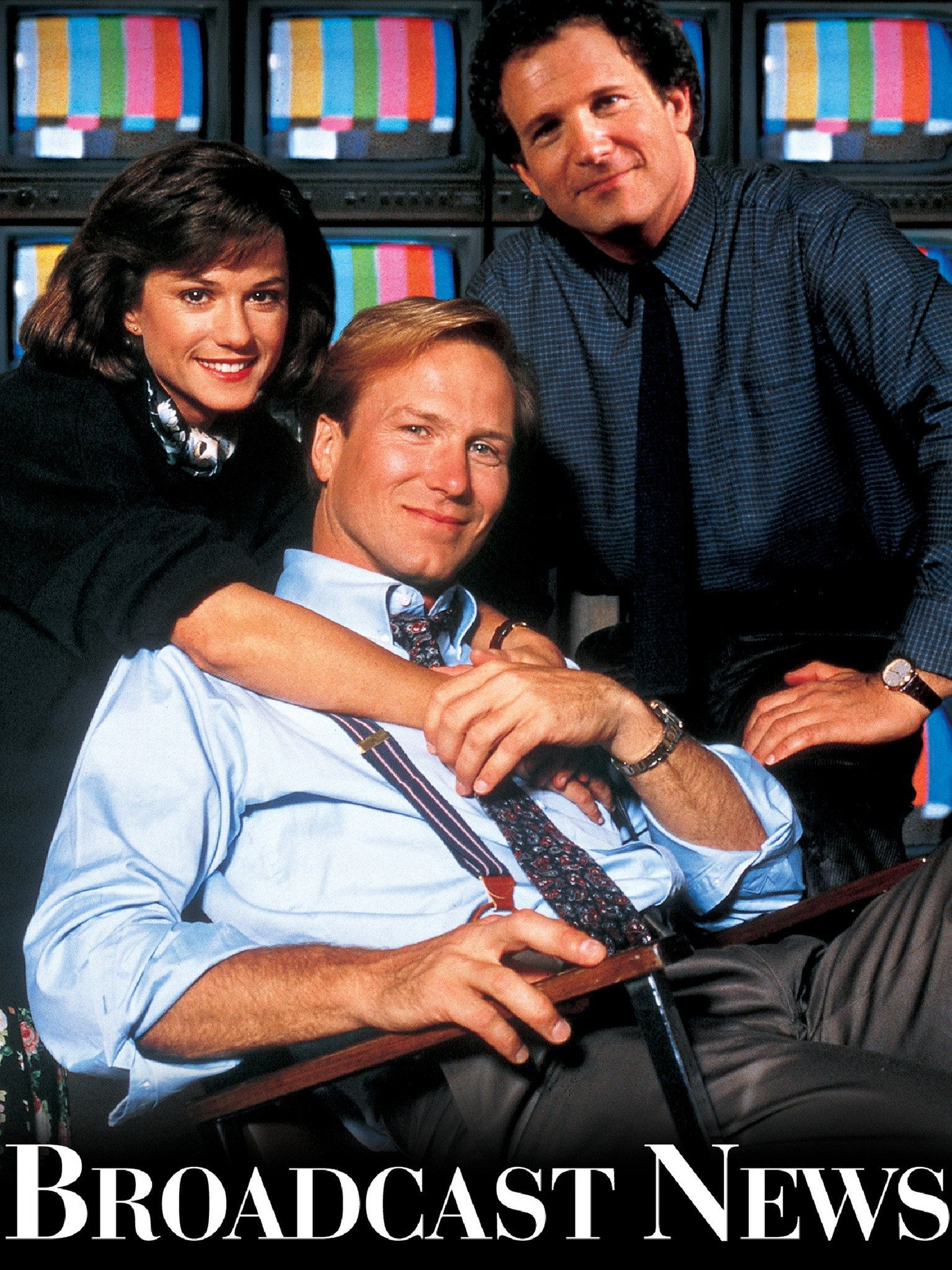
In Broadcast News, Brooks melds a love triangle with a story about journalism and ethics that is prescient.  Holly Hunter is the producer of the Washington bureau of a major news network, Albert Brooks is a gifted but un-telegenic correspondent, and William Hurt is the new up-and-coming golden-boy, groomed to replace the current anchor (Jack Nicholson, in a hilarious cameo).  Hurt is attractive but shallow (as Brooks says, he is against everything Hunter is about).  But Hurt is also sweet and in his own way, genuine.  He fancies Hunter and when Brooks tries to anchor the weekend news in an effort to save his job, Hurt is there, giving him advice, some of which is excellent (“punch” a thought in each sentence) and some of which makes Brooks very uncomfortable (“Just remember that you’re not just reading the news, you’re narrating it. Everybody has to sell a little. You’re selling them this idea of you, you know, you’re sort of saying, trust me I’m, um, credible. So when you feel yourself just reading, stop! Start selling a little”).  Hunter becomes infatuated with Hurt, and as they grow closer, Brooks professes his long love for Hunter and reveals the ethical threat that is Hurt.

The picture is loaded with crisp, witty dialogue, and at its best, it evokes the great Grant/Stewart/Tracy v. Hepburn romantic comedies. The picture also injects something of substance (the deterioration of the news), not with the acid cynicism of Network, but gently, so as not to get in the way of the story and humor.

There is also great physical comedy, provided by Joan Cusack as a gawky assistant producer, and Brooks, who endures the great humiliation of flopsweat during his shot at anchor.  The scene is one of the funniest in film history.

The movie has one problem, but it is a big one.  Holly Hunter is so mannered and quirky that you simply cannot understand Hurt’s attraction to her, much less that of Brooks. Sure, the good looking neophyte might be intrigued by the neurotic but fascinating “other” ala’ Robert Redford and Barbra Streisand in The Way We Were.  But Hunter takes “odd” up several notches, and in many scenes, her facial expressions approximate her work in the live cartoon Raising Arizona.  Her temper is also so volcanic as to suggest mental illness.

Certain lines cannot be crossed in a romantic comedy.  I was reminded of the awful Hugh Grant-Sandra Bullock vehicle Two Weeks Notice, wherein Bullock has an attack of diarrhea on the highway and Grant has to commandeer a stranger’s RV so she can relieve herself.  This may work for Will Ferrell and Zach Galifinakis.  But no romantic lead can be shown in such an unflattering light.  Hunter does not sink to such depths here, but her portrayal does border on the grotesque and it detracts.

There is also the weakness of the import of Hurt’s great journalistic sin (he recreates a moment of emotion in an interview) .  There is no question – the act was unethical.  But in the context of some of the other stagey and easy shortcuts engaged in by Hunter and Albert Brooks, their high dudgeon (which is critical to the picture) rings hollow, and the film never gives them a comeuppance on this point other than Hurt’s rebuttal to Hunter after she accuses him of crossing the line — “It’s hard not to cross it.  They keep moving that little sucker, don’t they.”

Romantic.  Comedy.  Can one be successful with only a little bit of both?  The Jennifer Aniston-Vince Vaughn vehicle, The Breakup (2006), fell into the category, as it depicted the deterioration of a relationship primarily built on convenience and a shared apartment.  The scenes between Vaughn and Aniston were so arch and cringe-inducing you wondered, ‘where the hell is the ‘rom’ much less the ‘com’?'”

Friends with Kids makes The Breakup seem like Love Actually.  Three couples form the center: the unmarried, platonic sister-brother like duo (Adam Scott and Jennifer Westfeldt); the canoodling, just pregnant, earthy types (Maya Rudolph and Chris O’Dowd);and the sizzling, “just had sex in the bathroom” couple (Jon Hamm and Kristen Wigg).  We meet them at a fancy dinner in Manhattan and then fast forward four years to a second meal at the home of Rudolph and O’Dowd.  Scott and Westfeldt are unchanged, but Rudolph and O’Dowd are now sloppy, harried and laden with kids (she screams at him for doing nothing, he does less, and their kids scream all around them).  Hamm and Wigg bring their own newborn, who appears to be just one source of tension in their quietly crumbling relationship.  Scott and Westfeldt survey the wreckage, determine they can do it better, have their own baby while maintaining their independence (and separate apartments in the same building) and live happily ever after.

Well, no.  Westfeldt is in love with Scott, and Scott has absolutely no clue – he’s bought into their experiment.  In the meantime, they go on a ski trip with their friends, each bringing a new beau (Megan Fox and Ed Burns).  Hamm and Wigg implode, and Westfeldt realizes that her love for Scott is so strong she must profess it.

So, let’s tally.  The first scene of mayhem and bitterness (the four years later dinner) is depressing.  The scene of Scott and Westfeldt trying to make years of friendship square with sex to conceive is uncomfortable.  The scenes of Scott casually mentioning how awesome Fox is to Westfeldt are brutal.  The ski trip is akin to the dental examination in Marathon Man.  And Westfeldt’s profession of love, which is spurned by Scott, will open the vodka.

I liked the picture, but it ain’t no rom-com.  Scott, as always, is perfect, both wry and when it is called forth, impressively anguished.  What is funny in the picture is largely due to the crude banter between Scott and Westfeldt.  The other characters play well, save for Westfeldt, who also wrote and directed.  She is so pitifully earnest, it didn’t seem a fair fight.  And the exchanges between the couples are often illuminating.

The film is also quietly traditional.  Scott and Westfeldt do appear to be doing well on the outside with their arrangement, but as the fissures show, during the ski trip from hell, Hamm, in his own deteriorating marriage with Wigg (note: the mastermind of Bridesmaids provides not one single laugh in this picture) delivers an angry, vicious broadside against their hubris.

Scott delivers an effective rebuttal, which, of course, cements Westfeldt’s love for him:

You think that we don’t love each other? You know, I have loved this girl for nineteen years, Ben. That is fully half my life. I know everything there is to know about her. I know the mood she’s in when she wakes up in the morning – always happy, ready for the day. Can you imagine? I know that she is honest; she won’t even take the little shampoo bottles from the hotel room, or sneak into the movie theater for a double feature. She always buys a second ticket. Always. I know that we have the same values, we have the same taste, we have the same sense of humor. I know that we both think that organized religion is completely full of shit. I know that if she is ever paralyzed from the neck down, she would like me to unplug her – and I will. I know her position on just about everything, and I am on board. I am on board with everything about her, so you tell me, Ben. What better woman could I have picked to be the mother of my child?

Nonetheless, the film culminates in Scott’s realization that Hamm was right – you can’t just craft a perfect bubble of domestic bliss by jettisoning the inconvenient parts, such as “’til death do us” and fidelity.

Still, this movie can be a trial.  And the picture is not too traditional.  It is probably the only film to conclude with the line, “Fu** the sh** out of me.”

The Best "Movie" Pitcher |

Baseball season is upon us, so a review of a Sam Raimi baseball movie (?) is apropos.  Raimi, whose credits include three Evil Dead movies, three Spiderman movies, and Drag Me to Hell, proves a strange choice to helm a love story-via-flashback, as an aging starter (Kevin Costner) thinks on his love life while trying to pitch a no-hitter.

I am no Costner-hater.  He is limited but does what he does well – affable, with a flash of anger and occasional stoicism.  Get him outside his comfort zone (Robin Hood, JFK, 13 Days) and you got problems.  But he was a fine, goofy golfer in Tin Cup and as the sweet but violent and repressed killer in Open Range.  Here, he’s Tin Cup but replaces goofy with taciturn.

Costner is not the problem.  In fact, his time on the mound is compelling.  But when he gets to thinking about that woman of his – Kelly Preston (wife of John Travolta, poor thing) – things go to pot.  Preston is thin, harpy and jittery, and her pitch is, “you need to settle down with serious people like me instead of living the life of a little boy.”  Her case is not strong.  Even though she has a nice daughter (Jenna Malone), it does not seem conceivable that a good-time, easygoing jock like Costner would be enticed by her invitation.  And thus, the movie is undone (and at 2 hours and 17 minutes, very trying).

Postcript:  this is supposed to be a baseball movie, and while I understand that athletes get injured in the off-season performing everyday tasks, Raimi has Costner slicing his hand on a router.  A pitcher making $15 million a year is not working in the shed with his Black and Decker (hell, he is likely contractually prohibited from self-gratification).

The film also has the manager putting guys up in the bullpen while Costner, who is at the end of his career, IS PITCHING A PERFECT GAME for a team no longer in the pennant race!

Absurd.

With Terms of Endearment, Broadcast News, and As Good as it Gets on his resume’, James L. Brooks commands the respect of viewing one of his movies, even if it was not well-reviewed.  So, I watched How Do You Know, the story of a 31 year old Olympic softballer (Reese Witherspoon) who is cut from the team and thereafter, alternates between two romantic futures – a freewheeling, rich, fun and unserious Major League baseball pitcher (Owen Wilson) and a nervous, polite, endearing corporate-type under federal investigation (Paul Rudd).  Rudd’s predicament stems from the wrongdoing of his father (Jack Nicholson) and ultimately, he must choose jail for himself or Dad.

The film is fine in parts, and it has its funny moments, almost all of which come from Wilson and Nicholson, but it doesn’t catch hold or intrigue.

The chemistry between Wilson and Witherspoon and more acutely, Witherspoon and Rudd, is just not there.  Wilson is his daffy, charming self (though as much a baseball pitcher as I am an astronaut), so he’s trying, but Witherspoon is horribly miscast as a jock who doesn’t buy into a future of love.  She is not at all jock material, and she seems to know it.  Her response is confusion.  This is a younger Sandra Bullock role.   And Rudd so overplays his mooning infatuation that you soon hope he does not get the girl and, in fact, is jailed.  Most times, Rudd’s sweet mug works, but too often in this movie, you just want to smack him in the mouth.

There’s also too many cutesy scenes and quirky characters, where everybody has the witty line.  The scene in a delivery room (Rudd’s secretary has a baby and gets a marriage proposal from a cookie cutter galoot) is so precious you may retch.  Even the relationship between Nicholson and Rudd, which has some pretty good laughs, is too broad and thus unconvincing.

There are, however, funny moments and some very good lines even beyond the ones in the trailer. And I’ve certainly seen worse romantic comedies.

Bounce (2000) - IMDb

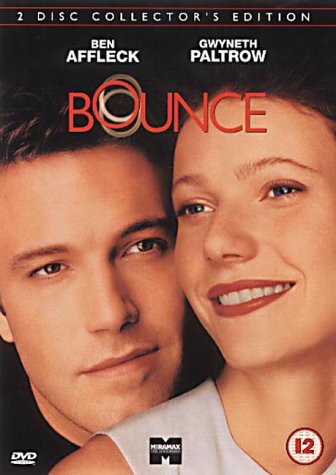
In 1998, Don Roos came out of the gate with The Opposite of Sex, one of the funnier comedies of the 1990s.  As a reward, he got to helm a big budget romance with a promising story.  A playboy gives his plane ticket to a husband/father so the husband/father can be a good Dad and the playboy can make a girl at the airport bar.  The plane goes down.  The playboy is affected and insinuates himself into the widow’s life.

First problems first.  The playboy is Ben Affleck.  Affleck has found his way as a director (Gone Baby Gone and The Town are excellent and fine, respectively). When acting, however, he is best in an ensemble – a little goes a long way.  But Bounce came out when they were trying to make Affleck a lead, which he is not.  He is a leaden, two-trick pony (the eyes welling with tears; the set jaw).  Affleck is the best friend, not the lead.  He can occasionally rise to the occasion, but he is no more than a big, good-looking light-stepper.

Paltrow, who prior to her strange incarnation as a country singer, could lead, is weighed down by a script that requires her to lament and panic at almost every turn.  She is less and less sympathetic as she veers into the territory of mentally unbalanced.  Perhaps this is because she is being stalked by Affleck, who has decided to change his debauched ways on the back of the husband’s death.  The effect is creepy and doesn’t lend itself to a love story.

Image result for Crazy stupid love

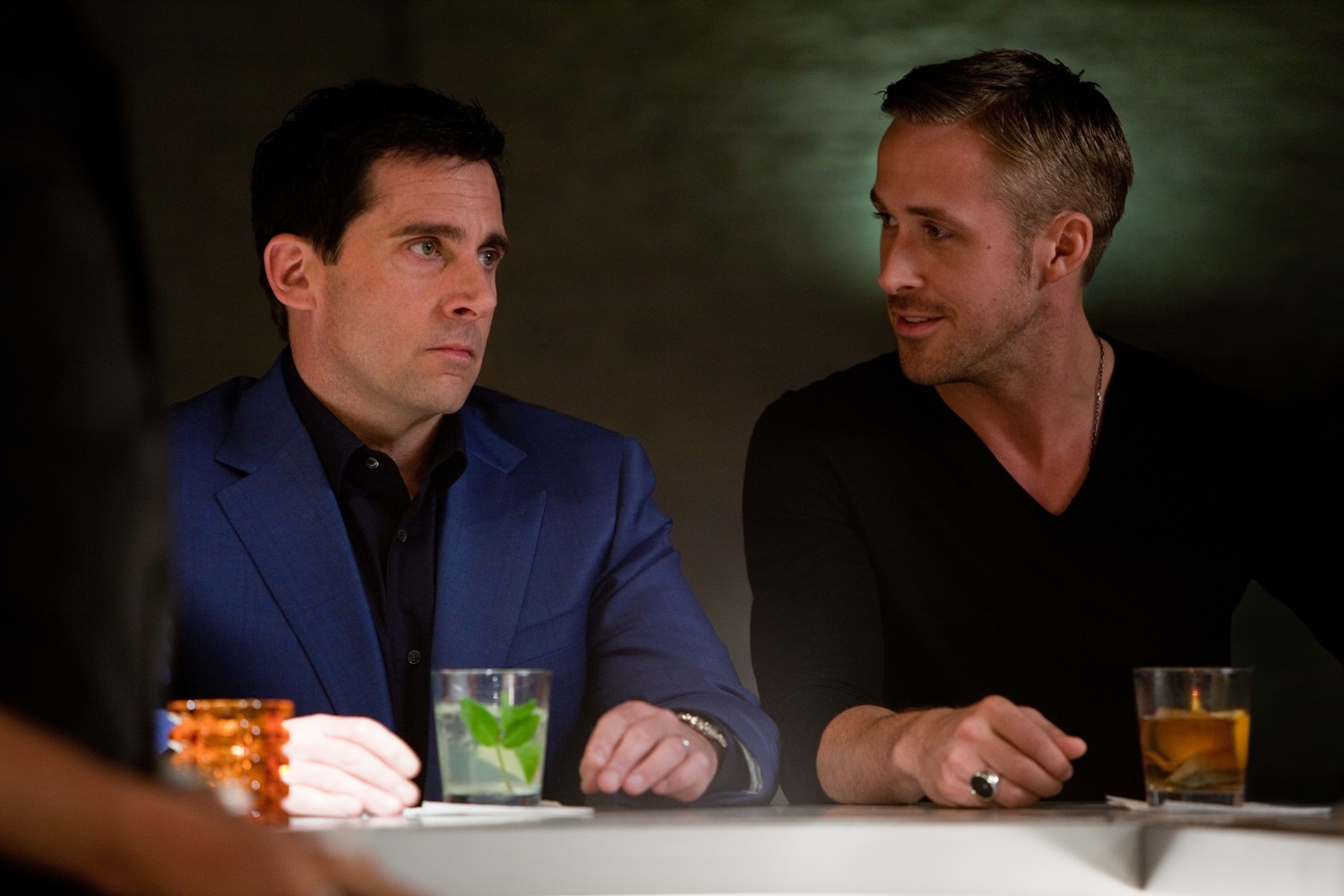
A nice ensemble “bromantric” comedy.  Steve Carell plays the schlub husband thrown over by the “wife in mid-life crisis” Julianne Moore after she flings with an office colleague.  Despondent, Carell retreats to the local singles bar to lick his wounds, where the charming, suave ladies man Ryan Gosling takes him on as a project, ala’ Henry Higgins.  Carell is soon quite the ladies man himself but still pining for his wife, while Gosling learns the merits of deeper love with the electric but gawky Emma Stone.

There are some glitches: Carell’s sad-sack/nice guy routine is getting a bit stale; the friends of the broken-up Carell and Moore and Stone’s lame-o boyfriend are ridiculously stock and unrealistic; Carell’s 8th grade son is a little too cloying and hip; and Moore is reprising her flustered role in last year’s excellent The Kids Are Alright.

Still, this is cute and mostly funny, and Gosling, who I have been very hard on for his work in The Ides of March (confused) and the wildly overrated Drive (catatonic) is the engine.  His repair work on Carell provides some of the best scenes, and he and Stone have very convincing chemistry.

Also, Marisa Tomei plays a one-night stand who ends up being a teacher of Carell’s son.  Tomei just keeps getting better and better looking and more charming to boot.  She can be very dark, as she’s shown in The Wrestler and Before the Devil Knows You’re Dead, but she’s also a deft comedienne, as she showed here and in Cyrus.

The Artist. I was not excited to see a silent film, and it took a little while for me to warm up to it, but this is a natural, funny and beautifully shot picture, a riches-to-rags-to riches love story with enormous heart.

The movie is almost entirely dependent on its two leads, Jean Jujardin and Bérénice Bejo, both of whom are nominated for Academy Awards, and deservedly so. Dujardin is a silent film king who gives Bejo her big break, falling in love with her in the process. She ascends in the talkie era and he fades away. Particularly affecting is the scene of Dujardin in his last gasp movie, lost in quicksand:

Dejardin’s descent dragged a little bit, but that is the only criticism I have.

Dejardin and Bejo are aided by a plucky performance by a dog and the contributions of John Goodman as the studio mogul and James Cromwell as the loyal chauffeur. But they carry the film and their performances, which could easily have been big and over-the-top, are subtle and moving. The scene where they fall in love – a series of takes where Dujardin dances with then-extra Bejo, each take becoming more entranced – is captivating.

This is the favorite to win Best Picture tonight and it is the second best picture of the year.

Margin Call, nominated for best original screenplay, is still at the top of my heap.

Image result for blast from the past"

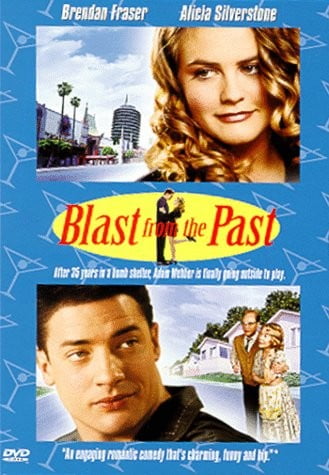
Brendan Fraser plays a 35 year old man mistakenly vaulted in a bomb shelter with his parents (Sissy Spacek and Christopher Walken) since the early 60s. Now, he’s out in modern L.A., and he’s wearing a windbreaker and calling black people “Negroes.”

While Fraser is pretty funny, and Walken and Spacek are properly “kooky” as conservative parents who took to the fallout shelter and never came out during the Cuban Missile Crisis, this romantic comedy lags.  Alicia Silverstone, as the love interest, is dull and plump, a bad actress with weak comic timing (didn’t she come and go in a hurry?). Dave Foley, of “Kids in the Hall,” plays Silverstone’s gay, advice-dispensing roommate, but he’s forced, and he’s given none of the snappy patter of a Cam or Mitchell from “Modern Family” (and if you needed someone to play the gay roommate from “Kids in the Hall”, why not Scott Thompson?)

In the end, fish-out-of-water can only get you so far.

500 Days of Summer.  A romantic comedy that takes another whack at the rom-com dreck machine (1567 Dresses, He’s Just Not That Into You, Maid of Honor, etc . . . ).  Great chemistry between an earnest Joseph Gordon-Levitt and an aloof Zooey Deschanel, who at times tests your ability to stomach the quirky, bohemian modern girl but still captivates.  Still, it is hard to dislike a film that can carry a Hall and Oates dance number in the middle of an L.A. park.  Also, I did notice that the office where Gordon-Levitt is interviewing in the last scene is Jack Nicholson’s office in Wolf.  Great office.