Archive

Genre

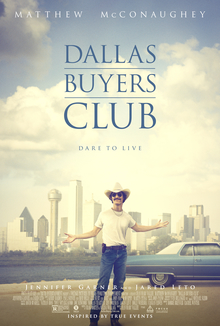
Image result for dallas Buyer's club
Matthew McConaughey’s transformation from wiry homophobic cowpoke to frail, determined AIDS survivor in mid-80s Texas is riveting, and he is ably supported by Jared Leto as a young transvestite who becomes his business partner (the business being the importation of non-FDA approved drugs for AIDS patients as an alternative to the toxic AZT). I expect Oscar nominations for both actors for their understated and moving performances, when showy and overwrought was to be expected.

The first half of the film paints a portrait of Ron Woodruff’s (McConaughey) fast living, his “I ain’t no homo” denial of his diagnosis, and his determination to stay alive and flourish, and your investment in his fate is total. But that leaves half a film, and unfortunately, the picture then stumbles. McConaughey makes the jump from survivor to advocate and soon, his finger in in the face of the FDA, the presumably corrupt dispensers of AZT at the hospital, Big Pharma, and yes . . . the system.

The institutional corruption and failure story has been done to death, and it carries a feel wholly distinct from what has come before – inauthenticity. I’ve read a great deal about Woodroof, and much of his tale is corroborated, but in that corroboration, there is no confirmation of the most Hollywoody of the film’s vignettes, such as his attacking the evil doctor in the hospital or his crashing of Big Pharma roll outs of AZT. Perhaps these things occurred, but even if they did, their depiction in the film is cheap and easy. As a historical aside, the availability and affordability of AZT was demanded most vigorously by Act-Up, and its therapeutic value was significantly greater than shown in the film.

There are other problems. Jennifer Garner, as the doctor who McConaughey charms to his side of the drug fight, is a fictional character. She never should have been drawn, or at least, she should have been cast with a more compelling actress. Garner is no match for McConaughey. She gamely tries to communicate empathy and dawning but musters mere wet eyes and wonder.

The bad guys (Dennis O’Hare and Richard Barkley) are stock, almost sneering suits and what Steve Zahn is doing in this picture as a 3 foot ridiculously mustachioed sheriff escapes me.

Otherwise, Dallas Buyer’s Club is a serviceable platform for McConaughey and Leto which eventually succumbs to its own good intentions.

The premise is about as plausible as Escape from New York. If crime can increase so much that Manhattan must be cordoned off as a separate, lawless prison, than the nation could establish a 12 hour period annually where its citizens can “purge” and commit any crime without punishment. The purge is a mix of a social reform (by allowing one night of consequence free crime, we have no other crime the rest of the year) and patriotic-religious act. But it occurs in 2020, and as bad as either Bush or Obama has been, I can’t see that kind of institution gaining traction so quickly. Frankly, it is unlikely the government could get the website for The Purge up and running in 6 years. In the end, the filmmakers don’t really invest much in the concept, and as my son remarked, “the problem with the movie is that you didn’t need The Purge to make it.” He’s right. When the killers looking to take advantage of their wild night surround the well fortified home of Ethan Hawke and his really stupid family (note to self; on Purge night, make sure your foolish son doesn’t get all Good Samaritan and lift the security gates), they may as we’ll be zombies or Manson family members or the bad guys in The Strangers or You’re Next. There is no reason to go high concept if you have no intention of exploring that concept.

Or maybe not. On a budget of $3 million, it made $64 million.

image

A fitting choice on the 50th anniversary of President Kennedy’s assassination, Parkland is a sober, gripping recreation of that event through the eyes of his Secret Service detail, the FBI office in Dallas, the medical staff at Parkland Hospital, Abraham Zapruder and Oswald’s family.  It is hard to achieve verisimilitude on such a well known event, but director Peter Landesman does just that in his handling of detail.  It seems unbelievable that the Secret Service would entrust the 8mm film shot by Zapruder to his care even as they desperately sought local facilities to develop the film, but it was his property, that’s exactly what they did, and the discussions over the disposition of the footage are fascinating. There is also an incredible frenzied argument between the Dallas medical examiner and the Secret Service staff over control of the body, which Landesman handles without judgment, and while it just seems incredible that Vice President Johnson is walled off in a hospital file room behind a barricade of guns while the medical staff works on the president, that too is a true fact not oft reported.

These touches are enhanced by determined performances from Billy Bob Thornton, Paul Giamatti, Colin Hanks, Zach Effron, Marcia Gay Harden, Mark Duplass and others. The scene where Kennedy’s aides and the Secret Service have to remove seats from the plane and jam the casket into the passenger area is particularly and deeply affecting.

The primary criticism of this film is that it lacks cohesion, that it somehow didn’t communicate something broader. Actually, that was its strength. The characters do not strive to communicate anything more than having to deal with a horrific event as best they can, and Landesman focuses on their plight, not on a deeper meaning to the event.  The assassination itself is enough to provide the context, and in an era when each of these bit players in a national trauma would likely be on cable news within minutes, the self-restraint of the picture underscores the self-restraint of the times.

The closest I came to smelling Hollywood was when they wheeled Oswald into the same emergency room as Kennedy and the senior nurse pushed him to another, saying, “He’s not going to live or die in here.”  It was artistic license, but it was appropriately chosen.

A minor nit – Texas Governor John Connally, also struck by rifle fire, was taken to Parkland as well, and it would have been interesting to have covered even in a small way his treatment while the hospital staff worked so desperately on Kennedy.

The central conceit of Ain’t In it for My Health, the documentary of The Band’s recently deceased drummer, Levon Helm, is that its subject is compelling enough to sustain interest in his daily chatter, visits to the hospital and scattered observations. It’s not.

Helm is closed off, we learn from a fellow musician, because “Levon’s got demons he’s struggling with over this whole Band legacy.”

If you dropped Fat Boy over Japan, I can see you struggling with demons over your legacy.  In contrast, it is tough not to juxtapose Helm’s bitterness with an excerpt from a recent article I read on Bob Dylan: “Now, though, he was out on his own – after eight years’ abstinence, just as rock touring reached new debauched depths. The Band had roadies take Polaroids of girls wanting to get backstage, poring over potential beauties like horse-traders. Cast-offs were handed to the crew.”

Still, I was game.  Helm’s issues with The Band and posterity’s treatment of same could be interesting.  Of Robertson, Manuel, Danko and Hudson, their travels and impact, Helms says that . . . . “the credits and the money” on the third Band record was a “screw job” (Robertson was the writer and got the royalties) and after that, well, it was pretty much all over.

That’s the whole of it.

Otherwise, Helm just broods and ambles and lounges amongst younger acolytes (including Billy Bob Thornton) and these scenes are interspersed with nature photography of Helm’s property in Woodstock, NY.  Near the end, surviving wives and girlfriends tell us that the real downfall of The Band was drugs and alcohol.

Mind. Blown.

On the plus side, there’s some nice old footage of The Band, some later footage of Helm who played live not long before his death, and the portrait of the musician at the end of his career, with cancer ravaging his voice, can be poignant

Frances Ha (2012) Review |BasementRejects

In the first ten minutes, you realize this is going to be a melange of a Woody Allen black-and-white paen to New York and Lena Dunham’s HBO sensation Girls. Dunham’s show is an entertaining but often frustrating characterization of four girls, post-college, making their way in the world of New York City via witty, self-satisfied rejoinders and copious infusions of cash from their parents. Loaded with self-esteem but no brightly discernible skill, Dunham’s quartet negotiate the shoals of a hip, ever-changing landscape while coming to the realization that every girl with a B.A. from Oberlin is not destined to be a smash in the literary and art worlds. It’s hard to like her characters, especially, Dunham herself, whose Hannah is so grotesque, self-involved and deluded that you’re often left cringing or sputtering in amazement. Or, at almost 50 years of age and closest in sensibility to her poor beleaguered parents on the show, I am.

Still, Girls is a solid work, surprisingly addictive, and it always elicits a great discussion that can range from generational rot to what the cool kids are into these days. I also credit Dunham with either knowingly or unknowingly crafting a sharp indictment of extended, subsidized adolescence, and despite her ridiculous persona as her star ascends, I think she knows it. Or she should.

If Girls were a quintet, the protagonist of Frances Ha, Greta Gerwig, would play the mopey, co-dependent would-be dancer. Unfortunately, Frances is not in the hands of Dunham, who could effectively compensate for Frances’s pathetic existence with humor or humanism. Instead, she’s in the hands of a filmic sadist, Noah Baumbach, whose characters are often so vile and/or degraded that you wonder if the point of the exercise is solely to make the audience feel better about themselves. As the divorcing parents in Baumbach’s The Squid and the Whale, Laura Linney and Jeff Daniels are positively toxic, as is Nicole Kidman’s abusive, miserable mother in Margot at the Wedding. Ben Stiller’s Greenberg is similarly noxious, though at least Baumbach offers some redemptive qualities near the end of that film.

The difference between those characters and Frances, however, is that they are in varying positions of power, whereas as a 27 year old Vassar grad who is as much a dancer as I am a power forward, Frances is at the mercy of her surroundings and singularly ill-equipped to handle them. You can feign amusement at her plight in the various uncomfortable situations Baumbach creates for her only so long before you feel guilty. Baumbach may have caught on to his excess, because in the last five minutes, Frances develops character, self-esteem and a place in this world for no apparent reason other than to avoid a mass suicide at the local cineplex.

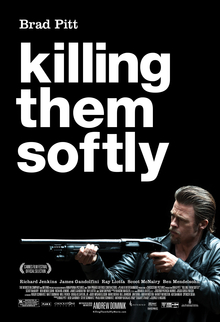
Killing Them Softly - Wikipedia
The Assassination of Jesse James was a wildly impressive American debut by director Andrew Dominik, but the director’s dreamlike, meditative style does not lend itself to a basic, gritty crime story. This tale of a hitman (Brad Pitt) laboring under the fiscal corner-cutting and meddling of his employers on a pedestrian job is dull, and no amount of pretty slow-motion photography can change that fact. The story is also awkwardly juxtaposed against the 2008 financial crisis and the ascendance of Obama, seemingly all for one supposedly killer line by star Pitt that closes the film. Specifically, referring to Obama’s victory speech, Pitt rejoins: “This guy wants to tell me we’re living in a community? Don’t make me laugh. I’m living in America, and in America, you’re on your own. America is not a country; it’s just a business. Now fucking pay me.”

Oof.  I mean, wince.  Sigh. Then, oof.

If the movie has worth, it is to see James Gandolfini (as a hitman who has lost his nerve) in one of his few post-Sopranos film roles.  

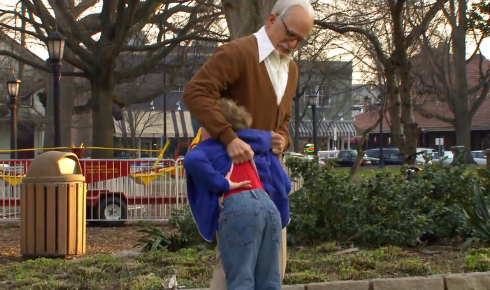
There is a difference in this installment of the Jackass series.   Creator Johnny Knoxville and collaborator Spike Jonze have given us an actual character. Instead of a gaggle of cut-ups and clowns crashing golf carts or defecating in showroom toilets, we have an old man (Knoxville in convincing makeup and prosthetics) who is recently widowed (in fact, his dead wife is in the trunk of the car) and whose daughter was just jailed.  The old man is forced to drive his grandson from Nebraska to North Carolina to drop him off with his deadbeat father, pranking merrily along the way.  Some pranks hit (his uninvited involvement in a male strip show and his being hurled through a plate glass window while astride a kiddie ride), some are okay (a malfunctioning bed that crushes him, a drunken trip thru a drive-up window in a shopping cart) and some are too uncomfortable or disgusting to recapitulate.

Ultimately, like Borat before it, Bad Grandpa is accidentally patriotic.  As bad as this grandpa acts, as much as he destroys and mucks up, the tolerance and kindness that greets him is noteworthy.  As Christopher Hitchens observed about Borat, whose hijinks were decidedly more cruel and condescending than Knoxville’s shock routine, “Americans are almost pedantic in their hospitality and politesse.

The patience of the prank-ees in Bad Grandpa is its strongest feature and, for that, we should be thankful.

Enough Said is an engaging, touching semi-romantic comedy for adults in the target market of 40 to 60. The trials of Julia Louis-Dreyfus, a middle aged masseuse, do not include keeping the sex drive hot with the advent of a new baby, or struggling with the fact that all of her friends are married while she is not. Rather, she is divorced, working, plagued by her daughter’s move from LA to NY for college, and the hunt for a man has been reduced to a mere occasional flare. But she meets a man, and his ex-wife, and develops a romance with the former and a friendship with the latter, initially ignorant of their connection. She is soon wise and makes the calamitous decision to use intelligence gathered from the ex-wife to evaluate her new partner.

Enough Said is a beautiful epitaph for James Gandolfini as the love interest, who plays a portly middle-age loner in angst over the departure of his own daughter to college with a subtlety and nuance that may well have freed him from the shackles of Tony Soprano once and for all (the Lord works in mysterious ways, and there is no greater example than having Enough Said released after The Incredible Burt Wonderstone).

Louis-Dreyfus is also impressive. There is no questioning her comedic chops (HBO’s Veep shows how effortless she moves in that milieu), but here, she draws deeper, and slowly reveals repressed fear and insecurity. Not in the paroxysm of a self-revelatory banner speech or after undergoing the withering but “true” dressing down of a gal pal in the penultimate act, but in ascending scenes of awkwardness, comfort, quiet resignation as to her actions toward Gandolfini, and then need.

The film also handles secondary characters with maturity. They err and recover, but we are not let off the hook by cartoonish villains or easy marks. This is a bit of a departure for writer-director Nicole Holofcener (Lovely and Amazing, Friends with Money), who was previously very tough on her protagonists and supporting characters in a manner that bordered on condescending. Still, in Friends with Money, Holofcener zeroed in on the casual iciness of an outwardly happy marriage between Catherine Keener and Jason Isaacs and her skill depicting the dynamics of couples has not eroded.

One of the, if not the best film of the year.

Rear Window, or the World's Scariest Bottle Episode – Scriptophobic

I just engaged in a donnybrook of a discussion with a few friends over this film, the primary contention being what it was actually about. It was the kind of exchange only the participants could enjoy, but the spirited debate about the film and Hitchock in general led me to re-watch Rear Window this weekend.

Jimmy Stewart is an adventurous photographer who has a broken leg (but he got the shot of the crashing motor car before it hit him). Cooped up in his New York City apartment, he spends the time peeping on his neighbors across the way (he has a splendid view of their windows and courtyards), and in the process, he begins to suspect one (Raymond Burr) of murdering his wife. He enlists his socialite girlfriend (Grace Kelly), whose marriage entreaties he is fending off, in his investigation, leading to a thrilling conclusion.

The film succeeds on three levels. First, it is a witty comedy, with sharp exchanges between Stewart (the confirmed bachelor and super snooper) and Kelly, as well as Stewart’s health care attendant, the brusque Thelma Ritter. The women are pro-marriage and anti-peeping. As these discussions develop, Stewart enlists them in his monitoring of Burr, and thereby, Kelly “proves” herself to Stewart as something more than a rich, pampered girl. At its best, it plays like a David Ogden Stewart or Ruth Gordon battle of the sexes script.

It is also a love story, initially very light, but when Kelly is in harm’s way, Stewart evinces true passion. Stewart has been lampooned so often (“Zu Zu’s petals!”) that one forgets his ability to communicate depth of emotion, but before those petals, there was his haunting breakdown in Martini’s bar. Also, given the 21 year age disparity, it is surprising Stewart and Kelly manage chemistry, but it’s there.  Indeed, the insane idea of rejecting Grace Kelly is made more comprehensible by Stewart’s cranky maturity.

Finally, this is a meticulous thriller with a few dark overtones. Stewart peeps as a lark, but soon, he is obsessed and a little ashamed.  He sheepishly admits to Kelly that they’re viewing “pretty private stuff going on out there.”  She retorts, “We’re two of the most frightening ghouls I’ve ever known.”  And what they see is generally pretty depressing: a suicidal Ms. Lonelyhearts, a composer in despair, newlyweds from shine to routine. And, of course, a killer, nagged by his wife and driven to extremes. It’s not a happy place, as is shown by one neighbor whose dog, sniffing in the wrong garden, meets an untimely end.

I’ll end with the thoughts of someone more distinguished, David Thomson, from his book The Moment of Psycho: How Alfred Hitchcock Taught America to Love Murder:

Hitchcock knew that a system locked into watching and seeing can misread its surroundings and can even lose its identity and ordinary human sympathies because of the pressure of voyeurism. The voyeurism is so heavy, so forceful, it can smother real human nature. Psycho is the conclusion to a set of films beginning with Rear Window, and for me that is Hitchcock’s best film in that the smile of satisfaction at the end covers without hiding the loneliness that affects real people. Rear Window is a romance, a comedy and a thriller, but a portrait of alienation too. The apartments and windows are screens, of course, but they are traps, or cells – in that entire courtyard no one seems to “know” anyone else; neighborliness has not been invented.