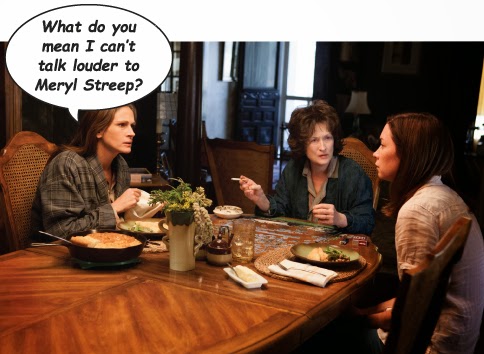
A grueling, gloppy, false film. A poet father (Sam Shepard) goes missing (and then dies) and the family is summoned to bury him. They proceed to vomit all over each other as the matriarch (Meryl Streep) goads and undermines the lot of them.
It is based in Oklahoma, which elicits exaggerated heartland/Southern accents and theatrical, hokey back-and-forth (Julia Roberts’ “get tough” bit with her mother, Streep, is laughably unconvincing). There are confrontations and serial reveals of family secrets, followed by more wailing and teeth-gnashing, and that’s about the whole of it.
The film is adapted from a stage play, which encourages overacting. Streep and Roberts are particularly culpable, the former not so much in technique but in volume and size. She positively leers at her stupid family, and horns near come out of her head. Naturally, the Academy nominated them both for Oscars, but nobody in their right mind would spend another minute with these women after the mildest of their taunts or insults. But there this family of dolts sits, taking it just like the audience.
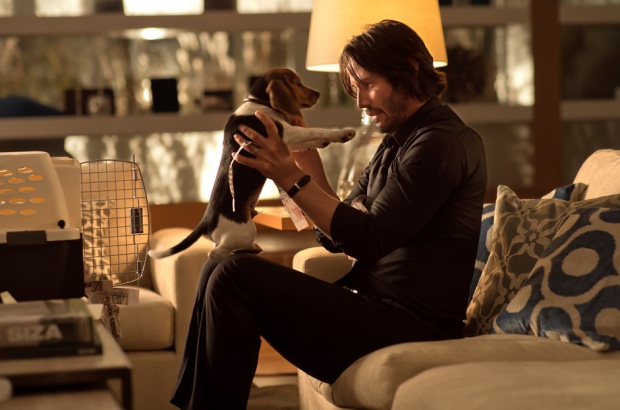
Terrific shoot ’em up, mindless yet smart, thrillingly violent yet tasteful. John Wick (Keanu Reeves) is a retired hitman, at least until the snot-nosed son of New York City’s crime boss steals his car and destroys the last gift given to him by his beloved, deceased wife.
Oh, and then it’s on. The film sports sixty to eighty beautifully choreographed deaths (the co-directors are seasoned stunt coordinators), a few funny lines, and a clever depiction of a criminal underground with its own rules, parlance and neutral Switzerland. Reeves plays Wick straight and dead serious, so we are not tormented by smirks, tag lines or witty asides. And the bad guys are, as they should be, the most interesting characters in the film. If there is a criticism, it’s this: whatever the final count, it’s about 20% over the killings the film should have. Nobody can employ that many henchmen in this economy.
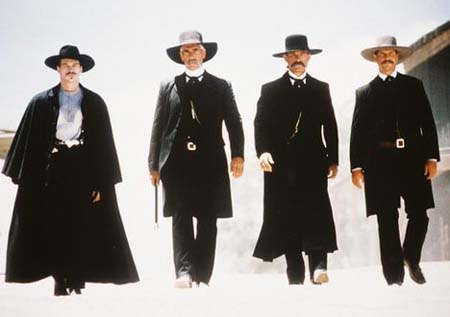
I only thought of this film because of Deadspin’s ode to Val Kilmer’s Doc Holliday, and on reflection, Kilmer’s performance is not only the best thing about this western, it’s the only good thing about it. Thus, to have one performance account for 2.5 stars – that’s really something. But Kilmer’s languid, dissipated Holliday is a treat to behold. He is having a blast with the role, and while everyone else is somber or uncomfortable (or both), he chews and chews and chews.
Unfortunately, no one else (except perhaps Powers Boothe, who actually twirls his mustache as the evil leader of the redlegs, Curly Bill) is having any fun. The Earps (Kurt Russell, Sam Elliot, Bill Paxton) are dull as dishwater, particularly Russell as Wyatt, who decides that fury and blue eyes will see him through. The villains, and there are scads of them from any number of sitcoms, look like they’re at cowboy camp. In fact, this whole movie has a certain slipshod, Eagles photo-shoot for Desperado quality to it.
The women are weak as well. As Kilmer’s moll, Joanna Pacula is just a hair shy of the cartoon Natasha, and Dana Delaney as Wyatt’s love interest lacks the lustful lure necessary to break down a rigid lawman. Delaney is a school marm, not a vamp; she doesn’t sizzle so much as reach room temperature.
Director George Cosmatos’ best efforts besides this leaden dog are Stallone vehicles, Cobra and Rambo: First Blood Part II. After Tombstone, he got one more feature (a Charlie Sheen vehicle) and that was that (he died in 2005). After Tombstone, which is a pedestrian, forgettable, script, writer Kevin Jarre penned The Devil’s Own and The Mummy and, again, that was that.
But oh what Kilmer does with what he’s given:
The charms of the character are legion. As explained by Kilmer in a recent interview:
So Bob Dylan loves “Tombstone”, It turns out. I found out he was in New York so I called my friend and I said you know, I’d love to meet him, is there any chance and he says, “I don’t know, I’ll find out.” And the next call I got I thought was going to be my friend, but it wasn’t, it was Bob.
I was real excited, like a crazy fan, like a child; it was so great. Basically it was like nothing. It was like we were old friends, it was like “you want to come over?” and he was like, “yeah.” So, hangs up the phone, I was newly married and we had a baby and I went in and said “I think Bob Dylan’s coming over…I’m not sure, it could be a hoax…”
He shows up and sits down and he wants to talk about “Tombstone”, but I just can’t, you know, nor can I talk about any of his stuff. Eventually he says, ‘ain’t you going to say anything about that movie?’ and I said, “do some ‘Blowing in the Wind’ and I’ll…”
That’s what I said to him, basically I said no. I get like that sometimes. So I turned him down and, I thought, no one turns this guy down. Anyway, I felt like an idiot afterwards, well, yeah I could have said a few lines. They’re fun lines too, like people still ask me to say lines and now I’ll tell any schmo in the airport, I’ll say “I’m your huckleberry”, but I wouldn’t say it Bob Dylan!
I felt so bad about it. I was like how could I make it up to him? So what I did was, I recorded “It’s Alright Ma, I’m Only Bleeding” but as Doc Holiday and I put in all of the big lines from the movie into the song and made him a little tape
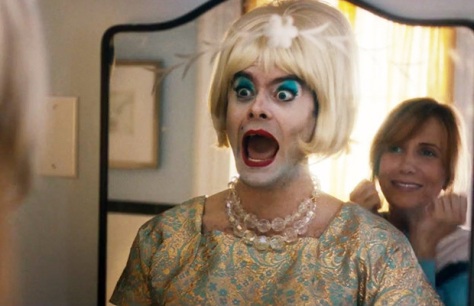
When the two major characters of a film attempt suicide in the first scene, by the end of the picture, you’re not supposed to regret their lack of success. The Skeleton Twins is a ragged, cloying, mannered dramedy starring entirely-out-of-their-depth SNL alums Kristen Wiig and Bill Hader as estranged siblings brought together by near tragedy. Wiig is utterly lost here, and all her tics and quivers cannot make up for substance. Hader is a little better, if a facsimile of a gayer Sean Hayes from Will & Grace is the aim.
The siblings are the children of tragedy, their father a suicide and their mother a hackneyed New Age narcissist introduced only to make her children seem noble. They are presented to us as seeming losers who have lost their way and their special bond on the rocky road of life. They come alive in a weirdly incestuous routine of replaying bits and hijinks from their childhood, and the watching (particularly, a drawn out stoned scene featuring Wiig’s HI-larious flatulence and a lip-synch duet brazenly stolen from Bridesmaids, sans humor) is cringeworthy. These two are as likely to be siblings as Olivier and Midler, but as foreign as they seem, the real problem is that they are fundamentally disinteresting to anyone but each other. It’s like spending an evening with two dull people who constantly crack each other up with reference to inside jokes and childhood excesses (burps, farts, hopes and dreams). Um. Check please.
As for the story, it is a lurching mess, serving primarily to highlight ridiculous and arty visuals, such as a slow dance in Halloween costumes that is finger-down-your-throat precious. When nothing happens (the film feels interminable), a character says or does something clunky and overt, and we slog forward. One example: Wiig is unhappy in her marriage to Luke Wilson and surreptitiously takes birth control pills while they are “trying” to get pregnant. Hader tips Wilson off after a HI-larious scene where hetero Wilson takes homo Hader rock climbing, which is funny because . . . gay. The clue? Sometimes my sister hid things when we were kids. And off Wilson goes to find the pills in a basket of decorative soaps.
An awful hipster picture with nary an authentic moment in it. Makes Zach Braff seem like Cassavettes.
In the vein of Carl Franklin’s One False Move, writer director Jeremy Saulnier has produced a moody, taut and earthy thriller that bleeds authenticity. Dwight (Macon Blair) is a seemingly harmless, homeless drifter who haunts a beach town in Delaware. He eats out of the boardwalk trash cans and his crimes are petty (he breaks and enters not to steal, but to take hot baths while the homeowners are away). Dwight is well known to the authorities, one of whom takes him aside and lets him know the killer of his parents has been released from prison in Virginia. This revelation sets in motion a chain of events that brings Dwight back home to confront the killer, and his family.
Saulnier shoots the eerie back roads of Virginia in a manner that accentuates Dwight’s foggy mental state. He seems almost enveloped by a mist of doom upon returning to his childhood home. Despite the haunting, dreamlike feel of the picture, Saulnier does not glamorize the violence, which is up-close, personal and jarring. People panic, they miss their mark, they make unbelievably stupid mistakes, and they say things under duress that people under duress actually say.
The actors are true. Blair near carries the entire film (in a fair and just world, he’d be an Academy Award nominee). We meet him insulated by the cloud of his drifter life. When he is jerked back to grim reality, we see the dawning, and the depth of the anger he has been suppressing. When he reunites with his sister (Amy Hargreaves), the familial anger is obviously shared, but we pointedly feel her ambivalence upon the return of her troubled brother. It’s as if she worked for years to form a scab which is ripped off the moment Dwight arrives.
Saulnier’s storytelling is such that you credibly piece together the events that led to Dwight’s fresh hell, and there is no predictable satisfaction from extraction of his revenge. Instead, both he and the audience come to realize this is a slow-moving clusterfuck of a car crash from the word go.
If none of this floats your boat, I have one more pitch: Eve Plumb (of The Brady Bunch) makes an unexpected, terrifying appearance.
One of the better pictures of the year, a deserved 96% on rottentomatoes, available streaming on Netflix and all the more impressive when you know it was done for $425,000.
I avoided this film because of an aversion to dramas about viruses and plagues and because I was still shellshocked at the total crappiness of the 1995 Dustin Hoffman vehicle Outbreak (guess what? The military did it!). Unless the eventual outcome of a filmic plague is zombies, 21 Days Later-esque “rage” victims or altered humans ala’ The Omega Man, count me out.
But you’ll watch most anything in a hotel, and Contagion had three extra things going for it – it was the $4.99 special, a few friends recommended the picture and it was directed by Stephen Soderbergh. Despite my reticence, I was treated to an engrossing, intelligent and moving drama about what a 1918-like worldwide plague (where the entire world lost 1% of its population) would look like today. The answer through Soderbergh’s eyes is — not pretty, but not hopeless.
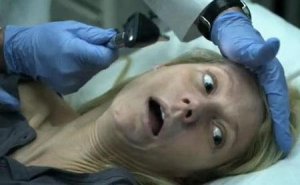
The films starts with poor Gwyneth Paltrow, who is the second carrier of an infection transmitted by touch. Once she is identified as Patient 1 (a Chinese cook is actually Patient 0 – he touched the pig who ate the bat got that started this whole mess, and then he shook Paltrow’s hand), we follow her from China through Chicago and to Minneapolis, where she has touched at least a dozen people And an epidemic starts.
Soon, the government (Laurence Fishburne at the CDC, Bryan Cranston at Homeland Security) swings into action, regular CDC folk (Kate Winslet, Jennifer Ehle) act heroically, an internet crackpot become a messiah (Jude Law), and Paltrow’s husband and many other regular folk have to deal with a paralyzed world. Lawlessness increases because law enforcement is sparse; fear runs rampant; trash piles up in the street; and people hole up waiting for aid and/or a vaccine.
This is a gripping, sober thriller, thankfully bereft of the normal tropes of the genre. The government did not create the virus for military purposes; almost every character is doing the best they can under difficult circumstances; and while society does break down, it also holds up.
All the actors are very good and very believeable. Special kudos to Matt Damon, who continues to be the least-appreciated American actor of his generation. He had the misfortune of being outshined by Jude Law in The Talented Mr. Ripley and Jack Nicholson and Mark Wahlberg in The Departed. They got the nominations and Damon, who carries both films with decidedly more difficult roles, got squat. Here, he serves as the father who has lost a wife and son and seeks to ensure his surviving daughter is not affected while at the same time giving her some life of normalcy. The scene where he is told his wife is dead is particularly moving.
Final note: Gwyneth Paltrow gets the Lifetime Achievement Award for Actress Who Allows Herself to Be De-Glamorized to Best Serve the Role (you’ll know what I mean when you see it).
Never let your child select his own book to read at bedtime, for he might select “Mr. Babadook.” This is a terrifically scary psychological thriller/haunted house yarn about a single mother (Essie Davis) pushed to the breaking point. Widowed seven years prior when a car accident took her husband’s life en route to the hospital to deliver her son, she’s not in a good place. The boy (Noah Wiseman) is uncontrollable during the day and plagued by monsters underneath his bed at night. He is, in short, a spoiled handful and a weird one at that. His peculiarity is driving his mother to the brink, and in the midst of this turmoil comes Mr. Babadook, a terrifying bogeyman.
Davis is sympathetic as she tries to resist the evil force that has taken advantage of her torment, and as has been proven time and again in scary films, from The Shining to The Sixth Sense to The Devil’s Backbone, the contribution of a gifted child actor greatly enhances the terror, as you see what unfolds through the child’s eyes. Wiseman is a brilliant mix of charming and brutally annoying, and while he evokes both compassion, you resent him, making the viewer complicit in unleashing Mr. Babadook.
This is writer/director Jennifer Kent’s first feature and it is assured and often iconic. There are images that stick hard with you, they are not solely the scary ones, and she doesn’t resort to gore (late night Australian television, which is playing a good portion of the film, is quite horrifying enough). While Kent owes a little to James Wan’s Insidious, she avoids his slickness and has a way of capturing what frightens even in the most mundane of settings. She merits a Hollywood project.
The film versions of Dennis Lehane’s books Mystic River and Gone Baby Gone are excellent, but they are mythic stories about the bonds of family in a criminal world. The Drop has no such sweep. It’s a small crime film about a Brooklyn bar and the little people (James Gandolfini and Tom Hardy) who run it for the Chechen mob. When the bar is used as a “drop bar” for the mob’s money, and it is robbed, the little people are thrust into a situation they are ill-equipped to handle.
I just saw Hardy as a meticulous Welsh construction manager dealing with his crumbling life in Locke, and he was immersed in the role. But when you bring foreigners to “New Yawk” (or Biloxi, for that matter), you run the risk of the mannered, cartoonish accent and swagger of Russell Crowe in Naked City. Forget foreigners. Even Mickey Rourke and Eric Roberts can succumb to the perils of “da’ street, and as anyone who has seen The Pope of Greenwich Village will attest, the sight is not pretty.
Not so with Hardy. He is comfortable with the character and the milieu and while it’s no stretch for Gandolfini to play the type, in his last role, Tony Soprano does not disappoint. Hardy is Gandolfini’s quiet second banana, either inscrutable or dim, but steady and loyal either way. As the out-of-their depth small-timers, Hardy and Gandolfini are ably supported by Noomi Rapace, the damaged local girl who binds with Hardy over an abused pit bull left in her trash can (the dog is so cute as to be unnerving; his fate becomes almost too paramount and you spend an inordinate amount of time asking, “Where’s the damn dog?”).
As good as these actors are, Matthias Schoenaerts steals the film as Rapace’s ex-boyfriend, a local hood looking to capitalize on the heist. He presents the perfect mix for a villain; terrifying, intriguing and just a little sympathetic, although you can’t put your finger on why. It’s a great performance that should be recognized come Oscar time. There is no chance that will occur.
This is Michael Roskam’s first American film, and the Belgian exhibits everything you want a new filmmaker to show. It is understated, assured in its pace, taut, organic and comfortable with the quiet moments. Roskam feels no need to amp the action or to bolster the emotional connection between the characters. He lets the audience fill in the gaps, resulting in very poignant moments between Hardy and Gandolfini and a compelling love story between Hardy and Rapace, even though they don’t so much as kiss.
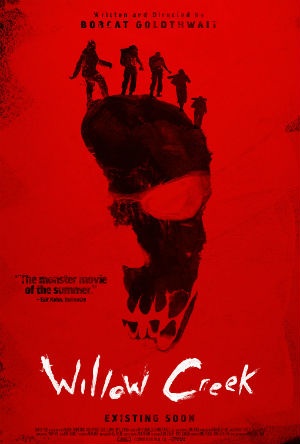
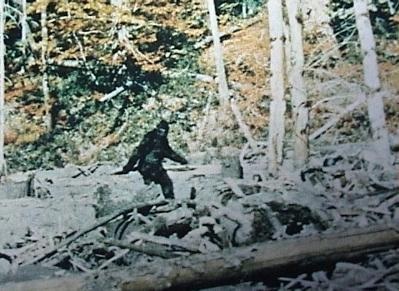
The ingenious creators of The Blair Witch Projectknew enough not to go back in the woods again with their follow up. But 15 years later, director Bobcat Goldthwait has picked up the torch, only this time, his unfortunate videographers are on the trail of Bigfoot, not ritual killers. After slumming with the locals, where absolutely no tension mounts and no character is developed, our couple (he, an overgrown kid obsessed with the Bigfoot sighting, she a supportive actress girlfriend, neither very interesting) go into the woods of the Pacific Northwest. Unlike their predecessors in the woods of Blair Witch’s Burkittsville, these geniuses receive three very clear early warnings to get the hell out of Dodge, but hey, what’s a camping trip without a sinister, threatening local, your clothing mysteriously hung from the trees and a wrecked campsite? We must sally forth to find, well, not even Bigfoot, but the place where this iconic picture was taken.
This has all been done and much better at that (the scene where the couple realize they are lost is a criminal rip-off of Blair Witch). The characters are so culpable they repel sympathy, and the acting is woeful (Bryce Johnson, the Bigfoot enthusiast, conveys fear with a goofy face that I’m sure he assumes is grim determination but comes off as half concussed, half constipated).
There’s also not a scary moment in the film.
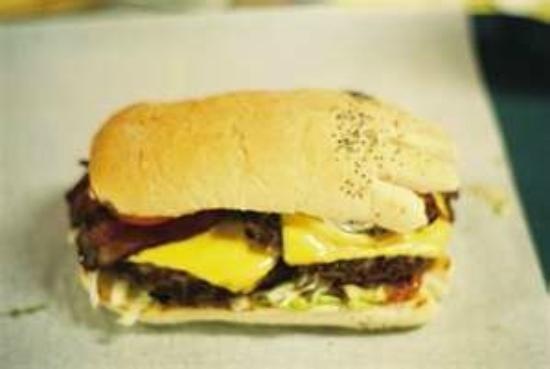
One star, though, for the kitschy Bigfoot locales and The Bigfoot burger.
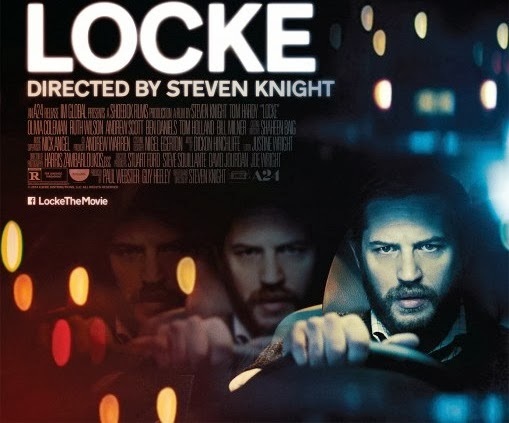
My first thought before watching Locke was of Hitchcock’s Rope, a film remembered more for the gimmick of no cuts than its merit. With an entire film consisting of hands free cell phone conversations from a car, I was primed to evaluate how the director handled such a limited visual scope. It’s a testament to the film that 10 minutes in, I never once gave another thought to that limitation. Ivan Locke (Tom Hardy) is a precise, obsessive construction manager, and on the eve of his greatest work triumph, his personal and professional lives implode, a disaster made worse by his determination to do one thing above all others. As he travels to his destination, he attempts to cobble together the fragments of his shattered life while figuratively sparring with the ghost of his deceased father in the backseat. Hardy, who seems to get every plum role these days, goes a good way to explaining why here. He is riveting and he expands his physical constrictions, evoking desperation, skill and even some gallows humor in the process. This is an audacious, confident second feature by writer director Stephen Knight, who I am pleased to report is writing the forthcoming World War Z 2.





 filmvetter