Archive

Historical

image

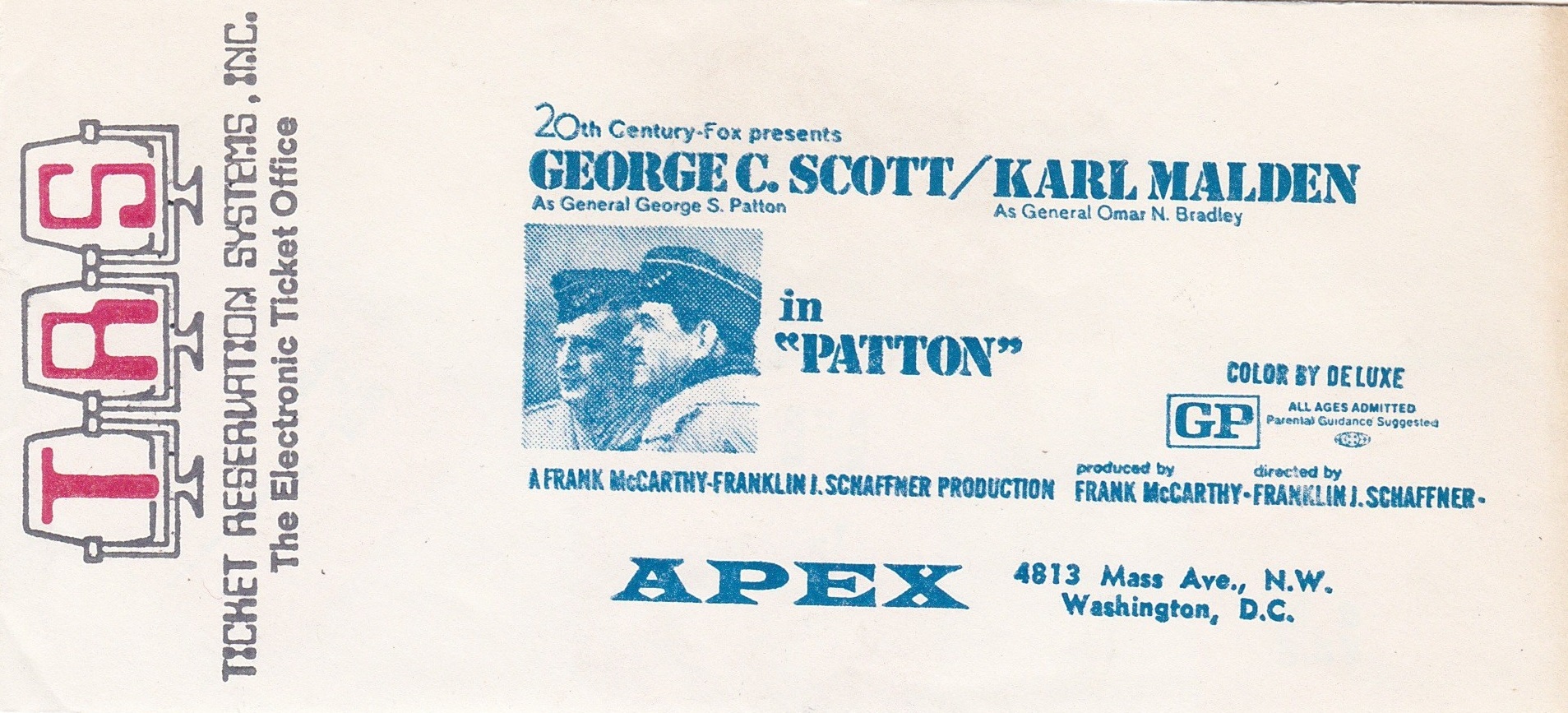
(actual ticket to a Washington, D.C. showing of the movie found in my father’s dresser drawer)

The quintessential biopic, Patton (which was co-written by Francis Ford Coppola) gets everything right.   Let me count the ways

It is content to present its subject without the context of some anachronistic cause. In Coppola’s hands, Patton is not emblematic of something larger and more ominous or glorious, be it the hubris of American imperialism, the degradation of war, blah blah blah. He is a flesh-and-bones person who grafted himself onto and shaped one of history’s more momentous times.

It is nuanced. Coppola never lets you get comfortable with Patton and by the end of the film, you remain torn as to the sum of his virtues and vices, which is so much more interesting than the hagiographies or hit jobs we see so often today.

It’s largely composed of true events. Patton did say the outrageous things attributed to him (if not in the form presented by the film), and he was every bit the preening ass and decisive, bold general portrayed in the film. The two incidents where Patton slaps soldiers are condensed into one, and Patton is given too much of a role in the plan to invade Sicily, but otherwise, the picture hews closely to history without becoming tedious. Most historical criticisms of the film zero in on what it doesn’t depict (much as with American Sniper), which is a legitimate criticism only if you give credence to the “I would have done it this way” school.  When it does take poetic license, it comports with other established facts. Patton did not shoot his pistol at attacking German aircraft, but the attack occurred just as he was berating the Brits for failure to provide air cover, and Patton’s risky bravado in the face of enemy fire was legendary. Patton did not shoot mules blocking a convoy, but he did order them shot and their cart dumped into the river.  Patton did not tell a British general that he had been in a battle centuries old, but he was a strong believer in reincarnation.  Indeed, he wrote a poem in 1922, “Through A Glass Darkly”, a stanza of which reveals his inclination:

Perhaps I stabbed our Savior
In His sacred helpless side.
Yet I’ve called His name in blessing
When in after times I died.

Patton is also noteworthy because the actor playing the subject gives a commanding performance. George C. Scott reportedly made a determined study of General Patton and by most accounts, captured him (save for Patton’s higher pitched voice). Incredibly, Rod Steiger, Lee Marvin, Robert Mitchum and Burt Lancaster all turned down the lead role.

It also looks authentic, in large part, because the producers rented out WWII-era materiel that had been sold to Spain and largely filmed the picture there.  Obviously, shortcuts were made (the Spaniards didn’t have a passel full of Tiger tanks), but director Franklin Schaffner (Planet of the Apes) does great work with what he has in terms of equipment and locale.

Finally, what a Jerry Goldsmith score.

The movie won 7 Oscars, including Best Picture, Best Actor, and Best Original Screenplay and sits at #89 in AFI’s top 100 films.
image

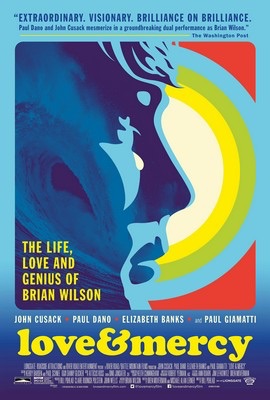
A competent biopic that smartly alternates between the rise of Beach Boys impresario Brian Wilson (played as a young man by Paul Dano) and his later life (during which he is played by John Cusack), where the ravages of mental illness, substance abuse and the dubious oversight of Svengali psychiatrist Eugene Landy (Paul Giamatti) have taken their toll. We meet the older Wilson as he tries to buy a Cadillac from saleswoman Melinda Ledbetter (Elizabeth Banks), revealing the only peace he can find, alone with her in the car at the dealership, while Giamatti and his associates hover on the other side of the glass.

The film spaces nicely, and the early pressures on Dano (fear of flying, his abusive and controlling father, the stress of touring, an aversion to conflict) are manifested in Cusack’s caged, distrusting performance, one of many really nice touches in the film.  Near first time director Bill Pohlad delves into but doesn’t overplay Wilson’s demons, choosing to give equal access to his love of the art of pop music and visionary work in the studio.  Nothing in the picture feels hackneyed or stale, a difficult feat in the face of traditional musical biopics like Ray and Walk the Line.  Also, in the era where “Behind the Music” has left these stories vulnerable to the Dewey Cox treatment, the film feels fresh and immune to parody.

Banks and Cusack also radiate the wonder of first love, subordinating the “bio” aspect of the movie to a heartfelt romance.  They have a convincing chemistry, which bolsters the efforts she undertakes to wrest Wilson from Landy.

As Landy, Giamatti is the weakest link.  He is ferocious where he should be merely intrusive, maniacal instead of crafty.  Landy may well have been that excessive, but he didn’t just walk off the street; he was a pop psychologist to many stars, from Alice Cooper to Rod Steiger.  The performance is so over the top, you wonder how Wilson, even in his vulnerable state, could have succumbed to such a bully and how Landy could have had the smarts to set himself up so nicely.

Currently on Hulu.

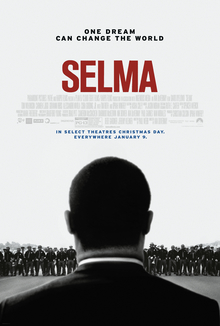
Selma (film) - Wikipedia

Moving, didactic and unsurprising.  The film suffers from what I call the Milk syndrome, a heartfelt fealty to its subject so strong it obliterates any sense of authenticity.  Martin Luther King (David Oyelowo) is etched in marble, and marble is both beautiful and boring.  While the film is occasionally poignant, we are left with its one-dimensional hero, colorless acolytes (Coretta Scott King and everyone who works with King) and cartoonish villains (Tom Wilkinson’s LBJ and Dylan Baker’s Herbert Hoover are particularly ridiculous).

The film’s best moments come when King is not ennobled, but crafty, as when he explains to two Selma locals why he needs to elicit violent repression from the authorities for publicity purposes; King as tactician is just more interesting than King as emblem.

The worst moments come in quiet discussions, where the activists trade speeches littered with biblical passages and maxims like “eyes on the prize.” There are too many long sermons provided to educate an audience director-writer Ana DuVernay doesn’t trust (a conversation between Coretta and her husband about his infidelities has a reserved dignity that is otherworldly).

In a film punctuated by Oyelowo’s expert recitations of King’s actual speeches, the effect is tiresome.  The characters are in the middle of a pressure-cooker maelstrom, uncertain as to which road to take, hemmed in by any number of political and social forces, and beset by violence at any turn.  Yet, they are reduced to the roles of resolute and/or suffering nobles.  When one black man wants to go get his gun after the marchers have been brutally bloodied, he is met with a sermon on the foolhardiness of his instincts and its effect on their historic struggle.  After an ass-beating, it’s a rare man who can summon a soliloquy.

The film is beautifully photographed. Cinematographer Bradford Young (who, in A Most Violent Year, captured early 80s NYC) employs a lyrical, classic style he describes as a “period, Kodachrome-esque look.”  The effect creates memorable moments, some stunning.

But pretty isn’t enough.

A film that got away from me, perhaps because it gave off such an air of discomfort, I watched There Will Be Blood this weekend. The movie is very good, but my instincts were correct.  It is a very difficult movie to endure.

Daniel Day Lewis plays a Charles Foster Kane-esque Daniel Plainview in Paul Thomas Anderson’s sprawling tale of an oil man who rose from a single claim prospector to a wealthy oil magnate through sheer will and a ruthless brutality that destroyed everything in its wake. Whereas Welles’ Kane, obsessed though he was, could enjoy the taste of his success and the fruits of his labor, Plainview cannot. He is a tortured, singular man, made dangerously distrustful the moment he gets close to anyone for fear of what that person will take. Worse, he cannot abide a slight, and when a young preacher (Paul Dano) fences with Plainview, forcing him to endure a humiliating baptism in exchange for the rights to a critical tract of land, the incident burns in Plainview. As played by the spellbinding Day Lewis, it damn near appears to eat his insides out.  Anderson’s representation of California – be it the barren oilfields or the lonely mansion Plainview inhabits at the end of the movie – becomes more forbidding and cruel as Plainview descends into madness.

All well and good, especially near flawlessly rendered, and yet, this is a cold, one-note film, devoted near completely to a terrible, monochromatic character. What is Anderson telling us about ourselves, or, is he telling us anything? Many cite the picture as an evocation of the American experience, a “portrait of a young nation struggling to find itself, torn between religious and business values” or “a harrowing cautionary warning to a country with oil pumping through its veins, clouding its judgment and coarsening its soul.”

If only. Anderson’s vision is too personal and too specific to Plainview, and it is a testament to the director’s gifts and Day Lewis’s skill that such a narrow focus remains compelling. The result is a lot of blood and guts but no real heart, which keeps it from being great.

image

Downton Abbey is a hugely successful period British soap opera that is anachronistic, predictable and overwrought.  The Imitation Game is Downton Abbey for the movies.  Alan Turing (Benedict Cumberbatch) is the Sheldon Cooper of World War II; brilliant, odd, effeminate and humor impaired, and he is tasked with cracking the Nazi Enigma code.  He does so, with the help of Keira Knightley and Matthew Goode and an actor from Downton Abbey, all the while struggling with his sexuality, his anti-social personality and a race against the clock.

There is not much in the film that isn’t expected.  After alienating his colleagues, Turing wins them over.  After being quirky, we are charmed and in his corner.  After connecting with a teen friend in boarding school in flashback, the boy dies. After that boy tells Turing, “Sometimes it is the people who no one imagines anything of who do the things that no one can imagine,” that line is delivered again and then again.  After the team cracks the code, they immediately pinpoint the location of every ship in the Atlantic and deduce that a passenger ship is in danger, but they can’t save it, because it would give their achievement away to the Nazis, and then, it turns out the brother of a team member is on the ship in danger, and he tells Turing he can’t be God.

Cumberbatch is good in parts, but it is a mannered, tic-laden performance, one that eschews every one of the relationships he is supposed to develop.  You don’t believe he has bonded with his co-workers and you sure don’t believe he and Knightley have established an intellectual kinship.  Curiously, Turing’s homosexuality is successfully used against him – when he discovers a Soviet spy in his midst, the spy threatens to reveal Turing’s sexual orientation and Turing clams up.  And how did the spy come to learn Turing was gay?  When Turing became engaged to Knightley to keep her on the team, after treating his sexuality as a state secret, he rather comfortably tells the spy his personal business.

Another problem is the insistence on establishing a suffering symbol for homosexuality, a dramatic decision that has plagued African American characters in historical films for eons.  The real Turing was pretty openly gay with his co-workers, even coming on to several male colleagues.  Now that is interesting.  But we need a noble victim here so, let’s just forget the stubborn and inconvenient facts.  It is one thing to amp up Turing’s role in creating the device that breaks the German code.  It’s another to change his very essence to deliver us our important lesson.

But its British, it’s topical, it has sweep and it is a tragedy anchored by Cumberbatch’s Oscar bait tears and quivers.  So, it is heralded.  But when it is not being ridiculous and ahistorical, it is pedestrian.

image

American Sniper is a spellbinding war film. Clint Eastwood conveys the simplicity of patriotism, the horror of war and its psychological toll when it is concluded, and the ambiguity of heroism, all encapsulated in a riveting re-creation of combat during the second Iraq War.  Bradley Cooper is the perfect vessel for Eastwood’s tale. As sniper Chris Kyle, Cooper projects a forthright assuredness that, as he is tested, wears down, not in the expected emotional breakdown or the hackneyed apologia and rejection of values, but physically, in the narrowing of his eyes, the long stare, the suspicion with which he greets even the most unthreatening of domestic events. It’s a haunting, restrained performance, completely at odds with Cooper’s manic turns in Silver Linings Playbook and American Hustle, and beautifully in tune with Eastwood’s anti-war, yet very much a war movie (the combat sequences are expert; in particular, a closing battle that Eastwood makes cogent and gripping even though the combatants are enveloped in a sand storm).

The picture is one of the most successful of the year, predictably eliciting a tired cultural debate as to its politics and its accuracy. The film’s political offense can be found in its marrow. There is no defense of the Iraq War.  There is no suggestion that the endeavor was worthy or advisable and the events depicted suggest otherwise.  Kyle’s own brother, while shipping out, looks hollow, telling Kyle “fuck this place” and Kyle’s first kills are regrettably a child and his mother. Ty Burr’s conclusion that it is a “tragedy in which American certainty comes to grief against the rocks of the real world, and it views its central figure as a decent man doing indecent things for what he keeps telling himself is a greater good” is perfectly defensible.

But Kyle is a Texan from a churchgoing family. His father teaches him to hunt and to be violent in defense of those who are weaker. Kyle is called to duty by the terrorism of the 90s and beyond, and he builds the rapport of the soldier with his fellow Seals, with all the machismo, camaraderie and xenophobia that entails. He is a patriot, unyielding in his views toward his country and his fellow soldiers. And that is one noxious stew for certain quarters. Hence the sniggering of Seth Rogen, Michael Moore, and Bill Maher, comfortable in their condescension and elevated station. When Howard Dean (who did his Vietnam tour in the snows of Killington) attributed the film’s success to anger and the Tea Party, he conveyed two certainties: he had not seen the film but he had read and heard a lot about it from like minded folk.  When dolts aren’t taking potshots at the culture Eastwood presents, others decry its lack of context, nothing more than the idiocy directed at Zero Dark Thirty, which ostensibly failed because it omitted the Surgeon General’s warning, “Torture is bad and no valuable intel ever came from it.”

The other controversy has centered on the picture’s accuracy. In a year when Selma took flak for creation of an LBJ-Hoover conspiracy to get Martin Luther King, it’s fair to expose American Sniper to some rigor. But as Slate‘s Courtney Duckworth points out, while Kyle may have been a fabulist in other areas of his life (Kyle, who embraced celebrity, said he killed two carjackers in Texas, sniped looters during Hurricane Katrina, and punched Jesse Ventura in the face), “more than any other strategy, omission keeps the film true to life.” Generally, what Eastwood filmed was true to Kyle’s memoir, though that truth was often subject to standard massaging and embellishment (a cell phone call to his wife mid combat, creation of one bad guy and expanded dramatization of another).  The truth is incredible enough:  over 250 kills, and survival of four tours, three gunshot wounds, two helicopter crashes, six IED attacks and numerous surgeries.

Instead of training in on the accuracy of what Eastwood depicts, there seems to be an expectation that Kyle as blowhard should have been plumbed.  I’m not sure how that would have worked thematically, and it could really only be justified as a caution about the wartime events he wrote about.  I have not read anything that suggests Kyle’s telling of that part of his life is assailable, so it would be like injecting JFK’s serial adultery into a Cuban Missile Crisis flick – enjoyable for those prone to  dislike Kennedy but otherwise awkward and misplaced.

The Monuments Men (2014) - IMDb

Full disclosure – I came in late, but I saw enough of this obvious, treacly, hackneyed, preachy pile of cornpone to feel safe that I didn’t miss the good part. Hitler is destroying all of Europe’s art. The Monuments Men, each and every one a gentle soul borne of devotion to those things that ennoble us, arrive in Europe to stop him. In the process, they say things like: “You can wipe out an entire generation, you can burn their homes to the ground and somehow they’ll still find their way back. But if you destroy their history, you destroy their achievements and it’s as if they never existed. That’s what Hitler wants and that’s exactly what we are fighting for” and “Who would make sure that the statue of David is still standing or the Mona Lisa is still smiling? Who will protect her?”

It’s not hard to figure what director and co-writer George Clooney was aiming for, an inspiring, old-fashioned period piece that trumpets the virtues of humanity in a world mired in barbarism, updated to include a little wit.  Call it “Band of Oceans 14.”

Clooney fails utterly.  Every character is stock, and the film feels untethered, veering wildly from the cornily comic to the embarrassingly sentimental (the deaths of Downton Abbey master Hugh Bonneville and Jean Judarin from The Artist are laughably operatic).  Bill Murray and Bob Balaban go for some night air, meet a scared German boy-soldier and share a cigarette with him.  Makes you think, right?  Then, Matt Damon, a member of the mission to save the art, steps on a land mine, prompting Clooney to quip, “Why d’you do something like that?”  And then Elliot Gould and Brad Pitt show up and they all have a drink at The Bellagio.

Clooney took a very interesting story and made it a bunch of hooey. Turns out Hitler didn’t order the destruction of art. Now, is Hitler the kind of historical character you actually need to lie about to make him look worse? I submit he is not. But this manifest picture isn’t taking any chances.

Image result for Belle film

A promising period piece based on the true story of the illegitimate, black daughter (Gugu Mbatha-Raw) of a British naval officer, given to the care of his aunt and uncle (Tom Wilkinson and Emily Watson) as a child in the late 18th century. Dido Elizabeth Belle is raised with a foot in two worlds — with title, means (200 pounds a year) and support yet still divorced from full status (for example, she may not dine with the family when guests are present). Complicating matters is the fact that Wilkinson is the Earl of Mansfield and the Lord Chief Justice, deliberating over a fraud case in which slavers may have thrown their sickly human cargo overboard for the insurance proceeds.

The film is lush and has a Downton Abbey feel. Unfortunately, it’s about as subtle, anachronistic and schmaltzy as Downton Abbey.  Belle must contend with the easy racism of her time, racism represented by an odious, money grubbing family that includes scheming Miranda Richardson and her eldest son, Tom Felton (Draco Malfoy from The Harry Potter movies, who is really evil; you can tell because he was a member of Slytherin House and he sneers in every scene). Everything is spelled out for the audience, and there is no nuance to any character. Belle’s true love, played by Sam Reid, is the abolitionist son of a minister, so ardent and well-meaning you want to punch him. And as Wilkinson agonizes over his court decision and rails against the impudence of Reid, Watson reminds him that she once knew a young man who wanted to change the world.  Guess who that young man was?

The case at the heart of the picture is also decidedly and unnecessarily dull. So dull that in real life, the owners dropped the claim against the insurance company amidst a storm of bad publicity. Yet, the real Earl of Mansfield presided over a case much better suited to the film, that of a slave who had been brought to England, escaped, was caught and then was forced onto a ship bound for the West Indies. The slave owner argued his right over property, but the Earl set the slave free, judging that colony slave laws were of no force in England and concluding, “The state of slavery is so odious that nothing can be suffered to support it.”

Such an interesting life deserved a better picture.

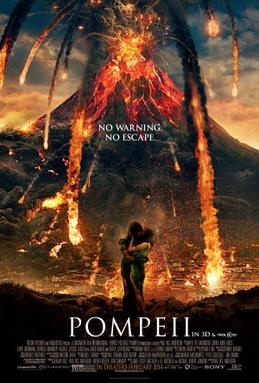
It was on.  Nothing else was on.  An old recipe–

*2 tsps. hunk from “The Wall” on Game of Thrones (Kit Harrington)

*1 lb. Gladiator, including a contest in the arena based on a Roman conquest where our hero commands an ahistorical result, an African gladiator who becomes our protagonist’s friend and soul mate, a knock-off of the ghostly Hans Zimmer score, and a baddie (Kiefer Sutherland) who wants to put his thumb down but must turn it up lest he lose the favor of the people

*1/2 lb. Titanic, including star-crossed lovers from different backgrounds, looming disaster, a chase through the beleaguered city as time runs short, and laugh-out-loud funny anachronistic dialogue, mostly from our Kate Winsletian heroine, Emily Browning (“Men killing each other for amusement is not a sport”; “Senator, you have mistaken me for the kind of woman who drapes herself across your lap in Rome“; “He made me feel… safe. “

* 12 lbs. of crazy ass CGI

It cost $100 million to make and made $110 million at the box office worldwide, so Pompeii II: The Reaping has probably been avoided.

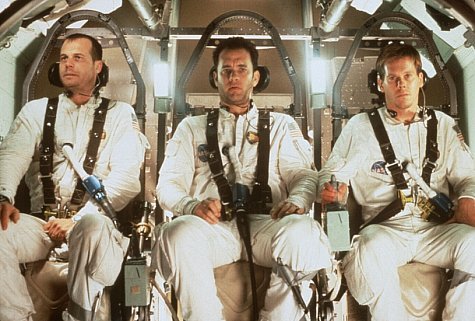
A thrilling and engaging piece of Americana and an homage to national ingenuity and purpose, this is the kind of film you hope your children watch (jocks and geeks and in-between alike, for they are all celebrated and shown as peers) and thereafter, become inspired.  I was surprised at how white-knuckle the re-creation of the near-doomed mission felt given I knew the outcome (Spoiler – the crew of Apollo 13 survived), but this is really edge-of-your-seat fare.

The performances are all excellent. Tom Hanks as mission commander Jim Lovell is hitting right in his sweet spot, the decent, measured everyman of Saving Private Ryan, Castaway and Philadelphia, and he is ably supported by Bill Paxton (a likeable but ever weakening Fred Haise) and Kevin Bacon (as Jack Swigert, added to the mission at the last minute, both defensive and independent). On the ground at home, Kathleen Quinlan is steely and vulnerable as Lovell’s wife, she underplays a role that is stock and often butchered by over drama (see Madeline Stowe as the suffering wife in We Were Soldiers), and she was deservedly nominated for Best Supporting Actress.  In Houston, it is a cast of seemingly thousands, led by Ed Harris as NASA Flight Director Gene Kranz, who work tirelessly to bring the crew back home to earth safely. At every moment, you recognize another character and/or commercial actor and say, “oh, yeah, he was in . . . .”

A year after the stunning visuals of Gravity, I expected the 20 year old Apollo 13 to feel dated. It does not.  But this is not a picture featuring aesthetics, but rather, the resourcefulness of all types of individuals engaged in a grand effort during a harrowing rescue mission, told without schmaltz or thick reverence.  The immediacy of the film comes in part from the fact that the dialogue between Houston and the astronauts is near verbatim from transcripts and recordings, and Hanks, Paxton and Bacon were all trained at NASA’s space camp in Huntsville, AL.  It’s Ron Howard’s best picture.