Archive

Historical

Image result for The Pianist

Roman Polanski won best director and Adrien Brody won best actor, so I expected something special.  I was disappointed. The story of a Polish pianist and his grueling fight for survival during the Nazi occupation (and extermination) of Warsaw depends on one caring for the lead (Brody). And to the extent one cares for any human made to endure unendurable suffering, the film carries you through.  But it becomes more of an assignment than an enjoyment. Brody is a blank slate in freedom and notoriety (he is a well known musician), and he becomes even less interesting during the Nazi occupation (most of which he spends hiding in apartments provided to him by sympathetic non-Jewish Poles).

The picture is beautiful – the scenes of a devastated Jewish ghetto are particularly memorable.  And the slow, desperate demise of Brody’s family, who incur one withdrawn right after another while managing to stick together, is affecting.  But the film is 150 minutes long, and the family loses its struggle about half way through.  That leaves us Brody.  He is not enough, and soon, the film becomes tedious and stubborn.  Many characters help Brody (from an old flame to fellow musicians to a Nazi collaborator to a Nazi officer), but we don’t get to know them.  Polanski is content to stay with Brody as he becomes more emaciated and desperate, and in the end, little more than a caged animal.  To the extent Polanski wants to demonstrate that even through the most awful of horrors, people can survive and return to the pre-horror life relatively undamaged, The Pianist succeeds.  But as drawn in the film, it’s a minor success.

24 Hour Party People quad poster.jpg

Michael Winterbottom’s time capsule sells itself as a rendering of the birth of the rave culture.  In fact, as the film’s protagonist – Manchester television personality and producer Tony Wilson – constantly informs us in fourth wall breaking break away chats and insights made directly to the camera, the film is about at least a half dozen things: Manchester itself, the rave culture, the birth of what I then-called the British moany-boy bands (Joy Division, New Order), punk, “selling out”, and the comforts of being the next big thing.

The picture has been reviewed in the following manner: “if you liked New Order, you’ll . . . “, as if enjoying the music is intrinsic to enjoying the picture.  Untrue. The picture is sharp and funny, regardless of whether you dig the music at its center (I never did).  Indeed, Winterbottom explicitly dispenses with the necessity of the bands being good.  With the constant wild Kurt Loderesque accolades to the bands (there are even two “geniuses”), Winterbottom is mocking the creation of mini-gods to fuel the gravy train.

Smartly filmed, sometimes gonzo, always electric, and all the performances – especially Steve Coogan’s Wilson (our self-interested cum true-believer-in-the-music guide) are tops.

The Last Samurai - Wikipedia

Tom Cruise is a dissipated, drunken Civil War vet who slaughtered women and children Indians (at the evil Tony Goldwyn’s behest) and must atone and “find himself” in the mystical East.

I’m not a Tom Cruise hater.  His effort is incomparable and he’s a star, in that, most everything he does on screen, if not interesting, is watchable. But he has two huge drawbacks.  First, he’s eternally youthful and thus, cannot effectively be world-weary.  Second, he is just weird in period pieces.  I didn’t like Cold Mountain, but Jude Law struck me as a man of his time and thus lent the film authenticity.  Cruise, on the other hand, is hopelessly 21st century and appears on the cusp of saying “Dude” a few times.

He is not helped by this hackneyed, American-hating, simplistic piece of garbage that is the script.

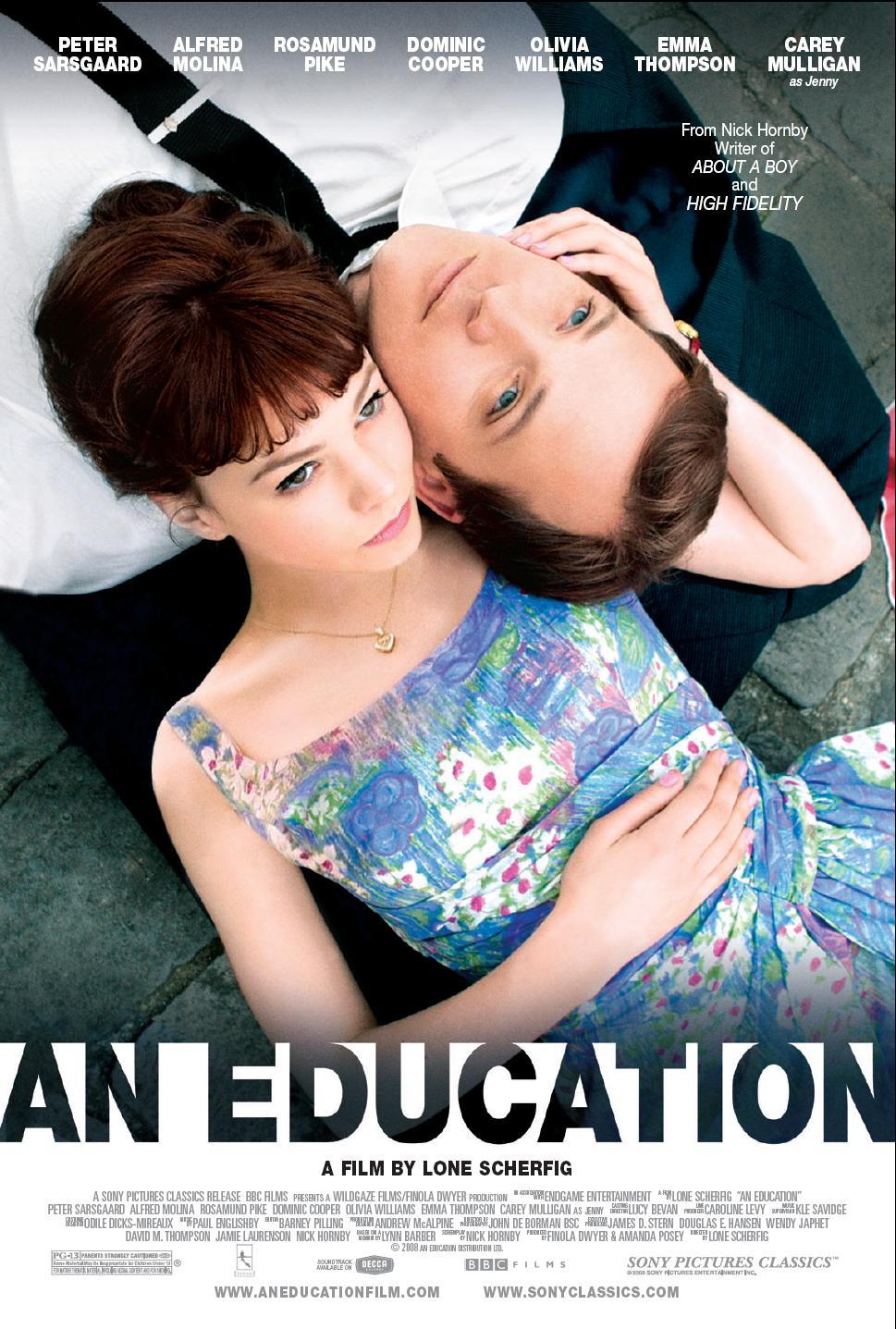
An Education (2009) - IMDb

A fine period (1961 Twickenham, London, Paris) and coming of age piece, anchored by a very engaging Carey Mulligan as a 16 year old schoolgirl who dreams of Oxford until she is swept off her feet by an older, debonair man (Peter Sarsgaard).  She is nearly derailed by his machinations and the misguidance of her parents, who want to protect her but also want her to be happy (and presumably, not like the protagonist in McCartney’s “She’s Leaving Home”).  Scripted by Nick Hornby and directed by Lone Scherfig, who has a knack for the travails of young women in earlier times (see Their Finest).

But this is no more than a nice little film, and the idea that it was nominated for Best Picture is just one more example of the awkwardness of ten such nominations.

The King's Speech - Movie Review - The Austin Chronicle

If not exceptional, the film is a competent and beautifully appointed period piece. The Oscar nominations of Colin Firth and Helena Bonham Carter are well deserved.  As King George, Firth encapsulates the insecurity and terror of a man thrust into power who fears he will be found wanting, or even an imbecile, such is his speech impediment. As Firth’s wife, Bonham Carter deftly plays the role of droll, drawing room observer as well as the rock that supports her husband. Their bond is authentic.

The interplay between George VI and his speech therapist (Geoffrey Rush) is funny and very well written, and the introduction of modern psychology to the era’s infantile methods of treatment for the speech malady is interesting.

Guy Pearce also contributes as the callow Edward, leaving his brother and country in the lurch for that Baltimore tramp.

Time Magazine's 'Person of the Year' since 1927 | Wallis simpson,  Socialite, Wallis

Red Riding Trilogy (1974 1980 1983) : Movies & TV - Amazon.com

A British television production released theatrically in the U.S., the story is set against a backdrop of serial murders in the north of England, including the Yorkshire Ripper case. The investigation is covered in three installments: 1974, 1980 and 1983. Though the murders are the central focus, this is really a rich and gritty story about police corruption and the strain of the cases on the police and the community. I liken it to David Fincher’s masterpiece Zodiac. Brilliant.