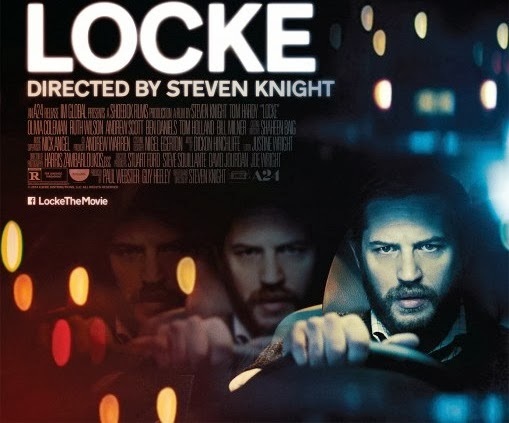
My first thought before watching Locke was of Hitchcock’s Rope, a film remembered more for the gimmick of no cuts than its merit. With an entire film consisting of hands free cell phone conversations from a car, I was primed to evaluate how the director handled such a limited visual scope. It’s a testament to the film that 10 minutes in, I never once gave another thought to that limitation. Ivan Locke (Tom Hardy) is a precise, obsessive construction manager, and on the eve of his greatest work triumph, his personal and professional lives implode, a disaster made worse by his determination to do one thing above all others. As he travels to his destination, he attempts to cobble together the fragments of his shattered life while figuratively sparring with the ghost of his deceased father in the backseat. Hardy, who seems to get every plum role these days, goes a good way to explaining why here. He is riveting and he expands his physical constrictions, evoking desperation, skill and even some gallows humor in the process. This is an audacious, confident second feature by writer director Stephen Knight, who I am pleased to report is writing the forthcoming World War Z 2.
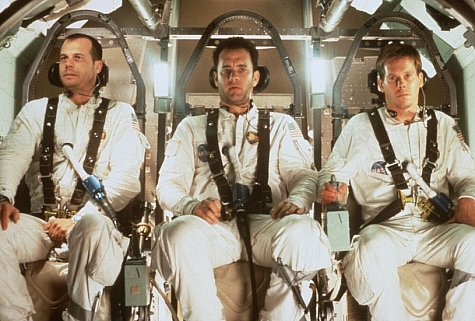
A thrilling and engaging piece of Americana and an homage to national ingenuity and purpose, this is the kind of film you hope your children watch (jocks and geeks and in-between alike, for they are all celebrated and shown as peers) and thereafter, become inspired. I was surprised at how white-knuckle the re-creation of the near-doomed mission felt given I knew the outcome (Spoiler – the crew of Apollo 13 survived), but this is really edge-of-your-seat fare.
The performances are all excellent. Tom Hanks as mission commander Jim Lovell is hitting right in his sweet spot, the decent, measured everyman of Saving Private Ryan, Castaway and Philadelphia, and he is ably supported by Bill Paxton (a likeable but ever weakening Fred Haise) and Kevin Bacon (as Jack Swigert, added to the mission at the last minute, both defensive and independent). On the ground at home, Kathleen Quinlan is steely and vulnerable as Lovell’s wife, she underplays a role that is stock and often butchered by over drama (see Madeline Stowe as the suffering wife in We Were Soldiers), and she was deservedly nominated for Best Supporting Actress. In Houston, it is a cast of seemingly thousands, led by Ed Harris as NASA Flight Director Gene Kranz, who work tirelessly to bring the crew back home to earth safely. At every moment, you recognize another character and/or commercial actor and say, “oh, yeah, he was in . . . .”
A year after the stunning visuals of Gravity, I expected the 20 year old Apollo 13 to feel dated. It does not. But this is not a picture featuring aesthetics, but rather, the resourcefulness of all types of individuals engaged in a grand effort during a harrowing rescue mission, told without schmaltz or thick reverence. The immediacy of the film comes in part from the fact that the dialogue between Houston and the astronauts is near verbatim from transcripts and recordings, and Hanks, Paxton and Bacon were all trained at NASA’s space camp in Huntsville, AL. It’s Ron Howard’s best picture.
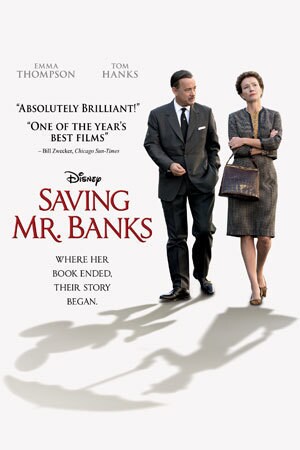
The writer of the Mary Poppins books, P.L. Travers, was apparently such a pain in the ass that, according to her grandchildren, she “died loving no one and with no one loving her.” As played by Emma Thompson, Travers more than fits this bill as she is whisked to Hollywood against her better instincts to be wooed by Walt Disney (Tom Hanks) in an effort to adapt her stories to the screen. Travers’ prickliness and exactitude with Disney and his team (Bradley Whitford, Jason Schwartzmann and B.J. Novak, all very good here) is the best part of the film. Unfortunately, director John Lee Hancock (The Blind Side) keeps interrupting the best part with flashbacks to Travers’ childhood, and in particular, her relationship with her whimsical, alcoholic father (Colin Farrell).
I understand the juxtaposition. The audience is supposed to learn what has embittered this awful woman. But you really don’t care (she’s such a witch that motivation is irrelevant), and you also begin to resent the interruption of the more interesting creation of a film.
Worse, the technique is cloying, leading to a sugary-sweet ending that has Disney melting the ice encasing Travers’ heart. In reality, Disney and Travers ended their relationship in acrimonious fashion, with Disney fed up with her stubborn nature, and Travers so offended she refused any further association between the company and her books. The disharmony is alluded to in the film, but it is near-blotted out by Travers’ copious tears as she undergoes a sort of catharsis at Grauman’s Chinese Theater.
Those were actually tears of fury. From Travers herself: “As chalk is to cheese, so is the film to the book. Tears ran down my cheeks because it was all so distorted. I was so shocked I felt that I would never write—let alone smile—again!”
Noah is a modern day environmentalist/pacifist who is also a vegetarian, fights the rape of the land, and communes with Transformer-like monsters/fallen angels (it was quite a shock to learn that Optimus Prime was so critical to the Old Testament). God tells him to save the innocent; the animals. He complies.
Unfortunately for us, neither God or Noah cannot save this dreary and ponderous story nor can they remedy Darren Aronofsky’s leaden direction. I was surprised by James Gunn’s ability to handle a broad and sweeping epic in Guardians of the Galaxy given his prior experience with smaller films. In Noah, Aronofsky, who also has little experience with big films, does not surprise. He is completely lost visually, primarily relying on a slow backward tracking shot to say BIG! Some of the CGI, and there is a lot of it, looks as silly as Harry Hamlin-age Clash of the Titans. The script, which Aronofsky co-wrote, is a repetitive mix of New Age blather (birds arrive and Crowe intones, “it begins”) and mundane domestic drama. The performances are rote, good actors intuiting “this is biblical” which they apparently perceive as solemn.
On the plus side, the making of this film means at least one less Aronofsky ode to masochism and sadism (although Aronofsky does let Russell Crowe sing again).
You also get the sense Aronofsky feels the film is getting away from him, so he relies more on Noah’s trippy dreams and his story of creation (a psychedelic light show and some stop-action photography), and indeed, they are welcome respites from the numbing dialogue.
On the heels of Robin Williams suicide, I thought I’d review one his few films I liked. In Gus Van Sant’s drama, written by Matt Damon and Ben Affleck, Williams plays a community college professor and psychologist. With his MIT credentials, he could have been a big deal but was waylaid by love and is now stricken with grief at her passing.
When William is introduced to guide the damaged savant, Will Hunting (Damon), we know that when all is said and done, both characters will have taught each other something valuable about life.
A lot can go wrong here.
But Van Sant keeps it even. Williams is smartly subdued, with no hint of the manic persona that became more schtick and adrenaline than acting. He is patient, picks his spots and elevates much of the film’s schmaltz with real pathos. When he is riled, it feels authentic and raw.
As for the film itself, I’ve always been torn. The concept is smart. A working-class Boston kid is also a genius, sadly mopping floors at MIT, but he finds a way to shine and then falls in love and then, through therapy, grows out of his limiting, Southie world. Van Sant’s direction is inventive (the slo-motion rumble to Gerry Rafferty’s “Baker Street” is particularly nifty, and there are many such cool touches); the exchanges between the Southie pals (Damon, Ben Affleck – again, proving he can be very good in small doses – Casey Affleck and Cole Hauser) are believable, very natural, and often hilarious; there is actual heat between Damon and his romantic interest, Minnie Driver; and Elliot Smith’s musical contributions are hauntingly memorable.
On the downside, while Damon is quite good as the lead, his character is kind of one big cheat. Plagued by his own demons, we are supposed to empathize with Will, but he is a selfish, smug prick throughout, just about every assist you can give a modern protagonist – he’s lonely, he was shuttled from foster home to foster home, he was beaten as a child, his enemies are grotesque caricatures that lack only the villain’s mwahahahahahaha, and yet …
Here, Will goes toe-to-toe a snooty Harvard type:
Obviously, the Hah-vahhhd pony-tail is the bad guy (on the strength of the pony tail alone), but much of the film is sneering at the uptight folks who admire his genius and do him no injustice.
It reminded me of Walker Percy’s The Thanatos Syndrome: “There’s Hawkeye and Trapper John back in Korea. I never did like those guys. They fancied themselves super-decent and super-tolerant, but actually had no use for anyone who was not exactly like them. What they were was super-pleased with themselves. In truth, they were the real bigots, and phony at that. I always preferred Frank Burns, the stuffy, unpopular doc, a sincere bigot.”
So, as the music swells, and Will escapes the clutches of Southie to chase love, I’m pretty sure he’s going to revert to being a smug prick soon enough. Only now, Minnie Driver will be there to socialize him.
When Rain Man came out, I enjoyed it, but soon came to sour on the film for its easy emotional manipulation and an affected star turn by Dustin Hoffman. I didn’t credit Hoffman the prescience of Robert Downey Jr. in Tropic Thunder (“never go full retard”) and found Hoffman’s portrayal of an autistic adult unsubtle and obvious. Perhaps had I waited until Al Pacino’s blind rampage in Scent of a Woman, I would have been more forgiving.
Pauline Kael called it “a piece of wet kitsch” and I can’t say I could have disagreed. Rain Man has always maintained a spot in the pantheon of overpraised domestic drama Oscar winners that, I assumed, would age very ungracefully (see Forrest Gump, American Beauty, Crash).
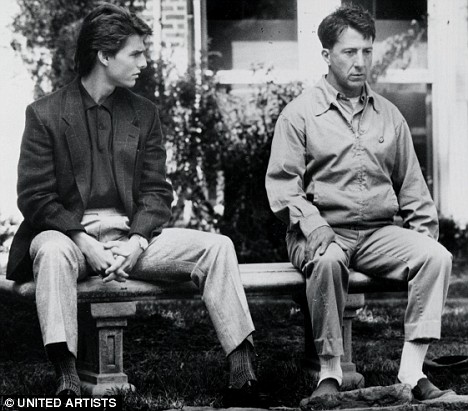
Rain Man has hit the schedule on my pay movie channels, and yes, it is emotionally manipulative and yes, it does sport some of the more annoying hallmarks of the 80s (a Hans Zimmer synthesized score that would put him on the map, a few too many montage scenes, a gorgeous and pointless female lead, Valeria Golino, who came and went). But Hoffman’s performance as a hidden older brother to Tom Cruise (Cruise learns of him upon their wealthy father’s death and “kidnaps” him to have an edge in getting his share of the will) is very strong. What unfortunately became represented by cute catchphrases (“I’m an excellent driver”, “10 minutes to Wapner”) is actually a canny, deep portrayal of a tortured soul, and director Barry Levinson never really lets you forget the dangers that lie therein. Much like Bradley Cooper in Silver Linings Playbook, Hoffman is endearing until he is terrifying, and at exactly the moment Spielberg would have inserted treacle, Levinson has Hoffman explode again.
Tom Cruise is even better in his role as Hoffman’s wheeler-dealer, LA smooth brother, Ray. His frustration with Hoffman is communal. His entire performance is a study in anger at Hoffman, not for being denied his loving company or for being shut out by his father, but because Hoffman is an annoying lunatic. “I know you’re in there somewhere,” he screams, and while he undergoes change in his time with the afflicted Hoffman, he does not become redeemed so much as educated.
The film is also very, very funny, perhaps too much so for our times. I can imagine grievance groups objecting to the use of an autistic adult for chuckles, but the screenwriters’ (Barry Morrow and Ronald Bass, the former of whom, like Golino, pretty much disappeared after this film) don’t pull many punches and the exchanges between Hoffman and Cruise are often brutally comic:
The best sports movie ever made, a character-driven blend of sentimentality and tension that dramatizes the football culture on a small, poor Texas town. Every trope that is bandied about by lesser sports films is obliterated, yet, the film doesn’t reject the formula. There are gridiron heroes, strong women who stand behind them, racial undertones, father-son generational combat and an obligatory half time speech.
But compare the ridiculous grandiosity and easy message of most any sports film with the replication of the game in this picture and you’ll find there is no comparison. The women are actual characters, not noble support. The racial issues are genuine and near imperceptible, the blacks don’t exist to teach the whites to dance, and the whites don’t exist for the confession of absolution. The father son dynamic between Tim McGraw and Garrett Hedlund is incredibly moving and Billy Bob Thornton’s halftime speech is poetry.
This is a beautifully acted film, as much about a community as the players, and I’m moved every time I see it. Never more so than by Derek Luke’s work in this scene:
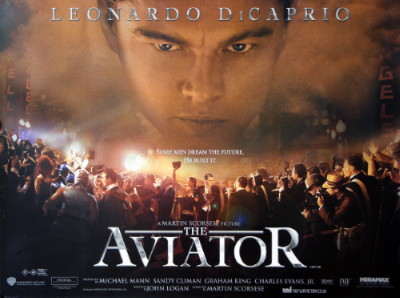
Martin Scorsese’s critically acclaimed biopic of the young-to-middle age Howard Hughes (Leonardo DiCaprio) has much to recommend it. It was the first role that established DiCaprio as a force, and in inhabiting the kinetic, driven and tortured character of Hughes, he was able to shuck off the callowness of his characters in Titanic (Jack London: Teen Wolf!), The Beach and Catch Me if You Can. His time to become a leading “man” had arrived (his attempt at a mature character in Gangs of New York was undermined by the garish nature of the picture, Daniel Day Lewis’s battering ram of a counter-performance and what appeared to be DiCaprio’s own discomfort in the role).
The film is also visually stunning. Scorsese is usually the king of movement in tight spaces, but the sky liberates his eye, and the scenes of flying (there are five) are vast and poetic, and for the ones that end in crashes, utterly thrilling.
When Scorsese is on the ground, the film does not suffer. His glitzy pre-war Los Angeles, where the parties are populated by the likes of Errol Flynn (a jaunty Jude Law) and Ava Gardner (a tough, motherly Kate Beckinsale), are eye-popping.
Finally, the choices of Scorsese and screenwriter John Logan (Gladiator, Sweeney Todd, Skyfall) are adept. Rather than focus on the breadth of Hughes’s life, they opt to show him at his most vibrant, while giving ever-increasing glimpses of the madness that would grip and eventually consume him later in life. For an almost 3 hour film, it’s clear they could have shot for Hughes in the 70s, surrounded by a Mormon coterie and the madness that it protected. By skillfully giving us the symptoms, they economically finish the story.
So, what’s not to like? While DiCaprio and Alan Alda (playing Hughes’s nemesis, the slimy Senator Owen Brewster) were rightfully nominated, though they did not win, so too was Cate Blanchett as Hughes’s love interest Katherine Hepburn, and she actually took home the Best Supporting Actress statuette.
To call her performance cartoonish is a gross understatement. It’s manic, ludicrous mimicry.
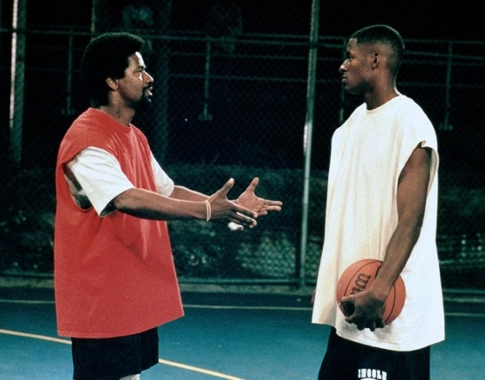
This is one of Spike Lee’s better films, an audacious picture of Americana (scored by Aaron Copland no less) that both mythologizes and indicts the sports culture while dramatizing the strained relationship between a convict father (Denzel Washington) and his son (Ray Allen), a prized high school basketball recruit. Washington is released from Attica with the promise of a lessened sentence if he can convince Allen to sign with the governor’s alma mater. He has one week to do it, and has to overcome several hurdles, the greatest of which is the fact that he is in jail for accidentally killing Allen’s mother in a domestic fight.
As in Summer of Sam, Lee’s appetite is enormous, and he typically tries to tackle too many issues in this sweeping story. He also includes a pointless subplot between Washington and a prostitute (Milla Jojovich) and indulges in his unfortunate penchant for speeches (Roger Guenveur Smith plays the local crime boss and delivers a PSA soliloquy on all the perils of fame that brings the picture to a screeching halt). But at the heart of the picture is Lee’s love for basketball, which he portrays as something truly majestic and unifying, skillfully interspersing old footage to punctuate the revered history of the game.
Washington is also commanding as the father who drove his son to succeed, and we see in him the love as well as the excesses of a parent who wants too much for his child. The scenes of a younger Washington pushing his little boy to be Jordan and their later one-on-one are beautiful and heartbreaking. Allen, an acting novice, does surprisingly well as the son, communicating the wonder of it all as the world opens itself for him.
This is a flawed picture, but Lee is working from the heart and shooting for the stars and it shows.
As biopics go, this one is near the top, a sprawling, textured story of fame, fall, passion and redemption that can’t avoid cliche’ but never nears cheezy.
Joaquin Phoenix doesn’t embody Johnny Cash so much as incorporate him into his own personality. His performance feels roots deep rather than technically proficient (see Jim Carrey as Andy Kaufman in The Man in the Moon for an example of the latter), enhancing your investment in Cash’s plight. Phoenix does all his own singing and his vocals are deeper and more frenetic than those of Cash (his live version of “Cocaine Blues” at Folsom Prison is more fevered and angry than Cash’s performance), but they feel real, especially when matched with Reese Witherspoon’s brassy bid as June Carter. James Mangold’s film is ostensibly the love story of Cash and Carter, but his attention to the music is the glue to the picture. The supporting players in the roles of Jerry Lee Lewis, Roy Orbison and Elvis are all musicians also doing their own singing. And the scene of Cash’s audition is notable not only for the tension and the dissertation on what goes into music people want to listen to, but for the riveting turn of Dallas Roberts as producer Sam Phillips. Talk about making the most of your one scene.
If there are weaknesses, one is self-inflicted and one is a related injury. Cash’s demons stem from the childhood trauma of his brother’s death, after which he felt unworthy and guilty. His father (Robert Patric) didn’t help when immediately after the funeral, he yelled at a grieving little boy, “he took the wrong son!” Now, perhaps this happened. But even if it did, the screenwriter has to jettison historical accuracy for good sense. It’s too incredible, too jarring, to believe. Worse, it became the centerpiece joke of the Walk the Line spoof, Walk Hard: The Dewey Cox Story.
The effect is much like that of Austin Powers on the prior James Bond films, changing them in your mind from occasionally fun and campy to wholly ridiculous. Another nit is the unfair treatment of Cash’s first wife, who is portrayed as so shrill and shrewish it feels unfair.



 filmvetter