Archive

Drama

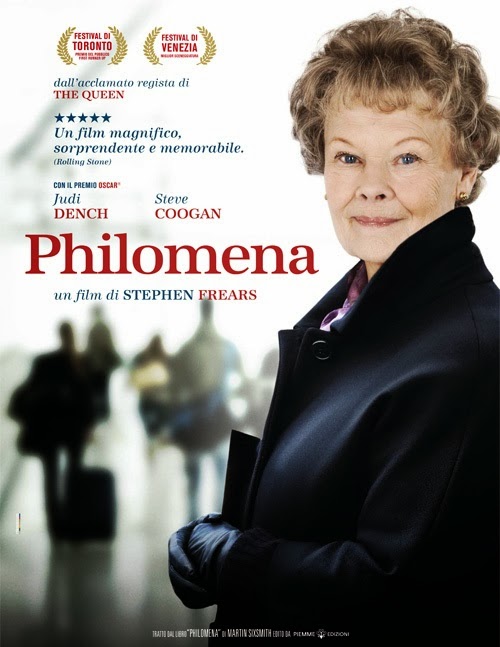
This Oscar nominated film got past me in 2013, and I am all the sorrier for it. Judi Dench is Philomena, a provincial, sweet Irish retiree in London who, living with her adult daughter, reveals a long-hidden secret – that she gave birth to a son in Ireland out of wedlock in the 1950s, and subsequently, was forced into labor in a Catholic abbey as penance while her child was relocated, at a price, to the United States. Philomena’s daughter enlists the assistance of a recently sacked Blair-administration official, Martin Sixsmith (Steve Coogan), who, grudgingly and rather condescendingly takes on her “human interest” story to find her son. What follows is a trip (yes, another Steve Coogan trip movie), first to the abbey, and them after receiving no help there, to America. Along the way, Coogan’s cynicism, self-importance and emptiness tangles with Dench’s faith, sincerity and essential decency.

This is a beautiful, kind-hearted, witty movie. Dench is moving as a mother haunted by the absence of a child she kept firmly in her mind (the nuns at the abbey allowed the shamed mothers to visit their children an hour a day, making their inevitable separation even more traumatic), and Coogan is firmly cold-hearted and self-pitying without being a caricature. Their scenes together are sensitive and comedic without lapsing into treacle or schmaltz, and the impact each has on the other is believable.  My only mild criticisms are a few too-cute moments for Dench and a juiced-up ending, pouring it on the nuns.  While it works dramatically, it paints a picture even the real Philomena was uncomfortable with, and upon reflection, it’s too much (we are provided an evil nun who spits a final rejoinder of, “self-denial and mortification of the flesh is what brings us closer to God. These girls have no one to blame except themselves”).

Nonetheless, this is largely true to the incredible true story, and I can’t recommend it enough.

image

J.C. Shandor wrote and directed my favorite film of 2011, Margin Call, a verbose, intricate “what if?” financial thriller set before the crash of 2008. Last year, Shandor made the critically acclaimed All is Lost, a tale of survival on the sea starring Robert Redford and featuring a script of a mere 31 pages (it is now on Netflix streaming but I’ve neglected to see it). If there was any doubt, Shandor’s third film cements that he has no interest in doing the same thing again.  A Most Violent Year is the anti-crime picture, a meticulous thriller set in the suburbs of 1981 New York City revolving around the intricacies and corruption of . . . the home heating oil business. Oscar Isaac and Jessica Chastain are a married couple working to expand their reach in the business, in the face of union troubles, a prosecutor’s investigation, the hijacking of their trucks and the intimidation of their sales force. Isaac, an immigrant, is resolute in combating these obstacles in a legal and above-board manner. Chastain is the daughter of a mob boss, and her fealty to the straight-and-narrow is less stringent. As the screws turn, you think you can see where this is going.  You’re wrong.

Chandor’s medium cool meditation emphasizes Isaac’s passion, ethics, and larger vision and while the stakes are small in the scheme of things, to Isaac, they are everything, and Shandor effectively invests the audience in his struggle without infusing the narrative with the expected fleshy, pulpy, satisfying retributive violence. I’ll admit:  bloodletting is what I wanted and expected and as the tension mounted, Chandor’s resolution felt unsatisfying. In that way, Chandor transforms the genre.

This is an ingenious, unique movie.  Chandor’s feel for 80s New York is sharp, his pacing is tight and he never veers far from the heart of the picture, the unswerving devotion of Isaac and Chastain to their business and to each other. Their performances are riveting; they feel like a married couple who melded passionately but never addressed longstanding disputes in their view of the world.  Like a real married couple.

One of the best of the year.

image

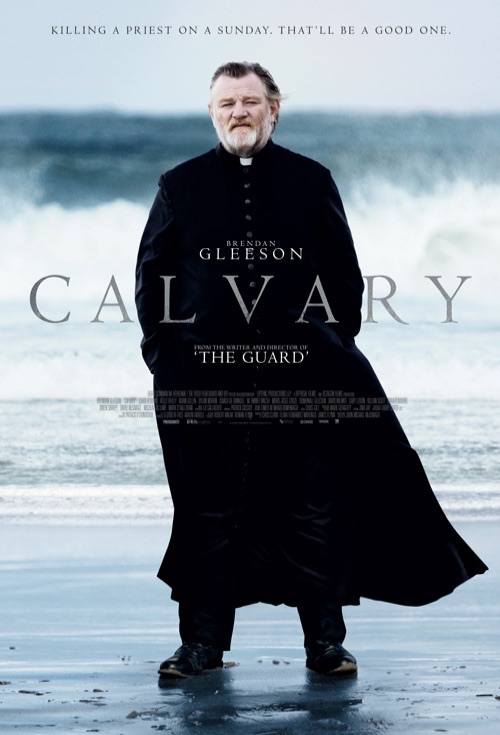
John Michael McDonagh’s The Guard was one of the best films of 2011, a sharp, wry, talky culture clash comedy that pitted straight laced federal agent Don Cheadle against the blustering, Irish provocateur Brendan Gleeson. In Calvary, Gleeson is again McDonagh’s center as a Catholic priest tending to an Irish seaside community. The film opens in the confessional, with a man telling Gleeson that in 7 days time, he will meet him on the beach and murder him. What follows is a depiction of Gleeson’s role in a town in transition culturally, economically and spiritually, where Gleeson’s faith is tested time and time again. McDonagh has crafted a compelling parable, deep with import.  It also stands as one of the few films that conveys the centrality of religion in a particular modern locale (The Apostle comes to mind but that was set in the American South, which is in many ways archaic)Yet, as much as the film is steeped in the story of the New Testament, it is thoroughly modern, as Gleeson is mocked, goaded and pitied by a flock that considers him a joke from days gone past yet are drawn to his authority and the promise of understanding and guidance.

This sounds very heavy and yet, McDonagh’s strength is his keen grasp of the unique Irish patter, with its unyielding thrust and parry.  The dialogue is razor sharp and bitingly funny, and when these characters get past the language that insulates them, an almost national dialogue, revelation of their pain is truly moving.  One of the best of the year, and while the crimes of the Academy are many, the omission of Gleeson and the screenplay for nominations is, keeping in a religious vein, an abomination.

image

Downton Abbey is a hugely successful period British soap opera that is anachronistic, predictable and overwrought.  The Imitation Game is Downton Abbey for the movies.  Alan Turing (Benedict Cumberbatch) is the Sheldon Cooper of World War II; brilliant, odd, effeminate and humor impaired, and he is tasked with cracking the Nazi Enigma code.  He does so, with the help of Keira Knightley and Matthew Goode and an actor from Downton Abbey, all the while struggling with his sexuality, his anti-social personality and a race against the clock.

There is not much in the film that isn’t expected.  After alienating his colleagues, Turing wins them over.  After being quirky, we are charmed and in his corner.  After connecting with a teen friend in boarding school in flashback, the boy dies. After that boy tells Turing, “Sometimes it is the people who no one imagines anything of who do the things that no one can imagine,” that line is delivered again and then again.  After the team cracks the code, they immediately pinpoint the location of every ship in the Atlantic and deduce that a passenger ship is in danger, but they can’t save it, because it would give their achievement away to the Nazis, and then, it turns out the brother of a team member is on the ship in danger, and he tells Turing he can’t be God.

Cumberbatch is good in parts, but it is a mannered, tic-laden performance, one that eschews every one of the relationships he is supposed to develop.  You don’t believe he has bonded with his co-workers and you sure don’t believe he and Knightley have established an intellectual kinship.  Curiously, Turing’s homosexuality is successfully used against him – when he discovers a Soviet spy in his midst, the spy threatens to reveal Turing’s sexual orientation and Turing clams up.  And how did the spy come to learn Turing was gay?  When Turing became engaged to Knightley to keep her on the team, after treating his sexuality as a state secret, he rather comfortably tells the spy his personal business.

Another problem is the insistence on establishing a suffering symbol for homosexuality, a dramatic decision that has plagued African American characters in historical films for eons.  The real Turing was pretty openly gay with his co-workers, even coming on to several male colleagues.  Now that is interesting.  But we need a noble victim here so, let’s just forget the stubborn and inconvenient facts.  It is one thing to amp up Turing’s role in creating the device that breaks the German code.  It’s another to change his very essence to deliver us our important lesson.

But its British, it’s topical, it has sweep and it is a tragedy anchored by Cumberbatch’s Oscar bait tears and quivers.  So, it is heralded.  But when it is not being ridiculous and ahistorical, it is pedestrian.

A beautiful film, lovingly rendered by Richard Linklater, who has an affinity for passage of time and coming of age stories.  His Julie Delpy-Ethan Hawke Before trio of films similarly plumbed a relationship over the years and Dazed and Confused is perhaps the best coming of age film ever made. Shot a short period of every year over a 12 year period, Linklater presents the life of a family (Patricia Arquette, Ethan Hawke, son Ellar Coltrane and daughter Lorelie Linklater) from 2002 through 2013.  We see the kids grow up before our eyes, as well as mother Arquette through two post-Hawke relationships and father Hawke through maturation from free spirit, bohemian divorcee’ to a more grounded, traditional man, with a second wife and child.  The exchanges are utterly believable and poignant, in particular, those between Coltrane and Hawke. The leads, with an exception below, are very good, and the authenticity of the endeavor is enhanced by their restrained performances.  Linklater’s treatment of the transient characters – Arquette’s two troubled husbands, the boy’s high school teacher and boss at work, and the others who comprise his support group – is deft and even-handed.  Missing are the histrionics of most any family drama or the easy lessons and dawnings that infect the coming of age genre.

There are two problems with the picture, neither insignificant nor crippling. First, unlike Hawke, who appears to have meticulously studied his character as a changing being, Arquette is static in her role as the boy’s mother. Some of this is attributable to the stolid nature of her character, but when, as Coltrane is about to depart for college, she breaks, Arquette doesn’t have the chops to deliver the scene, and what Linklater has her deliver – a surprising, almost narcissistic “what about me?” plea – is atonal and off-putting.  The film is also too long. The last stretch, covering the son’s high school and entry to college, traverses from languid to drowsy.

Still, a deserved Best Picture nominee and groundbreaking in its production.  As Linklater noted in a recent interview, “you talk to business people, and they couldn’t get their heads around it. They were like, ‘What? We can’t see any of the film before it’s finished? And we don’t get our money back for 13 years?’ All of that makes people insecure . . . The idea that an executive at a company anywhere in this business would green-light it and still be there 12 years later – that’s a statistical anomaly. So if a film like this never gets made again it’ll be for those reasons.”


image

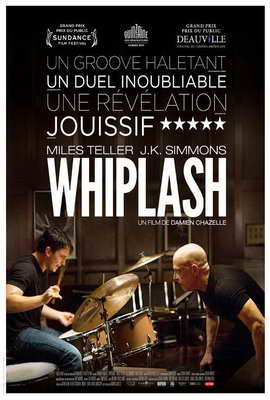
The best film in what has been a very strong year, writer-director Damien Chazell’s story of a 19-year-old jazz drummer (Miles Teller) and his relationship with his driven jazz teacher, played by J.K. Simmons, is flawlessly delivered and thought-provoking. Teller aspires to be the next Buddy Rich, and matriculates at the best music school in the country.  Simmons chooses him to join his ensemble, a stepping stone to greatness but also, an invitation to the meat grinder of abuse handed out by the demanding, mercurial instructor.

The story avoids every pitfall and expected plot turn of a feature film, yet it is not contrary for the sake of it. You can count on two hands the places a more pedestrian picture would take you, and the resolutions it would offer, but in service of a better narrative, Whiplash rejects the certainty of the tried and true, instead allowing the audience to come to their own conclusions.

The film is also about something, exploring the nature of greatness and what is necessary to achieve it; the limits of drive and the intersection of ego and cause; the meaning of teaching; and the changes and struggles between nature and nurture, raising children, molding character and demanding perfection. At one point, Simmons remarks, “There are no two words in the English language more harmful than good job,” and while that may play well to the instincts of some, he is such a flawed deliverer of the message, the audience is forced to question such an ethos knowing it will be practiced by such people.  I saw the film with my wife, my college-age daughter, and my high school-age son, and we talked about it – and I’m confident will continue to do so – for some time.

The film is evenhanded, a trait best represented in its depiction of minor characters. In a family dinner scene, Teller’s family, who appear casually condescending towards his achievements, are also perfectly decent, pushing back at his obnoxious “tortured artist” routine with annoyance but also concern and patience.  When Teller is approached by an attorney who represents a student allegedly harmed by Simmons’ practices, she does not lick her chops.

The picture is also stunningly confident, an achievement made even more impressive by its 19 day shooting schedule and $3.1 million budget.  Clint Eastwood released a film about music earlier this year, and he should have consulted Chazell about how to make Jersey Boys less static, less turgid. Whiplash is loaded with musical numbers played by stationary figures, but the camera riffs along with notes, constantly in motion, and like the art form it dramatizes, it is inventive and surprising.

I can’t commend the performances of Teller and Simmons enough.  They are both entirely natural and convincing, Teller conveying the conflicting hubris and hesitation of an ambitious yet shy young man, Simmons the grandiosity and brutality of the committed, brilliant instructor, inspiring one minute, petty the next.

Finally, Chazell has done something that is very rare in film. I suppose there are some folks who see Gladiator and think, “Hmmm. Roman history looks interesting. I might take a look into that.” But not many. Conversely, by his own depiction of the music, and the dramatization of love for it through the eyes of Teller and Simmons, I’m confident that many people who see Whiplash will one day look back at it as their entrée to jazz. That may be my enthusiasm for the picture talking (I’m not a jazz enthusiast myself), but I’m sticking with it.

The Monuments Men (2014) - IMDb

Full disclosure – I came in late, but I saw enough of this obvious, treacly, hackneyed, preachy pile of cornpone to feel safe that I didn’t miss the good part. Hitler is destroying all of Europe’s art. The Monuments Men, each and every one a gentle soul borne of devotion to those things that ennoble us, arrive in Europe to stop him. In the process, they say things like: “You can wipe out an entire generation, you can burn their homes to the ground and somehow they’ll still find their way back. But if you destroy their history, you destroy their achievements and it’s as if they never existed. That’s what Hitler wants and that’s exactly what we are fighting for” and “Who would make sure that the statue of David is still standing or the Mona Lisa is still smiling? Who will protect her?”

It’s not hard to figure what director and co-writer George Clooney was aiming for, an inspiring, old-fashioned period piece that trumpets the virtues of humanity in a world mired in barbarism, updated to include a little wit.  Call it “Band of Oceans 14.”

Clooney fails utterly.  Every character is stock, and the film feels untethered, veering wildly from the cornily comic to the embarrassingly sentimental (the deaths of Downton Abbey master Hugh Bonneville and Jean Judarin from The Artist are laughably operatic).  Bill Murray and Bob Balaban go for some night air, meet a scared German boy-soldier and share a cigarette with him.  Makes you think, right?  Then, Matt Damon, a member of the mission to save the art, steps on a land mine, prompting Clooney to quip, “Why d’you do something like that?”  And then Elliot Gould and Brad Pitt show up and they all have a drink at The Bellagio.

Clooney took a very interesting story and made it a bunch of hooey. Turns out Hitler didn’t order the destruction of art. Now, is Hitler the kind of historical character you actually need to lie about to make him look worse? I submit he is not. But this manifest picture isn’t taking any chances.

Image result for Belle film

A promising period piece based on the true story of the illegitimate, black daughter (Gugu Mbatha-Raw) of a British naval officer, given to the care of his aunt and uncle (Tom Wilkinson and Emily Watson) as a child in the late 18th century. Dido Elizabeth Belle is raised with a foot in two worlds — with title, means (200 pounds a year) and support yet still divorced from full status (for example, she may not dine with the family when guests are present). Complicating matters is the fact that Wilkinson is the Earl of Mansfield and the Lord Chief Justice, deliberating over a fraud case in which slavers may have thrown their sickly human cargo overboard for the insurance proceeds.

The film is lush and has a Downton Abbey feel. Unfortunately, it’s about as subtle, anachronistic and schmaltzy as Downton Abbey.  Belle must contend with the easy racism of her time, racism represented by an odious, money grubbing family that includes scheming Miranda Richardson and her eldest son, Tom Felton (Draco Malfoy from The Harry Potter movies, who is really evil; you can tell because he was a member of Slytherin House and he sneers in every scene). Everything is spelled out for the audience, and there is no nuance to any character. Belle’s true love, played by Sam Reid, is the abolitionist son of a minister, so ardent and well-meaning you want to punch him. And as Wilkinson agonizes over his court decision and rails against the impudence of Reid, Watson reminds him that she once knew a young man who wanted to change the world.  Guess who that young man was?

The case at the heart of the picture is also decidedly and unnecessarily dull. So dull that in real life, the owners dropped the claim against the insurance company amidst a storm of bad publicity. Yet, the real Earl of Mansfield presided over a case much better suited to the film, that of a slave who had been brought to England, escaped, was caught and then was forced onto a ship bound for the West Indies. The slave owner argued his right over property, but the Earl set the slave free, judging that colony slave laws were of no force in England and concluding, “The state of slavery is so odious that nothing can be suffered to support it.”

Such an interesting life deserved a better picture.

An effective spy thriller, in keeping with the post-Watergate cynicism and paranoia of so many American films (The Parallax View, Executive Action, The Conversation, Winter Kills). Robert Redford is a lowly CIA analyst at a New York City agency front (a historical society) who comes back from lunch one day to find all of his co-workers gunned down.  Redford goes on the run, commandeering Faye Dunaway, and as he flees the hitmen (led by Max Von Sydow) and negotiates with the Agency rep (Cliff Robertson), he woos Dunaway and uncovers the reason for the murders. Needless to say, that reason is of the times.

There are problems. Redford can be intense, but he cannot be harried or excitable. As such, he handles some pretty shocking developments in a discordantly world-weary way. As far as the plot, despite all the cloak-and-dagger, it’s very bare bones. The film is also horribly scored, sporting a 70s saxophone that makes the dullest love scene ridiculous. Redford and Dunaway don’t seem to be having sex so much as playing the “who blinks first” game.

Dunaway, however, is quite good, managing to convey a captive’s ability to bond with her captor, and as an Agency “contractor”, Von Sydow is understated and interesting. Robertson is also given respect, even though he’s ostensibly the government baddie. His speech to Redford at the end is a fair defense of the dirty tricks spy trade:

As Director Sydney Pollack noted about Robertson’s character, “I’m much more interested in the CIA guys who are trying to help us and do something [widely considered] immoral than I am about guys who are just immoral because they want to sell dope and make money. That’s boring to me. It’s much more complicated to say, here’s a bunch of guys whose job it is to protect us and they’re saying there’s no way we’re going to sell the fact that the Middle East [states] control the oil and if we don’t get control of the oil and they [seize its production], we’re going to end up with what we have now.”  Now, juxtapose Pollack’s view of Robertson with Oliver Stone’s Wall Street creation, Gordon Gecko, who at the height of his megalomania, answers a question as to why he wants to wreck a company with, “Because it’s WRECKABLE!” and you’ll understand why that film travels so poorly.

Pollack also makes great use of grimy 70s New York City – the World Trade Center figures very prominently in the film. More Pollack: “I was looking for the logic of where the [Central Intelligence Agency (CIA)] might be [located]. I didn’t want to have a building that said CIA on it because I didn’t think that would exist. I figured they would want some kind of anonymity and that the best kind of anonymity are these two massive buildings with thousands of offices and you wouldn’t know who’s where.”


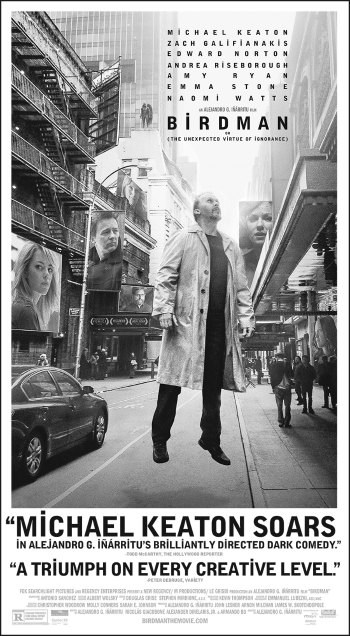
Birdman is so visually audacious you almost lose focus on its engrossing performances, cutting sense of humor and ambitious breadth. It is Rope on meth, tracking, almost hounding, with very few cuts, our tortured protagonist (Michael Keaton) in, through and around Broadway’s St. James Theater as he seeks to revive an acting career defined by his iconic role as a movie superhero. His fortune and name are on the line, and he is beset on all sides by family (fresh out of rehab daughter Emma Stone, ex-wife Amy Ryan), his jittery manager (Zack Galifianakis), his needy female co-stars (Andrea Riseborough, Naomi Watts), his antagonistic male co-star (Edward Norton) and a vicious and even more antagonistic New York Times reviewer (Lindsey Duncan).

One other character gives him some trouble as well.  His alter ego, who at first is a voice in his head but soon appears in person, telling him that all this stage acting bullshit is just that, he needs to get his ass back in a Birdman movie, and he must “shave off that pathetic goatee. Get some surgery. Sixty’s the new thirty, motherfucker!”

Director Alejandro Gonzalez Inarritu collaborated with three others on the play-within-a-play script, which is a satirical series of verbal jousts on the topics of sex, relationships, acting, the stage versus Hollywood, machismo, art versus commerce and the impact of social media.  The clashes between Keaton and Norton (sell-out v. artiste’) and Keaton and Duncan (the sell-out virus stinking up the hallowed stages of Broadway v. the Lord Protector of those stages) are particularly sharp, but the entire screenplay is chock full of gems.  My favorite is Keaton explain how he is holding up under the strain:  “”I’m broke, I’m not sleeping and this play keeps hitting me in the balls with a tiny little hammer.”

The frenetic, adrenaline rush style of the film heightens the tension (the cinematographer, Emmanuel Lubetzki, was the mastermind behind the dizzying tracking shot in Children of Men). The manic shooting makes the performances all the more impressive.  Keaton is superb.  His early trademark (ironically, before he became Batman) was a fevered, riffing style of acting, which could be spellbinding or just exhausting.  Older and more world-weary, Keaton internalizes his frenzy, struggling to bottle it in just as he struggles to keep Birdman at bay.  It’s a riveting turn.  Everyone else is excellent, and Norton deserves special mention.  As an actor with a history of being temperamental, Norton’s performance as a condescending, difficult, self-loathing actor is canny and knowing.  He damn near steals the film, which again, mirrors what is going on in the story.

Gonzalez Inarritu also gives the actors a great deal of space.  In Boogie Nights, Paul Thomas Anderson filmed a solid chunk of a drug deal going bad solely on the face of Mark Wahlberg.  The effect was powerful because in Wahlberg’s eyes, the audience could register the disaster unfolding before him.  Whenever I think of that classic film, I first remember that scene.  Of all the memorable parts of Birdman, there is a scene when Stone lashes out at her father, purposefully trying to hurt him.  In one of the few times the camera isn’t moving, Gonzalez Inarritu holds on Stone’s face as she delivers the cut and then as she sees its effect.  It’s a captivating moment in a film full of them.

Thus far, the best film I’ve seen all year.