Archive

Drama

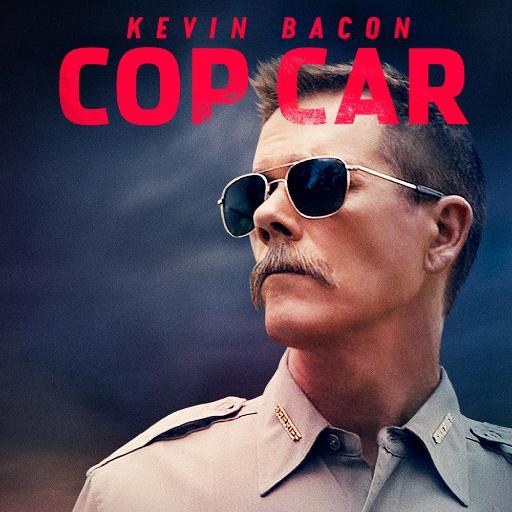
I was just talking about how professional and polished yet paint-by-numbers and predictable Bridge of Spies was and I juxtaposed it with the other film I watched this weekend – Cop Car. With a fraction of Spielberg’s budget, writer-director John Watts’s second feature is inventive, engaging and darkly comic. Two boys are running away from home when they come across what appears to be an abandoned police cruiser, and, as boys will be boys, they take it for a joyride around the fields and deserted highways of Colorado. Turns out the car belongs to a crooked county sheriff (Kevin Bacon), who lost the car to the boys in the middle of dirty business. He races against time to find them, and what follows is often thrilling and occasionally inspired. But what elevates the material is an intelligent dialogue between two boys, with one foot in the world and the other in the imagination. As they confront real danger, Watts revels in their innocence yet uses it to amp up the tension. A great deal happens to these boys, but there is no scene more gripping than when they handle firearms as if they are as harmless as the ones on Playstation.

The film isn’t without faults. It drags a bit here and there, and ultimately, its charms succumb to a more pedestrian action thriller. But it maintains a sly sensibility, and it trusts its audience to have patience and get the drift. The same can’t be said for Spielberg, who rarely extends such trust, opting for the sledgehammer. A beautifully crafted and polished instrument, but a blunt one nonetheless.

image

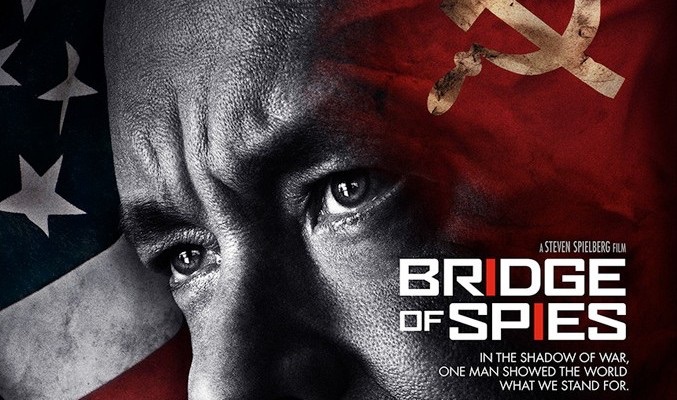
Steven Spielberg’s rendition of private attorney James Donovan’s (Tom Hanks) defense of a Cold War Russian spy (Mark Rylance) and then his negotiation of the swap of that spy for downed U2 flier Gary Powers and an American student detained in East Berlin is assured, workmanlike, forgettable, and plagued by the schmaltz that accompanies much of his work. Spielberg takes a can’t miss, gripping tale of espionage and burdens it with overwrought homilies to American civil liberties, repetitive scenes of bland conversation, and cheap comedy (Rylance is even given a catchphrase he repeats three times). I’m as patriotic as the next fella, but it’s not enough to show Hanks resisting the zeal of the Cold War simply because he’s Hanks. We never learn why Donovan holds his convictions. They apparently come with Hanks, no assembly required.

Worse, Spielberg juices up the action, probably because he sensed the movie was a bit of a slog. So, Donovan’s house is shot up because he is representing a Russian spy (never happened) and Donovan witnesses East Germans gunned down as they try and make it over the wall (also never happened).

It’s an okay film, it has some moments, and I’ve certainly seen worse, but it’s no great shakes, and as with much of Spielberg’s work, it stays safely in the lines.

image

This story of one woman’s journey – a 1000 mile hike along the Pacific Crest Trail – is unfortunately marred by unconvincing dialogue, inconsistent pacing, and an actress not quite up to the task. Reese Witherspoon’s best actress Oscar came after her portrayal of June Carter Cash, a performance that took advantage of her quick wit, common sense instincts, and sunny disposition. She was also able to sing, no mean feat.  As the distraught daughter of a mother who died young (Laura Dern), Witherspoon cannot sing her way to our hearts, and de-glamorization and nudity do not sell the fact that she is supposed to have lapsed into a downward spiral of promiscuity and heroin addiction after Dern’s death. There is still too much of Ellle Woods and Tracy Flick in Reese Witherspoon. She doesn’t even curse authentically, much less play a waitress who has sex with two customers in the alley behind her restaurant just because it feels good. The role required an actress with more gut and greater reserves. Meg Ryan, another plucky can-do lead, tried to toughen up later in her career in In the Cut with similar results.

Even with another actress, this film still has real problems. Everyone becomes depressed upon the death of a loved one, but there is no basis to suggest why Witherspoon’s character became so self-destructive. Rather than elicit our sympathy, Witherspoon at times threatens to evoke our scorn. Her choices are presented to us in flashback, in the bedrooms of strange men, with her long suffering friend, in the heroin dens of Minneapolis, or in conversations with her mother, scenes that are supposed to give us insight into how she ended up here. They don’t. Rather, they are too disjointed to tell us much of anything, and we are left wondering “how the hell did she end up there?”

Finally, the film is too new-agey and pat for its own good. Witherspoon reminisces along the trail while inscribing the words of poets at its various check-in stations. She is followed by a mystical fox. She meets people who say wildly unrealistic things (her discussion with a little boy in particular) that are supposed to reflect her singularity and the momentous nature of her trek (she is even dubbed queen of the trail by other hikers). She finishes and tells us in an ego-centrism that lacks any self awareness that it all worked out in the end. Heck, she informs us in voiceover – she even has two lovely kids.

To the good, it is beautifully shot and the beginning of the film, when Witherspoon is starting on the trail wholly unprepared and over-fortified, had promise. I thought she might even get an appendage stuck in between some rocks.

image

I loathe artistic political correctness in all its forms, be it the soul-sucking idiocy of demanding cultural authenticity in casting, the blanket condemnations of some “ism” by the cultural debt counters, or the wails of some grievance group as one of their own is skewered for comedic purposes (Robert Downey Jr.’s “retard” riff in Tropic Thunder comes to mind).  The effect is the same – to straightjacket creative endeavor so it presents like a PSA. The only good that comes of the p.c. influence are–

* the groveling apology (Cameron Crowe bootlicking because he cast Emma Stone as a quarter-Asian, quarter Hawaiian: “I have heard your words and your disappointment, and I offer you a heart-felt apology to all who felt this was an odd or misguided casting choice”);

* the unctuous backpedaling (Matt Damon, after having been caught on camera rejecting affirmative action and using the word “merit”: “My comments were part of a much broader conversation about diversity in Hollywood and the fundamental nature of ‘Project Greenlight’ which did not make the show. I am sorry that they offended some people, but, at the very least, I am happy that they started a conversation about diversity in Hollywood. That is an ongoing conversation that we all should be having”), and

* inane public proclamations (Viola Davis, who, when receiving an award for a TV drama, without a hint of irony or self-awareness equated her struggle to that of Harriet Tubman).

That said, Welcome to Me is an offensive film, and the heart of its offense is in how it portrays mental illness.   Kristen Wiig plays a sad shut-in, obsessed with Oprah, who wins the California lottery. She suffers from borderline personality and is off her medication, yet that doesn’t stop a local production company run by Wes Bentley and James Marsden from taking her millions so she can develop her own show. That show is a stage for Wiig to exhibit all the debilitating aspects of her un-medicated disease in a manner that at best is quirky and at worst is truly disturbing.

If done well, I don’t have a huge problem with making a dark comedy about a mentally disturbed person being taken advantage of.  I’ve gone down weirder, filmic roads.

So, to be clear, my objection is not to the premise nor do I advocate for the babying of any protected class in art.

But when you take this on, you can’t have your cake (using the disability as comedic tool) and then ask the audience to regurgitate it in shame after the eating.

Essentially, that’s what writer Elliot Lawrence does here. It’s not that the picture is poorly acted or directed or that there aren’t even a few funny scenes. Rather, the film is an exploitative movie about a sick person being exploited, and it wants to use mental illness for yucks while pretending to be brave in showing the true face of that illness.

You need a really deft hand for that kind of trick, and Lawrence and sophomore feature director Shira Piven do not have it.

Worse, the movie condescends with a throw-away lame anti-television theme, and in the end, Wiig is transformed into a “winner” with the help of a mere few pills.

image

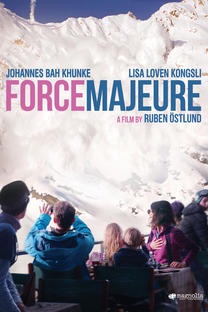
This is a disquieting look into how a single failure, even one that is in no way fatal, can fray the bond of an entire family. Tomas, Ebba and their two young children are on a ski vacation. While having lunch at the resort’s outdoor patio restaurant, at the base of the slopes, a controlled avalanche gets a little out of control and for a moment, threatens to engulf them.

How Tomas and Ebba react, and the aftermath, reveals a great deal about fear, commitment, gender expectations, the frailty of masculinity, the dangers of self denial and the ability of people ostensibly in love to casually, cruelly gut each other.  I know that seems a mouthful, but it’s all there in this literate, intelligent picture. See it with spouse, boyfriend/girlfriend, and/or friends, and you’ll be chatting deep into the night.

The film was rightly bandied as a potential Best Foreign Film nominee, but it did not make the cut,  perhaps because it never takes a strong stand. It is as gray as gray gets.

Remade, horribly, as a Julia Louis Dreyfus/Will Ferrell picture.

The film has aspirations to Wes Anderson, but you’ll learn quickly, having Bill Murray in your cast isn’t enough. Murray plays an old Brooklyn codger, a man who drinks, smokes, and consorts with a pregnant Russian stripper/prostitute (Naomi Watts, sporting an accent so thick and implausible it would make Gary Oldman recoil and say, “no, no . . . too much”).  He also gambles at the track, is in deep with a bookie, and spits in the eye of anyone who might show him kindness. Yet, he’s cool because he listens to a Walkman that plays kitschy 70s pop or Dylan. So rest assured, this guy has a heart of gold. Naturally, when he gets new neighbors (newly divorced and fed up nurse Melissa McCarthy and her impossibly wise yet innocent son Jaeden Lieberher), he opens up a crack, takes the kid under his wing, and to the track, and to the bar, and in the vicinity of the prostitute.  Predictable hijinks ensue, but when the son gets the assignment at his Catholic school to find a saint here on earth, well . . . guess who?

It’s a testament to the effectiveness of first time writer-director Ted Melfi that he can get you to well up a little on occasion, but that doesn’t change the fact you want to punch him in his face for manipulating you so brazenly.  This is paint by numbers, hip treacle that might make even Zach Braff a little queasy.

image

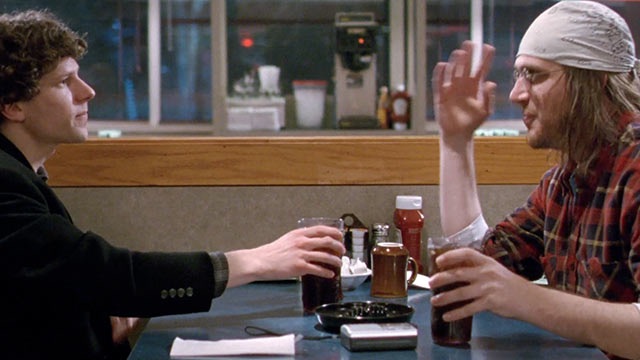
The film is a flawless meander over a few days with an enigmatic and at times debilitatingly insecure novelist.  Jason Segal’s turn as author David Foster Wallace is soul-deep, a particularly impressive performance given that it is from a light comedian. As a film about a doomed man (Wallace hung himself 12 years after the events depicted), the picture is also refreshingly light on foreboding. We are not here to observe the clues that led to Wallace’s demise.  Rather, we are here to enjoy the mind of the author, while being made privy to some of the demons within him, as he is interviewed by a Rolling Stone writer, played by Jesse Eisenberg. We are allowed to hang out with two writers as they discuss their craft, their fears, and America; fence over their different viewpoints and goals through the interview process; and eventually, form a fleeting friendship. Thankfully, the movie is so self assured it doesn’t feel the need to provide the expected big reveal or the emotional paroxysm.

But perhaps what is best about this film – a film about a writer where we do not hear him recite his prose – is the fact that you’ll become affected enough to go read his work after the movie is over. I generally do not read fiction, I have never read Wallace (with the exception of a few magazine pieces), but on the strength of this very personal and intriguing film will read one of his novels.

image

First time film director Yann Demange’s cat-and-mouse historical thriller is taut and assured, blending wrenching action sequences with emotional and historical authenticity.  A Brit soldier (Jack O’Connell) detailed to Belfast in 1971 is stranded after a riot in the Catholic section, and he must negotiate an internal power struggle amongst IRA strongmen, retribution from Protestant terrorists, army incompetence, and double-dealings amongst the intelligence personnel that have rank over his unit, to get out alive.

Belfast is portrayed as nothing less than the white man’s Mogadishu, and while there are some intelligent exchanges in first-time screenwriter Gregory Burke’s script, thankfully, there is no time for an examination of the various political agendas and hypocrisies at play.  Instead, the dismal backdrop of Belfast does most of the political talking, taking a backseat to the heart-pounding chase of O’Connell (who played the lead in Unbroken, so he’s created a niche for characters who have been put through the wringer).  It’s realistic, engrossing and heart-pounding.

In an interview, Demange gives a sense of his perspective on balancing the historical and the dramatic:

At first you can say, “It’s ‘Apocalypto’ in Belfast!” And yes it is, but you can’t just exploit a recent and painful period in people’s lives to make a fucking genre picture. And we all knew that. So we knew it had the shape of a genre picture, that’s how we’ll get a 20-year-old to watch it. But it had to have an honesty, a humanity, a soul.

What was hardest was bringing in shades of grey. Because I’m not like a Greengrass, you know? I’m not that bright, I didn’t go to good schools, I’m not a historian. I’m not interested in lessons. I just wanted to connect in a human way.

And I really struggled, when I began, to understand the Loyalist point of view. It was all white noise when I grew up. I was born in Paris, and plonked into Streatham in the late ’70s, ending up in West London, and this thing was just on the news constantly. But no one in my house understood it, it was just, “there’s been another bomb” “Who is it?” “The IRA” “Oh right.” It was like hearing Brits trying to talk about the Algerian conflict: Algeria? Where’s that? Eastern Europe?

We were so parochial, you know? I was amazed how ignorant I was, once I started meeting people and talking about it. I had no idea the level of sectarian division. I had no idea, and why they don’t put it on the curriculum?

Demange does owes a bit to Paul Greengrass’s Bloody Sunday and some more to the Red Riding trilogy, but his vision is unique.  His camerawork alternates between shaky documentarian and lyrical, giving you a breather while amping up the suspense.

As with those films, I recommend use of the subtitles.  I couldn’t understand a damn thing most folks were saying.

.

image

Nominated for Best Foreign Film, this Argentinian entry consists of several vignettes of revenge, the first being one of the best openings of a film I’ve ever seen. The stories that follow exhibit a sly and dark sense of humor, enlivened by writer-director Damian Szifron’s accomplished visual style. It’s difficult to criticize any of the decision-making that led to the massive hit that is Jurassic World. But that film is a charmless, forgettable visual mess, and I’ll never understand why such a project was given to a filmmaker whose last work, as much as I liked it, was on such a small scale. It’s a picture that should have been given to the likes of Szifron, who handles close-in dialogue and action, suspense and large-scale calamity with expertise and vision.  If I have a a criticism, it’s that it was all too much.  I needed a break.

image

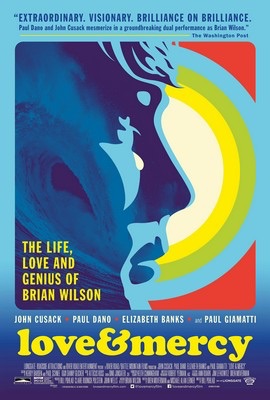
A competent biopic that smartly alternates between the rise of Beach Boys impresario Brian Wilson (played as a young man by Paul Dano) and his later life (during which he is played by John Cusack), where the ravages of mental illness, substance abuse and the dubious oversight of Svengali psychiatrist Eugene Landy (Paul Giamatti) have taken their toll. We meet the older Wilson as he tries to buy a Cadillac from saleswoman Melinda Ledbetter (Elizabeth Banks), revealing the only peace he can find, alone with her in the car at the dealership, while Giamatti and his associates hover on the other side of the glass.

The film spaces nicely, and the early pressures on Dano (fear of flying, his abusive and controlling father, the stress of touring, an aversion to conflict) are manifested in Cusack’s caged, distrusting performance, one of many really nice touches in the film.  Near first time director Bill Pohlad delves into but doesn’t overplay Wilson’s demons, choosing to give equal access to his love of the art of pop music and visionary work in the studio.  Nothing in the picture feels hackneyed or stale, a difficult feat in the face of traditional musical biopics like Ray and Walk the Line.  Also, in the era where “Behind the Music” has left these stories vulnerable to the Dewey Cox treatment, the film feels fresh and immune to parody.

Banks and Cusack also radiate the wonder of first love, subordinating the “bio” aspect of the movie to a heartfelt romance.  They have a convincing chemistry, which bolsters the efforts she undertakes to wrest Wilson from Landy.

As Landy, Giamatti is the weakest link.  He is ferocious where he should be merely intrusive, maniacal instead of crafty.  Landy may well have been that excessive, but he didn’t just walk off the street; he was a pop psychologist to many stars, from Alice Cooper to Rod Steiger.  The performance is so over the top, you wonder how Wilson, even in his vulnerable state, could have succumbed to such a bully and how Landy could have had the smarts to set himself up so nicely.

Currently on Hulu.