Archive

Drama

image

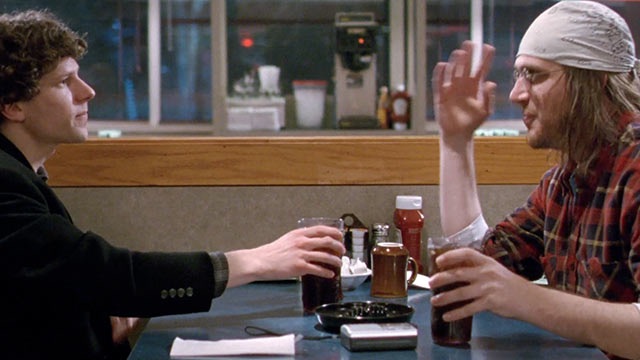
The film is a flawless meander over a few days with an enigmatic and at times debilitatingly insecure novelist.  Jason Segal’s turn as author David Foster Wallace is soul-deep, a particularly impressive performance given that it is from a light comedian. As a film about a doomed man (Wallace hung himself 12 years after the events depicted), the picture is also refreshingly light on foreboding. We are not here to observe the clues that led to Wallace’s demise.  Rather, we are here to enjoy the mind of the author, while being made privy to some of the demons within him, as he is interviewed by a Rolling Stone writer, played by Jesse Eisenberg. We are allowed to hang out with two writers as they discuss their craft, their fears, and America; fence over their different viewpoints and goals through the interview process; and eventually, form a fleeting friendship. Thankfully, the movie is so self assured it doesn’t feel the need to provide the expected big reveal or the emotional paroxysm.

But perhaps what is best about this film – a film about a writer where we do not hear him recite his prose – is the fact that you’ll become affected enough to go read his work after the movie is over. I generally do not read fiction, I have never read Wallace (with the exception of a few magazine pieces), but on the strength of this very personal and intriguing film will read one of his novels.

image

First time film director Yann Demange’s cat-and-mouse historical thriller is taut and assured, blending wrenching action sequences with emotional and historical authenticity.  A Brit soldier (Jack O’Connell) detailed to Belfast in 1971 is stranded after a riot in the Catholic section, and he must negotiate an internal power struggle amongst IRA strongmen, retribution from Protestant terrorists, army incompetence, and double-dealings amongst the intelligence personnel that have rank over his unit, to get out alive.

Belfast is portrayed as nothing less than the white man’s Mogadishu, and while there are some intelligent exchanges in first-time screenwriter Gregory Burke’s script, thankfully, there is no time for an examination of the various political agendas and hypocrisies at play.  Instead, the dismal backdrop of Belfast does most of the political talking, taking a backseat to the heart-pounding chase of O’Connell (who played the lead in Unbroken, so he’s created a niche for characters who have been put through the wringer).  It’s realistic, engrossing and heart-pounding.

In an interview, Demange gives a sense of his perspective on balancing the historical and the dramatic:

At first you can say, “It’s ‘Apocalypto’ in Belfast!” And yes it is, but you can’t just exploit a recent and painful period in people’s lives to make a fucking genre picture. And we all knew that. So we knew it had the shape of a genre picture, that’s how we’ll get a 20-year-old to watch it. But it had to have an honesty, a humanity, a soul.

What was hardest was bringing in shades of grey. Because I’m not like a Greengrass, you know? I’m not that bright, I didn’t go to good schools, I’m not a historian. I’m not interested in lessons. I just wanted to connect in a human way.

And I really struggled, when I began, to understand the Loyalist point of view. It was all white noise when I grew up. I was born in Paris, and plonked into Streatham in the late ’70s, ending up in West London, and this thing was just on the news constantly. But no one in my house understood it, it was just, “there’s been another bomb” “Who is it?” “The IRA” “Oh right.” It was like hearing Brits trying to talk about the Algerian conflict: Algeria? Where’s that? Eastern Europe?

We were so parochial, you know? I was amazed how ignorant I was, once I started meeting people and talking about it. I had no idea the level of sectarian division. I had no idea, and why they don’t put it on the curriculum?

Demange does owes a bit to Paul Greengrass’s Bloody Sunday and some more to the Red Riding trilogy, but his vision is unique.  His camerawork alternates between shaky documentarian and lyrical, giving you a breather while amping up the suspense.

As with those films, I recommend use of the subtitles.  I couldn’t understand a damn thing most folks were saying.

.

image

Nominated for Best Foreign Film, this Argentinian entry consists of several vignettes of revenge, the first being one of the best openings of a film I’ve ever seen. The stories that follow exhibit a sly and dark sense of humor, enlivened by writer-director Damian Szifron’s accomplished visual style. It’s difficult to criticize any of the decision-making that led to the massive hit that is Jurassic World. But that film is a charmless, forgettable visual mess, and I’ll never understand why such a project was given to a filmmaker whose last work, as much as I liked it, was on such a small scale. It’s a picture that should have been given to the likes of Szifron, who handles close-in dialogue and action, suspense and large-scale calamity with expertise and vision.  If I have a a criticism, it’s that it was all too much.  I needed a break.

image

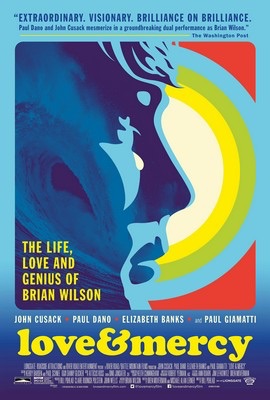
A competent biopic that smartly alternates between the rise of Beach Boys impresario Brian Wilson (played as a young man by Paul Dano) and his later life (during which he is played by John Cusack), where the ravages of mental illness, substance abuse and the dubious oversight of Svengali psychiatrist Eugene Landy (Paul Giamatti) have taken their toll. We meet the older Wilson as he tries to buy a Cadillac from saleswoman Melinda Ledbetter (Elizabeth Banks), revealing the only peace he can find, alone with her in the car at the dealership, while Giamatti and his associates hover on the other side of the glass.

The film spaces nicely, and the early pressures on Dano (fear of flying, his abusive and controlling father, the stress of touring, an aversion to conflict) are manifested in Cusack’s caged, distrusting performance, one of many really nice touches in the film.  Near first time director Bill Pohlad delves into but doesn’t overplay Wilson’s demons, choosing to give equal access to his love of the art of pop music and visionary work in the studio.  Nothing in the picture feels hackneyed or stale, a difficult feat in the face of traditional musical biopics like Ray and Walk the Line.  Also, in the era where “Behind the Music” has left these stories vulnerable to the Dewey Cox treatment, the film feels fresh and immune to parody.

Banks and Cusack also radiate the wonder of first love, subordinating the “bio” aspect of the movie to a heartfelt romance.  They have a convincing chemistry, which bolsters the efforts she undertakes to wrest Wilson from Landy.

As Landy, Giamatti is the weakest link.  He is ferocious where he should be merely intrusive, maniacal instead of crafty.  Landy may well have been that excessive, but he didn’t just walk off the street; he was a pop psychologist to many stars, from Alice Cooper to Rod Steiger.  The performance is so over the top, you wonder how Wilson, even in his vulnerable state, could have succumbed to such a bully and how Landy could have had the smarts to set himself up so nicely.

Currently on Hulu.

image

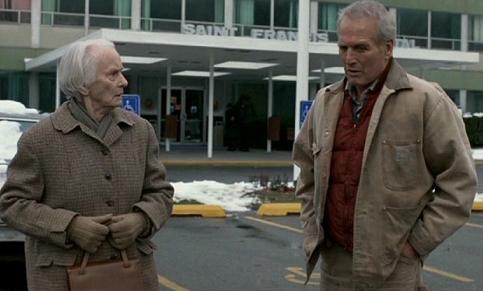
Robert Benton’s adaptation of this Richard Russo novel is centered in the wintry environs of North Bath, NY, where everyone knows each other so well they can be regular poker mates while simultaneously failing each other in any number of ways. Paul Newman plays Sully, an off again, on again employee of property contractor Bruce Willis (who he is suing in a personal injury claim) and the only tenant in an old Victorian owned by Jessica Tandy (in her last role before her death). Sully is woven into the fabric of the town, but he is at heart detached and cynical, and the only hint we get of any warmth are in his interactions with Willis’s wife, Melanie Griffith, who suffers her husband’s callous infidelities with a defiance that saps her verve. When Sully’s estranged son (Dylan Walsh) shows up in the midst of a marital and professional crisis, Sully becomes re-engaged, recognizing his role in the community and accepting the responsibility that comes with it, a George Bailey for the 1990s

The film is alternatively very funny and sneakily touching. Benton expertly captures the claustrophobia of a small town and even its collective ethos without letting eccentricity become cloying. Almost all of the characters are good, and Newman, who was rightly nominated for an Oscar, is perfectly suited to the material.   Of Newman, David Thomson wrote:

As a young man, Paul Newman was so handsome he developed a sneer as if to frighten away the fans – the women, especially – who assumed he was ready and available. There were times when this arrogant manner seemed ready to dismiss not just most of his work, but anyone who took it seriously. He seemed to be saying, “Can’t you see – I’m not like this. I’m a real person, unfairly afflicted with movie looks. I’m Jewish!”

Newman was 30 when he first appeared in a movie; it meant he was a grown man, with hard-earned experience, before he started pretending in public. He had been three years in the Navy, as a radio operator; he had helped run his father’s store in Cleveland; he had been married and had children.

Later in life, the sneer fell away, along with the prettiness, until he was left a stoical old man with pain and losses, as well as the abiding perplexity that anyone should take him or acting that seriously. By then, he was one of the finest and most resolute old men in pictures – some achievement in a culture horrified by age.

The observation perfectly captures Newman in this picture.  Newman communicates the pain and loss in Sully in barely perceptible ways, and when he does so, he doesn’t linger in a manner at odds with his core.  He retreats to the crass aside or the blithe “oh well” and that’s that, making those moments of introspection and dawning even more affecting.  It’s a sharp and knowing performance.

The film suffers a few missteps.  Dylan Walsh, as Newman’s son, is badly miscast. He not only looks nothing like Newman, but he doesn’t share a teaspoon of his inner strength or mystery.  Worse, when he arrives with family and children, they are played too broadly, with modern domestic woes and a miscreant younger child (who nicknames a child with a hitting problem “Whacker”?).  So too is a very young Phillip Seymour Hoffman as the anal town deputy, and Josef Sommer as Tandy’s cowardly son.  In a movie where every other character plays the line between comic and grounded beautifully, these turns are a shame, if easily overlooked.

It is a blessing to have children who like movies. We watched this classic John Huston film last night with my daughter, a movie I saw with my father in the theaters in the 70s. Based on a Rudyard Kipling short story, Michael Caine and Sean Connery are old vets in British India, cynical, loyal to each other and avarice. They make a compact to traverse Afghanistan to its upper northwest, into the wilds of Kafiristan, with provisions and weaponry to lend their talents as mercenaries. In doing so, they brave avalanches and the warring locals, and after allying with one in particular, Connery is deemed a god by virtue of an arrow that failed to pierce his heart and a Mason’s necklace.  It all goes to his head.

The sweep of the film is broadly romantic, though, visually, it suffers in comparison to today’s epics due mainly to technical advancement. Caine and Connery are very well-matched, and though Connery’s seduction and their estrangement is a bit rushed, their bond at the end is actually quite moving. This is a throwback adventure film, deliciously retrograde in attitude; the Brits are charming rogues and everyone around them is a cowardly or fundamentalist savage. As Vincent Canby wrote at the time, “Gloriously old-fashioned in its approach – right down to the characters’ politically incorrect attitudes toward anyone who isn’t one hundred per cent British – The Man Who Would Be King is pure entertainment in the grand tradition of Gunga Din.” The film would never be screened on an American campus today, but oh what fun if it were.

Selma (film) - Wikipedia

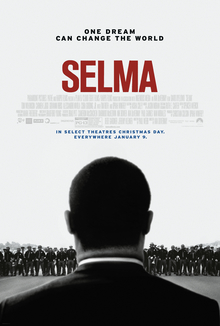
Moving, didactic and unsurprising.  The film suffers from what I call the Milk syndrome, a heartfelt fealty to its subject so strong it obliterates any sense of authenticity.  Martin Luther King (David Oyelowo) is etched in marble, and marble is both beautiful and boring.  While the film is occasionally poignant, we are left with its one-dimensional hero, colorless acolytes (Coretta Scott King and everyone who works with King) and cartoonish villains (Tom Wilkinson’s LBJ and Dylan Baker’s Herbert Hoover are particularly ridiculous).

The film’s best moments come when King is not ennobled, but crafty, as when he explains to two Selma locals why he needs to elicit violent repression from the authorities for publicity purposes; King as tactician is just more interesting than King as emblem.

The worst moments come in quiet discussions, where the activists trade speeches littered with biblical passages and maxims like “eyes on the prize.” There are too many long sermons provided to educate an audience director-writer Ana DuVernay doesn’t trust (a conversation between Coretta and her husband about his infidelities has a reserved dignity that is otherworldly).

In a film punctuated by Oyelowo’s expert recitations of King’s actual speeches, the effect is tiresome.  The characters are in the middle of a pressure-cooker maelstrom, uncertain as to which road to take, hemmed in by any number of political and social forces, and beset by violence at any turn.  Yet, they are reduced to the roles of resolute and/or suffering nobles.  When one black man wants to go get his gun after the marchers have been brutally bloodied, he is met with a sermon on the foolhardiness of his instincts and its effect on their historic struggle.  After an ass-beating, it’s a rare man who can summon a soliloquy.

The film is beautifully photographed. Cinematographer Bradford Young (who, in A Most Violent Year, captured early 80s NYC) employs a lyrical, classic style he describes as a “period, Kodachrome-esque look.”  The effect creates memorable moments, some stunning.

But pretty isn’t enough.

image

This is a football movie made by people who, if they ever saw a football, would mistake it for hippo shit.  Kevin Costner is the General Manager of the Cleveland Browns. His Dad just died. He’s in crisis. He’s a “go with your gut” kind of guy. He has the number 1 pick in the draft. He intends on getting a hot shot quarterback but becomes disenchanted when he learns that the quarterbacks’ teammates didn’t come to his 21st birthday party. Costner is then offered 2 NFL starters and 2 future number 1 draft picks for that number 1 pick. He declines the trade. Instead, he uses the number 1 draft pick to select a linebacker who we have been told “may” be selected 15th. For non-football fans, this is the equivalent of Bill Gates selling his Microsoft shares for a Shetland pony and a wheel of Gouda.  But Costner desires the linebacker because he saw the linebacker get kicked out of a game for giving his dying sister a football after he scored a touchdown.

Nothing I just wrote about the plot is made up.

Then, Costner wheels and deals with other NFL general managers to come out of the draft with 100 draft picks. One general manager is 11 years old. Another releases his bowels when Costner raises his voice during a conference call.  All the others are at risk of dying from swallowing their own tongues.

The movie is about men, and choices, and your instincts and tradition and commitment and respect.  The film also has a minor a romantic subplot between Kevin Costner and Jennifer Garner so uncomfortable it has an almost molesty feel. Garner feels it. She damn near makes herself catatonic to get through this travesty. Costner merely looks embarrassed.

This is the anti-Moneyball. This is not merely one of the worst sports films ever made. It’s one of the worst films ever made.  It is so bad, you have to see it.  It’s mandatory.

And it was endorsed by the NFL. When current NFL Commissioner Roger Goodell walks out to open the draft, the audience erupts in applause.

Which is bullshit.

image

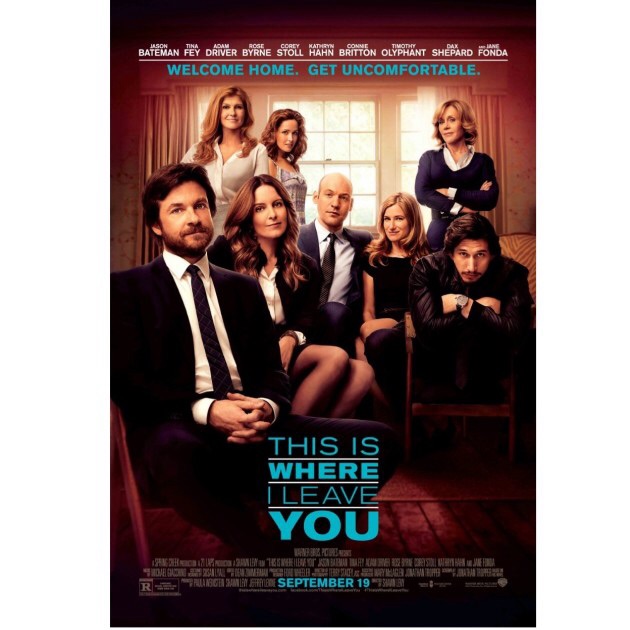
There is a certain kind of self satisfied dramedy that can only be written by a child of the affluent, over educated and beleaguered by the misery of his suburban upbringing, yet oh so smitten with its quirky coolness. Tragedy brings this writer into contact with his or her estranged family. Their hypersexualized mother (Jane Fonda) is overbearing and positively lords her “hip for her age” persona over them. One brother is the unreliable, manchild rebel (Adam Driver), one sister (Tina Fey) the angry perfectionist. Then there is the long suffering, stodgy older brother (Corey Stoll) and finally, there is the sarcastic, sad brother (Jason Bateman). What unites them is their fealty to stereotype and ostentatious progressivism, a condescension to every other non-familial character, 80s pop, odd folks from the old neighborhood, the fact that nothing that happens in the story would ever happen in real life, secrets revealed (“Mom’s a lesbian!”; “Dad was a bad businessman!”; “You slept with HIM?”), assigned stem winders, a scene where the sons smoke weed (found in Dad’s jacket!  Crazy!!!!) and heartfelt tributes immediately followed by crass one-liners.

And that is This Is Where I Leave You.

Truly terrible in every way.

A film that got away from me, perhaps because it gave off such an air of discomfort, I watched There Will Be Blood this weekend. The movie is very good, but my instincts were correct.  It is a very difficult movie to endure.

Daniel Day Lewis plays a Charles Foster Kane-esque Daniel Plainview in Paul Thomas Anderson’s sprawling tale of an oil man who rose from a single claim prospector to a wealthy oil magnate through sheer will and a ruthless brutality that destroyed everything in its wake. Whereas Welles’ Kane, obsessed though he was, could enjoy the taste of his success and the fruits of his labor, Plainview cannot. He is a tortured, singular man, made dangerously distrustful the moment he gets close to anyone for fear of what that person will take. Worse, he cannot abide a slight, and when a young preacher (Paul Dano) fences with Plainview, forcing him to endure a humiliating baptism in exchange for the rights to a critical tract of land, the incident burns in Plainview. As played by the spellbinding Day Lewis, it damn near appears to eat his insides out.  Anderson’s representation of California – be it the barren oilfields or the lonely mansion Plainview inhabits at the end of the movie – becomes more forbidding and cruel as Plainview descends into madness.

All well and good, especially near flawlessly rendered, and yet, this is a cold, one-note film, devoted near completely to a terrible, monochromatic character. What is Anderson telling us about ourselves, or, is he telling us anything? Many cite the picture as an evocation of the American experience, a “portrait of a young nation struggling to find itself, torn between religious and business values” or “a harrowing cautionary warning to a country with oil pumping through its veins, clouding its judgment and coarsening its soul.”

If only. Anderson’s vision is too personal and too specific to Plainview, and it is a testament to the director’s gifts and Day Lewis’s skill that such a narrow focus remains compelling. The result is a lot of blood and guts but no real heart, which keeps it from being great.