Archive

Drama

image

Paul Rudd lost his young son in an accident and compensates by taking a 6 week caregiving course for the disabled. His first client is a plucky, wheelchair bound Brit named Trevor, who suffers from muscular dystrophy and an over-inflated sense of his own cleverness. For example, to shock Rudd, he pretends he’s choking or having a seizure, a real gut buster. Rudd later pretends he has misplaced Trevor’s lifesaving medicines, so . . . relationship established.

Both parties learn life lessons, but to better cement them, they–

A). Make love
B). Take a road trip
C). Join a white supremacist sect
D). Enter into a suicide pact

Of course the answer is B), but the other answers would have made for a better film, for those options would not have resulted in their meeting bad girl hitchhiker Selena Gomez. How do we know she is bad? She–

A). Smokes
B). Curses
C). Is a white supremacist
D). Smokes while cursing

Oh, if it had only been C).

Gloppy, lazy, hackneyed gruel.

Nick Kroll is a pretty big deal in New York City until his Google-glassish innovation goes busto and he loses all his money and all the money of his so-called friends, so he seeks solace by retreating to the icky suburbs and his childhood home in New Rochelle, NY, currently inhabited by his harried sister (Rose Byrne), her swarthy, down-to-earth home builder husband (Bobby Cannavale) and their charmless 3 year old boy.  There, Nick becomes intertwined in their lives, much like Bill Hader in The Skeleton Twins, who went home to Nyack, NY after a trauma.  Kroll discovers Cannavale is having an affair, much like Hader’s sister Kristen Wiig in The Skeleton Twins.  Coincidentally, in The Skeleton Twins, Wiig was cheating on her husband Luke Wilson, who was also a blue collar guy, just like Cannavale.

Crazily, Kroll reveals the fact of the affair to Byrne, again, like Hader to Wilson in The Skeleton Twins.  And that results in a heartfelt discussion about how Kroll ran out when their mother was dying of cancer, and the discussion is reminiscent of the recriminations and regrets of Hader and Wiig about their father, also dead by suicide.   In The Skeleton Twins.

For a few easy laughs, the town is populated by faintly ridiculous folk from high school who Kroll can look down upon.  Much like Hader in The Skeleton Twins.  And there are places that inexplicably have Christmas lights up even though it is not Christmas.  Just like the town in The Skeleton Twins.

And Kroll grows, growth which is signaled by the fact he chooses the welfare of his sister’s son over his new job.

Just like James Caan in Elf.

Torture that at its best is mildly diverting.

Review: In 'Midnight Special,' on the Run With a Highly Unusual Child - The  New York Times

No one does Americana better than Arkansan writer-director Jeff Nichols. Shotgun Stories and Mud are monuments to understatement and authenticity. He has a unique ability to convey the lazy currents rural life as well as its plain-spoken and direct dialogue. None of it comes off as a posture or a condescension.

These qualities are found in Midnight Special, a story of a boy kidnapped by his father (Michael Shannon) away from the clutches of a religious compound in Texas. Soon, however, the federal government gets involved, and that’s where Nichols loses his way. The story morphs into the supernatural, the genesis of which is never fully explained, and the visual payoff – a world within our own that arises in Louisiana – is jarringly cheesy (I was reminded a little of The Abyss, James Cameron’s gripping underwater yarn, which was undone by the silliest representation of aliens you ever saw).

Still, I recommend the picture for the quiet moments and the care Nichols takes with both characters and milieu.

image

Given the subject matter – reporter Tina Fey gets out of her rut in NYC by going to cover the war in Afghanistan circa 2003 – it’s amazing they managed to make such a boring film. The first error is casting Fey, who can barely get one inch past her Liz Lemon character from 30 Rock. She’s little more than a smirk and a wink, so any transformation in or development of her character is simply impossible, and when she starts an affair with photographer Martin Freeman, she seems as put-off by the experience as the audience. Their love scene is akin to two kangaroos boxing, and further suggestions of coitus are shown the morning after, where Liz Lemon is hungover and horrified she may have slept with Griz.

Taxing her limited dramatic abilities further, the filmmakers ask her to try her hand at being an “action junkie.” You can almost hear the voices in Fey’s head imploring her, “act, damn you, act!”

So, we are left with a culture clash flick, with Fey repeatedly doing things most people in Afghanistan would not like, such as walking around without headcover, and holding hands publicly with Freeman, and filming things surreptitiously under her Islamic garb. Also not very good.

Although it does have the value of being surprisingly politically incorrect – the indigenous folk are primarily used as pratfall props while the Westerners are amused and snide, and in what has become the cardinal sin of Hollywood, non Afghanis are (gasp!) cast as locals – none of it rings true, which is a particular problem with a film based on a true story.

The film closes with a violent lurch to a Bin Laden type rescue of Freeman, orchestrated by the plucky Fey, to “Can’t Live” by Badfinger (or Harry Nilsson) and a treacly visit to a maimed Marine for whom she feels responsible but whose aplomb helps her become more grounded.  It’s just godawful.

The film has two directors, neither of whom knows what he is doing, which they demonstrate repeatedly over the picture’s excruciating two hours.

Billy Bob Thornton is the only saving grace as a gruff Marine officer who shepherds Fey around, but his screen time is limited.


image

There’s not one thing in Antoine Fuqua’s boxing rise-and-fall epic that even nears original, but cliche’ does not always have to be hackneyed, and through inventive camera work, all-in performances by Jake Gyllenhaal (as the Hell’s Kitchen boxer who loses it all) and Forrest Whittaker (playing the wise and world weary trainer), a captivating turn by the child actress playing Gyllenhaal’s daughter (Clare Foley) and expert pacing, assisted by a jumped up soundtrack, the thing works and works well.  There are problems. Gyllenhaal’s fall is a bit too protracted, and as hard as she tries to be working class, Rachel McAdams simply lacks the necessary grit.  They tried to dirty Amy Adams up in another boxing movie, The Fighter, and that too was a bridge too far.  These actresses don’t evoke the street, unless that street has a cul-de-sac.

David O. Russell’s American Hustle was an over-heralded, stream-of-consciousness mess, but it was nominated for Best Picture, and I was a huge fan of Silver Linings Playbook, so the watching of Joy was obligatory. It was not an altogether unpleasant experience given Russell’s command of the camera and his early sense of pace. Russell briskly lntroduces us to Joy Mangano, a little girl and then a young woman destined for great things, if only she weren’t consistently thwarted by her lunatic family, a coterie of misfits and weirdos so peculiar they veer into Tim Burton territory. Still, with her one big idea – a self-wringing mop – she perseveres to become queen of The Home Shopping Network, though her journey is an exhausting “one step forward, two steps back” ordeal so arduous, even Jennifer Lawrence’s pluck and a kick ass Rolling Stones song (“Stray Cat Blues”) can’t make the resolution tolerable. One gets the sense Russell knows his audience is bored, because he appears to get bored, veering off into a resolution so off-kilter (Lawrence faces down her business foe in Texas, cutting her hair and donning leather, after reviewing some documents in a “Voila!” moment) it is laugh out loud funny.

Image result for Suspicion Hitchcock

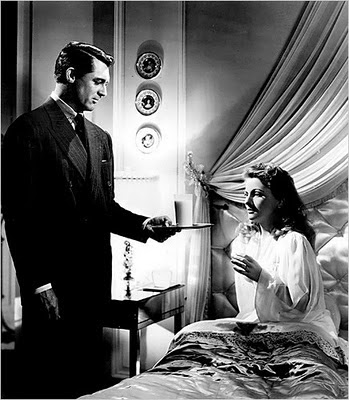
And those stars go to Alfred Hitchcock’s deft hand and Cary Grant’s irrepressible charm. Grant plays a society cad who gloms on to spinster Joan Fontaine, who impulsively marries him out of rebellion and passion. She soon learn Grant, charming though he may be, is a liar, a thief and a lay-about gambler, and his debts may be propelling him to more capital crimes. The essential tension, however, is wasted. The deck is so stacked against Grant that when he professes “it was all a misunderstanding”, you’re left disappointed at the expenditure of time and contemptuous of Fontaine, who just seems like a ninny. If Grant could not commit the capital crime, the studio sure did by insisting their star male lead could not play a wife murderer.

The film was nominated for Best Picture, Fontaine won Best Actress for her very delicate, frail but stagey performance which does not travel, and in an interview with Francois Truffaut, Hitchcock summed it up when he reported the actions of a producer who initially took every scene out that indicated Grant was a murderer, leaving a 55 minute product.

Anyone interested in Truffaut’s interviews with Hitchcock, enjoy.


Image result for shotgun stories

Anyone who watches movies knows that some of the greatest offerings of falsity come in the package of authenticity, and this is never more so than when a filmmaker takes his shot at rural or back home America. The pitfalls are many, and invariably, films about the small town succumb to oppressive nostalgia (Hoosiers), salt-of-the-earth worship (Promised Land), the presence of an impossibly attractive lead as he or she slums (Mel Gibson in The River, George Clooney in The Perfect Storm), cutesy “we’re jes’ folks” condescension (Passion Fish), amped up mythology (Out of the Furnace) or just plain old moronic messages, like money doesn’t buy happiness or home is where the heart is or safe sex is the best sex.

There are exceptions (Billy Bob Thornton’s Sling Blade, Carl Franklin’s One False Move, Debra Granik’s Winter’s Bone), but they are rare and they are not current. In Mud, Take Shelter, and this film, a story about two modern Arkansas families drawn into a violent confrontation upon the death of their shared patriarch, writer-director Jeff Nichols cements that he can translate the patterns, pace and feel of the small town like no other. The actors portraying the family members are natural and unburdened by archetype, and the town itself is not presented to you as a metaphor or cautionary tale, just a town.

What Nichols does with actors and setting he achieves with tone. The families are seemingly in as safe a place as you can be, but when their animosities surface, their very environment becomes foreboding, and the pressure mounts accordingly. As the calamities befall them, there are no revelations or Hollywood speeches or screenwriter dot-connecting. Nichols is content to let you be the judge of what it all means.

This was Echol’s first film, and that may explain its brevity (about 90 minutes). The result is some backstory that is a tad rushed, but nonetheless, this is a gripping, thoughtful picture.

image

Screenwriter Diablo Cody made a big splash with the clever Juno, and showed real growth with the acid Young Adult. But that was a while ago.  This trite stinker, in the mold of so many dramadies about the travails of rich families as they negotiate the perilous path of monied suburbia, is a massive step backwards.

Cody offers Ricki, a talentless front woman for a cover band who has come home to her estranged, affluent ex-husband and adult children after a long hiatus.  She chews with her mouth open, says dirty words, and attends a family wedding.

But hey, it’s Meryl Streep, so we’re okay, right?

Right?

Wrong.  Streep is just terrible, whether slumming as the hip cast-off or leading the worst bar band ever. She’s in-authentically grungy and gratuitously down-to-earth and when she visits her erstwhile family, led by the kind ex-husband (Kevin Kline), it is cringe-inducing, not because of the fish-out-of-water stuff (this is the kind of movie where the denizens of the tony enclave practically say, “Well, I never!”), but because there’s not a word of it that feels real.  There is no way Streep’s character would even be a distant cousin to these people, much less the former matriarch.

Kline has, of course, remarried a protective earth mother type who raised the abandoned children while Ricki honed her craft covering Tom Petty.  Others who Ricki abandoned include a nice son about to get married to the most stuck-up bitch imaginable; a fragile daughter who has had a breakdown because her marriage of three seconds failed (you’d think she’d been a captive of Boko Haram, so extreme is her distress); and a son straight out of gay central casting (he is furious because Ricki called his gayness a phase and voted for W . . . twice!)

All of which would be humdrum but bearable twaddle save for the fact that Ricki and her shit band play about 7 numbers in this picture, including a version of Wooly Boolie so bad we could have won the war on terror years ago had it been utilized at Guantanamo.

Worse, Ricki’s version of Springsteen’s My Love Will Not Let You Down starts more like a Quarterflash tune and ends with your head in a bucket.

After August: Osage County and this, I am not saying Streep is at that Pacino point, where she thinks she can just fart in a bottle and call it potpourri.

But she’s veering to the off ramp.

Least likely sentence I ever expected to write?  Rick Springfield, who plays the lead guitarist for the Flash and Ricki’s love interest, deserved better.

 

image

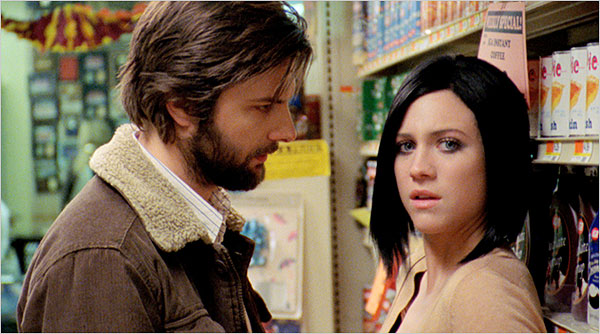
In the vein of “awful people who became awful because they suffered childhood trauma” family drama movies, this one is not half bad. That’s mainly due to Adam Scott, who is one of the more versatile and under-appreciated actors working today.  Scott plays the damaged, stuck in the hometown older brother who picks up his younger brother and the brother’s girlfriend from college and proceeds to fall in love with the latter. Scott is a depressive, an alternately cruel and then apologetic anti-hero, who maligns the girlfriend as a whore who will hurt his naive little brother. The problem is that she succumbs to his damaged entreaties, thus partially cementing his earlier uncharitable appraisal.

There is the obligatory childhood trauma and the big reveal, and it could all be so pat, except for Scott’s ability to communicate real suffering and writer-director Lee Toland Krieger’s insistence on taking these characters seriously instead of using them as charming archetypes to condescend to the audience. More to the credit, there is no wrap-up or deeper understanding. It starts messy and ends up hopeful but still messy, which is commendable.

There are problems.  The hometown is overpopulated by distinctive characters, the father (J.K. Simmons) is too seminal to be so underdeveloped and the hipster soundtrack is now so obligatory it borders on self-parody.  Still, a worthwhile watch on a rainy Saturday.  Thanks, Xmastime.