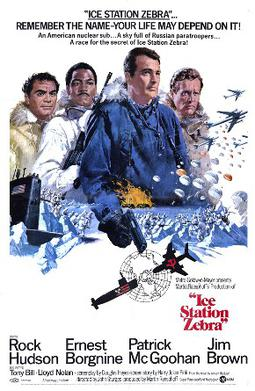
A serviceable John Sturges (The Magnificent Seven) Cold War action/espionage thriller from 1968, currently on Tubi. The Soviets take photographs of our missile installations from space, but in attempting to retrieve the film, things go awry. The canister lands near a British scientific weather station in the Arctic, and the race is on for retrieval before the Soviets get there. The mission is led by nuclear submarine skipper Rock Hudson, who has MI6 spook Patrick McGoohan, friendly Soviet Ernest Borgnine, and Marine squad leader Jim Brown along for the ride.
I watched the flick when I was a little kid on TV. It was thrilling.
50 years later, it still holds up somewhat. It’s really worth catching for three particularities.
First, clearly of its time, a significant portion of this rather long picture (it has both an overture and an intermission) is devoted to the inner workings of a nuclear submarine, sometimes, pedantically so. But you have to remind yourself that in 1968, film audiences would have been thrilled with a long dissertation on the inner workings of a nuclear submarine.
Second, I never understood why McGoohan was not a massive star. He is a great villain, but he also has a charming smile and twinkle in the eye that communicates humor and a little menace.
I read up on him. He was swallowed up by television, which probably suppressed a budding film career. He was also extremely Catholic, and would not take any role in which he was required to kiss a woman other than his wife, thereby taking him off the James Bond list (and apparently, he was on it). Modern audiences would know McGoohan as the villainous king who steals and chews scenes in Mel Gibson’s Braveheart.
Lastly, Jim Brown is still cool, even in a winter parka.
In one of the first moments of the film, we meet Bruce Springsteen (Jeremy Allen White) as a little boy, hearing his father (Stephen Graham) coming up the stairs, drunk, to spar with him. In the process, Bruce catches a slap. We know it’s gonna’ be these two guys the whole picture, as the shy, depressed superstar makes his most personal, least commercial opus, Nebraska, while grappling with his troubled upbringing.
I read Bruce’s autobiography and was mightily impressed with its honesty, charity, and equanimity. There was little, however, about the ghost of his abusive father. Maybe Bruce wasn’t ready to share. But the point is relevant because while his father seems to be a handful, he is not portrayed as such a monster so as to justify the depths of Bruce’s torment. In fact, when Bruce is writing Nebraska, he seems more influenced by Terence Malick’s Badlands than Daddy issues.
In the midst of his struggle, Bruce has a relationship with a single mother (Odessa Young). It is supposed to be a simple, earthy union, a local rocker and a “heart of gold” fan who sees through The Boss’ facade, a ludicrous conceit. This is post The River. He’s massive. He’s been on the cover of Newsweek and Time. But the picture persists in the silliness of Bruce the regular guy. When Bruce drops his waitress gal off, because of course she’s a waitress, in a diner, it is in a blue collar neighborhood, oil storage tanks in the background. Her father comes out and says, in a hackneyed, suspicious New Jersey small townie way, “is that the … uh … guitar player fella’?” Dad then sneeringly harkens to Uncle Dave, who “played guitar” and presumably, was not much of a success.
Oof.
Worse, the relationship doesn’t add much if anything to the story. Given the woman didn’t exist, one would expect writer/director Scott Cooper (Hostiles) to do more with the character. But she is there solely to be dumped by the angsty Bruce and to utter pap like, “if you can’t be honest with yourself, I don’t know how I can expect you to be honest with me.”
Oof.
The second half of the film is where we go straight into the ditch. Bruce is struggling to present Nebraska in his stripped down vision while fending off pressure to release Born in the USA. In the doing, he engages some more with his father both then and now while struggling with depression. It’s a long slog, with Bruce upset that his cassette tape cannot be replicated in the studio. This principal struggle is treated as if we were watching Oppenheimer and his team of scientists discussing the moral conundrum of unleashing nuclear power onto the world. In these moments, the film has absolutely no sense of proportion and lapses into the ridiculous. The Boss’ head is in his hands. A lot.
Another negative. Jon Landau (Jeremy Strong) is laughably written. As Springsteen’s manager, he is supposed to provide some obvious tension between the Boss’ failure to follow up The River with something more commercial as opposed to his sparse, acoustic passion project. But there really is none because Landau is all therapist, uber reverential. With no concerted pushback, only soothing support, we near ennui. If Bruce said he wanted to follow up The River with hand puppetry, from this Landau, we’d get:
“Hey [deep soulful look into Bruce’s eyes, hand on shoulder]. I Iove you. You do you.”
When Landau and his wife discuss the Nebraska demo, their conversation is the most elemental thing you’ll hear in film, as if Cooper fears the audience is so stupid it must be painstakingly explained just what a departure this record is and just how “dark” it seems. The couple have two such conversations. She contributes to the first one, but during the second, Landau is so smitten and high falutin’ about his plagued client, she just kind of looks at him.
And when Bruce plays the hit Born in the USA, Landau says, “I think a Muse came down and kissed you on the mouth.”
Oof.
Ultimately, Cooper cannot land on any one thing for very long, and it is just not very cinematically interesting to watch a film about a guy writing a singularly personal solo record. It’s all in Bruce’s head. And the memories of his Dad, the ghost, are drab and not all that shocking.
The resolutions at the end are brutally maudlin. Like, shield your eyes syrupy. “You need therapy man” bad. Like sitting on his father‘s lap as an adult and saying, “you did the best you could. You had your own battles to fight” bad.
A positive. Jeremy Allen White is really quite good as Springsteen. One has to be really careful with such a mythic figure, and White does a very understated job while still capturing the persona. The script calls for him to be perpetually tortured but he pushes back with a refreshing natural humanity. This is no small thing given how humorless and dour the script portrays him.
It’s not grotesquely terrible. But it’s pretty bad, hopelessly muddled and much duller and pedestrian than it had to be.
I was hoping this touching film would be properly rewarded at Oscar time, but it was ignored. The omission is even more galling given the Academy’s decision to nominate 10 films this year, including the dreck of F1 and Frankenstein. Getting an Oscar nomination is never a confirmation of merit. But with 10 nominees? Please. Noah Baumbach’s story of mega Hollywood star Jay Kelly (George Clooney) in midlife crisis is clever, entertaining, and tender, and Clooney gives his best performance since The Descendants. The picture deserved better.
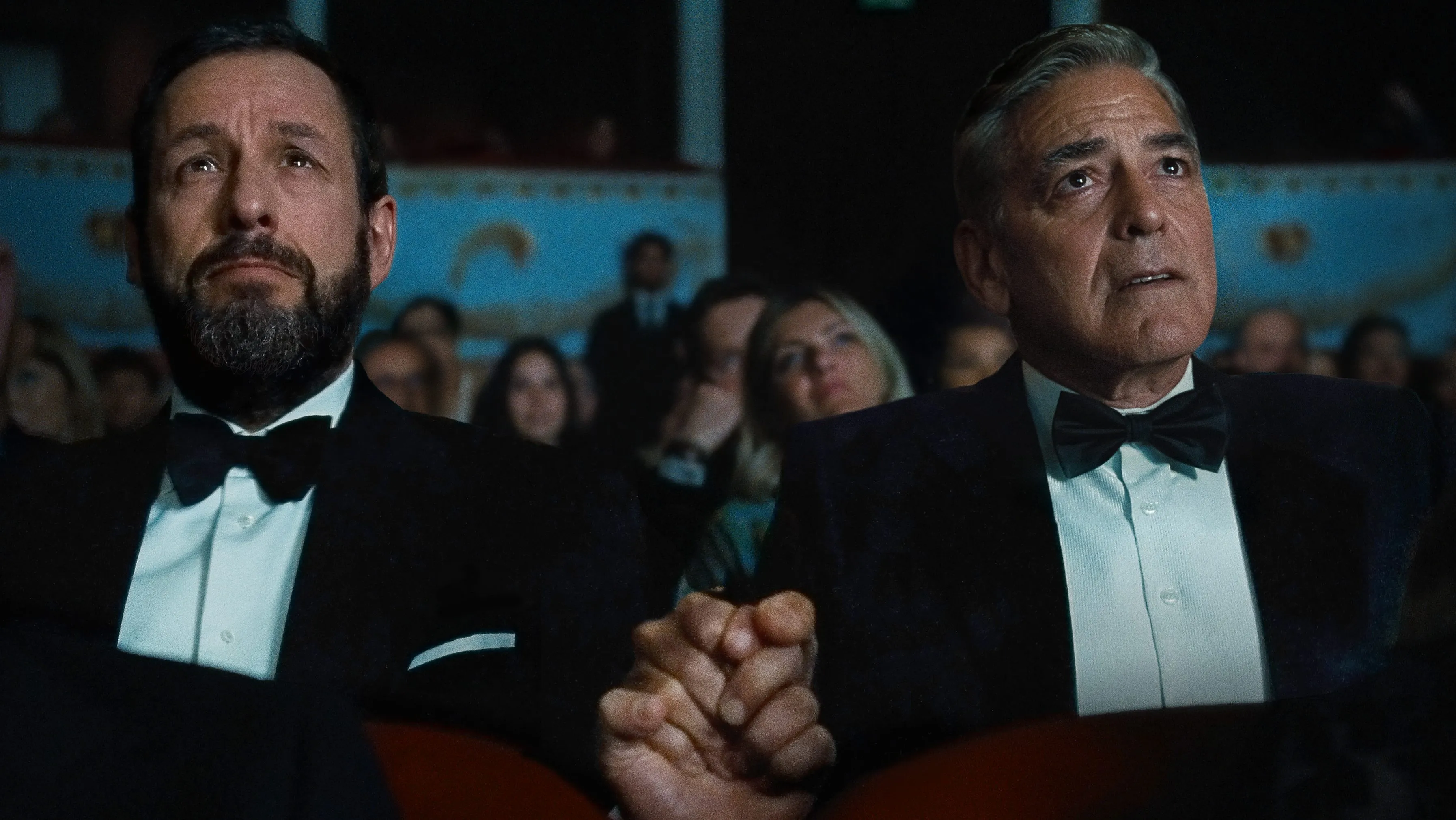
After the death of a mentor, the man who “discovered” him, Clooney is approached by an old friend from acting school (Billy Crudup). In the hope of establishing more of a real connection with both his past and normality, Kelly invites Crudup for drinks to reminisce about the old times. Unfortunately, Clooney is a massive, unknowing target, and he becomes the repository for Crudup’s bitter regret, as well as a TikTok sensation when the two get into a fist fight in the parking lot. Clooney, however, is not deterred, and takes his retinue, led by longtime manager Adam Sandler and publicist Laura Dern, to chase his younger daughter through France on his way to a tribute ceremony in Italy. To be unencumbered is a freeing experience for Clooney, albeit one that is laughably abnormal. He is recognized, fawned over, and catered to by a staff of five, and soon, even he sees the absurdity in his efforts.
The trek is infused with real heart and pathos, and throughout, Clooney flashes back to his ascent to stardom. While he seeks to reconcile himself to failures with family and friends, including his father (an irascible Stacy Keach) and an older adult daughter, who is estranged and embittered and attributes all of her mental torments to her wanting father, ultimately, they are not there for his moment. Clooney is left to the expected support from his longtime manager and assistants, but Sandler himself is going through his own crisis, realizing the limits of friendship in his uneven relationship as the fixer of all things for megastars. Dern has had it, and bolts with a “save yourself, this man does not love us” warning for Sandler. Eventually, Clooney is alone.
There are wonderful exchanges, poignant moments but, thankfully, no real resolution. Baumbach studiously avoids the pat. This type of film would normally result in some kind of oath, or commitment, or suggest a rapprochement, a teachable moment. Here, it ends with Clooney at the festival given in his honor to credit him for his life‘s work on the screen, and his lesson is not quite clear. Yes, like all men and women, Clooney has made mistakes, but when you get to see the joy in the faces of the people who love his work, work that has accompanied and maybe even inspired many of the moments in their own lives, there is at least a rebuttal to the regret.
For some, this, I suspect, may be too much sentimental log rolling for Hollywood. I ate it up with a spoon and wanted more.
A lovely film, one of the best of the year, replete with fantastic, unheralded performances. Sandler is particularly good, vulnerable and piercing. Though he has impressed enough, however sporadically (Punch Drunk Love, The Meyerowitz Stories, Uncut Gems, Hustle) that I can no longer register surprise.
I signed up for Tubi because it has a lot of older movies that don’t get run on some of the other streaming services. This very competent Peter Yates (Bullitt) flick from 1977 beguiled me as a young teen for a couple of reasons. First, it was a Peter Benchley, post Jaws vehicle, with Robert Shaw as yet another boat captain, though this time his quarry is treasure, not a shark.
Second, well … I was 13 years old, Jacqueline Bisset, enough said.
My prurient childhood fascination aside, this is a pretty solid picture. Two tourists (Nick Nolte and Bisset) happen upon two collided shipwrecks while snorkeling. They cross a local drug lord (Louis Gossett) who also has an interest in what they’ve found (tens of thousands of vials of morphine from an old WWII medical ship) and must enlist a wily old diver and antiquity collector (Robert Shaw) to help them find treasure from the other vessel, deliver the drugs, and otherwise negotiate their way out of the mess.
Nolte exudes charisma as the thrill seeker captivated by the jewels of the sea. Shaw is Shaw, commanding and interesting even when he is probably phoning it in. Gossett is oozily charming as a lethal Haitian trafficker interested not in treasure, but in the drugs, until he learns of the treasure and gets greedy.
Bisset is every bit as alluring as she was when I was 13, and it turns out, now that I can focus, she can act. She is menaced throughout the picture and her terror is palpable.
The film gets balky when Gossett inexplicably harasses the trio even though they are working on his behalf, and the ending is the cheesiest finale in movie history. But otherwise, sexy and solid.
If AI did not write this film, then we need more AI in film.
I feel confident, however, AI had a hand in this empty, soulless picture, which feels like a Marvel flick but doesn’t even meet that low bar. The movie looks good, moves relatively well, and the actors are for the most part fine. But the script is predictable slop and the presentation so dumbed down, all things equal, it must have come from an algorithm. Writer/director James Vanderbilt has a few Screams and Spidermans under his belt, but, inexplicably, co-wrote Zodiac. So color me perplexed.
The picture also offers a glimpse as to what the future holds for historical films. Not a single bit of this recitation of the Nuremberg trial rings true. Sure, it technically comports with some of the facts, but the feel is all “now.” Viewers can glean just enough information to get a sense as to historical stakes (Nazis bad, Herman Göring bad but sneakily charming), but the picture never nears informative or elucidating.
The Nazis have lost the war, and in an over-long lead-up, we learn it is critical they be placed on trial through Supreme Court Justice Robert Jackson (Michael Shannon), who spars over the wisdom and efficacy of such a trial with his wife via witty banter. When the trial becomes threatened, Jackson goes to the Vatican to enlist the Pope’s blessing, which he receives by blackmailing the Church as an arguable co-conspirator with Hitler, a complete fabrication. But a lie that serves an exchange in keeping with this simplistic rendition.
Pope cowed. Full steam ahead.
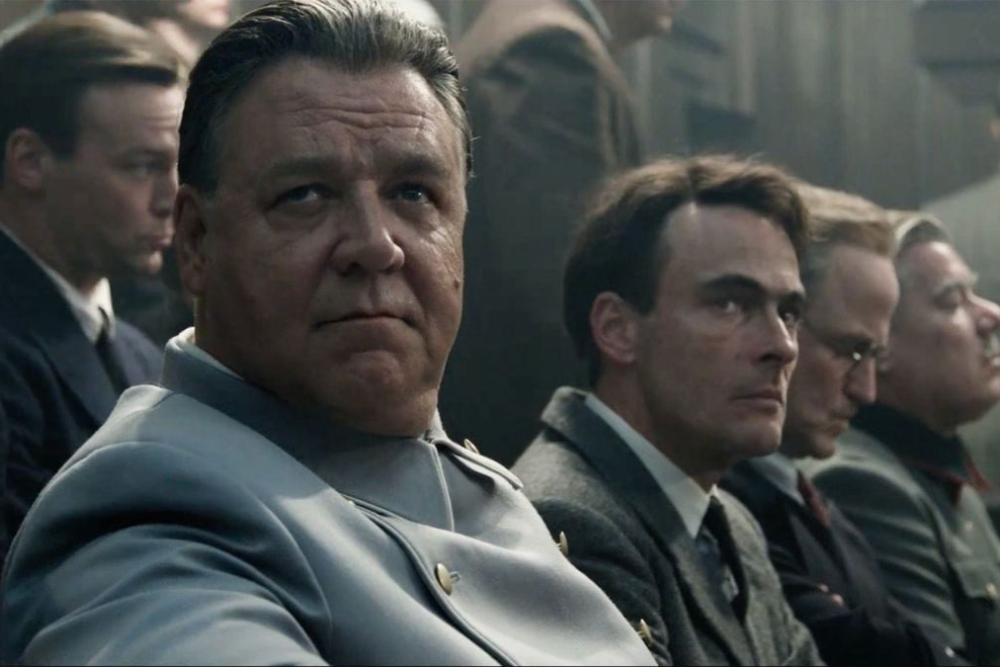
Russell Crowe plays Göring, the biggest fish in the dock. He must go to toe-to-toe with army psychologist Rami Malek, a cynical practitioner so full of himself his eyes bug out.
Okay. Cheap shot.
The men bond in verbal exchanges that are dull and unilluminating. One gets the sense Crowe got the role because he’s heavy and imposing, but he competently delivers the muck given him. As for Malek, his casting is a mystery. He should not receive any further film roles unless in Bohemian Rhapsody II or movies where he plays offbeat or weirdo. When Malek engages with Göring’s young daughter, as he passes letters between father and family, he almost takes on the mien of a molester. Peter Lorre as William Holden.
Malek gets deeper into Göring’s psyche while acting as Jackson’s mole and stoolie, which is incongruent, given all of Jackson’s testaments to fairness. Malek also intercedes on behalf of Göring‘s family when they are arrested. Depressed, he takes refuge in the arms of a buxom reporter and spills his guts. She prints a front page article betraying him and leading to his ouster from the Army.
Most of these plot points are either false or distorted. In reality, the Malek character was not cashiered; he was promoted and back in the U.S. by the time Göring took the witness stand.
In the film, Malek attends the trial and before so, he rushes in to see Jackson to offer his book of notes entitled, How to Get Herman Göring.
The big day arrives.
The Nazis and lawyers don their outfits for legal battle.
Göring does pushups in full regalia and walks out amongst cheers from other caged Nazis. Like in Gladiator.
Cue AI dialogue.
“In seven hours, the whole world will be focused on this room. This is it. This is everything.”
“Let’s finish this war.”
“This is your day. You’re ready.”
“Bury him.”
“He’s got him.”
While watching this drivel with my family, we started a game. A character would say something. We would pause the movie and take a stab at what would be said in response. Our success rate was shockingly and depressingly high.
Example. The interpreter who works with Malek offers him a cigarette. When Malek notes the interpreter does not smoke, he explains he carries cigarettes to curry favor with officers. The interpreter then states wistfully that perhaps, at the end of the war, he will have a cigarette. Malek responds, “the war has ended.” There is a silence.
The movie was paused. Bets were placed on whether the interpreter would have his cigarette at the moment of conviction of the Nazis.
EXT. PALACE OF JUSTICE – NIGHT
Howie stands outside. Silence save for the crickets. He pulls out the pack of cigarettes. Takes one out. Puts it in his mouth. Goes to light it. Hands shaking…From inside, we hear the gallows drop again. Another man down. Howie stands there. Pulls the cigarette from his mouth unlit and tosses it away.
There is a great deal of this hackneyed bullshit throughout the flick.
Thankfully, the dreck eventually ends. Malek, who writes a book about the experience, is portrayed as a haunted soul, desperately trying to warn the world that the good German is in all of us. And then, he kills himself, just like Göring.
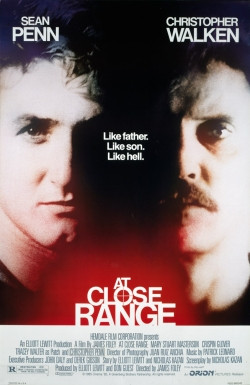
James Foley’s (After Dark, My Sweet) film never really decides what it wants to be, a family drama or a crime picture. Foley eventually throws up his hands and cedes everything to the captivating Christopher Walken.
Not the worst of decisions. Walken plays a minor rural Pennsylvania crime kingpin. He skippers a crew that includes his two brothers and a few other hardened locals. They do heists, car thefts, drugs, and, if necessary, murder, a lethal but merry band of crooks.
Walken’s estranged son, Sean Penn, is a townie still living at home with his mother and grandmother. The women smoke, glare at the TV and otherwise exude the hopelessness of abandonment and near poverty. Penn, seeking something more, falls in at-first-sight love with Mary Stuart Masterson, who looks his way as he cruises at night around the town square. It is for her that he joins up with his father’s crew, to “get out while we’re young … ’cause tramps like us …”
When Penn realizes murder is part of the gig, he splits from Walken, gets arrested working his own “baby” crew (which includes his brother Chris and a very young Crispin Glover and Kiefer Sutherland), and is incarcerated. There, the cops work on him to fink on his father.
Here, the film becomes ridiculous. Walken, paranoid Penn will flip on him, kills nearly every one of the kids working with Penn, even though Foley does not show them to be integral enough to his operation to be much of a threat. He also rapes Stuart Masterson, which makes even less sense if the plan is to bring Penn back into the fold. Penn comes out of jail, tries to make a run for it with his gal, fails, and in a rushed, abrupt ending, testifies against his father (for 30 seconds).
That’s that. Lights up.
None of it makes much sense, but the thematic indecision is worsened by gross character underdevelopment. Walken is a charming sociopath, but how did he get here? No clue. We even have his ex-wife moping about, warily eying the establishment of a relationship between Walken and Penn. Foley, however, suffices to use her as a sad totem, so we don’t get any insight into Walken from her. Similarly, Penn needs a Daddy. Then, on a dime, he doesn’t. As he is near mute for most of the picture, we are left to guess as to what he has missed and the basis for his immediate and strong moral stand. Stuart Masterson is looking for something, but as she and Penn prepare to light out for the territories, leaving her house, she is clearly from money. So why is she hanging with these lowlifes? Unexplored.
The film has its strengths. Foley’s feel for rural Pennsylvania is strong. The fields and woods are spooky and forbidding at night. During the day, the crappy cars and houses, the dead-end bars, they all contribute to Penn’s lust for some way to get out. Foley shows just how big and cold this country can be, the kind of place that swallows you up and tells no tales or grinds you down little by little. The murder spree is indelible.
As noted, Walken is the picture, and in every scene, he is riveting. Penn, however, goes low to Walken’s high, and the effect is somnambulant. He’s in with Daddy, then immediately out, then annoyingly internal until his final nose-to-nose with Daddy, all to the conclusion that he needed a better Daddy.
Another note – at the time of the picture, Penn was married to Madonna. She had a song for the picture which then became extended to the soundtrack. It is synthy, mid-80s fare, better suited to Vision Quest or even Risky Business. It has no business being near this gritty movie. Sure, I joked about Springsteen above, but his music would have been pitch perfect to the film.
A timely watch, as I recently finished Nuclear War, A Scenario, an eye-opening, cautionary theoretical which envisions North Korea lobbing several nuclear warheads at the United States, thereby testing decades- old protocols from all major powers and igniting a nuclear Armageddon.
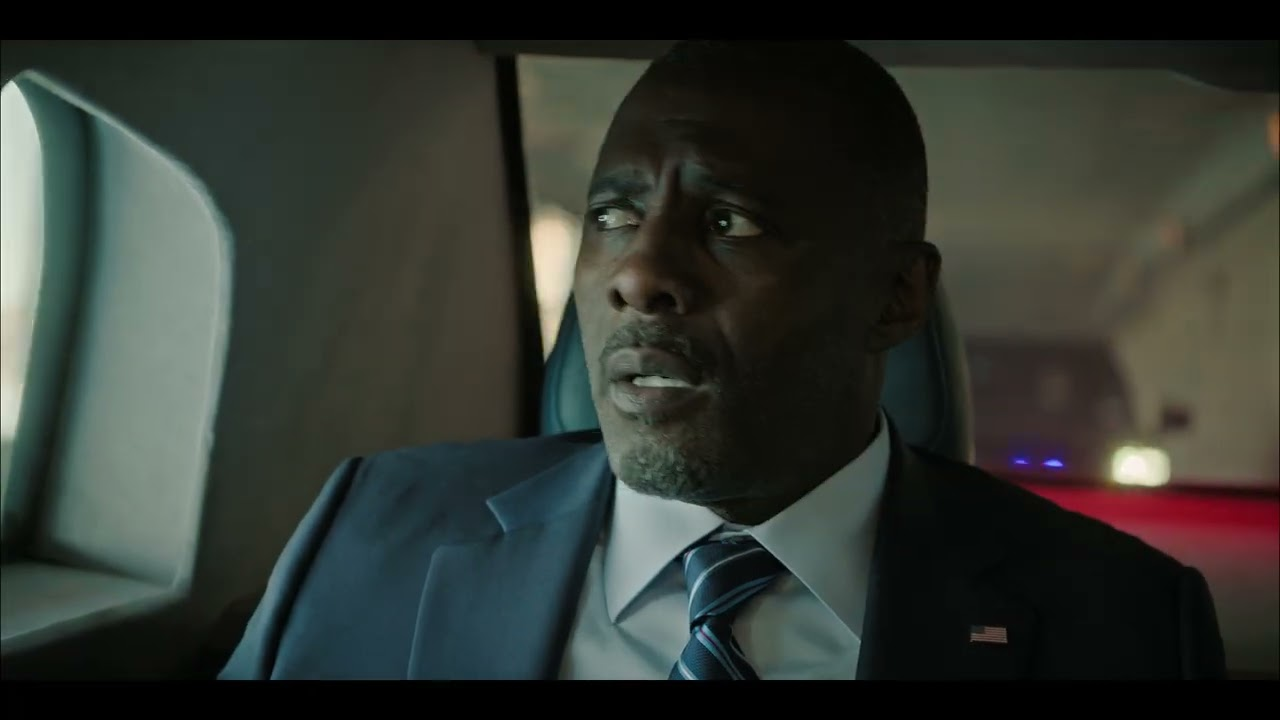
Here, Kathryn Bigelow (Zero Dark Thirty) dramatizes the story via three timelines, all ending at the moment of decision as to response. Just as the attack is reported, after which we have 16 minutes before detonation, President Idris Elba, harkening back to George W. Bush reading to little kids when informed of the terror strikes of 9-11, is shooting hoops at a basketball camp run by Angel Reese.
And … there goes another minute.
Heart-pounding, riveting, and expertly paced, I was most reminded of Paul Greengrass’ United 93, a picture that elevated the professionals and non-professionals in a nightmare scenario, finding bravery, competence, and no matter the outcome of their particular hell that day, a rise to the occasion, with beautiful moments of humanity and humility. Bigelow’s characters are authentic, capable, and thus, all the more engrossing, and she does not neglect them in a film primarily about process and protocol. We learn but tidbits about who they are and what they do. With 16 minutes, there is not time enough, but Bigelow’s economical explication is superb.
On Netflix, one of the better flicks of the year.
*SPOILERS*
There is one major hole. In the book, the scenario had more than one missile coming and they were definitively from North Korea, which truly made the decision as to retaliate more salient. Were more coming? If so, now may well be the time to counterstrike to ensure they were interdicted, even if it meant destabilizing Russia and/or China and inviting a counterstrike based on their misapprehension.
Here, by using a single missile, and making the striking of Chicago a foregone conclusion, on reflection, the response, for which we are all obviously waiting on pins and needles, is not really in doubt.
You would wait on the single missile to hit, see if it detonated, and then wait to see if any more were launched. Nothing that you could do two minutes before the missile hit, you could not do after the missile hit.
A big, flashy, visually overwhelming nirvana for speed junkies. But when cars are not going vroom vroom around the cinematic coliseums of the Formula 1 race tour, the film is unoriginal, dull, sexless, and stupid. It is also badly acted (Brad Pitt excepted, as he doesn’t act so much as pose).
Pitt is a journeyman racer, much like Tom Cruise’s Cole Trickle in Days of Thunder, though Cruise was silly as an old “I can race anything with wheels” hand given his youth in that picture. Pitt is more plausible as a man who can race anything, be it in NASCAR, Lemans, Formula One, Baja, or, the Sahara, on a camel. But he’s still silly as a a man looking for something transcendent and elusive, like Kwai Chang Caine in Kung Fu. When Pitt’s old chum Javier Bardem arrives to offer him a spot on his flailing Formula One team, Pitt can’t say no even if it interrupts his quest.
The old timer Pitt joins the team and runs into a hotshot younger driver teammate (Damson Idris). Idris is resistant to the grizzled interloper. He makes his mark on social media more than on the track.
Pitt teaches him maturity, discipline and self-respect.
Pitt also runs into team car design guru Kerry Condon.
Condon teaches Pitt how to be a good teammate.
They also sleep together.
Pitt has not had very good on-screen chemistry with women since Thelma and Louise. The trend continues Here, he is a stoic, and in return, Condon musters all the heat of a flagging sterno cup. With a strongly established “older brother, younger sister” vibe, they have what can only be envisioned as some of the worst sex in history.
Just when you are nodding off, another race will start. You will perk up, because the spectacle is kinetic and exciting. But you can only watch so much racing. These people will have to start talking again, and when they do, it is drivel.
The plot then begins to echo that of a much better racing film – Talladega Nights. There is corporate skullduggery in the form of Tobias Menzies, who wants control of the entire racing team and schemes to depose and supplant Bardem. Like Ricky Bobby, Pitt must not enter the final race for Menzies’ machinations to succeed.
Pitt, of course, enters the final race and saves the day.
In a withering coup de grace, Pitt texts Menzies an emoji.
It is the finger.
Now, we have just spent an entire film trying to establish that Pitt is a simple, grounded, live-in-your camper, shut-out all of the noise enigma.
Yet, in declaration of his own worth and independence, he texts an emoji.
Yeesh.
The movie is terrible when characters talk, impressive when wheels are turning, a bit of a conundrum, because I can’t imagine it would transfer as well at home.
Use your best judgment. Knowing what I know now, I believe mine would have been to forgo the film and watch the vastly superior Rush.
An unheralded gem, powered by the stellar performances of Robert De Niro and Robert Duvall, as brothers Dez and Tom Spellacy. De Niro is a rising monsignor in post-WWII Los Angeles, archbishopship on the horizon. Duvall is a tainted LA homicide cop. De Niro is ambitious and technocratically capable but fast becoming disillusioned with the moral elasticity necessary to keep the church afloat, including being chummy with the likes of a scumbag real estate mogul (Charles Durning, who seeks the church as beard for his corruption and literally sweats menace). Duvall is trying to make up for his past as a bagman. A Black Dahlia-esque murder connects them, and as De Niro wrestles with his faith and station, Duvall agonizes over his past crimes and his attempt to make amends by going after Durning, damage to his brother be damned. We learn about their secrets and upbringing in an L.A. that has a Chinatown-vibe.
One of my favorite fiction authors, John Gregory Dunne, wrote the screenplay with his wife Joan Didion, and it exudes verisimilitude and deftness. The script allows De Niro and Duvall significant space and what they do with the quiet moments is poignant. There is always tension, but also, always an intimacy and a shorthand that speaks to shared happier, or unhappier, times. Their exchange on their uber-Catholic mother is emblematic:
Tom Spellacy: How’s ma? Is she still eating with her fingers?
Des Spellacy: Well, she says the early Christian martyrs didn’t have spoons.
Tom Spellacy: Tell her they didn’t have Instant Cream of Wheat, either.
It’s a cheat to cite a review within a review, but Vincent Canby’s is so dead on and conclusive, I’ll transgress: the film is a “tough, marvelously well-acted screen version of John Gregory Dunne’s novel, adapted by him and Joan Didion and directed by Ulu Grosbard who, with this film, becomes a major American film maker. Quite simply it’s one of the most entertaining, most intelligent and most thoroughly satisfying commercial American films in a very long time.”
If there is a problem, it is third act, which could have used a few more moves to get to the ultimate revelation. But I’m hesitant even in that criticism for fear that any nod to beefing up the procedural would have taken away from Grosbard’s patience and care with the characters. The film not only showcases De Niro and Duvall, but takes time to establish real connections between De Niro and an older priest (Burgess Meredith), who De Niro puts out to pasture because of the latter’s interference and sermonizing (“I’m not a man of the cloth, I’m a man of the people”); Duvall and a whorehouse madame (Rose Gregorio) with whom he had some sort of ragged relationship until she took the fall for his crookedness and did a stint in jail (“I need you like I need another fuck,” she spits at him); and Duvall and his partner, Kenneth McMillan, who shakes down Chinese restaurants for his retirement motel and tries to keep Duvall out of trouble (“You know who we’re going to pull in on this one? Panty sniffers, weenie flashers, guys who fall in love with their shoes, guys who beat their hog on the number 43 bus. What? Do you think I’m gonna lose any sleep over who took this broad out?”). The blunt and cynical nature of the dialogue aside, Dunne and Didion never stoop to hackneyed tough guy patter, and they counterbalance with real tenderness. The train station scene where the parents of the murdered girl meet with Duvall to take their dead daughter home is one memorably piercing example.
William Friedkin’s follow-up to the massive successes of The French Connectionand The Exorcist, the film has met with greater favor in recent years, but at the time, it was a dud at the box office. While it has its charms, the tepid response at its release was deserved.
By way of set up, Roy Scheider is part of a 4 man stick-up crew in New York City that robs from the mob. Three are killed in the caper and Scheider goes on the run, to a small town in Chile, There, he works as a laborer under an assumed name on subsistence wages for an American oil company. He is joined by a French financier, an Arab terrorist, and a hit man of indeterminate background, all incognito and under the gun for their own reasons. None has the means to get out of town. Guerillas, however, blow up an oil well 200 miles away, and the four men are hired to ferry highly combustible dynamite containing nitroglycerin in two trucks through a hellacious terrain of winding mountain roads, dismal swamps, and, at times, torrential rain. The dynamite is necessary to cap the well and extinguish the geyser of fire.
The problems.
First, Roy Scheider is not a lead. Never has been. His intensity is unquestioned but his range is limited, and he’s only asked to be wary and furious, which he does fine. He’s just not very interesting.
Second, given the massive jostling and bouncing in the trucks during the expedition, one does wonder, “Why again was a helicopter out of the question?” Assuming it just was because somehow the flight was more unstable than the truck (which when you see the journey, is ludicrous), I’m still with one commenter, and I don’t think this is niggling:
“This big oil company calls in a helicopter and asks the pilot to transport unstable nitro that would be unsafe to handle, but never thinks to ask the helicopter pilot to bring with him some stable explosives that they can use right away. Was it more cost-effective to pay 40000 pesos (plus supplying two large trucks and apparently a bunch of additional new auto parts) and risk a 218-mile land journey than it would have been to just fly in some new explosives?
Third, other than the French financier (Bruno Cremer), with whom we spend a lot of time explaining his backstory, we don’t really get to know these men, and in their journey, they share very little.
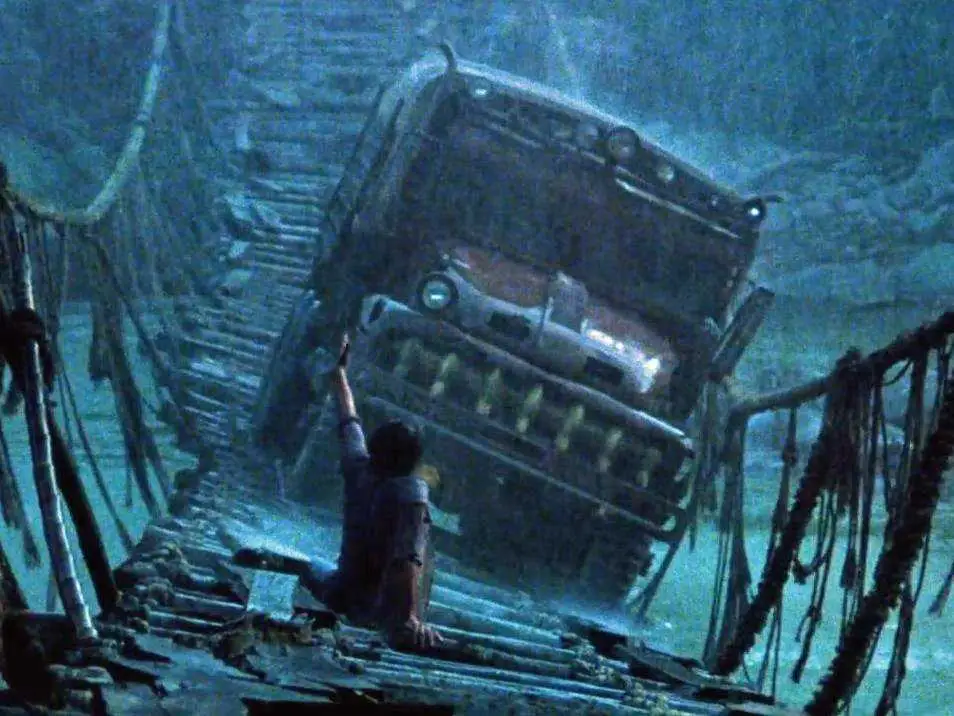
On the plus side, many of the ordeals are stunning (getting the trucks over wooden, swinging bridges is one of the most riveting things I’ve ever seen in movies); the visual grit of the film is palpable, which in the age of sterile CGI, is always welcome; there is also a matter-of-fact lack of sentimentality that melds well with the harshness of the environment; and the picture introduced Tangerine Dream (Thief, Risky Business, Near Dark) and the synthy soundtrack is dissonant but effective, as the environs seem almost otherworldly.
Bill Burr, Quentin Tarantino, and my son (his biting rejoinder pending) are decidedly more enthusiastic. Hell, Tarantino deems it “one of the greatest movies ever made.”




 filmvetter