Archive

Comedy

Jack Nicholson and Helen Hunt won Oscars in this James L. Brooks comedy about a cantankerous romance writer with OCD (Nicholson) and a worn-out, single mother waitress (Hunt) who meticulously serves him at the only Manhattan diner at which he will eat. Nicholson is a holy terror, complaining “there are Jews at my table” when it is occupied. At home, he is no better, throwing the dog of his gay artist neighbor (Greg Kinnear, who won a best supporting actor Oscar) down the trash chute. But Nicholson is soon drawn into the world he loathes out of necessity. Hunt has to leave her job because of the health of her son, and Kinnear is beaten into a wheelchair by local thugs, which leaves Nicholson to take care of his dog. The man has to eat, and he bonds totally with the pooch, so soon, he is arranging for medical treatment for Hunt’s child and acting as support for Kinnear. In the process, he and Hunt begin a relationship that is halting at best.

This picture can be riotously funny, and Nicholson gets all the good lines, including my favorite.

If I have a problem with the movie, it is Hunt’s character. Her harried waitress is overbearing, self-pitying and often bullying, and her demand for control is every bit as off-putting as Nicholson’s knee-jerk rudeness and his fear of cracks on the sidewalk. Yet Brooks denies us any judgment of her – she is presented as plagued, but somehow noble. Mind you, Hunt’s performance is excellent, but her character is unpleasant without the benefit of making me laugh, and my teeth are always set on edge during her scenes.

That’s probably my hang-up.

Frances Ha (2012) Review |BasementRejects

In the first ten minutes, you realize this is going to be a melange of a Woody Allen black-and-white paen to New York and Lena Dunham’s HBO sensation Girls. Dunham’s show is an entertaining but often frustrating characterization of four girls, post-college, making their way in the world of New York City via witty, self-satisfied rejoinders and copious infusions of cash from their parents. Loaded with self-esteem but no brightly discernible skill, Dunham’s quartet negotiate the shoals of a hip, ever-changing landscape while coming to the realization that every girl with a B.A. from Oberlin is not destined to be a smash in the literary and art worlds. It’s hard to like her characters, especially, Dunham herself, whose Hannah is so grotesque, self-involved and deluded that you’re often left cringing or sputtering in amazement. Or, at almost 50 years of age and closest in sensibility to her poor beleaguered parents on the show, I am.

Still, Girls is a solid work, surprisingly addictive, and it always elicits a great discussion that can range from generational rot to what the cool kids are into these days. I also credit Dunham with either knowingly or unknowingly crafting a sharp indictment of extended, subsidized adolescence, and despite her ridiculous persona as her star ascends, I think she knows it. Or she should.

If Girls were a quintet, the protagonist of Frances Ha, Greta Gerwig, would play the mopey, co-dependent would-be dancer. Unfortunately, Frances is not in the hands of Dunham, who could effectively compensate for Frances’s pathetic existence with humor or humanism. Instead, she’s in the hands of a filmic sadist, Noah Baumbach, whose characters are often so vile and/or degraded that you wonder if the point of the exercise is solely to make the audience feel better about themselves. As the divorcing parents in Baumbach’s The Squid and the Whale, Laura Linney and Jeff Daniels are positively toxic, as is Nicole Kidman’s abusive, miserable mother in Margot at the Wedding. Ben Stiller’s Greenberg is similarly noxious, though at least Baumbach offers some redemptive qualities near the end of that film.

The difference between those characters and Frances, however, is that they are in varying positions of power, whereas as a 27 year old Vassar grad who is as much a dancer as I am a power forward, Frances is at the mercy of her surroundings and singularly ill-equipped to handle them. You can feign amusement at her plight in the various uncomfortable situations Baumbach creates for her only so long before you feel guilty. Baumbach may have caught on to his excess, because in the last five minutes, Frances develops character, self-esteem and a place in this world for no apparent reason other than to avoid a mass suicide at the local cineplex.

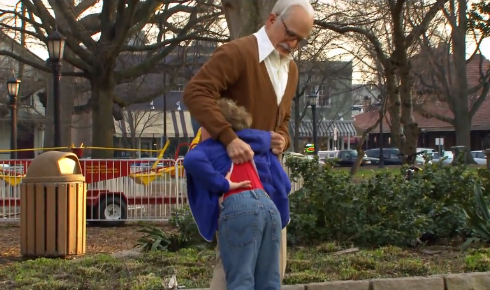
There is a difference in this installment of the Jackass series.   Creator Johnny Knoxville and collaborator Spike Jonze have given us an actual character. Instead of a gaggle of cut-ups and clowns crashing golf carts or defecating in showroom toilets, we have an old man (Knoxville in convincing makeup and prosthetics) who is recently widowed (in fact, his dead wife is in the trunk of the car) and whose daughter was just jailed.  The old man is forced to drive his grandson from Nebraska to North Carolina to drop him off with his deadbeat father, pranking merrily along the way.  Some pranks hit (his uninvited involvement in a male strip show and his being hurled through a plate glass window while astride a kiddie ride), some are okay (a malfunctioning bed that crushes him, a drunken trip thru a drive-up window in a shopping cart) and some are too uncomfortable or disgusting to recapitulate.

Ultimately, like Borat before it, Bad Grandpa is accidentally patriotic.  As bad as this grandpa acts, as much as he destroys and mucks up, the tolerance and kindness that greets him is noteworthy.  As Christopher Hitchens observed about Borat, whose hijinks were decidedly more cruel and condescending than Knoxville’s shock routine, “Americans are almost pedantic in their hospitality and politesse.

The patience of the prank-ees in Bad Grandpa is its strongest feature and, for that, we should be thankful.

Enough Said is an engaging, touching semi-romantic comedy for adults in the target market of 40 to 60. The trials of Julia Louis-Dreyfus, a middle aged masseuse, do not include keeping the sex drive hot with the advent of a new baby, or struggling with the fact that all of her friends are married while she is not. Rather, she is divorced, working, plagued by her daughter’s move from LA to NY for college, and the hunt for a man has been reduced to a mere occasional flare. But she meets a man, and his ex-wife, and develops a romance with the former and a friendship with the latter, initially ignorant of their connection. She is soon wise and makes the calamitous decision to use intelligence gathered from the ex-wife to evaluate her new partner.

Enough Said is a beautiful epitaph for James Gandolfini as the love interest, who plays a portly middle-age loner in angst over the departure of his own daughter to college with a subtlety and nuance that may well have freed him from the shackles of Tony Soprano once and for all (the Lord works in mysterious ways, and there is no greater example than having Enough Said released after The Incredible Burt Wonderstone).

Louis-Dreyfus is also impressive. There is no questioning her comedic chops (HBO’s Veep shows how effortless she moves in that milieu), but here, she draws deeper, and slowly reveals repressed fear and insecurity. Not in the paroxysm of a self-revelatory banner speech or after undergoing the withering but “true” dressing down of a gal pal in the penultimate act, but in ascending scenes of awkwardness, comfort, quiet resignation as to her actions toward Gandolfini, and then need.

The film also handles secondary characters with maturity. They err and recover, but we are not let off the hook by cartoonish villains or easy marks. This is a bit of a departure for writer-director Nicole Holofcener (Lovely and Amazing, Friends with Money), who was previously very tough on her protagonists and supporting characters in a manner that bordered on condescending. Still, in Friends with Money, Holofcener zeroed in on the casual iciness of an outwardly happy marriage between Catherine Keener and Jason Isaacs and her skill depicting the dynamics of couples has not eroded.

One of the, if not the best film of the year.


Joseph Gordon-Levitt directed, wrote and stars in this surprising romantic comedy about a New Jersey working class lothario who prides himself on an ability to bed the most beautiful girls at the clubs (the “dimes”) but maintains a more personal, lasting relationship with on-line porn.  When the dimiest of dimes, Scarlett Johannson, comes between Levitt and his smut, he is forced to make a choice, with the assistance of an older friend, Julianne Moore.

The picture starts out fresh and funny, getting the most out of Levitt’s conundrums and fetish, but it takes a sweet and slightly deeper turn as he comes to realize the degenerative, asocial impact of his choices.  Gordon-Levitt is a winning performer, and even as a slightly dim palooka, you invest in him. Johannson and Moore are also strong in support. In fact, the entire cast is sharp, save for Tony Danza and Glenne Headley doing a louder, less capable Robert De Niro/Jackie Weaver from Silver Linings Playbook.

In some ways, this movie appears to be the last thing a teen should watch, especially a younger one.  It is crude and deservedly R rated.  But I’m going to recommend it to my high school freshman son and senior daughter because it is original and clever and, as importantly, because it communicates a positive lesson about sex and love in a world where, well, you have porn stars wondering why they just aren’t accepted and the medical community searching for yet another clinical addiction.

The World’s End, the third installment of Director/Writer Edward Wright and Writer/Lead Simon Pegg’s Three Flavours Cornetto trilogy, melds their two prior comedies. There is the apocalyptic vision of Shaun of the Dead, as a troupe of 40-something high school mates (led by Pegg) take another shot at an epic pub crawl, only to learn that their pastoral hometown as been infiltrated, not by zombies, but by robots. There is also the town itself, which has become a sterile, cookie-cutter environment, not by the hand of the secret community beautification cult of Sandford, as in Hot Fuzz, but by aliens. All three films feature the great buddy tandem of Pegg and Nick Frost, Wright’s Abbott and Costello, but in The World’s End, Frost is the responsible member of the duo (a barrister, if you can believe it), until Pegg’s jabbering and the tenacity of the robots transform him into an unstoppable robot-killing machine.

These are great joy ride films, with inspired action sequences punctuated by some very funny lines. Forced to choose, I’d have to put Hot Fuzz at the top, if only for the best movie shootout ever, the beginning of which is below:

The opening scene, where our beleaguered protagonist Duncan (Liam James) has to endure a numeric assessment from his mother’s new boyfriend (Steve Carell, who deems Duncan a “3” on a 1 to 10 scale for his layabout ways) reveals a great strength and a great weakness of the film.  James, as an awkward, inward 14 year old dragooned to Carell’s beach house with his mother (Toni Collette) for the summer, exhibits all the hideous hallmarks of the age. He’s ungainly, goofy and paralyzingly shy.  Carell also keenly occupies his type – an exact, sly bully who masks his menace in the cause of trying to be a father figure.  Everyone time he says “hey, buddy”, it presages a cut, an attack, and therein lies the problem with this coming of age tale.  With Carell identified as a villain from the get go, little that occurs next is unexpected or fresh.

That said, the script, from the Oscar winning writers of The Descendants (Nat Faxon and Jim Rash, who also co-direct) is assured.  The story of Duncan’s growth under the tutelage of Sam Rockwell, a comic guru who runs the local water park, takes pity on Duncan, and gives him a job, is the heart of the picture, and their banter is really very funny and often surprisingly touching.  As Duncan’s mother loses herself in Carell’s world, we know  Carell must be slayed.  While we wait for that inevitability, however, Faxon and Rash have a blast with the water park and all of its quirky characters (including both Faxon and Rash, who are both very funny as well).  Carell’s coterie at the beach are also well written, if not fully developed, with Allison Janney delivering the lion’s share of the killer lines, most of which are directed at her own son, who has a wandering eye she insists be covered up by a patch.

There is triumph and happiness at the end of the picture, as you knew there must be, but with a little more care and guts, the writers could have made a great film.  Instead, in the middle, they so vilify Carell that they do lasting damage to the story.  Duncan goes on a boat trip and Carell forces him to wear a ridiculous life vest while the much younger kid with the wandering eye is unburdened.  The cruelty is too much.  It robs Carell of any chance of being anything but a caricature, demeans Collette, and is so humiliating to Duncan that you start to lose sympathy for the kid.  I don’t think Faxon and Rash wanted Carell’s numeric assignment to find purchase with the audience, but that’s what they risked.

This film is a similar to, but not as good as Adventureland.

Image result for Burt Wonderstone

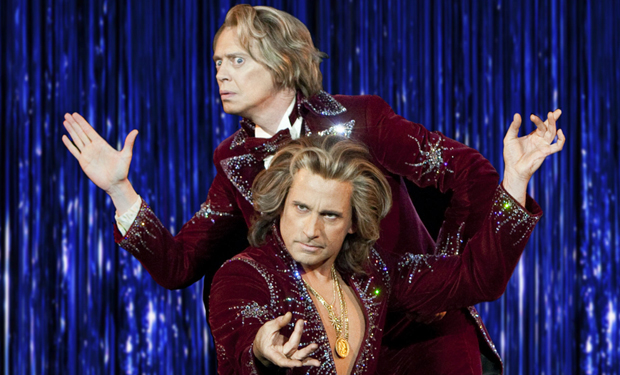
Not bad, not great, along the lines of Dodgeball, with a few good gags (in particular, Vegas magician Steve Carell freaking out 20 minutes after the start of his 7 day stunt stint in a box above The Strip).

This is a movie that answers the question: What would Michael Scott have been had he left Dunder Mifflin to become David Copperfield?

Two takeaways.

First, Jim Carrey plays Carell’s nemesis, and boy has he aged.  Cable Guy schtick doesn’t work so well from such a weatherbeaten vessel.

Second, I am a huge fan of Steve Buscemi.  He stood out in Miller’s Crossing, his dramatic work in Reservoir Dogs and Fargo was gritty, his season on The Sopranos was sublime, and his Nucky Thompson on Boardwalk Empire is rock solid.  But where did he get the reputation for comedic chops?  He’s been in 5 Adam Sandler vehicles, but having that on your resume’ isn’t exactly a recommendation.

Funny looking is not funny.

Image result for Trading Places

A funny, cynical 80s movie that holds up well, unlike, say Splash.  While Dan Aykroyd is obtrusive and over-the-top as the snooty Philadelphia financier who, in the service of a sociological inquiry/$1 bet, is framed as a thief and drug dealer by his financial titan bosses and replaced by the homeless Eddie Murphy, John Landis’ picture overcomes his scene-chewing.  Well, Murphy does.  He is electric and inventive, Jamie Lee Curtis voluptuous and winning, and as the scheming Wall Street chieftains Duke and Duke, Ralph Bellamy and Don Ameche are having such fun it is infectious.

A friend passed on a nifty oral history of Trading PlacesThe best bit:

LANDIS: The most remarkable story, casting wise: I thought, ‘Well, I need someone who was a movie star in the ‘40s, who never has never really played a villain, and I was thinking, ‘Hey, what about Don Ameche?’ And the casting woman said, ‘Don Ameche’s dead.’ And I said, ‘I don’t think so, I would know if Don Ameche is dead.’  And so we called the Screen Actor’s Guild, and his residuals were being sent to his son in Phoenix, Arizona. And I thought, ‘Well that’s not a good sign.’ And he didn’t have an agent, and I thought, ‘Shit, goddamm, who else could we get?’ when one of the  secretaries said, ‘I heard you’re looking for Don Ameche.’ We said ‘Ya.’ She said, ‘I see him all the time walking on San Vicente in Santa Monica.’

So I called information, and I said, ‘I there a Don or D Ameche on San Vicente in Santa Monica?’ And there was! So I called him. And you know he has that unmistakable voice, and you realize, Don was a huge star, in the late ’30s, definitely a big star in the ’40s — I mean he was Alexander Graham Bell for chrissakes! — a major star in the ’50s, Broadway star, radio star, movie star, television star.

And I said, ‘Mr. Ameche?’ ‘Yeeessss…?’ ‘My name is John Landis, I’m with Paramount Studios, and I’m making a film and I’d like you to consider a part.’ So I had a script sent over. ‘And could you please read this and can you come in tomorrow?’ And he said, ‘Yes.’ Would you like us to send a car?’ He said, ‘No no, I can drive.’ I said, ‘Great.’

And he came in and was prepared to read for me. I was so shocked. I said ‘You don’t have to read for me.’

He hadn’t made a movie in 14 years, he’d been doing dinner theater.

While we were shooting later in Philadelphia — he was so wonderful — I said, ‘Don, may I ask a question? How come you haven’t worked in 14 years?’ And he said, ‘Well, nobody called!’