Archive

Comedy

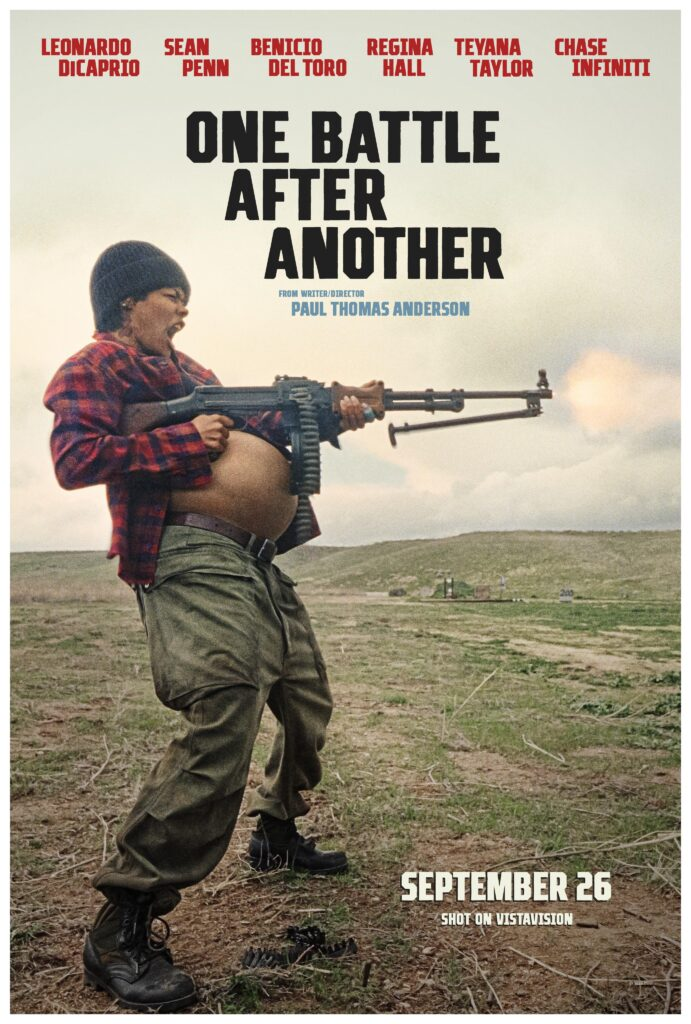
A wild, screwball thrill ride, Paul Thomas Anderson infuses adrenaline with wit and a surprising knack for action sequencing. Leonardo DiCaprio, after Once Upon a Time In Hollywood again demonstrating he is our most accomplished dramatic/comedic actor, plays Bob, a former American domestic revolutionary. Think Weathermen, or Symbionese Liberation Organization, but hyper-charged with comic book pizzazz. Bob got out of the game when he had a daughter, Willa (Chase Infiniti). When Willa is endangered by the past, DiCaprio must save her from a dangerous man on a mission, the government, and a white supremacist society that feels like a mix of Eddie Bauer and SPECTRE. If you wish to stop the review here, as this is a current release, no worries. Enjoy and come back. This is one of the better flicks of the year.

*MINOR SPOILERS FOLLOW*

DiCaprio’s wife, Perfidia Beverly Hills (Teyana Taylor), is a mix of Coffy and Angela Davis. After Willa is born, Perfidia cannot quit the rush of the struggle or face the yoke of motherhood, so she abandons the family, continues to participate in robberies and bombings, and is eventually captured. Her kick-ass bravado exposed, Perfidia squeals on her fellow compatriots, leaving DiCaprio vulnerable and forced to lam it with infant Willa. Bob gives up the life and settles in a quiet town a fat happy stoner, where Willa’s safety is priority number one. 15 years later, a loose end from the past, Sean Penn as Colonel Lockjaw (yes, this is indeed a comic book), needs the daughter, DiCaprio must rouse his flabby mind and body to save her, and the giddy, hilarious chase and race are on.

**MAJOR SPOILERS FOLLOW**
On the minus side, and the basis for deductions.

The film is overlong. Penn is offed twice, to no good end in a film nearing 3 hours. Anderson also tacks on a sop, Willa reading a “Fight the Power!” letter from Perfidia, which, if you do not see it coming means you do not watch many movies.

Penn is also problematic, some of it his fault, some not. He is well-developed as a rigid, top-of-food-chain guy who is so sexually attracted to Perfidia (and she to him) his obsession seems genuine and all-encompassing. They are warriors, on opposite sides, feral, carnal, battle junkies. But when Perfidia is gone, and 15 years pass, Penn’s fixation stems from a funny cartoon creation. “The man,” as in white supremacist corporatist types in a suburban star chamber, come calling for Penn and offer him entree’ to their racial purification club. To enter this august body, however, Penn must erase the fact of his mixed-race daughter. If Anderson had expeditiously grounded Penn’s desires for acceptance and/or the roots of his racial enmity as well as he did his hunger for Perfidia, the film would have been stitched tighter, and Penn’s dilemma would have been more interesting.   

Penn himself is also over-the-top at times, which is sometimes called for (Mystic River) and sometimes not (his William Holden in Anderson’s Licorice Pizza was a masterclass in cool understatement, but he still has the sin of Casualties of War for which he must atone). Given that we spend so much time on Penn’s fate, he needed to be better fleshed out and ratcheted back.  

There is also the matter of the film’s politics. While the revolutionary group opposes all forms of classist, misogynist, racial establishment dominance, ICE-like deportation raids are at the center of the story. Indeed, DiCaprio is ensconced in a sanctuary city. Naturally, this has raised the hackles of observers on the right, another sad development in a world where you can’t even eat a Chick-Fil-A sandwich or drink a Bud Lite without a political colonoscopy.  Nonetheless, Anderson is not interested in proselytizing. He wants action, slowing only to have a little fun, such as when DiCaprio forgets a password and must deal with a punctilious comrade much as we all have to deal with help desks and call centers:

  • Bob: I need this rendezvous point, you understand what I’m saying? I need it.
  • Comrade Josh: I understand and the question is “What time is it?”
  • Bob: Fuck! If you don’t give me the rendezvous point, I swear to God I will hunt you down and stick a loaded, fuckin’ hot piece of dynamite right up your fuckin’ asshole.
  • Comrade Josh: Okay, this doesn’t feel safe. You’re violating my space right now.
  • Bob: Violating your space? Man, come on – what kind of revolutionary are you, brother? We’re not even in the same room here. We’re talking on the phone, like, man!
  • Comrade Josh: Okay, there’s no need to shout. This is a violation of my space to me. These are noise triggers.
  • Bob: Fuckin’ noise triggers? Listen, I wanna know something. I wanna know one thing when this is all said and done: what is your name? I need to know your name.
  • Comrade Josh: My name is Comrade Josh.
  • Bob: Comrade Joshua? Get a better name. “Comrade Josh” – that’s a fuckin’ ridiculous name for a revolutionary. First off. Second off, I want to know your coordinates. I want to know your location right now. What is it?
  • Comrade Josh: I’m in a secure location somewhere between the stolen land of the Wabanaki and the stolen land of the Chumash.
  • Bob: You’re fuckin’ intolerable, man. You’re really intolerable. This is not the way revolutionaries do shit. Do you know how hard you are to talk to? Do you know the information I’m trying to give you? You’re a little nitpicking prick! That’s what you are: a little nitpicking prick. And do you know what I’m gonna do to nitpicking pricks? I’m gonna call in a Greyhawk 10.
  • Comrade Josh: You’re calling in a Greyhawk 10?
  • Bob: I’m calling in a Greyhawk 10, all right? I want you to get your supervisor on the phone right now, because I know you’ve got one. I know you’ve got one, Comrade Josh. All right, I’m going way over your fuckin’ head. Way over your head, all right? Put your commanding officer on the phone now!
  • Comrade Josh: Cause you’re calling in a Greyhawk 10?
  • Bob: I’m calling in a Greyhawk 10, Comrade Josh.
  • Comrade Josh: Please hold.

The interlude is a reminder that this is a trip, not a treatise, and the revolutionaries and their adversaries on the ground are presented as professionals or cogs rather than ideological heroes or villains. They never veer too far from a wink and a nod.  

Ultimately, I think liberal audiences will love the flick no matter their artistic sensibilities. As I feel the excitement of conservative retributive justice (rights be damned!) in a Dirty Harry or Equalizer movie, this flick is the fantasy of glorified gutsy, cool, strutting anti-fascists who possess skill, discipline, and smarts. As opposed to their meh real-life counterparts, living in their mother’s basement, contributing to the revolution one bag of Cheetos and social media post at a time.   

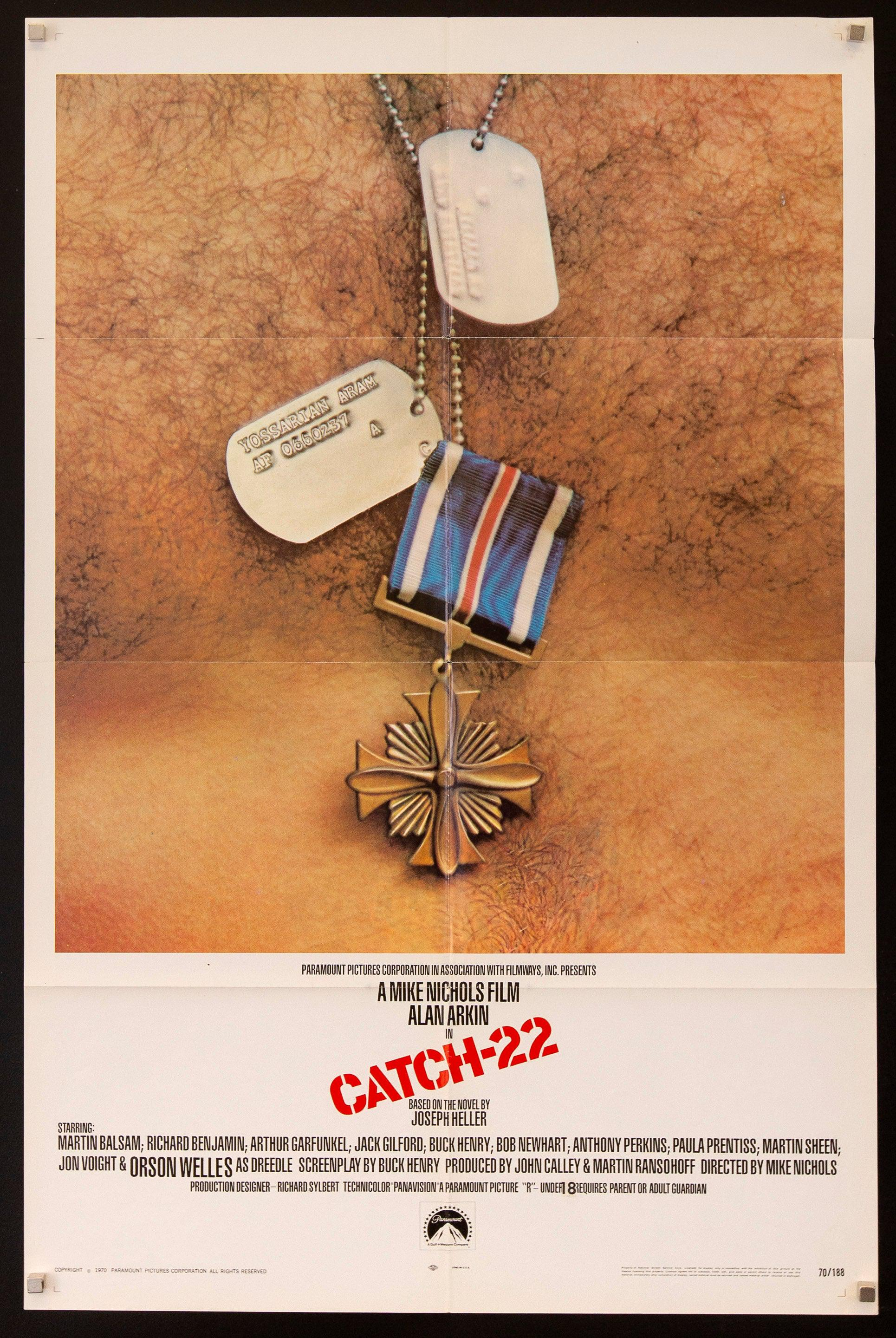
Mike Nichols’ adaptation of Joseph Heller’s dark comic novel is energetically brisk and sometimes entertaining. Tonally, however, the film is an uneven mess, a pointless downer playing bleakness for laughs. 

As the original Corporal Klinger, Alan Arkin’s Captain Yossarian is the engine of the picture, a bombardier stationed in Italy who is losing his nerve and wits. His superiors (Bob Newhart, Buck Henry, and Martin Balsam) vex him by upping the number of bombing missions necessary for a ticket home to curry favor with their commanding officer (Orson Welles). Yossarian’s fellow fliers (including Martin Sheen, Richard Benjamin, Anthony Perkins, Charles Grodin, Bob Balaban, Jon Voight, Art Garfunkel, Jack Gilford and Norman Fell ) all suffer under the same yoke, but with cheerful acceptance or apathy rather than the indignation of Arkin’s whirling dervish.  How the Academy overlooked Arkin astonishes me; whatever the flaws of the picture, his commitment and on-the-edge turn requiring an actor’s entire skill set is unforgettable.        

The film’s main problem is rooted in the see-sawing expanse of the endeavor. Yes, war is FUBAR, and aspects of it are both craven and bizarre. In the world of Nichols and Heller, the poor bombers are riddled with asinine and unctuous leadership, wackadoodle stir-crazy types, suicidal loons, sex-crazed fiends, one murderer, and one uber-capitalist who trades parachutes for commodities on the open market.

When played for laughs, the picture is solid, and no one is begging for verisimilitude. However, when pathos is introduced, such as truly tragic deaths of compatriots (including a particularly brutal death of a young flier) and civilians, the film feels incongruously cruel.

Worse, the picture is more than anti-war. It is anti-American, maybe even anti-everything. As nothing matters, there is no investment in the fates of anyone. A fair juxtaposition is Robert Altman’s M*A*S*H, in which the madness of the endeavor is clear but even in that madness, the professionalism of the medical staff is unquestioned and laudable, the loss of life truly sad. Nichols himself felt M*A*S*H did his picture in: “We were waylaid by MASH, which was fresher and more alive, improvisational, and funnier than Catch-22. It just cut us off at the knees.” All of which is true. But M*A*S*H also had heart and a respect for the craft of combat surgery. Here, there is no respect for anything or anyone and the characters seem more from Looney Tunes than Heller’s book.

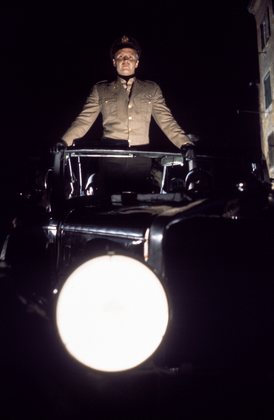
Indeed, every hallmark of the American ethos is there for Nichols to malign. The military leaders are insecure dolts, silly and moronic, who care not a whit for the men. The fliers are chumps or burn outs, pawns in the great game, either oblivious or devious in their plans to get out and shirk. Everyone is also an automaton, caring for nothing, even each other. The goal and aim of the war, and this is World War II we are talking about, is at best corrupt and ultimately criminal, as we bomb not only towns with no military significance, but, in a perversion of capitalism, we allow the Germans to bomb our own base for profit. The Italians are victims of the Americans, just as they were victims of the Germans, because, you see, there is no difference between the two. By the end of the picture, the genius behind the corporate conglomerate, Jon Voight, is now close to full Nazi in regalia and trappings.

Hell, even parents who come to Italy to see their dying son are treated as props for a goof.   

Yes, yes. None of this is to be taken literally in a “war is madness” story, and the film is a black comedy grossly overgeneralizing for the laughs. Still, it’s the kind of smart set entertainment that fairly encapsulates the philosophy of the sophisticate, a sneering besmirchment that puts the last torpedo into a sinking ship.

I wonder what Heller made of the movie’s iciness. Obviously, his book was a cynical send-up (I read it in high school, along with Vonnegut’s SlaughterHouse-Five), but Heller also flew 60 combat missions as a B-25 bombardier during the war.

On Amazon Prime.               

Liam Neeson is an inspired successor to Lt. Frank Drebben. Proof? His Sam Spade voiceover estimation of the physical gifts of Pamela Anderson.

And she had the type of bottom that would make any toilet beg for the brown.”

Enough said.

And if you are surprised by Neeson’s comedic chops, you should not be:

*You have to love this stuff, which I do.

A sweet, bumbling but well-meaning widower (Tim Key) pays a hefty sum for a reunion concert of a busted-up (professionally and romantically) folk duo (Tom Basden and Cary Mulligan) at his home, a remote island off Wales, without telling one that the other will be attending. Funny, charming but never  saccharine, smart, short, restrained, and not bound by the prerequisite of tying it all up in a bow. Felt like one of my favorite flicks, Local Hero. One of the best I have seen this year.  Streaming everywhere for $9, free on Peacock.

Amazon Prime is loaded with old crime pictures and though it pains me to categorize a 1990 flick as an “old crime picture,” there you have it.

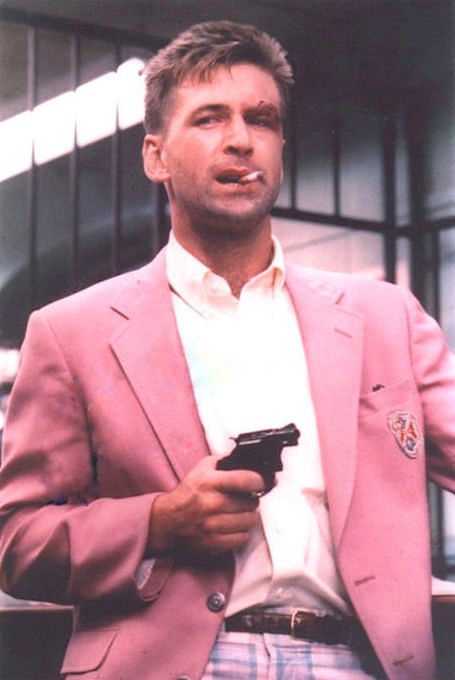
George Armitage (Grosse Pointe Blank) directs an adaptation of a Charles Willeford Detective Hoke Mosely novel (Willeford is a Florida crime novelist less heralded and a lot better than Carl Hiaasen). Alec Baldwin is a quirky thug just out of prison who lands in Miami, accidentally kills a Hari Krishna at the airport, and lands with small town and just starting out call girl Jennifer Jason Leigh. He evades arrest by Detective Mosely (Fred Ward), who is investigating the death of the Hare Krishna, and in the process, steals Mosely’s gun, badge, and dentures, thereafter ripping people off with the imprimatur of authority. The movie is absurdist and light, Armitage’s direction is workmanlike and industrious, and the result is more soft than hard boiled, a fun jaunt through weird 80s Miami. Enjoyable and mostly forgettable.

Mostly. Baldwin is so talented, loose and committed, his weirdo ex-con is fascinating and often gut-splitting. Literally every time he flashes Mosely’s badge, it is laugh out loud. As everyone he tries to hoodwink responds with a weary “ya’ gotta’ be kidding me,” Baldwin amps up his TV cop persona and the result is even funnier. These were early days for Baldwin, a hell of a dramatic actor but stellar in comedies. His choices are brazen and risky, and they all hit. The performance screams “star.”

To complement him, Jason Leigh as the hooker with a heart of gold is so earnest (she is saving up to start a fast food franchise) she actually moves you. Baldwin matches her with a crazy sweetness as they play house (until Mosely closes in).

Worth it, flaws and all, for the performances.

Sean Baker (The Florida Project) delivers an uproarious, tender, unexpected love story, powered by a rollicking, unyielding performance from Mikey Madison as the lead (last seen by me as one the Manson gals of Once Upon a Time in Hollywood, the one who Leonardo DiCaprio ultimately dispatches with a flamethrower).

Anora, or Ani, works as a stripper at Headquarters in Midtown, a sanctum where she peddles her wares (simple company, lap dances, and in the private rooms, maybe more). She supplements her income as an escort. Sex is transactional, which does not devalue her ability to enjoy it, but the financial nature permeates the act such that her brittle nature seems organic rather than a symptom.

Then, she meets her knight in shining armor, Vanya, the child-like, fun-loving son of a Russian oligarch (Mark Eydelshteyn), who blows through Daddy’s rubles like water, rents her for the week, and then, after a bender in Vegas, marries her. This obviously does not go down well, and the oligarch must rely on his Armenian reps in New York to rectify the situation. They are not quite the Eastern thugs of lore, and their intercession is more Three Stooges than John Wick.

As they say, hilarity ensues.

As does much more. The connection between the man-child Vanya and Anora is in part about money, yes, but you can feel a spark, and even though Anora remains focused on the payments, soon, she fancies herself Julia Roberts. This is love, and he is hers, even if he just started shaving. You know that it cannot be, but Baker has you as enthralled as Anora, on pins and needles, hoping against all hope and reason. When the forces of power intercede, they are partially represented by an Armenian thug Igor (Boris Yurasov) who reveals a gentle, protective disposition and an alternative approach, one that Anora fights with the same verve and fire she exhibits to hold on to Vanya.

Ultimately, there is a reckoning, a declaration of independence, and a new beginning, but before we get there, Anora and her unwelcome coterie of Armenian minders endure an evening that harkens to Scorsese’s After Hours.

As with The Florida Project, Baker has such command of place, you feel immersed. Here, due to the whirlwind nature of the story, Baker’s pace is not Florida languid, but Big Apple urgent and exhilarating. It’s a joy ride with heart.

Madison, Eydelshteyn, and Yurasov all deserve Oscar nominations, and my fingers are crossed, as Madison and Yurasov received nominations for the Golden Globes.    

I have many films to see, but this is currently the leader in the clubhouse for best of the year.

Elliott, a vacuous, self-satisfied, snarky Canadian teenager (Maisy Stella) is visited by her 39 year old self (Aubrey Plaza) during a mushroom trip. Plaza’s old ass has much to say to Elliott’s young ass, much of it a violation of the Prime Directive, the guiding principle of Starfleet that prohibits its members from interfering with the natural development of alien civilizations.

Yes. I watched Star Trek. What of it?

The set-up is well worn. Elliott wants to get off the family cranberry farm and find herself in the big city of Toronto. She is meant to be celebrated for her freedom and grab-life-by-the fistful approach. She’s gonna’ shake the red juice off her small town boots and let loose before global warming interferes with her cell service. She’s a rebel. But she’s also a loudly stupid and narcissistic rebel, and all the soft piano, oboe, and terrible acoustic dirges cannot make her interesting.

With a lead who could act and a less obvious, smarter script, My Old Ass could have been a clever twist on the coming of age flick, Freaky Friday meets A Christmas Carol.

Stella (member of the music duo Lennon & Maisy), however, cannot act. She is one-note, snotty, and charmless. She makes Disney Channel kids seem method. 

The film has a few genuine moments where Plaza, Elliott’s mother, and her would-be first boyfriend all present Elliott with a remembrance, a well-rendered insight, a moment of tenderness. In response, Elliott – not allowed to say “dude, what the fuck? for the umpteenth time- offers a “dude, what the fuck?” countenance. Any expressed emotion crashes into her stubbornly smug visage, where it thuds. Such that we are thinking, “Miley Cyrus could have really done something with this role!”

Worse, no one has bothered to make the trick explainable. After the drug trip ends, inexplicably, Plaza still texts and calls and visits Elliott. Tripping as portal to an Apple data plan? This is lazy mush and indicative of the ragged nature of this endeavor. 

The script is mostly middling sitcom. Plaza and Elliott say cool stuff like “when do we …?” Followed by “oh my God. This happens …” Plaza says to Elliott: “Moisturize!” Elliott replies with a form of “What the fuck? Dude!???” Elliott to Plaza: “Can I kiss you?” Plaza replies with “ewwwwwwwwwwww!” or some derivation of same. Stella says “fuck” and “dude” and “like” and “sick” a lot. She spouts hip cliche’-ridden observations that may tickle the fancy of an 18 year old peer, but test the patience of anyone who has read a magazine. Or a cereal box.

When we get to the meat, Plaza reveals a particular thing Elliott must prepare for, something so obvious, it seems a perfunctorily preordained. It is asked to serve as the emotional linchpin of the movie, yet the most Stella can muster is the disappointment of a girl who pours a bowl of Lucky Charms only to find a low marshmallow count. 

Sometimes, in these flicks, you get some funny, well-drawn secondary characters who maybe could drag Stella along. But everybody is pretty vanilla and meh. When they have something to say, it is leaden with announcement and unforgivably banal. 

The film might have been saved if Plaza told Elliott not to take a particular hike and she did it anyway and then she was almost murdered by the Green River killer.

Missed opportunity. 

Last point. Yes, teens say “like” and “fuck” nonstop, like men in war curse beyond any comprehension. But to actually let characters lapse into this doggerel in a script? Jesus. It may as well be serial farting. 

The picture was on a few top 25s and 50s and very highly rated on Rottentomatoes.com.

Undeservedly so. Like dude, what the fuck. 

On Amazon. Thankfully, for free. 

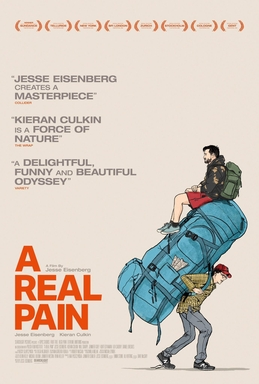
A beautiful, meditative story about family, and the disconnect between ancestry, past, and shared blood. Writer-director Jesse Eisenberg (The Social Network), and Kieran Culkin (Succession) are disconnected cousins who used to be very close when young, and are now held together by a strong attachment to their recently deceased grandmother. In remembrance and per her wishes, they join a tour group to Poland to visit her origins, including the concentration camp she survived. In that journey, they hash out some old differences, reveal their insecurities and grievances, and otherwise, commune with the past. Culkin is enagaging,  charming, yet emotionally dictatorial, and peripatetic. Eisenberg is OCD, eclipsed, a little bit pissed off about it, and, yet, desperate for his cousin’s ability to connect while at the same time weary of having to clean up his emotional messes.

The film is never overt, but it is very touching, particularly when the fissures between the cousins arise in the midst of a supportive group of fellow tourists (one of whom is Jennifer Grey, from Dirty Dancing, who is really quite good, even if she looks nothing like she used to given the radical plastic surgery she underwent many years ago). They are all on their own journey for different reasons, and they quickly become another family to the two protagonists.

Eisenberg’s script is sharp and his direction leisurely. At times, his take felt a little like Sofia Coppola, such is his comfort with the silences and the scenery (his shooting at the camp is haunting). The pain of the characters, as juxtaposed against the history, is made more acute, but again, there is no resolution, no great battle royale, no truly deeper understanding. But, quite tenderly, the bonds are strengthened. The experience may not change their trajectories, but that seems baked into Eisenberg‘s cake.

A lovely, bittersweet picture.

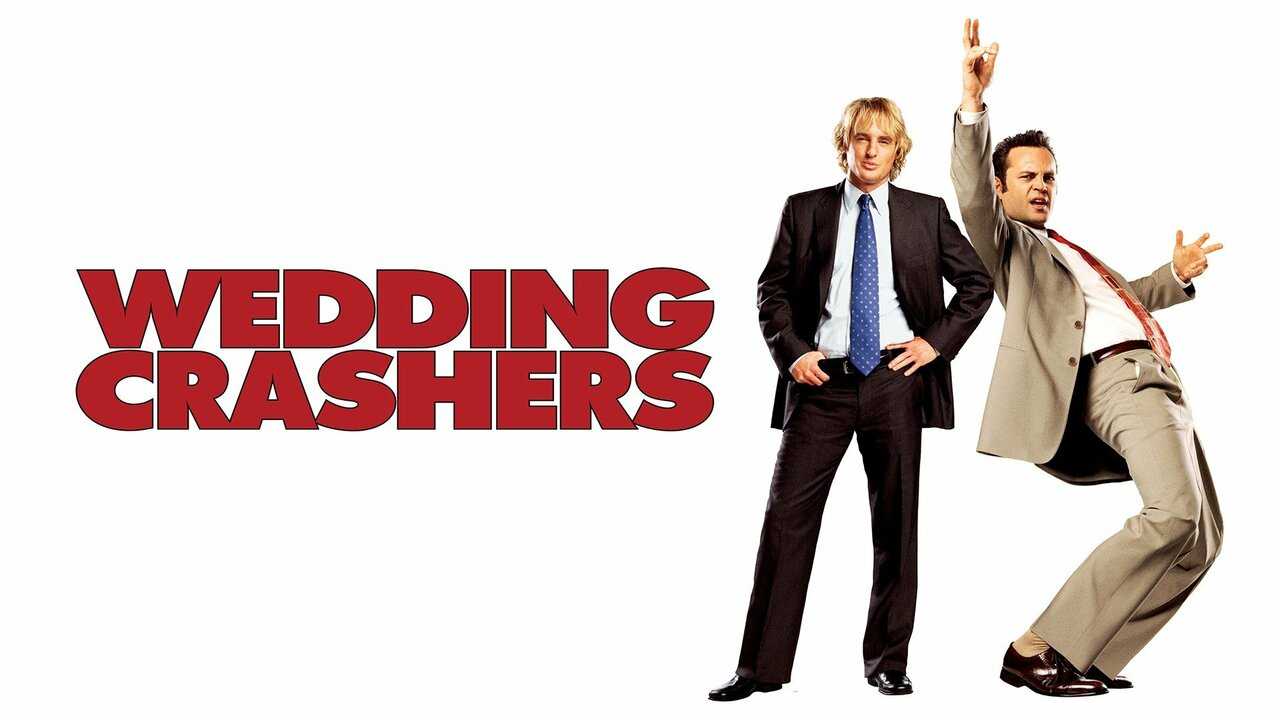
Sunday was a lazy day, watching whatever came on and doing squat. I dusted off the serious tone of Doubt with one of the funniest romantic comedies I’ve ever seen. The nucleus of the hilarity is the relationship between Owen Wilson and Vince Vaughn, two domestic relations mediators who crash weddings, and thereby, rather effortlessly bed the bridesmaids and other female guests with their practiced charms. Sure, the sex is good, but watching them savor the mini-crab cakes, woo the kiddies with balloon animals or cut the rug with granny, feels like an equivalent joy. The moves are practiced, the aim morally questionable, but the love of it all is there.  

They crash the mother of all weddings, that of a daughter of the secretary of the Treasury (Christopher Walken), where Wilson falls head over heels for another daughter (Rachel McAdams) while the third (Isla Fisher, who is somewhere between effervescent and lunacy) takes a shine to Vaughn. Wilson and McAdams flirt madly, and he saves her from a “too-snarky by a million” wedding toast. Vaughn and Fisher expedite matters, as he seemingly deflowers her at a secluded cove near the reception (which, if memory serves, was the Inn at Perry Cabin in St. Michaels, MD). Naturally, Vaughn wants to flee (one of the bazillion rules of wedding crashing is that there be no emotional involvement or connection after the reception), but out of loyalty to his fellow crasher and in their deception as distant family members, both are invited and go to the secretary’s Eastern Maryland home for the weekend. Hijinks ensue.

Wilson and McAdams are really quite convincing and warm. Chemistry goes a long way and they have it in spades. But the real love story is that of Vaughn and Wilson, who have such a genuine and easy connection that their banter elevates above the normal bro’ babble – these guys really love each other, and their interplay is always very funny and strangely moving. My favorite scene:

They elevate an incredibly hilarious and smart comedy where even without their intimacy, it would be hard to pick the scene that makes you laugh the most, be it the over the top family touch football game (Wilson’s nemesis is a young Bradley Cooper, who exerted stardom even then as the eco-friendly, psychotic heavy) or Wilson, having fallen out with Vaughn, hooking up with the Edison of wedding crashing, Chaz (Will Ferrell), who lives with his Mom and has moved on to funerals.

Whenever I see Vaughn in this flick, I think of my oldest and dearest friend, 40 odd years now, my own big guy who wants to bring it in with the big paws and the hug, Leo

Total blast. And a great montage song straight out of the rom-com bin

I was not a big fan of Yorgos Lanthimos. He is clearly talented, but he also revels in the ugly. The Lobster was inventive, but also, masochistic, even abusive. The Favourite was evocative but also grotesque. Lanthimos traffics in the absurd, but he luxuriates in meanness and the darkly visceral, with all its bleeding, flatulence, fluids, and muck. Yet, here, in this hilarious and charming re-telling of Frankenstein, he allows himself whimsy and some gut-busting hilarity.

The time is Victorian London. Emma Stone (Bella Baxter), a fully grown drowning victim fished from the Thames, is brought back to life by none other than a Dr. Frankenstein (actually, Dr. “God”win Baxter, Willem Dafoe) and given life via the insertion of her own unborn baby’s brain. When we meet her, she’s a mere child, eating like a infant, urinating where she stands, stubborn and defiant. But she grows, quickly, and when she happens upon sexual pleasure, she is out and free, with the assistance of a dandy (Mark Ruffalo) who haughtily acts as her tutor even as he is slowly enslaved. Soon, Bella becomes worldly, and learns a few hard lessons, but she quickly masters (speaking of absurd – this word was tagged by spell check as problematic) the ability to make her own destiny in a world that would normally relegate her to docility and subservience. To see her eat, to come, to dance, it is hard not to be as captivated by Stone’s gifted performance as Bella is by the world. And Ruffalo’s foppish moth to her carnal flame is riotous. Bella’s journey is wondrous, funny and beautifully shot, deftly lifting from the best artistic visions of both Tim Burton and Wes Anderson.

I laughed uproariously and sat in wonderment at Lanthimos’ ingenious world.

Two nits. First, I never really thought I’d say, “Hey, there’s just too much of Emma Stone naked” but the film is 20 minutes too long, and there’s just too much of Emma Stone naked. I think Lanthimos became entranced by Stone’s moxie, but soon, all of the sex seems less like a revelation, and more like an obstacle course.

Second, Jerrod Carmichael makes an appearance and there is no other way to put it – he’s terrible. Stilted, clunky, confused, and aggravatingly amateurish. You kind of feel bad for him, but you brighten when you realize he is gone.       

Otherwise, great, smart fun.

Seven down, three (Past Lives, Killers of the Flower Moon, The Zone of Interest), to go.