Archive

Decade

A crime family, one of the five that runs New York post World War II, negotiates the fall of its patriarch, the aging Don Corelone (Marlon Brando), and the transfer of power to the son who was supposed to the family’s representative in the legitimate world, Michael (Al Pacino). Francis Ford Coppola takes Mario Puzo’s potboiler and creates a rich, operatic, and layered crime saga.  As the film opens, it depicts the family’s strong ties to the old world of loyalty and blood with the marriage of the Don’s daughter (Talia Shire), and economic introduction of the hierarchy of the family: hot-headed oldest son Sonny (James Caan), sensitive and simple middle son (John Cazale), the adopted chief advisor son Tom (Robert Duvall) and Michael, who introduces his love Kay (Diane Keaton) to his family, all the while explaining that he is not them.  Indeed, he is in uniform, having distinguished himself in World War II. The disconnect is beautifully evoked in the back-and-forth between the primal Sonny and the advanced Michael.

What follows is the inevitable slow decline of the family as Michael is corrupted and deformed, becoming a Sonny, but with a perverted, soul-sapping sense of “blood” and “family.”

The casting is flawless and given the later body of work of the players, it may be the strongest ensemble in film history. Brando won best actor, and Pacino, Caan and Duvall were nominated for best supporting actor. Other character actors are brilliant in smaller but integral roles, like Richard Castellana and Abe Vigoda as the Don’s chief lieutenants; Al Letieri as a rival who tries to get the Don to bankroll him in the future of drugs; Sterling Hayden as a crooked NYC police captain who serves as Letieri’s guard; and John Marley as the Hollywood mogul and Alex Rocco as the Vegas founder who won’t bend to the desire of the Corleone family until they are made offers that cannot be refused.

Perhaps the best of the bunch is Cazale as the weak, disturbed Freddo. Cazale died of lung cancer after only five films, but what a career: The Godfather, The Godfather II, Dog Day Afternoon, The Conversation, and his last film, The Deer Hunter. If you have not seen it, I strongly recommend the documentary on Cazale, I Knew it Was You.

Mob stories are difficult to resist.  The allure of the criminal life, with its excess, dizzying violence and the seductive freedom to do whatever one pleases without retribution, makes for captivating viewing. The Ray Liotta character in Goodfellas is emblematic of the theme; he was intoxicated by the life and ended up being just an every day schmo, a schlub. The Sopranos melded soap opera and commentary on the modern that, while overpraised, was consistently sharp and engaging. But, oh, the moments when Tony does the things we all wish we could do. Like all mob figures in the movies and TV, the draw is the freedom and the power, consequences of the ethos over time be damned!

The Godfather, however, works as both Shakespearian tragedy and pulp. While providing a seamless criminal power struggle and family drama, Coppola articulates the creeping rot.  The degradation comes in many forms, but Pacino’s haunting performance exhibits it best in Michael.  He starts as a fresh face, canny, even altruistic, but determined to be separate.  Yet, by the end of the film, Michael is hollow, almost physically transformed, as if he has been poisoned slowly by an internal disease.  It’s an incredible turn, solitary and meticulous, so utterly different from the excess of what would come later in Scarface and Scent of a Woman.

The look of the film is stunning, perfectly attuned to the material. Gordon Willis’s cinematography is classic nostalgia.  Willis shoots in a darker hue as the story becomes more ominous and sinister.  Martin Scorsese has called it a trick so influential that “every director of photography over the last 40 years owes [Willis] the greatest debt for changing the style completely.”  The art direction is also noteworthy.  Whether it is an art deco bar that serves as the meeting ground where an enforcer is offed or the sumptuous estate of a problematic Hollywood mogul, every setting feels timeless.  Coppola is also crafty, shooting old New York tightly (his budget was not huge).  Nonetheless, iconic wide shots (a Long Island expressway and causeway, a Times Square street) make up for the lack of sweep.

For enthusiasts, Mark Seal’s book is a must read:

Leave the Gun, Take the Cannoli: The Epic Story of the Making of The  Godfather by Mark Seal

The film is no. 2 on AFI’s top 100. It should be no. 3, after The Godfather, Part II.
Are You Not Entertained?! 15 Most Iconic Quotes From Gladiator

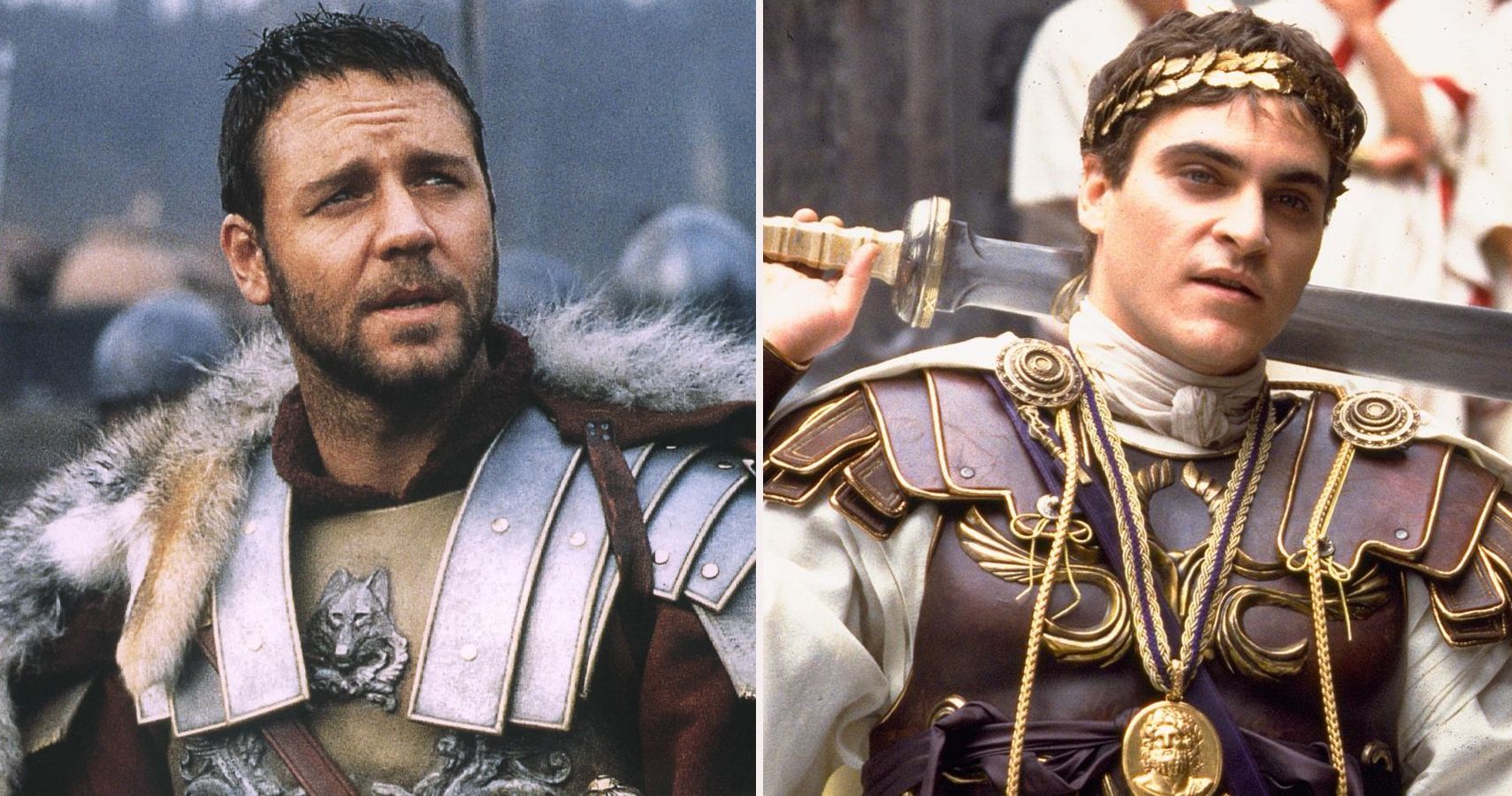
Are you not entertained? You should be. While the script is cobbled together and shallow (it was being written during filming and it shows) and is reliant on the life breathed into it by the players, there is plenty of life, as Russell Crowe, Richard Harris, Derek Jacobi and Joaquin Phoenix do wonders for a leaden draft. Though Oliver Reed is bloated and battered as Crowe’s owner, he also gamely pitches in (he died in a Malta bar during filming).

All the action sequences are riveting. From an impressive opening battle sequence in Germania, to Crowe’s first gladiatorial experience, to a great Ben Hur-ish sequence where a troupe of over-matched gladiators under Crowe’s command exceeds expectations in their first visit to the Coliseum, to a nice one-on-one between Crowe and another famed fighter, with tigers thrown into the mix . . . all are thrilling. There’s also enough of a story to get us from action sequence to action sequence.

Crowe commands the movie and seems “in time” (obviously, I couldn’t possibly know if Crowe acted like a Roman, but I assure you, it feels more authentic than Tom Cruise as a Civil War veteran or Kirsten Dunst as Marie Antoinette). But it is Phoenix as the mad usurper who steals the movie in what could have been a throw-away performance, the weak son to the strong emperor. Instead, Phoenix is genuinely touching (when he seeks his father’s favor and is spurned) and frightening (when he seeks a different kind of favor from his sister, threatening the life of her son in the process). You almost feel for the guy when the mob turns on him.

I am getting muthafu***** tired of these muthafu***** sharks!

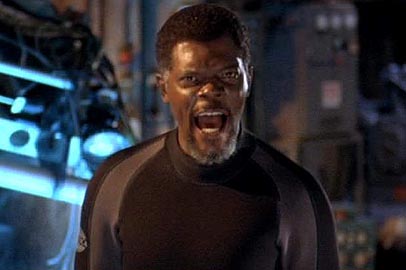
Deep Blue Sea. Researchers at a deep sea lab experiment on sharks by making their brains huge (4 times a normal size) so they can extract a secretion that will cure Alzheimers. The sharks (computer generated) get very smart. Too smart. A hurricane gives them an opportunity to hunt down several stock characters on the isolated station. None of the characters is “bankable” so their gruesome ends are ho hum. Samuel L. Jackson makes an appearance, and LL Cool J is the sea station cook who says things like “Damn, muthaf***a'” and “Peace out, bitc*” and “Open wide, you nappy toothed fu**a’.” And there is a Jacqueline Bisset look-a-like and damned if her diving suit doesn’t allow for ample cleavage.

There are three sharks, and they are all dispatched in manners strikingly similar to the Jaws films. Figure that.

All that said, this film can be fun and Jackson’s “give the sharks hell” speech is memorable. Snakes on a Plane memorable.

Lock, Stock and Two Smoking Barrels - Wikipedia

A black crime comedy that is full of visual gambits (many hit, many miss), this is a heist film billed as Great Britain’s Pulp Fiction. It has many similarities – the screwing around with sequence, the blase’ attitude to brutality, the quirky characters – but visually, it shares more in common with the Cohen Brothers first film, Blood Simple, though post-MTV in attitude. The director shows you every knife in his drawer, from stop action to slow motion 360 (an entertaining card game gone bad), to interspered music video. The result is a mash of a film, but it is populated by engaging players (a quartet of inept thieves, a trio of crass, drugged out marijuana brokers, a Mr. Big, a fatherly enforcer with a weird concept of family values, an Abbott and Costello) and it moves quickly (sometime, too quickly, because the Cockney is a bitch).

The director, Guy Ritchie, has moved on to the Robert Downey-Jude Law Sherlock Holmes flicks, infusing them with the same action and pace as this picture.

Does it have soul? None. It’s all flash and teeth.

The first half of this cynical war comedy is pretty audacious, if derivative. The plot – essentially, Kelly’s Heroes – has four Gulf War servicemen scheming to steal gold previously stolen by Saddam Hussein from the Kuwaitis.  The beginning of the picture is loaded with funny bits reliant on the culture clash of Americans and Iraqis. Coupled with eye-catching camera work and clever forays into fantasy (the recreation of the route of a bullet into the human body is noteworthy), the film hurtles along, and you never really notice the complete lack of plot or character.

The problems ensue when Three Kings moves from the wacky to the message-laden.  Faced with the horrors of war (dead civilians and specifically, the fate of Iraqis who rose against Saddam without U.S. support), our protagonist thieves become changed men. Up until this point, however, they are merely cleverly written cardboard cut-outs, so it is impossible to determine from where or what they have changed.

The film also descends into hackneyed “I have met the enemy and he is me” tripe.  The political moralizing becomes a bit much, and the sweeping feel-good ending is awkward.  Messages delivered — the war was about oil, not the liberation of Kuwait; there is a human cost to civilian deaths; war is indeed hell; and, if we just listen, we can all get along.

Still, the film’s first half is damn near flawless. The quartet – George Clooney, Mark Wahlberg, Ice Cube and Spike Jones – are also quite good, as are the people given the thankless, noble Iraqi roles.

How bad? Shortly after release, Liam Neeson told a magazine that The Phantom Menace was his last film (he recanted shortly thereafter). I’m guessing Neeson’s despair had nothing to do with The Phantom Menace.  This is the kind of film that makes me think Alec Baldwin was lying when he told Charlie Rose that when a film doesn’t work out, “it’s not like we planned to make an awful picture.”  The Haunting is made more wretched because it is purports to be a remake of an excellent supernatural, psychological thriller from 1963.

A sweet serial killer film, if such a thing is possible. Owen Wilson plays a drifter who poisons his victims. He is a gentle soul with a horrific secret, a man-child who comes into the lives of several characters in pain (in particular, Mercedes Ruehl and Brian Cox playing parents grieving the departure of what appaers to be their teenage daughter) and provides them what appears ito be support, all the while practicing his craft.

This is an offbeat, even sleepy picture, wholly reliant on Wilson’s quirky, dream-like performance, which I found riveting.

Image result for perfect storm

Twister but only marginally better acted.

The first 30 minutes is devoted to character development, so we can invest in our crew of six fishermen who will weather the storm of the century. There is the romantic captain on a bad streak (George Clooney); the young turk in love (Mark Wahlberg); the divorced father of one fighting to maintain a relationship with his son though he is a “man ‘o the sea” (John C. Reilly); the poor white trash outcast (William Fichtner); the old salt who just met true love in the form of a lonely, overweight woman at the bar (John Hawkes); and the superstitious guy (Allen Paine). Fichtner and Reilly don’t get along for reasons that make little sense, except that one must thereafter save the life of the other, which is exactly what happens.

We also meet the women who love the men who bring us fish fillets: a hard-bitten divorcee (Diane Lane) who curses the day a sail was set; a harder-bitten tavern owner and mother of two of our ill-fated crew (Sherry Jones); the competing hard-bitten captain who wants to transfer Clooney’s heart from the sea to her stern (Mary Elizabeth Mastraontonio); the hard-bitten overweight woman with two kids who waits for the old salt (Rusty Schwimmer); the ex-wife of Reilly; and some floozie who shacks up with the superstitious guy.

To a person, the characters are hackneyed and lame. Hollywood goes to Gloucestor and gets a Gorton’s fisherman accent.

As for the storm, it’s technologically impressive and makes the film watchable. The film is also helped by a gripping subplot involving a Coast Guard air/sea rescue (the insights into the pilots of the rescue helicopter are better communicated through a few lines during stress than all of the preceding soliloquies of the main characters).

But even during the technical wizardry, we are treated to two godawful bids for supporting actress nominations by Lane and Mastroantonio.  Big, gloppy, weepy, leaden and ultimately, unconvincing speeches.

The film even has an old sea captain making salty pronouncements at the bar.

“Ayyy matie! Let me tell you about the storm on ’62.”

The entire schmaltz-fest is coated in a gooey James Horner score. At end, rather than dab a tear from your eye, you are more inclined to go out for seafood and question the heroics of six men who risked life and limb (theirs and those of rescuers) so they could make a buck (they risk the storm because the ice machine on their boat broke, and if they wait the storm out, the fish will rot).

And they don’t wear life preservers.

Final note: the film is about sword fisherman, but they assure us that no animals were harmed during its filming, which means most of the picture’s budget was expended on wiggly, rubber fish.