Archive

00s

Clive Owen seemed such a natural choice to replace Pierce Brosnan as James Bond.  His breakout performance in the small budget Croupier even had him sporting a tuxedo in a casino.  But Owen passed, the role went to Daniel Craig, and “Bond was back!”

Except, Bond wasn’t back.  Daniel Craig and the creators of his movies turned their collective backs on a bunch of Bond movie staples.  Gone were the ridiculous gadgets, women named “Pussy” and “Goodhead”, painful puns and villains with designs to dominate and/or destroy the world.  Admittedly, Mike Myers’s Dr. Evil killed the last trope, which is a shame, because I’m less interested in villains with mere monetary designs.  But the advent of Craig signaled the death of a Bond audiences had come to know and tire of.

Instead, Craig brought us a hard, lean and rough Bond, a killer, but a smart, quick killer.  It was noteworthy that the first chase scene in Casino Royale is not by car, plane or boat, but on-foot, a dizzying, physical sequence where Bond chases down one man.  The suave and debonair is gone, as is evidenced by a drink order:

Like George Lazenby in On Her Majesty’s Secret Service, however, Craig is introduced as a Bond who falls in love.  We see another side, briefly, and then thankfully (I prefer Bond unencumbered), we see what he will be going forward (we didn’t get that option with Lazenby, who apparently thought he had a brighter future than Bond had to offer).

Paul Haggis wrote Million Dollar Baby and Letters from Iwo Jima, and he won the Oscar for Best Screenplay for Crash.  He also wrote Casino Royale, which is interesting, well-paced and modern as opposed to cute and campy.

Also gone are the bevy of beauties, with the Bond girl being, generally, the least dumb.  Instead, we get a quick-witted Eva Green, who is a match for Bond intellectually and thankful that she lacks his innate brutality.

Best, Casino Royale brought back the gorgeous locales.  Prague, Nassau, Montenegro and Venice are featured.
Are You Not Entertained?! 15 Most Iconic Quotes From Gladiator

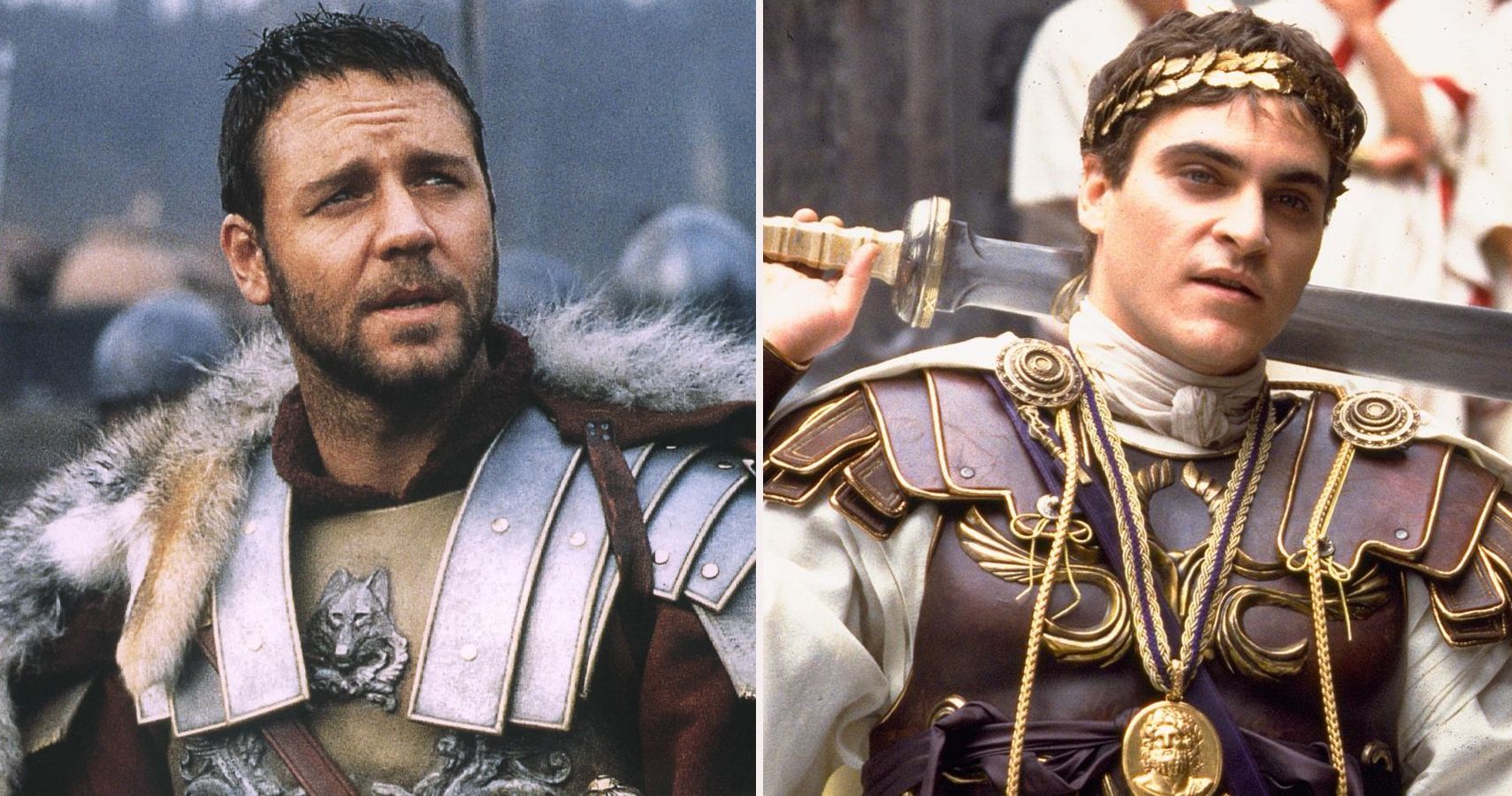
Are you not entertained? You should be. While the script is cobbled together and shallow (it was being written during filming and it shows) and is reliant on the life breathed into it by the players, there is plenty of life, as Russell Crowe, Richard Harris, Derek Jacobi and Joaquin Phoenix do wonders for a leaden draft. Though Oliver Reed is bloated and battered as Crowe’s owner, he also gamely pitches in (he died in a Malta bar during filming).

All the action sequences are riveting. From an impressive opening battle sequence in Germania, to Crowe’s first gladiatorial experience, to a great Ben Hur-ish sequence where a troupe of over-matched gladiators under Crowe’s command exceeds expectations in their first visit to the Coliseum, to a nice one-on-one between Crowe and another famed fighter, with tigers thrown into the mix . . . all are thrilling. There’s also enough of a story to get us from action sequence to action sequence.

Crowe commands the movie and seems “in time” (obviously, I couldn’t possibly know if Crowe acted like a Roman, but I assure you, it feels more authentic than Tom Cruise as a Civil War veteran or Kirsten Dunst as Marie Antoinette). But it is Phoenix as the mad usurper who steals the movie in what could have been a throw-away performance, the weak son to the strong emperor. Instead, Phoenix is genuinely touching (when he seeks his father’s favor and is spurned) and frightening (when he seeks a different kind of favor from his sister, threatening the life of her son in the process). You almost feel for the guy when the mob turns on him.

Image result for perfect storm

Twister but only marginally better acted.

The first 30 minutes is devoted to character development, so we can invest in our crew of six fishermen who will weather the storm of the century. There is the romantic captain on a bad streak (George Clooney); the young turk in love (Mark Wahlberg); the divorced father of one fighting to maintain a relationship with his son though he is a “man ‘o the sea” (John C. Reilly); the poor white trash outcast (William Fichtner); the old salt who just met true love in the form of a lonely, overweight woman at the bar (John Hawkes); and the superstitious guy (Allen Paine). Fichtner and Reilly don’t get along for reasons that make little sense, except that one must thereafter save the life of the other, which is exactly what happens.

We also meet the women who love the men who bring us fish fillets: a hard-bitten divorcee (Diane Lane) who curses the day a sail was set; a harder-bitten tavern owner and mother of two of our ill-fated crew (Sherry Jones); the competing hard-bitten captain who wants to transfer Clooney’s heart from the sea to her stern (Mary Elizabeth Mastraontonio); the hard-bitten overweight woman with two kids who waits for the old salt (Rusty Schwimmer); the ex-wife of Reilly; and some floozie who shacks up with the superstitious guy.

To a person, the characters are hackneyed and lame. Hollywood goes to Gloucestor and gets a Gorton’s fisherman accent.

As for the storm, it’s technologically impressive and makes the film watchable. The film is also helped by a gripping subplot involving a Coast Guard air/sea rescue (the insights into the pilots of the rescue helicopter are better communicated through a few lines during stress than all of the preceding soliloquies of the main characters).

But even during the technical wizardry, we are treated to two godawful bids for supporting actress nominations by Lane and Mastroantonio.  Big, gloppy, weepy, leaden and ultimately, unconvincing speeches.

The film even has an old sea captain making salty pronouncements at the bar.

“Ayyy matie! Let me tell you about the storm on ’62.”

The entire schmaltz-fest is coated in a gooey James Horner score. At end, rather than dab a tear from your eye, you are more inclined to go out for seafood and question the heroics of six men who risked life and limb (theirs and those of rescuers) so they could make a buck (they risk the storm because the ice machine on their boat broke, and if they wait the storm out, the fish will rot).

And they don’t wear life preservers.

Final note: the film is about sword fisherman, but they assure us that no animals were harmed during its filming, which means most of the picture’s budget was expended on wiggly, rubber fish.

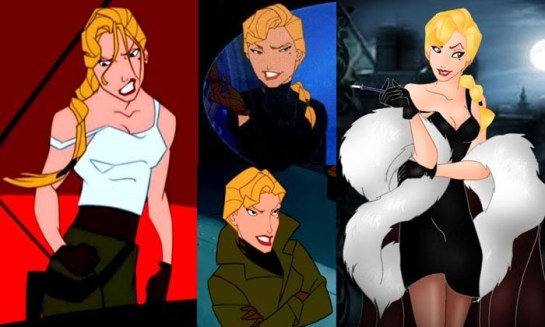
Atlantis: The Lost Empire.  I thought this was a good, very unique Disney movie.  A different style of animation, a little darker, tons of violence, with deaths in the hundreds (and a funeral to boot), and more than a little sex appeal.

It probably bombed because no animals talked and no heart-strings were tugged.  It did drag a little, but picked up quickly, and my only real complaint is that Michael J. Fox’s gee-willickers voice is grating.

Sherlock Holmes.  I expected to be underwhelmed and perhaps even dispirited as the Holmes character was “re-envisioned” for a new generation. What a pleasant surprise.  Robert Downey, Jr. and Jude Law are effortless in their banter and prove a great, smart duo (equaling my favorite, Christopher Plummer and James Mason in Murder by Decree).  The story moves, the visuals are impressive.  The weak spot is Rachel McAdams. She’s beautiful and wholly overmatched.  Fortunately, she is required to do little more than fear for her life.

24 Hour Party People quad poster.jpg

Michael Winterbottom’s time capsule sells itself as a rendering of the birth of the rave culture.  In fact, as the film’s protagonist – Manchester television personality and producer Tony Wilson – constantly informs us in fourth wall breaking break away chats and insights made directly to the camera, the film is about at least a half dozen things: Manchester itself, the rave culture, the birth of what I then-called the British moany-boy bands (Joy Division, New Order), punk, “selling out”, and the comforts of being the next big thing.

The picture has been reviewed in the following manner: “if you liked New Order, you’ll . . . “, as if enjoying the music is intrinsic to enjoying the picture.  Untrue. The picture is sharp and funny, regardless of whether you dig the music at its center (I never did).  Indeed, Winterbottom explicitly dispenses with the necessity of the bands being good.  With the constant wild Kurt Loderesque accolades to the bands (there are even two “geniuses”), Winterbottom is mocking the creation of mini-gods to fuel the gravy train.

Smartly filmed, sometimes gonzo, always electric, and all the performances – especially Steve Coogan’s Wilson (our self-interested cum true-believer-in-the-music guide) are tops.

Taken | Cox On Demand
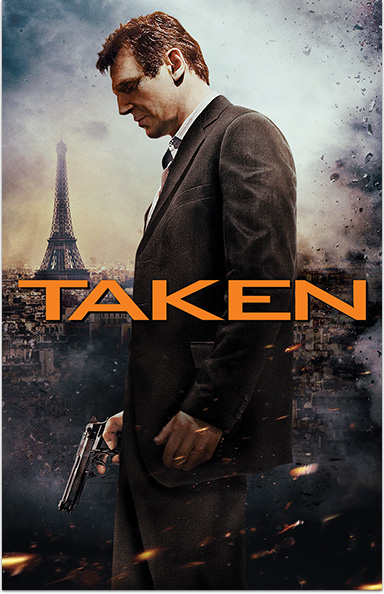
A revenge-rescue thriller fantasy with Liam Neeson delivering brutal, satisfying violence to the lowest of the low, Eastern European scum kidnapping girls on holiday in Europe (including Neeson’s daughter) to sell them as sexual chattel to harems and constructions sites alike. Pretty good stuff, though the girl cast as Neeson’s daughter is both unconvincing and much too old for the “Daddy’s little girl” role. But the righteous punishment doesn’t really require a perfect cast.

.