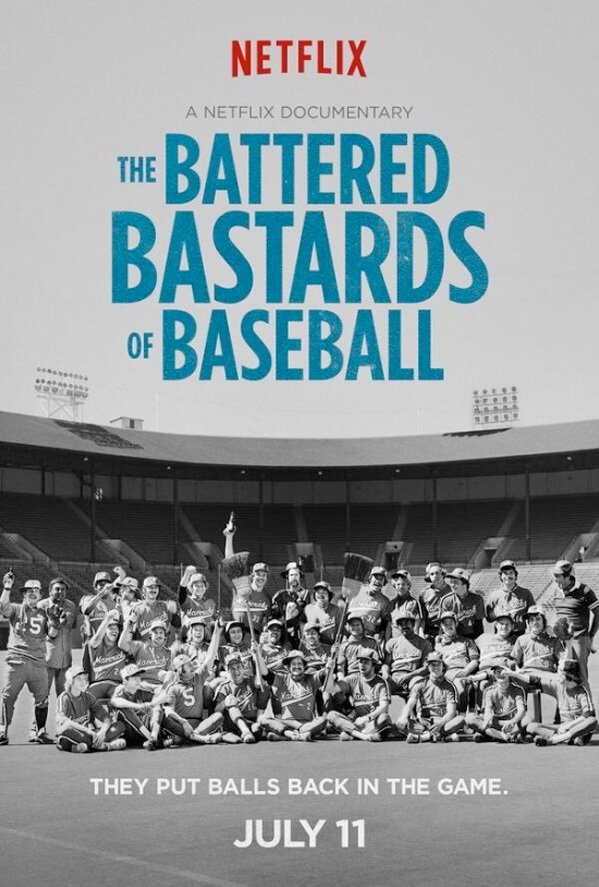
I’m not sure what is more surprising, this fascinating, Netflix-produced documentary chronicling the Portland Mavericks, an independent minor league baseball club run by baseball enthusiast and actor Bing Russell in the 1970s, or the fact that this story has not been made into a major motion picture. Russell capped off a lucrative career as a Hollywood “plumber actor” (according to his son, actor Kurt Russell, who also played on the Mavericks) by going to Portland and starting the only independent minor league baseball club in the country. The team is loaded with characters (including New York Yankee great and then baseball pariah Jim Bouton, who played for the Mavericks en route to a short MLB comeback), the story is utterly fascinating, and it has sweep, color, tragedy and vindication. Jesus, the damn thing writes itself.
This is available streaming on Netflix and I can’t recommend it enough, not only for the undiscovered gem of a story, but for the documentarians skillful restraint in reliance on interviewed remembrances and poignant found footage (a lot of which is 8mm). Not even close to schmaltzy, this output is yet another reason to get Netflix.
Noah is a modern day environmentalist/pacifist who is also a vegetarian, fights the rape of the land, and communes with Transformer-like monsters/fallen angels (it was quite a shock to learn that Optimus Prime was so critical to the Old Testament). God tells him to save the innocent; the animals. He complies.
Unfortunately for us, neither God or Noah cannot save this dreary and ponderous story nor can they remedy Darren Aronofsky’s leaden direction. I was surprised by James Gunn’s ability to handle a broad and sweeping epic in Guardians of the Galaxy given his prior experience with smaller films. In Noah, Aronofsky, who also has little experience with big films, does not surprise. He is completely lost visually, primarily relying on a slow backward tracking shot to say BIG! Some of the CGI, and there is a lot of it, looks as silly as Harry Hamlin-age Clash of the Titans. The script, which Aronofsky co-wrote, is a repetitive mix of New Age blather (birds arrive and Crowe intones, “it begins”) and mundane domestic drama. The performances are rote, good actors intuiting “this is biblical” which they apparently perceive as solemn.
On the plus side, the making of this film means at least one less Aronofsky ode to masochism and sadism (although Aronofsky does let Russell Crowe sing again).
You also get the sense Aronofsky feels the film is getting away from him, so he relies more on Noah’s trippy dreams and his story of creation (a psychedelic light show and some stop-action photography), and indeed, they are welcome respites from the numbing dialogue.
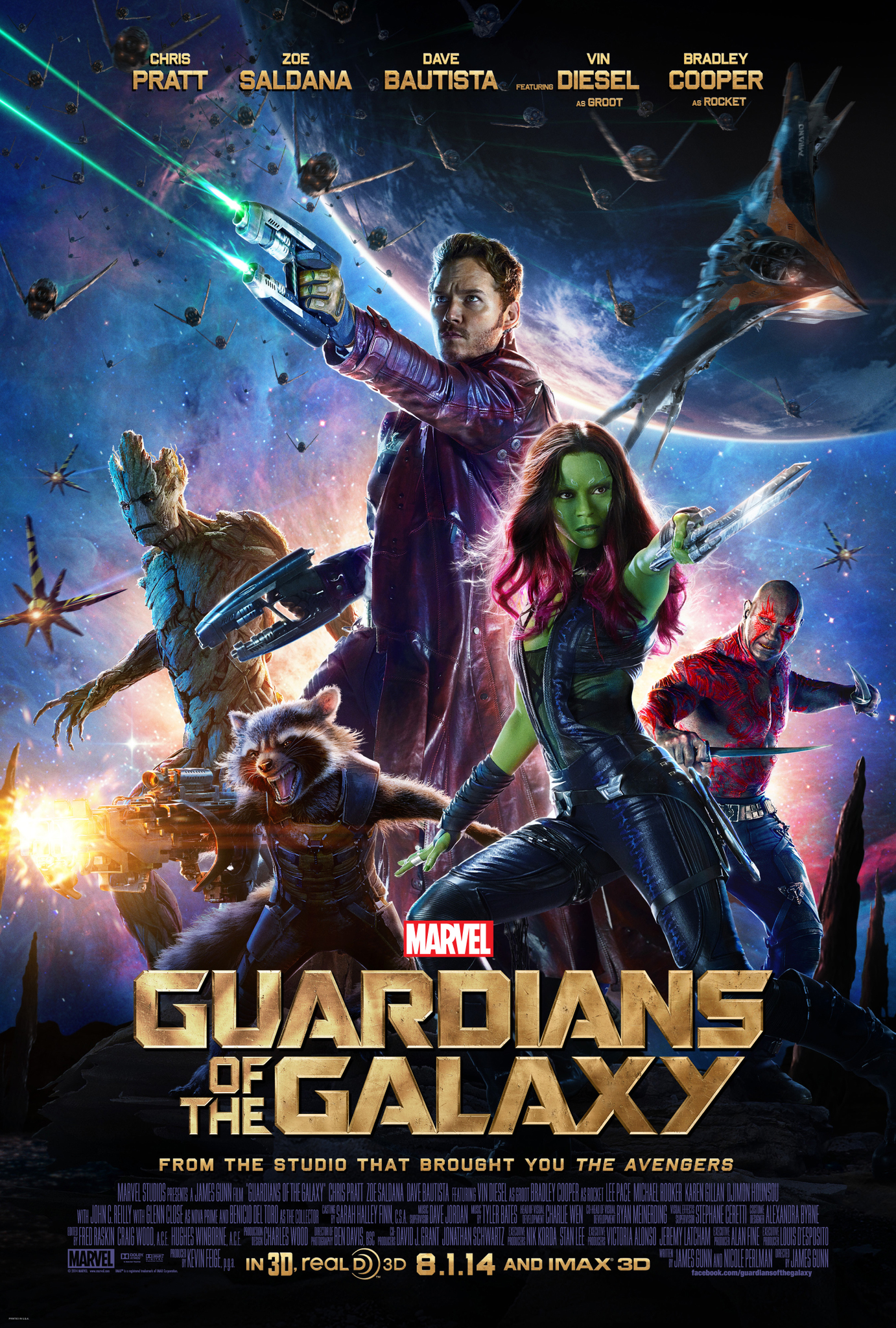
The model summer movie, with perfectly distributed action, humor and homage. There is nothing original in the film – Chris Pratt as intergalactic robber “Star Lord” is a younger, hipper Han Solo, Vin Diesel is Chewbacca without the fur, and the Death Star has been miniaturized to a tiny crystal – but if not unique, it is fresh. Rather than reaching for the myth of Star Wars, Guardians opts for more humor, and the operatic sweep of John Williams is replaced by vintage pop, courtesy of Pratt’s 70s mixtape. There is sweetness (Bradley Cooper voices a surprisingly moving raccoon) and while director James Gunn’s resume’ (Slither) contains nothing suggesting an ability to handle this fare, the actions sequences are expert, comprehensible and brief, avoiding the mind-numbing excess of so many Marvel pictures. The only criticism is the short shrift given to the motives and backstory of the villains, but I assume that comes in the inevitable and welcome sequel.
Wes Anderson makes highly detailed, whimsical and richly textured children’s stories for adults, films that evoke an old picture book or model train set from our youth.
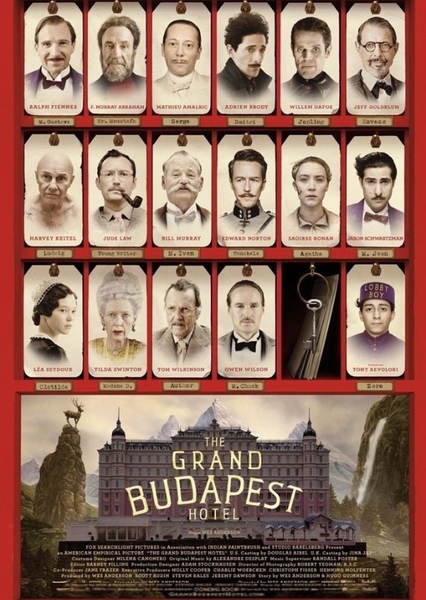
The Grand Budapest Hotel is in that same vein, a colorful story about the concierge of a once majestic property (Ralph Fiennes) and his efforts to tutor a protégé (Toni Revolore).
Here, Anderson accentuates the stylish (the scenery approximates toy furniture) and emphasizes the screwball. Missing, however, are the moments of true human connection that punctuate his earlier works, the moment inRushmorewhen Jason Schwartzman shows his hurt feelings or introduces his father, or in Moonrise Kingdom, when the children kiss or Edward Norton reveals his fears of failure as a scout master, or even in The Life Aquatic, when Bill Murray tries to woo Cate Blanchett.
Grand Budapest is Anderson’s non-animated The Fantastic Mr. Fox, a fantastic film, So too this film, but it’s Anderson’s least affecting picture.
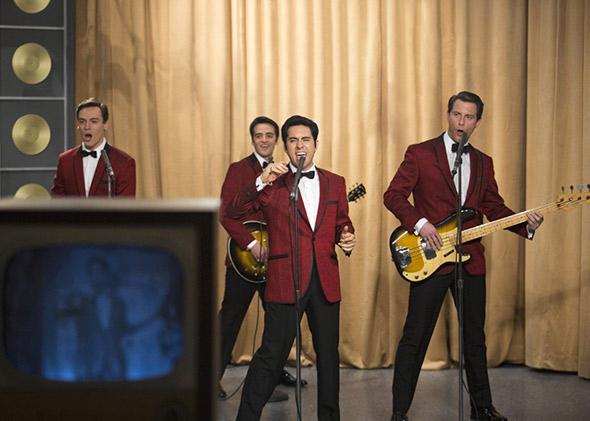
Having re-watched Walk the Line, I then took my son to go see Clint Eastwood’s Jersey Boys, the film version of the “smash!” Broadway hit chronicling the rise and fall of Frankie Valli and The Four Seasons. He liked the picture. I did not. Let me count the ways.
1) You couldn’t pick a worse director for this project than Eastwood. Music needs to be shot with energy and verve. Clint’s camera work is fixed and unimaginative. Basically, he shot Frankie Valli much like he shot J. Edgar Hoover. Close up. Then farther away. Then a shot to an admiring audience.
2) The performances mostly run from pedestrian to dreadful. In the latter category, John Lloyd Young as Valli sports a Broadway pedigree and little else. His “go to” move seems to be consternation, be it at the loss of a gig, $1 million or a daughter. Vincent Piazza (Boardwalk Empire) is so goombah you half expect him to hawk Ragu sauce.
3) The film can’t decide on being a whimsical tribute to the Broadway show or a dark, cautionary tale on the perils of stardom. Tonally, it’s schizophrenic.
4) One theme in particular – the omerta of tough Jersey guys – is severely undercut by the fact that these tough Jersey guys are about as scary as The Sharks and The Jets. In West Side Story, no one was asking you to be scared of ballet dancing toughs; it was a fantasy, delivered in dance, where even the violence was poetic. Here, their bond and hardscrabble roots are important, yet the whole existence seems comedic and pleasant.
5) 134 minutes!!!
6) The makeup here was worse, if that’s possible, than in J. Edgar, and I didn’t think that could be possible.
My son countered that I didn’t like the music and that queered the film for me. But I didn’t like the music in Dreamgirls, and that was a perfectly fine film.
If you want to see the antithesis of this picture, rent Tom Hanks’ That Thing You Do, which captures the excitement, fun and then, the letdown, of a one-hit wonder band.
So, why one star? Filial loyalty and the very funny turn by Mike Doyle as producer Bob Crewe.
Not as funny as the first one, mainly because it is too self referential and a great deal messier, but plenty funny anyhow. The plot is the same – Channing Tatum and Jonah Hill have to crack a drug ring, only this time, they’re at college. Highlights include Hill’s turn as a Hispanic gang member and later, his impromptu def jam poetry performance at a coffee house, as well as Channing’s bromance with the college quarterback. For better or worse, and mainly better, these guys may be the next Benny and Hope. Downsides include too much Ice Cube and a surprisingly leaden performance from the usually hilarious Jillian Bell (Workaholics, East Bound and Down). You could see this in the theater and get your money’s worth or wait for video and enjoy all the more with the extra $25 in your pocket.
Space aliens called mimics (lethal, metallic, whirring Battling Tops) have landed in France and after checking their advance at Verdun, a global force plans a knockout punch in a D-Day redux. Tom Cruise is unexpectedly assigned to that landing and upon his near immediate death on the beach, wakes up ala’ Groundhog Day to relive the event, again and again. The hero of Verdun, Emily Blunt, recognizes the potential and together, they train, re-live and work to gain the advantage.
Doug Liman’s (Swingers, The Bourne Identity) film is clever, straightforward in concept, and for sc-fi, plausible. Cruise is refreshing playing a reluctant if not cowardly cad thrust into the role of mankind’s savior and Blunt is a convincing, modern Joan of Arc. The blend of London and Paris with CGI is expert and the alien force is intricate and scary.
The picture also sports a sly, muted sense of humor, which Cruise delivers alone, as Blunt takes on the role of the tortured, stoic warrior. Naturally, it tries to establish a deeper connection between the leads, an attempt that largely fails (Cruise is still cursed with a 100% to 0% charm to romance ratio), but Liman doesn’t stubbornly force the issue. The end is also unsatisfyingly upbeat. Minor complaints.
Ryan Murphy’s (Glee, American Horror Story) adaptation of Larry Kramer’s semi-autobiographical play about the outbreak of AIDS in New York City circa 1981 is a mixed bag, often poignantly moving but more often numbingly repetitive. The film does not shy away from the cruelties of the disease and the inaction that followed its introduction, echoing the source material, an urgent polemic written before there was even a test and the disease was called GRID (Gay Related Immune Deficiency). It is an activist story for a perilous time (the play was produced in 1985) and the immediacy of the stage. Under Murphy’s direction, Mark Ruffalo, as New York City writer Ned Weeks, is largely utilized in a series of stem winders and broadsides against the Koch and Reagan administrations, the insouciant gay community and in particular, his fellow board members of a nascent advocacy and care group. Weeks’ passion is noteworthy but by the end of the picture, you fully understand the frustration of his compatriots. His tactics (a combination of haranguing, attacking and outing) are such that they can’t get a hotline set up without Weeks sneering or warning about the next Dachau (Kramer himself would end up being instrumental in the founding of Act Up, which was decidedly more confrontational and, to be fair, effective). A missed opportunity of an actual exchange, for example, is the fact that Weeks is affluent, making his offering of the livelihoods of all of his co-activists (one of whom is in the military) a rather cheap and easy proposition. This factor is unexplored beyond a toss-off comment.
Ruffalo is joined by several other notables (including Julia Roberts as a doctor on the frontlines and Taylor Kitsch as his more measured activist friend), all of whom have their own speeches, all movingly delivered but all awkwardly stagey. When they occur, we are meant to listen respectfully to the sermons, which are heartfelt, often spoken to bigots and/or bureaucrats (poor Dennis O’Hare, who, after this and Dallas Buyer’s Club, is a cottage industry of unsympathetic pencil pushers in AIDS dramas) or screamed at the heavens, and wholly devoid of nuance. As noted by Frank Rich in his review of the play back in 1985, “the playwright starts off angry, soon gets furious and then skyrockets into sheer rage . . . Some of the author’s specific accusations are questionable, and, needless to say, we often hear only one side of inflammatory debates. But there are also occasions when the stage seethes with the conflict of impassioned, literally life-and-death argument. … The writing’s pamphleteering tone is accentuated by Mr. Kramer’s insistence on repetition – nearly every scene seems to end twice – and on regurgitating facts and figures in lengthy tirades. Some of the supporting players … are too flatly written to emerge as more than thematic or narrative pawns. The characters often speak in the same bland journalistic voice – so much so that lines could be reassigned from one to another without the audience detecting the difference. If these drawbacks … blunt the play’s effectiveness, there are still many powerful vignettes sprinkled throughout.” Murphy’s film is nothing if not faithful to Rich’s evaluation.
When Murphy moves away from the politics of the disease and human relationships, the picture is much stronger. The relationship between Weeks, who is reticent about intimacy and the gay world’s sybaritic nature, and his lover Felix, played by Matt Bomer, is an exchange that offers a view into the difficulties growing up and being gay. The scene where Ruffalo demands that his straight and supportive brother (Alfred Molina) accept that they are essentially the same is the best one of the film, as each character is given a voice. And The Big Bang Theory‘s Jim Parsons delivers a beautiful eulogy for a friend and by extension, for all the “plays that will not have been written, dances that will not be danced” that is heartrending. Sadly, these scenes are the exception rather than the rule, and the watching of The Normal Heart eventually lapses into a very unfortunate place for entertainment – duty, a film you “should” see rather than one you would necessarily want to.
The good: the clever set-up of the origins of the beast incorporated into the opening credits; Bryan Cranston, as the obsessed Area 51 type who devotes his life to revealing those origins and the threat; the avoidance of the evil military-industrial tropes that often infect disaster movies; the destructions of cities other than NYC and LA; an ominous, moody score; and the monster battles, which are realistic, haunting and classic instead of computer-dizzying, antiseptic and deadening. And at just over 2 hours, it is the perfect length.
The bad: the script is banal. Anything the scientists (a barely intelligible Ken Watanabe and an absolutely pointless Sally Hawkins) contribute is mush, and when they object to the military’s plan to lure other monsters from the Godzilla family with nuclear weapons (which the eat like Chicklets), Hawkins merely shakes her head, like, you know, come on . . . that’s soooooo crazy, and Watanabe produces the pocket watch his father carried . . . in Hiroshima. Heavy.
Military commander David Staitharn is merely low grade concerned throughout, with an almost “Well, thank God this ain’t no 9-11” air about him. Aaron Taylor Johnson (Kick Ass), in a role made for Channing Tatum, is as evocative as a hot dog bun sopped in tap water (The Atlantic’s Christopher Orr said it better: “As for Taylor-Johnson’s performance as Ford, the movie’s central human protagonist, it was so dutifully generic that I forgot it even as I was watching it. I have no lasting impression of him whatsoever”). There is also a child actor who is child actory, better utilized to sell Underoos than terror at the loss of his mother and/or father. Finally, this is Godzilla. I don’t need Seth Rogen toking on a bong and yukking it up, but this film has almost zero sense of humor, depicting a world that perhaps deserves a good stomping.
Will Larroca’s stock as a director has been as volatile as Nic Cage’s acting career. Though critically acclaimed in some quarters, his first picture, The Monster, was uneven. It was followed up by a skilled but off-kilter homage, Will Will Kill. Thereafter, the word on the street was that he was working on a frightening script, House of Blood, which was even touted in promos by Larroca’s studio, PJ SmoothIson.
And then . . . Larroca was tied to a trippy, bizarre The Hugginns Movie, and then a weirdly religious but shockingly effective parable, Commandments Revamped. House of Blooddisappeared from the trades, replaced by talk of production of an as yet untitled American gangster opus, which is rumored to start filming shortly.
And now, we have The Ballad of Chad Big Bucks, with Larroca clearly in front of the camera. But how much of him was behind it? This seems like a production-for-hire, and while there is no shame in making a corporate buck (documentarian Errol Morris is the genius behind Taco Bell’s new “I am Ronald McDonald” ad campaign), it’s harder to discern where Larroca shows up on this endeavor, which is sold to us at the outset as someone else’s film.
Much of the good in Big Bucksclearly carries his stamp. The chase scene in the middle of the picture takes the fury and speed of Bullitt or The Seven Ups and turns it on its head. The super slo-motion is riveting, somehow making the violence of the action even more unbearable. I’ve watched the scene numerous times and find myself on pins and needles each one. Larroca’s use of the elements is also adept. The rain is borderline elegiac, and the operatic voiceover narrative, a sing-songy minstrel tune, brilliantly alternates between mournful and mocking. Finally, the film bravely ignores religious implication until the end of the picture, and it is still unclear whether Larroca is rejecting the idea of a higher power or endorsing it.
Much of the flick, however, is haphazard. What the heck is Spiderman doing at the outset? What is occurring with the almost purposeful rough edits, where actors turn to and acknowledge the camera? The line between the film story and filmmaking has always been malleable in Larroca’s films, but sometimes, sloppy is just that and no more. And why does the minstrel voiceover start screaming when the main protagonist is cycling in the streets ala’ Butch Cassidy & The Sundance Kid? And would Jordan Belfort really be walking around a leafy suburb? Larroca is clearly comfortable shooting in the same location, and there certainly are financial pressures in a young auteur using his own studio, but it’s time to leave his familiar surroundings and see the world.
While newcomer BGrimms is a standout (his anger and fall are heartbreaking), Larroca’s continuing fealty to Zeb Dempsey and Reid Brown is questionable. His devotion to these young actors is to be commended, but Brown’s mumblemouth approach (think Benicio del Toro in The Usual Suspects) has run its course, and Dempsey’s overacting compares unfavorably to the last films of Rod Steiger. One wants to see new faces as well as new places. Perhaps that’s why Larroca himself jettisoned his own persona in favor of homages to Nicolas Cage and Leonardo DiCaprio. The selections are apt, but the time has come for Larroca to move from parody to depth as an actor, and from provincial to worldly as a director.





 filmvetter