Archive

2014

Image result for fury

A traditional war picture depicting the harrowing experiences of an American tank unit at the close of World War II, this white-knuckle drama alternates between the well-trodden verisimilitude of Band of Brothers and Saving Private Ryan and the cynical outlook of The Thin Red Line and Flags of Our Fathers. Brad Pitt commands a tank crew that includes Shia LaBeouf (the religious gunner), Jon Bernthal (the profane Southerner), Michael Pena (the sly Mexican) and Logan Lerman (the baby-faced clerk/typist accidentally assigned to the unit). Lerman undergoes a baptism by fire, as Pitt attempts to de-sensitize him on the fly in an effort to make him more effective. This includes light beatings, a few sermons and, eventually, much worse. That pretty much does the trick, and the rest of the film consists of the unit taking on two missions, both of which are visually audacious and nerve-wracking. In particular, the battle between three under-matched Sherman tanks and a Tiger tank is a thing of beauty.

Writer/director David Ayer (End of Watch) occasionally veers into the hackneyed, but the actors elevate the material with a cohesion that seems genuine. They actually feel like a unit cramped together for three years, especially when they engage in everyday banter, such as “best job I ever had.” Ayer also writes a haunting scene where Pitt and Lerman spend a quiet meal with two German women, only to have the rest of the crew bluster in angrily to join them, a reminder of their grotesque existence.

One the downside, Steven Price’s score is bizarre and bombastic, better suited to a Lord of the Rings pic than a grim war film.  The final battle scene is also a bit too protracted and incredible, at odds with the grimy realism of what preceded it.

This is a solid picture and one I was surprised was made (the budget was over $60 million but at last count, it had grossed over $80 million domestic and over $200 million total).  Apparently, there’s an audience for this kind of story (unless Pitt still has that kind of box office juice).
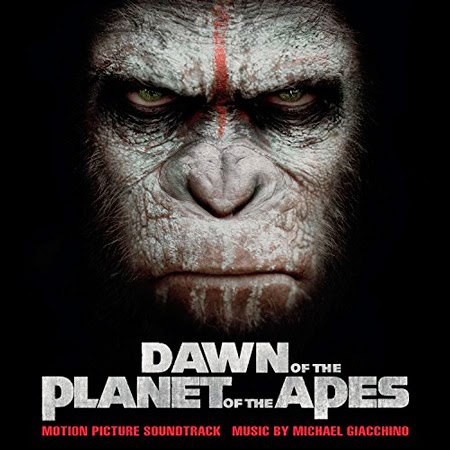
Better than its predecessor, for a couple of reasons: the perfunctory heartless, nasty corporation is not in the mix, the film is not saddled with the herculean task of presenting James Franco as a scientist, and we spend more time with the apes than the humans. The apes, led by Caesar (Andy Serkus), are decidedly more interesting, having created a thriving, peaceful colony outside of San Francisco. Since this sequel is set only 10 years after the apes escaped their Bay area zoo at exactly the moment mankind became afflicted with a disastrous plague, it appears the simians got right down to the nasty, because there are a shitload of monkeys hiding out in Muir Woods.  But man comes a calling . . .

The Trip to Italy - Movies on Google Play

Michael Winterbottom’s The Trip was a charming buddy flick/travelogue through the north of Britain, though these buddies (Steve Coogan and Rob Brydon) are British comedians and master impersonators (I still can’t decide who does the best Michael Caine).  I couldn’t imagine the first film lending itself to a sequel.  I was wrong.  The Trip to Italy is derived from a TV show on BBC Two, like the first film, and it is every bit as funny.  Though the banter of Coogan and Brydon is a tad staler, what comes through in their uncanny ability to riff is a deep affection, all set in the beauty of Italy from Liguria to Rome to Capri to Naples.  Winterbottom also grounds the characters with occasional but insightful reference to their domestic lives.

I confess I laughed much harder than my wife, which reminded me of a funny scene from Knocked Up.

The back and forth between Coogan and Brydon is only a bit more highbrow, but what they are engaging in is not so much conversation as a mixture of shit-giving, competition, and entertainment comprised of variations on old themes and bits.  Their discourse eschews any quiet moment, rejects a detour into anything serious, is decidedly male and, I suspect, has a very short shelf life for females, who, let’s face it, are more highly evolved.

Still, this is funny shit . . .


image

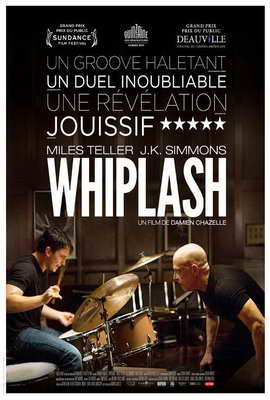
The best film in what has been a very strong year, writer-director Damien Chazell’s story of a 19-year-old jazz drummer (Miles Teller) and his relationship with his driven jazz teacher, played by J.K. Simmons, is flawlessly delivered and thought-provoking. Teller aspires to be the next Buddy Rich, and matriculates at the best music school in the country.  Simmons chooses him to join his ensemble, a stepping stone to greatness but also, an invitation to the meat grinder of abuse handed out by the demanding, mercurial instructor.

The story avoids every pitfall and expected plot turn of a feature film, yet it is not contrary for the sake of it. You can count on two hands the places a more pedestrian picture would take you, and the resolutions it would offer, but in service of a better narrative, Whiplash rejects the certainty of the tried and true, instead allowing the audience to come to their own conclusions.

The film is also about something, exploring the nature of greatness and what is necessary to achieve it; the limits of drive and the intersection of ego and cause; the meaning of teaching; and the changes and struggles between nature and nurture, raising children, molding character and demanding perfection. At one point, Simmons remarks, “There are no two words in the English language more harmful than good job,” and while that may play well to the instincts of some, he is such a flawed deliverer of the message, the audience is forced to question such an ethos knowing it will be practiced by such people.  I saw the film with my wife, my college-age daughter, and my high school-age son, and we talked about it – and I’m confident will continue to do so – for some time.

The film is evenhanded, a trait best represented in its depiction of minor characters. In a family dinner scene, Teller’s family, who appear casually condescending towards his achievements, are also perfectly decent, pushing back at his obnoxious “tortured artist” routine with annoyance but also concern and patience.  When Teller is approached by an attorney who represents a student allegedly harmed by Simmons’ practices, she does not lick her chops.

The picture is also stunningly confident, an achievement made even more impressive by its 19 day shooting schedule and $3.1 million budget.  Clint Eastwood released a film about music earlier this year, and he should have consulted Chazell about how to make Jersey Boys less static, less turgid. Whiplash is loaded with musical numbers played by stationary figures, but the camera riffs along with notes, constantly in motion, and like the art form it dramatizes, it is inventive and surprising.

I can’t commend the performances of Teller and Simmons enough.  They are both entirely natural and convincing, Teller conveying the conflicting hubris and hesitation of an ambitious yet shy young man, Simmons the grandiosity and brutality of the committed, brilliant instructor, inspiring one minute, petty the next.

Finally, Chazell has done something that is very rare in film. I suppose there are some folks who see Gladiator and think, “Hmmm. Roman history looks interesting. I might take a look into that.” But not many. Conversely, by his own depiction of the music, and the dramatization of love for it through the eyes of Teller and Simmons, I’m confident that many people who see Whiplash will one day look back at it as their entrée to jazz. That may be my enthusiasm for the picture talking (I’m not a jazz enthusiast myself), but I’m sticking with it.

The Monuments Men (2014) - IMDb

Full disclosure – I came in late, but I saw enough of this obvious, treacly, hackneyed, preachy pile of cornpone to feel safe that I didn’t miss the good part. Hitler is destroying all of Europe’s art. The Monuments Men, each and every one a gentle soul borne of devotion to those things that ennoble us, arrive in Europe to stop him. In the process, they say things like: “You can wipe out an entire generation, you can burn their homes to the ground and somehow they’ll still find their way back. But if you destroy their history, you destroy their achievements and it’s as if they never existed. That’s what Hitler wants and that’s exactly what we are fighting for” and “Who would make sure that the statue of David is still standing or the Mona Lisa is still smiling? Who will protect her?”

It’s not hard to figure what director and co-writer George Clooney was aiming for, an inspiring, old-fashioned period piece that trumpets the virtues of humanity in a world mired in barbarism, updated to include a little wit.  Call it “Band of Oceans 14.”

Clooney fails utterly.  Every character is stock, and the film feels untethered, veering wildly from the cornily comic to the embarrassingly sentimental (the deaths of Downton Abbey master Hugh Bonneville and Jean Judarin from The Artist are laughably operatic).  Bill Murray and Bob Balaban go for some night air, meet a scared German boy-soldier and share a cigarette with him.  Makes you think, right?  Then, Matt Damon, a member of the mission to save the art, steps on a land mine, prompting Clooney to quip, “Why d’you do something like that?”  And then Elliot Gould and Brad Pitt show up and they all have a drink at The Bellagio.

Clooney took a very interesting story and made it a bunch of hooey. Turns out Hitler didn’t order the destruction of art. Now, is Hitler the kind of historical character you actually need to lie about to make him look worse? I submit he is not. But this manifest picture isn’t taking any chances.

image

Very funny, very raw, often insightful comedy written and directed by Chris Rock. Rock stars as a facsimile of himself, a Hollywood success straight out of the mean streets of NYC, returned home on the eve of his made-for-Bravo wedding to a reality star (Gabrielle Union) and the opening of his shot at a serious film after making his fortune in broad comedies (the most successful of which is the Hammy the Bear series, which delivers a running joke, as everywhere Rock goes, you hear “hey, Hammy!”). Four years sober, Rock is accompanied on his return by a New York Times reporter (Rosario Dawson).  A convincing love story ensues as Rock opens up to her about his rise, fall, fears and regrets.

The film starts off a bit choppy, mainly due to the fact that Rock has to carry most if it. Rock has a winning smile and a wicked perceptivity, but he carries the armor and remove of a lot of comics, so his manner is a bit stiff, forestalling investment. But soon, Rock gets in his element, as he is surrounded by a dozen very good comics to play off. He loosens up in the second half, which allows him to reach deeper to connect with Dawson.

Rock borrows liberally from Judd Apatow’s Funny People and evokes Woody Allen’s chatty vibe (Rock’s back and forth with Dawson on the real reason for Martin Luther King’s assassination is alone worth the ticket and emblematic of their clever repartee) but he also writes strong, emotional moments which resonate stronger and longer than the gags, in particular, Rock’s reconnection with his father.

Image result for Belle film

A promising period piece based on the true story of the illegitimate, black daughter (Gugu Mbatha-Raw) of a British naval officer, given to the care of his aunt and uncle (Tom Wilkinson and Emily Watson) as a child in the late 18th century. Dido Elizabeth Belle is raised with a foot in two worlds — with title, means (200 pounds a year) and support yet still divorced from full status (for example, she may not dine with the family when guests are present). Complicating matters is the fact that Wilkinson is the Earl of Mansfield and the Lord Chief Justice, deliberating over a fraud case in which slavers may have thrown their sickly human cargo overboard for the insurance proceeds.

The film is lush and has a Downton Abbey feel. Unfortunately, it’s about as subtle, anachronistic and schmaltzy as Downton Abbey.  Belle must contend with the easy racism of her time, racism represented by an odious, money grubbing family that includes scheming Miranda Richardson and her eldest son, Tom Felton (Draco Malfoy from The Harry Potter movies, who is really evil; you can tell because he was a member of Slytherin House and he sneers in every scene). Everything is spelled out for the audience, and there is no nuance to any character. Belle’s true love, played by Sam Reid, is the abolitionist son of a minister, so ardent and well-meaning you want to punch him. And as Wilkinson agonizes over his court decision and rails against the impudence of Reid, Watson reminds him that she once knew a young man who wanted to change the world.  Guess who that young man was?

The case at the heart of the picture is also decidedly and unnecessarily dull. So dull that in real life, the owners dropped the claim against the insurance company amidst a storm of bad publicity. Yet, the real Earl of Mansfield presided over a case much better suited to the film, that of a slave who had been brought to England, escaped, was caught and then was forced onto a ship bound for the West Indies. The slave owner argued his right over property, but the Earl set the slave free, judging that colony slave laws were of no force in England and concluding, “The state of slavery is so odious that nothing can be suffered to support it.”

Such an interesting life deserved a better picture.

image

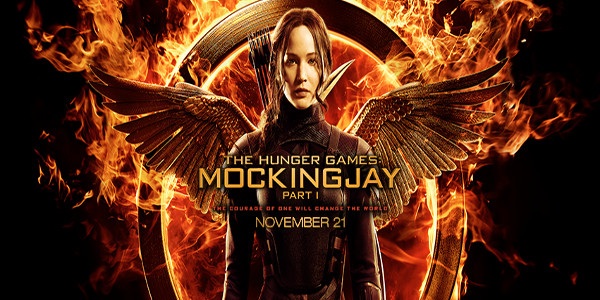
The main draws of the first two Hunger Games movies were the thrilling and terrifying nature of the games themselves and the frivolous corruption of the Capitol. Katniss (Jennifer Lawrence) was our guide, and after her selfless act (volunteering to take her sister’s place in the games), she served mainly as an action hero. As those movies progressed, Katniss became romantically tied to her teammate, Peeta (Josh Hutcherson) and her tie to him remains strong in this third installment. Unfortunately, this picture has neither games nor Capitol nor action. Instead, there’s a lot of Katniss pining for Peeta.

As the film opens, Katniss is ensconced in a drab underground facility that hides rebels under the leadership of the steely and completely uninteresting Julianne Moore. The primary conflict is whether Katniss will assist the rebels for propaganda purposes, and when she balks because of their hostility towards Peeta, who appears to be a collaborator, it is annoying. When she continues to prove difficult after surveying the carnage wrought against her own district (90,000 dead) and witnessing the Capitol bombing a rebel hospital she had just visited, it is very annoying. Her actions might be better accepted if she didn’t seem so mature; Katniss of the books is a teen while Lawrence is mid twenties.

There are bright spots. Phillip Seymour Hoffman, Elizabeth Banks and Woody Harrelson return, providing the film necessary humor and spark. And this is clearly a set-up for what one hopes to be a big finale. Let’s just hope Lawrence doesn’t appear to be in her early 30s, still reluctant to play a featuring role in the rebellion because she is mooning over Peeta.

image

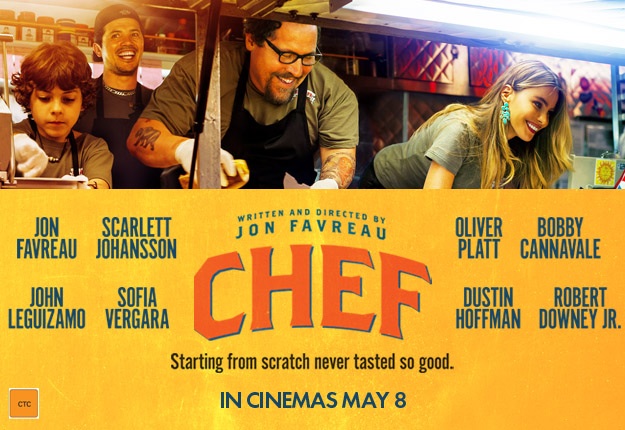
There’s not much to this Jon Favreau film, and it certainly doesn’t break new ground, but it is a charming, dare I say “feel good” comedy about a chef (Favreau) who stumbles spectacularly via the internet and Twitter (one of the funniest memes in the film is Favreau’s cluelessness about social media) and makes a comeback with a food truck. Favreau clearly has great fondness and respect for the subject matter and the loving depiction of cooking is one of several strengths of the film. Others include an enviable supporting cast (Scarlett Johansson, John Leguizamo, Sofia Vergara, Robert Downey Jr., Oliver Platt, Bobby Cannavale and Dustin Hoffman) and an unexpectedly moving but understated father-son dynamic between Favreau and his 10 year old, Percy (Emjay Anthony), worked out on a road trip.

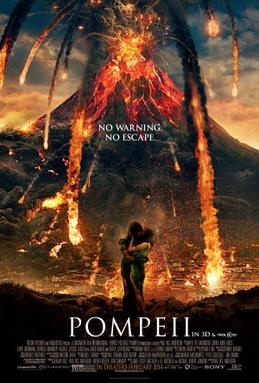
It was on.  Nothing else was on.  An old recipe–

*2 tsps. hunk from “The Wall” on Game of Thrones (Kit Harrington)

*1 lb. Gladiator, including a contest in the arena based on a Roman conquest where our hero commands an ahistorical result, an African gladiator who becomes our protagonist’s friend and soul mate, a knock-off of the ghostly Hans Zimmer score, and a baddie (Kiefer Sutherland) who wants to put his thumb down but must turn it up lest he lose the favor of the people

*1/2 lb. Titanic, including star-crossed lovers from different backgrounds, looming disaster, a chase through the beleaguered city as time runs short, and laugh-out-loud funny anachronistic dialogue, mostly from our Kate Winsletian heroine, Emily Browning (“Men killing each other for amusement is not a sport”; “Senator, you have mistaken me for the kind of woman who drapes herself across your lap in Rome“; “He made me feel… safe. “

* 12 lbs. of crazy ass CGI

It cost $100 million to make and made $110 million at the box office worldwide, so Pompeii II: The Reaping has probably been avoided.