Archive

Year

Gore porn (Hostel, Saw, etc . . . ) has taken over the scary movie market, and in that genre, the more grisly, authentic and perverse a killing, the better. There is never any question of escape for the protagonists. Almost all (if not all ) will be sacrificed, mutilated, or both so that a potential franchise is not suffocated in the crib.

Films that truly create a creepy sense of dread are dinosaurs. In The Exorcist, for example, none of William Friedken’s visual frights happen for nearly an hour. The head spinning, pea-soup vomiting and levitating all follow a rigorous exposition on the characters, the time, Catholic theology, medical inquiry and the growing mystery that surrounds a little girl who keeps getting sicker.  There is no chance such a film in its current form would be greenlit today. The best Friedken could hope for would be an early shot of pea-soup vomiting followed by flashback.

Sue me, but I’m a fan of horror film foreplay, which explains my enthusiasm for this years’ The Woman in Black and the Paranormal Activity films (I’ve seen 1 and 2, but not the third installment). The premise is simple. Modern day characters live in homes haunted by demons. The story is recorded ala’ The Blair Witch Project (in the first Paranormal film, one of the residents starts with a handheld camera and when things get spooky, sets up a few security cameras to validate his claims of the supernatural at work; in the second film, after the house is ransacked, the owners also install internal security cameras, supplemented by a teenage daughter’s video journal).

 The effect is chilling though very little happens for awhile. A hanging pot falls. Doors swing open. Shadows appear. And curious noises emit. In both films, however, the demon is aggravated even as we learn the source of its existence, and from there, things move with alarming speed.  Adding to the fear is the use of unknown actors.  Because they look like you in a wedding video or security cam, you feel more vulnerable.

Sure, some of their decisions are questionable.  But when demons infest your house, you’re allowed a few bad decisions.

EXCLUSIVE: Here's An ATTACK THE BLOCK 2 Update, Straight From Joe Cornish

An alien drops into the middle of a South London mugging (5 public housing thugs are dispossessing a young woman of her belongings).  The alien is a cross between a wolf and Gollum.  The boys chase it down and kill it.  Apparently, it was well-thought of, because shortly thereafter, a whole bunch of these things come from space for revenge.  Good, scary fun, a few good lines, and tense action sequences, not terribly marred by some unnecessary suggestions of the poor plight of London’s youth, forced to mug and terrorize by the inequities of an uncaring society.

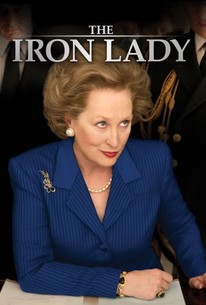
The Iron Lady (2011) - Rotten Tomatoes

First, I really have no idea as to the historical accuracy of the movie. To the extent there are historical nits to pick, I concede.

Second, this is two films.  One, very personal and touching, speaking to the loss of a loved one and an individual’s weakening ability to remember, a great thinker’s capacity to articulate and rationalize.   Meryl Streep’s turn as a woman infected by Alzheimer’s is frightening, poignant and moving.

Third, it works less well as a political biography.  The young Thatcher is a simplistic spouter of conservative bromides.   As prime minister, she’s almost ridiculously “iron” with the men about her always clucking like nervous nellies.  Worse, particular challenges are handled via music video montages and newsreel footage. It lends a certain cheap and easy feel to the endeavor.  During The Falklands War in particular, she is the lone Joan of Arc amidst jelly bellies. Speech follows speech, with great, grand pronouncement. It gets silly.  We even have the obligatory review of the casualty figures and the personal letter-writing histrionics.

Fourth, Streep is beyond convincing in the role and when assessing the body of her work, the idea that she is not the finest actress in the history of film is laughable.  There is no Magic Johnson to her Michael Jordan. It’s not even close. And she only gets better.  As the nun in Doubt, she completely captured the nuns of my early education, and as Julia Child in Julia and Julia, a role that like Thatcher could have been hammy and overt, she is vibrant and real.

This is a charming first love story, different in that the first love is Marilyn Monroe and her suitor is a third assistant director (a glorified gofer) on her 1957 picture The Prince and the Showgirl.  The picture co-starred and was directed by Laurence Olivier, who is played by Kenneth Branagh.  Branagh was fine and nominated, though I’m not sure deservedly so.  His primary posture is one of exasperation.

It is Monroe who exasperates Olivier, because she is tardy, skittish, unprofessional and seemingly over-handled by her method acting coach and her business manager.  Pills are used to control her.  Thus, she seeks companionship and escape with the gofer, played with wide-eyed innocence but occasional steel by Eddie Redmayne (Redmayne is a little distracting – he has lips that rival the collagen-induced monstrosities of Barbara Hershey, Meg Ryan, at al.)

Williams was nominated and deservedly so.  She’s a perfect confluence of beauty, sensuality, naivete’ and whore.  At times, she was so stunning that you could understand the entire Monroe worship.

Best, the story is sweet but not sugary, and economical.  It also has a great sense of time and sports some nice supporting turns by Dominic Cooper and Toby Jones as her weasel management and especially Julia Ormond as Olivier’s aging and jealous wife at the time, Vivien Leigh.  Leigh is obviously wary of Olivier working with Monroe which results in a great exchange with the smitten gofer:

VIVIEN

Of course, Larry would never leave me. (Pause) But, if anything were to happen, you would let me know, wouldn’t you?

COLIN

I’m sure he loves you very much.

There is a flash of sudden anger in her expression.

VIVIEN

Oh, don’t be such a boy!

COLIN looks shaken and she touches his hand in contrition.

VIVIEN (cont’d)

At least you still adore me, don’t you?

COLIN

Of course. Everyone does.

There is a wintry bleakness in her face for a second.

VIVIEN

I’m 43, darling. No one will love me for much longer. Not even you.

To the extent there is a weakness in the picture, however, it is implicit in the character of Monroe and not the film.  Monroe is so iconic as to be both beguiling and ridiculous.  Her end was tragic and elicits the syrup ladled out by Elton John’s “Candle in the Wind” (which can be dusted off and updated for a Princess Di and had Elton and she been friends, probably Anna Nicole Smith).  Luckily, we are spared the cruelties that lay in store for Marilyn, but the film does take for granted her absolute boundless and radiating talent.

It’s a tough sell.  Monroe was beautiful and seductive and had the ditzy blond bit down pat.  But had she not been such a notorious pain in the and piece of ass, vexing Olivier and Gable and bedding DiMaggio, Miller and two Kennedys, would she be the goddess of today or . . . Anna Farris?

Our Idiot Brother movie review (2011) | Roger Ebert

A ridiculous feel good comedy about a sweet, trusting stoner (Paul Rudd, so open he sells marijuana to a uniformed policeman who professes to having a bad week) forced to live at home with his mother and then with his witches brew of sisters (Emily Watson, Parkey Posey and Zooey Deschanel).  Hijinks and family drama ensue.

Admittedly, not a great sell job for this picture.  But the movie is carried by Rudd, whose innocence and good-naturedness are both attractive and believable.  There are also some pretty amusing scenes.  The drug bust is deft, and Rudd’s meetings with his jaded parole officer are also funny.  Deschanel, who plays the artistic sister who wants to be some sort or stand-up comic, is winning, and her performances in what appear to be a NYC basement bar have a real authentic feel (she is not funny and the crowd of 7 people watching her is 85% family).   Adam Scott, as the love interest of Posey, is also excellent.  I’m not sure there is a funnier guy in formulaic comedies than Scott (his asshole brother in Step Brothers is legend).

Unfortunately, Posey, as the unscrupulous celebrity interviewer (yet again, high strung) and Watson as the earth mother sister whose husband (an unpleasant Steve Coogan) is cheating on her are tedious cartoons, but once Rudd re-enters the movie, all is well again.

The film, however, is stolen by T.J. Miller as a stoner who replaced Rudd by taking up with his woman when Rudd went to jail.  Miller is a gentle soul, just like Rudd, and that they pair up at the end of the picture to start a candle making business is not a spoiler.  It just had to be.

Image result for Crazy stupid love

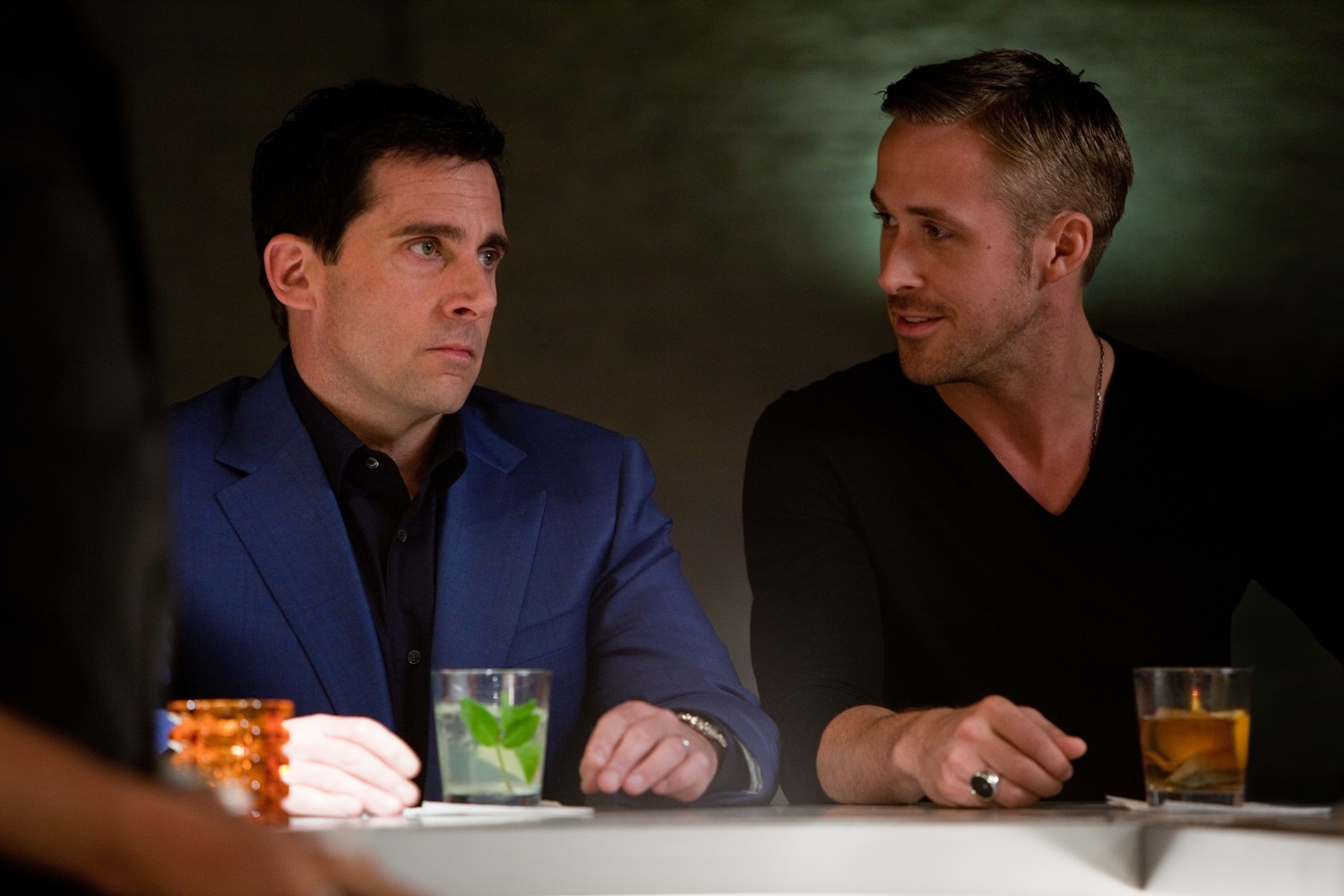
A nice ensemble “bromantric” comedy.  Steve Carell plays the schlub husband thrown over by the “wife in mid-life crisis” Julianne Moore after she flings with an office colleague.  Despondent, Carell retreats to the local singles bar to lick his wounds, where the charming, suave ladies man Ryan Gosling takes him on as a project, ala’ Henry Higgins.  Carell is soon quite the ladies man himself but still pining for his wife, while Gosling learns the merits of deeper love with the electric but gawky Emma Stone.

There are some glitches: Carell’s sad-sack/nice guy routine is getting a bit stale; the friends of the broken-up Carell and Moore and Stone’s lame-o boyfriend are ridiculously stock and unrealistic; Carell’s 8th grade son is a little too cloying and hip; and Moore is reprising her flustered role in last year’s excellent The Kids Are Alright.

Still, this is cute and mostly funny, and Gosling, who I have been very hard on for his work in The Ides of March (confused) and the wildly overrated Drive (catatonic) is the engine.  His repair work on Carell provides some of the best scenes, and he and Stone have very convincing chemistry.

Also, Marisa Tomei plays a one-night stand who ends up being a teacher of Carell’s son.  Tomei just keeps getting better and better looking and more charming to boot.  She can be very dark, as she’s shown in The Wrestler and Before the Devil Knows You’re Dead, but she’s also a deft comedienne, as she showed here and in Cyrus.

Image result for Girl with Dragon Tattoo

Harsh, unyielding and spooky, David Fincher’s adaptation of Stieg Larssen’s first of his best selling trilogy (adaptations of all three have been made in Sweden) is intricate, engrossing and decidedly chilly.  Daniel Craig plays a Swedish journalist who has just been convicted of libeling a financier.  Another corporate titan (Christopher Plummer) summons Craig after having his background checked by an investigative firm.  The firm’s investigator is a ward of the state (Rooney Mara) who ostensibly works as an office clerk, but, in fact, is a genius of surveillance and investigatory technique.  Plummer entices Craig to investigate the 50 year old disappearance of his niece, and Craig eventually enlists the loner and outcast, Mara, to assist him.

Fincher’s strongest milieu is psychological crime.  Seven gave us the mastermind of Kevin Spacey as he offed his victims using the seven deadly sins as a guide.  Zodiac was an intriguing take on a real life case, the Zodiac murders in Northern California during the late 1960s, early 1970s, and while it bombed at the box office, only two movies appeared on more critics’ top ten lists in 2007.  Fincher can deftly keep a lot of balls up in the air with great precision yet still tells a tale you can follow.  The book provided a family tree chart in the preface, and given the number of characters in the family, I found myself referring to it regularly.  Screenwriter Steve Zallian has smartly excised the plot of a few people, but not many, yet I never found myself confused.

Mara is genuine as a troubled, anti-social outcast who teams up with Craig to work on the mystery, and they produce a strong and convincing bond (her nomination for best actress is merited).  The close of the picture, when she realizes she cannot have perhaps one of the few people who has shown her affection, is a gut punch.

The ending, however, is muddled, tacking on a financial windfall/scam to the resolution of the mystery.  Once you’ve witnessed the solving of a string of gruesome ritual killings and a missing persons case that goes back decades, a coda of fraudulent financial transfers is hardly satisfying and robs crucial minutes away from further character study of the family, some of whom get short shrift given the sweep of the story.

Another distraction is Mara’s progressively expert investigatory skills, which by the end of the film near those of a super hero (as Christopher Hitchens noted about her literary character, she “is so well accoutred with special features that she’s almost over-equipped”).  The more La Femme Nikita she becomes, the less your investment in her.

Be warned.  Like Fincher’s Seven, this film is both brilliant and disturbing.  Gruesome murders, rape, animal mutilation, and what appears to be an unbearably cold Sweden all await.  Not for the faint of heart

Image result for Hugo Scorsese

It won a slew of technical Oscars and was nominated for best picture, and it looks good. But it is  a long, hard slog. I’m certain there were quite a few kids who came out of this one realizing that 3-D ain’t all that.  I nodded off more than once. When I awoke, I was greeted with the same mundane dialogue and plodding story.

Martin Scorsese makes a Parisian train station the center of this “magical” tale of an orphan, a secret, and the movies, but after the magic of the imagery wears off, you’re still left with two hours of cloying depictions of the inhabitants of the station.

You’re also stuck with two of the least interesting child actors in film history.

This is the kind of children’s movie certain parents would love their children to love, along with trans-fatless cookies.  I’ll take Puss and Boots and Oreos any day.

Modern political movies are a tough sell.  Last year, George Clooney provided the dry, obvious and somber The Ides of March (no one got stabbed – but boy, as dull as it was, it would have helped).  The American President was execrable, a love letter sent to suburban progressives who must not only follow but adore their leaders, preceding the advent of The West Wing and Martin Sheen as President Awesome.  The most recent good political movie was the rollicking Charlie Wilson’s War, which Mike Nichols directed.

Nichols must have a knack for it.  Primary Colors is Nichols’s cinematic mirror on the rise of the Clintons, an adept story of the tension between political values, electoral success and human frailty, all wrapped up in a big, fun yarn populated by larger than life characters (one of whom served as our regularly entertaining president from 1992 to 2000). There is no need to discuss the plot.  It tracks history loosely, but it will be familiar.

It is also an actor’s film and those actors are aided by a very tight, yet breezy screenplay.  The characters talk the talk of political campaign work, yet we are not burdened by the mundane or weighty.  Better, divergence into the philosophical is not stilted or preachy.  Adrian Lester, the true believer sucked into the expedience and fervor of a presidential race, serves as our somewhat wide-eyed guide.  He exudes the right amount of awe and moral ambivalence.  Billy Bob Thornton is James Carville, and he utters my favorite line about politicians to Lester:  “That’s what these guys do. They love you and then stop lovin’ you.”  Emma Thompson is the increasingly embittered and mercenary Hillary; she is determined, yet both fragile and icy.  Larry Hagman delivers a nice turn as a morally tainted dark horse challenger, and Kathy Bates keeps the fun in the picture as a political operative who knows the terrain of small town politics gone national.

Now, playing a president is a hard job.  Jeff Bridges was nominated for best supporting actor for his Clintonian president in The Contender, but he was so charming and wily as to feel false.   Michael Douglas was painfully self-pitying in the The American President and while Kevin Kline’s president in Dave wasn’t supposed to be realistic (if you’ll recall, Dave was a look-alike brought in to replace the real president, a heartless prick who I much preferred), he was so “aw shucks” Opie I found myself rooting against him.

Even harder is playing a president we know.  Kennedy does not count, because most filmgoers didn’t live through his presidency, and even if they did, JFK is difficult to separate from a Hollywood character (in fact, Kennedy is the only president to have a film released about him during his presidency, and you can rest assured that PT-109 did not show Jack screwing the pooch by letting his ship get rammed by a Japanese destroyer).  So, we are convinced by awesome hair and a few “Bahstans” and “Cubers.”  Oliver Stone gave us two grotesque caricatures — Anthony Hopkins made Nixon a sweating bundle of nerves and ambition in Nixon (Frank Langella’s Nixon in Frost/Nixon was so much better) and Josh Brolin as a clownish, frat boy/oaf in W (I’m still waiting for the casting of Gerald Ford in The Mayaguez Incident).

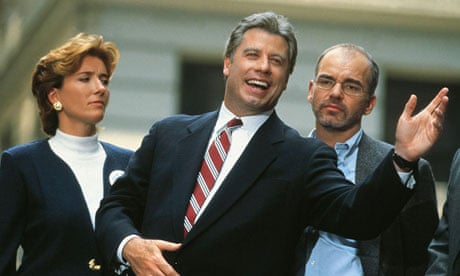
This leaves John Travolta as Clinton.  Granted, I have been spoiled by the real Clinton, a masterful communicator and tactician, and in my judgment, perhaps the greatest American retail politician.  But Travolta misses Clinton’s flashes and confluence of weakness and sincerity, warmth and opportunism, self-pity and bitterness.  It is a tall order to fill, Travolta does his best, but mimicry is often what he is forced to rely upon.  When he is adored by crowds in the movie, I thought, “Oh come on. How could they be buying this?”  Granted, I usually had those thoughts when the real Clinton spoke to adoring crowds.  But I rarely questioned the sanity of others who were thinking “Yes! He feels my pain” while I was rolling my eyes.

Still, Travolta does well enough, and Nichols smartly never gets you rooting for him or anyone else.  That is critical to the film.  You may like Travolta and Thompson, but you feel tarnished for doing so.  You may hate them, but you recognize their failures in yourself and politicans you admire.

The Artist. I was not excited to see a silent film, and it took a little while for me to warm up to it, but this is a natural, funny and beautifully shot picture, a riches-to-rags-to riches love story with enormous heart.

The movie is almost entirely dependent on its two leads, Jean Jujardin and Bérénice Bejo, both of whom are nominated for Academy Awards, and deservedly so. Dujardin is a silent film king who gives Bejo her big break, falling in love with her in the process. She ascends in the talkie era and he fades away. Particularly affecting is the scene of Dujardin in his last gasp movie, lost in quicksand:

Dejardin’s descent dragged a little bit, but that is the only criticism I have.

Dejardin and Bejo are aided by a plucky performance by a dog and the contributions of John Goodman as the studio mogul and James Cromwell as the loyal chauffeur. But they carry the film and their performances, which could easily have been big and over-the-top, are subtle and moving. The scene where they fall in love – a series of takes where Dujardin dances with then-extra Bejo, each take becoming more entranced – is captivating.

This is the favorite to win Best Picture tonight and it is the second best picture of the year.

Margin Call, nominated for best original screenplay, is still at the top of my heap.