Archive

2011

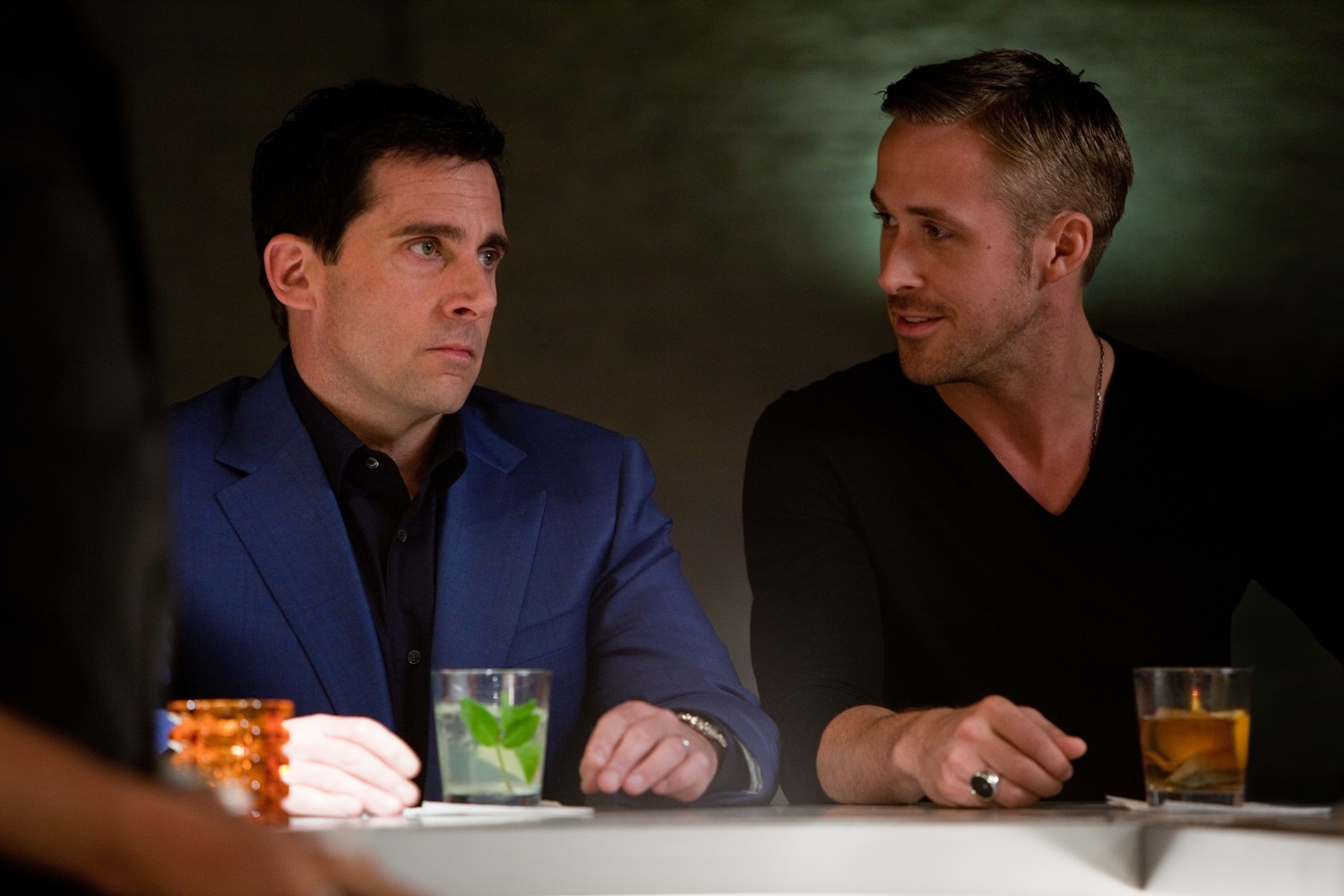
Image result for Crazy stupid love

A nice ensemble “bromantric” comedy.  Steve Carell plays the schlub husband thrown over by the “wife in mid-life crisis” Julianne Moore after she flings with an office colleague.  Despondent, Carell retreats to the local singles bar to lick his wounds, where the charming, suave ladies man Ryan Gosling takes him on as a project, ala’ Henry Higgins.  Carell is soon quite the ladies man himself but still pining for his wife, while Gosling learns the merits of deeper love with the electric but gawky Emma Stone.

There are some glitches: Carell’s sad-sack/nice guy routine is getting a bit stale; the friends of the broken-up Carell and Moore and Stone’s lame-o boyfriend are ridiculously stock and unrealistic; Carell’s 8th grade son is a little too cloying and hip; and Moore is reprising her flustered role in last year’s excellent The Kids Are Alright.

Still, this is cute and mostly funny, and Gosling, who I have been very hard on for his work in The Ides of March (confused) and the wildly overrated Drive (catatonic) is the engine.  His repair work on Carell provides some of the best scenes, and he and Stone have very convincing chemistry.

Also, Marisa Tomei plays a one-night stand who ends up being a teacher of Carell’s son.  Tomei just keeps getting better and better looking and more charming to boot.  She can be very dark, as she’s shown in The Wrestler and Before the Devil Knows You’re Dead, but she’s also a deft comedienne, as she showed here and in Cyrus.

Image result for Girl with Dragon Tattoo

Harsh, unyielding and spooky, David Fincher’s adaptation of Stieg Larssen’s first of his best selling trilogy (adaptations of all three have been made in Sweden) is intricate, engrossing and decidedly chilly.  Daniel Craig plays a Swedish journalist who has just been convicted of libeling a financier.  Another corporate titan (Christopher Plummer) summons Craig after having his background checked by an investigative firm.  The firm’s investigator is a ward of the state (Rooney Mara) who ostensibly works as an office clerk, but, in fact, is a genius of surveillance and investigatory technique.  Plummer entices Craig to investigate the 50 year old disappearance of his niece, and Craig eventually enlists the loner and outcast, Mara, to assist him.

Fincher’s strongest milieu is psychological crime.  Seven gave us the mastermind of Kevin Spacey as he offed his victims using the seven deadly sins as a guide.  Zodiac was an intriguing take on a real life case, the Zodiac murders in Northern California during the late 1960s, early 1970s, and while it bombed at the box office, only two movies appeared on more critics’ top ten lists in 2007.  Fincher can deftly keep a lot of balls up in the air with great precision yet still tells a tale you can follow.  The book provided a family tree chart in the preface, and given the number of characters in the family, I found myself referring to it regularly.  Screenwriter Steve Zallian has smartly excised the plot of a few people, but not many, yet I never found myself confused.

Mara is genuine as a troubled, anti-social outcast who teams up with Craig to work on the mystery, and they produce a strong and convincing bond (her nomination for best actress is merited).  The close of the picture, when she realizes she cannot have perhaps one of the few people who has shown her affection, is a gut punch.

The ending, however, is muddled, tacking on a financial windfall/scam to the resolution of the mystery.  Once you’ve witnessed the solving of a string of gruesome ritual killings and a missing persons case that goes back decades, a coda of fraudulent financial transfers is hardly satisfying and robs crucial minutes away from further character study of the family, some of whom get short shrift given the sweep of the story.

Another distraction is Mara’s progressively expert investigatory skills, which by the end of the film near those of a super hero (as Christopher Hitchens noted about her literary character, she “is so well accoutred with special features that she’s almost over-equipped”).  The more La Femme Nikita she becomes, the less your investment in her.

Be warned.  Like Fincher’s Seven, this film is both brilliant and disturbing.  Gruesome murders, rape, animal mutilation, and what appears to be an unbearably cold Sweden all await.  Not for the faint of heart

Image result for Hugo Scorsese

It won a slew of technical Oscars and was nominated for best picture, and it looks good. But it is  a long, hard slog. I’m certain there were quite a few kids who came out of this one realizing that 3-D ain’t all that.  I nodded off more than once. When I awoke, I was greeted with the same mundane dialogue and plodding story.

Martin Scorsese makes a Parisian train station the center of this “magical” tale of an orphan, a secret, and the movies, but after the magic of the imagery wears off, you’re still left with two hours of cloying depictions of the inhabitants of the station.

You’re also stuck with two of the least interesting child actors in film history.

This is the kind of children’s movie certain parents would love their children to love, along with trans-fatless cookies.  I’ll take Puss and Boots and Oreos any day.

Modern political movies are a tough sell.  Last year, George Clooney provided the dry, obvious and somber The Ides of March (no one got stabbed – but boy, as dull as it was, it would have helped).  The American President was execrable, a love letter sent to suburban progressives who must not only follow but adore their leaders, preceding the advent of The West Wing and Martin Sheen as President Awesome.  The most recent good political movie was the rollicking Charlie Wilson’s War, which Mike Nichols directed.

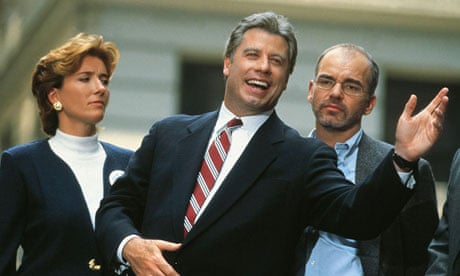
Nichols must have a knack for it.  Primary Colors is Nichols’s cinematic mirror on the rise of the Clintons, an adept story of the tension between political values, electoral success and human frailty, all wrapped up in a big, fun yarn populated by larger than life characters (one of whom served as our regularly entertaining president from 1992 to 2000). There is no need to discuss the plot.  It tracks history loosely, but it will be familiar.

It is also an actor’s film and those actors are aided by a very tight, yet breezy screenplay.  The characters talk the talk of political campaign work, yet we are not burdened by the mundane or weighty.  Better, divergence into the philosophical is not stilted or preachy.  Adrian Lester, the true believer sucked into the expedience and fervor of a presidential race, serves as our somewhat wide-eyed guide.  He exudes the right amount of awe and moral ambivalence.  Billy Bob Thornton is James Carville, and he utters my favorite line about politicians to Lester:  “That’s what these guys do. They love you and then stop lovin’ you.”  Emma Thompson is the increasingly embittered and mercenary Hillary; she is determined, yet both fragile and icy.  Larry Hagman delivers a nice turn as a morally tainted dark horse challenger, and Kathy Bates keeps the fun in the picture as a political operative who knows the terrain of small town politics gone national.

Now, playing a president is a hard job.  Jeff Bridges was nominated for best supporting actor for his Clintonian president in The Contender, but he was so charming and wily as to feel false.   Michael Douglas was painfully self-pitying in the The American President and while Kevin Kline’s president in Dave wasn’t supposed to be realistic (if you’ll recall, Dave was a look-alike brought in to replace the real president, a heartless prick who I much preferred), he was so “aw shucks” Opie I found myself rooting against him.

Even harder is playing a president we know.  Kennedy does not count, because most filmgoers didn’t live through his presidency, and even if they did, JFK is difficult to separate from a Hollywood character (in fact, Kennedy is the only president to have a film released about him during his presidency, and you can rest assured that PT-109 did not show Jack screwing the pooch by letting his ship get rammed by a Japanese destroyer).  So, we are convinced by awesome hair and a few “Bahstans” and “Cubers.”  Oliver Stone gave us two grotesque caricatures — Anthony Hopkins made Nixon a sweating bundle of nerves and ambition in Nixon (Frank Langella’s Nixon in Frost/Nixon was so much better) and Josh Brolin as a clownish, frat boy/oaf in W (I’m still waiting for the casting of Gerald Ford in The Mayaguez Incident).

This leaves John Travolta as Clinton.  Granted, I have been spoiled by the real Clinton, a masterful communicator and tactician, and in my judgment, perhaps the greatest American retail politician.  But Travolta misses Clinton’s flashes and confluence of weakness and sincerity, warmth and opportunism, self-pity and bitterness.  It is a tall order to fill, Travolta does his best, but mimicry is often what he is forced to rely upon.  When he is adored by crowds in the movie, I thought, “Oh come on. How could they be buying this?”  Granted, I usually had those thoughts when the real Clinton spoke to adoring crowds.  But I rarely questioned the sanity of others who were thinking “Yes! He feels my pain” while I was rolling my eyes.

Still, Travolta does well enough, and Nichols smartly never gets you rooting for him or anyone else.  That is critical to the film.  You may like Travolta and Thompson, but you feel tarnished for doing so.  You may hate them, but you recognize their failures in yourself and politicans you admire.

The Artist. I was not excited to see a silent film, and it took a little while for me to warm up to it, but this is a natural, funny and beautifully shot picture, a riches-to-rags-to riches love story with enormous heart.

The movie is almost entirely dependent on its two leads, Jean Jujardin and Bérénice Bejo, both of whom are nominated for Academy Awards, and deservedly so. Dujardin is a silent film king who gives Bejo her big break, falling in love with her in the process. She ascends in the talkie era and he fades away. Particularly affecting is the scene of Dujardin in his last gasp movie, lost in quicksand:

Dejardin’s descent dragged a little bit, but that is the only criticism I have.

Dejardin and Bejo are aided by a plucky performance by a dog and the contributions of John Goodman as the studio mogul and James Cromwell as the loyal chauffeur. But they carry the film and their performances, which could easily have been big and over-the-top, are subtle and moving. The scene where they fall in love – a series of takes where Dujardin dances with then-extra Bejo, each take becoming more entranced – is captivating.

This is the favorite to win Best Picture tonight and it is the second best picture of the year.

Margin Call, nominated for best original screenplay, is still at the top of my heap.

The movie starts off trying your patience with an overlong introduction of clarinet music and scenes of modern Paris. We are then introduced to American screenwriter Owen Wilson and his nagging, dispiriting fiancee, Rachel McAdams. Wilson is nervous and nasally and a noodge. McAdams is flat out hostile to Wilson. The idea that these two would ever be engaged is absurd. I kid you not, McAdams says to Wilson, “You always take the side of the help.” So, Wilson is married to a monster, doesn’t seem to know it, and yet, Allen wants us to care about him.

Worse, McAdams travels with her ugly American parents, who are (gasp) Republicans, distrustful of the French and country club obnoxious.

Allen makes the modern so unpleasant you can’t wait for Wilson to be transported to the 1920s. Sadly, we have to go to the 1920s with Wilson. And he’s doing Woody Allen, but whinier. He meets F. Scott Fitzgerald, Cole Porter, Ernest Hemingway, Salvador Dali, and Gertrude Stein says, “I was just telling Pablo . . .”

The greats are condescending, self-satisfied characters and they lord their superiority over all. Allen does the same thing, hiding it in his puny, nebbish persona, so his portrayal of them makes sense.

This movie is terrible. Perhaps Allen can still make a good picture. Match Point (2005) was a revelation and Vicky Christina Barcelona (2008) was charming, but he’s about done, and the nomination of this movie as best picture is ridiculous. The nomination as best screenplay is an affront. Perhaps Allen’s digs at Bush and The Tea Party explain it, but if not, and the Academy wanted to give him an unwarranted accolade, isn’t that why the Irving Thalberg award was created?

Some gems: “How long have you been dating Picasso. I can’t believe I’m saying that.”

Hemingway: “Have you ever shot a charging lion . . . Who wants to fight!”

“I wouldn’t call my babbling poetic, though I was on a roll there.”

“500 francs for a Matisse? I wouldn’t mind getting five or six.”

“The present is unsatisfying because life is unsatisfying.”

Yeesh.

There are some funny moments when Wilson lapses into Seinfeldian chatter and the folks from the 1920s look at him funny. Adrien Brody is a hoot as Dali. The movie is also very pretty.

That’s not enough, notwithstanding the Academy and a 93% rating on Rotten Tomatoes.

Matt Damon is a candidate for Senate in New York, pretty much a carbon copy of George Clooney’s presidential candidate in The Ides of March – smart, iconoclastic, liberal, not the kind of guy to admit he wouldn’t support the death penalty for the murderer of his wife. He finds his true love (Emily Blunt) before a big speech and then on a bus, and there is a real connection. But his path leads to higher things than true love. Sooooooooo . . . .

A bunch of angels (Anthony Mackie, John Slattery and eventually, ponderously, Terence Stamp) in ridiculous fedoras do all in their power to keep Damon away from Blunt and “on his plan.” And their power is impressive, except when it is not. So, they can freeze time and inject an idea into the mind of Damon’s campaign manager, but when Damon and Blunt are close, the best they can do is jam land lines and ensure that a cab won’t stop for Damon.

A decent premise (true love conquers all, even angels who have us on a predestined course) is destroyed by failure to let us in on the rules of what angels can do and cannot do (apparently, their powers are weakened near water, ala’ the aliens in Signs). Worse, the “Mad Men” hats the angels wear are actually powerful. They can open doors. Not in the “a well dressed man can get the right doors opened” way but in a “wearing this hat can get doors of teleportation to open.” And before you can say Ben Braddock, Damon is interrupting Blunt’s wedding.

Image result for Matt Damon The Adjustment Bureau hat

“How do I look in this? Really.”

Avoid.

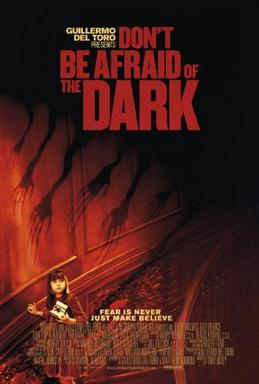
Image result for don't be afraid of the dark movie

Scary and interesting only up and until three things happen: you see the CGI little gnomes who are causing the trouble (they look ridiculous); Katie Holmes bashes your sensibilities into submission with her leaden acting; and you realize there is no adequate backstory for why the house is haunted by CGI gnomes.  It just is.

I confess, I got punked.  I saw Guillermo del Toro’s name associated with the picture.  He directed The Devil’s Backbone, Pan’s Labyrinth  and Cronos , which were spooky, atmospheric and rich.

Alas, the movie says Guillermo del Toro presents, not Guillermo del Toro directs.

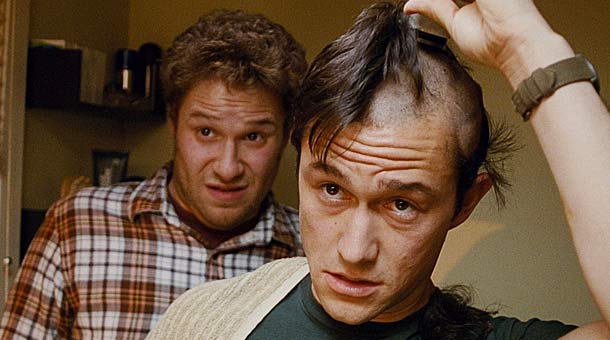
Image result for 50/50 Movies

Joseph Gordon Levitt gets a grim cancer diagnosis and is supported by Seth Rogen, who plays the standard best friend role (much as he did in Funny People), only now, he’s a stoner trying to get his friend to use the cancer to get women.  Rogen can be funny but he better branch out.  He’s got one persona and it is wearing very thin.

There is also a love connection with his cancer support therapist Anna Kendrick that is all too paint-by-numbers with its concerns about the ethics of falling in love with a patient and the inevitable breakthrough.  And there is an overbearing mom played with little imagination by Angelica Huston.

What is memorable about the picture is Gordon Levitt, who manages to convey the loneliness, confusion and other-worldliness of a possible premature death sentence with force and subtlety.  He’s almost worth the watch alone.

J.C. Chandor (A Most Violent Year) gives us a taut, intelligent, crisp story of one NY investment house which realizes (credibly, at least for movie purposes) that the economic crash/conflagration of 2008 is not only going to happen, but it is happening, however subtly.  As a result, we get to see the reaction of and impact upon the firm’s silky Gordon Gekko-like chairman (Jeremy Irons); the executives who sold him on the mortgage-based investment policy that brought the firm to the brink of ruin (a harsh looking Demi Moore, made all the more brittle by her counterpart, the Dorian Grayish Simon Baker); the traders (Kevin Spacey, who I would say steals this movie except for the fact that Paul Bettany as his no. 2 is every bit as good); and the lower-level young risk analysts (Zachary Quinto and Penn Badgley) who reveal the threat and then serve as wide-eyed witnesses to the first rumblings of the financial earthquake.  The film never misses a beat as it propels the story (which unfolds in a 24 hour period) while offering great characters in an ensemble piece loaded with dialogue that is thoughtfully cynical but never showy.

Chandor’s byzantine world of finance is neither sexy or diabolical, and the cogs are just performing their jobs in a system whose caprice they often fail to understand.   As the trading floor manager, and the closest thing the film comes to a moral voice, Spacey sees the inevitability of the resolution but he cannot resist it; the system won’t let him.  There are no villains, and thankfully, no simplistic Oliver Stone-esque sermons.  The characters are the audience, and they, like us, do not lash themselves to the wheel as the ship goes down.  They survive, take stock and move on.

By far the best film of 2011.