Archive

5 stars

Unbreakable (2000) - IMDb
It is a testament to M. Night Shyamalan’s clout after The Sixth Sense that he could get such a deliberate and meditative film made. Bruce Willis is a Philadelphia security guard, an ex-jock in a crumbling marriage with Robin Wright. His son is overly attached to him, sensing in his father something special and perhaps dangerous. After Willis emerges from a horrific train wreck as the sole survivor, with nary a scratch, the son’s suspicions are confirmed by the appearance of a comic book aficionado (Samuel L. Jackson) who leads Willis to a great revelation. It’s an old movie, but to discuss it further substantively would be an injustice. Before Shyamalan became a slave to big twists and reveals that became increasingly ridiculous, from aliens who invade earth but for whom water is acid (Signs) to an eco-counterattack where trees make people commit suicide (The Happening), he could deliver some truly effective codas, and Unbreakable contains my favorite.

Great ending aside, the story is original and sophisticated, Shyamalan’s Philly locales are lovingly chosen and spooky, Willis is the perfect choice for a regular Joe who soon learns he is anything but, and Jackson projects brilliant obsession. The penultimate scene, where Willis tests his new incarnation, is one of the more frightening I’ve ever seen.

The studio and Shyamalan had to have been disappointed by the latter’s sophomore effort. While it did very well overseas, its domestic gross exceeded budget by only $15 million compared to The Sixth Sense‘s $250 million. But Shyamalan had to know that such a painstaking, personal film would not garner an expanding mass audience, even if the studio didn’t.

Silver Linings Playbook,' Directed by David O. Russell - The New York Times

David O. Russell (Three Kings, The Fighter) has written and directed a special drama/romance, made all the better by a flawless ensemble. Bradley Cooper is just out of an 8 month court ordered stint in a psychiatric ward after having found his wife in the shower with her lover and beating the hell out of the former. Cooper is also bipolar. Under police supervision and ensconced in the Philadelphia home of his OCD, Philadelphia Eagle fanatic, bookie father (Robert De Niro) and supportive mother (Jackie Weaver), Cooper plots his way back into his wife’s heart, enlisting the help of a neighbor (Jennifer Lawrence) who has a few not insubstantial psychiatric and familial problems of her own. Unfortunately, he does this while forswearing the medications that will keep him on an even keel.

The film seamlessly portrays the pressure and effect of mental illness on a family with the Herculean effort of love and commitment it takes to manage it. Intertwined is a beautiful, engaging love story.

Cooper is rightly nominated for Best Actor. His performance is riveting, and no easy feat.  He presents a character plagued by demons, trying to hold them back, while leveling off to actually grow. As I walked out of the theater, my estimation of Cooper as merely a more electric Ryan Reynolds was erased, and Daniel Day Lewis’s turn as Lincoln seemed humdrum in comparison.

Jennifer Lawrence, also nominated, also wows. She is wounded and in crisis, and as she reaches for Cooper, her desperation and need are palpable. De Niro, who I wrongly suspected might have been nominated for best supporting actor as a nod to his overall body of work, is touchingly desperate as a father who carries his own mental disability as well as the weight of failing his son. Last, but certainly not least, the film’s fourth nominee Jackie Weaver plays Cooper’s mother lovingly while communicating the weariness of someone who has been required to hold a tenuous family together. The rest of the cast is also very funny, especially a portly Chris Tucker, who plays a patient from the psychiatric ward with a penchant for self-furlough.

This is a tough film to make. Mental illness does not lend itself either to yuks or romance, and without Russell’s deft hand, it could easily have been offensive, pat and/or schmaltzy. Cooper’s outbursts are funny, but that is because he’s a funny character whose disability has removed his filter. But Russell does not sugarcoat the illness, and when Cooper is manic, we are scared for him and those around him. Lawrence is also hard, mercurial and often tough to take, and normally, she would have been the whore with a heart of gold. In fact, her damage requires Cooper’s strength and the two share a strong chemistry.

To be able to construct a sweet, original romance from such stuff is both an achievement and a damning indictment of almost all romantic comedies/dramedies that have so little to say about people. This is the best movie of the year.

Zero Dark Thirty True Story: Everything The Movie Changed & Left Out

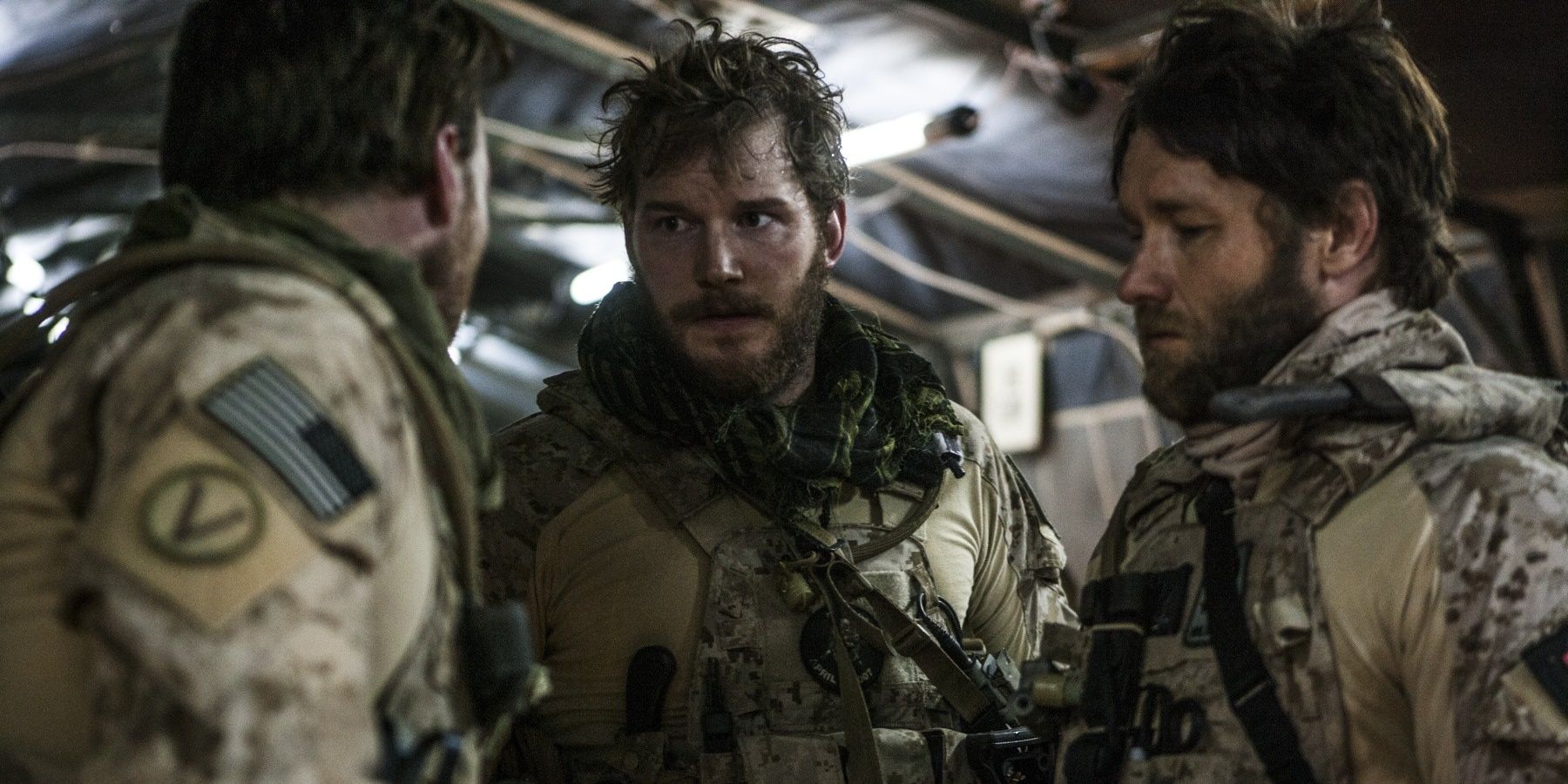
In The Hurt Locker, Kathryn Bigelow exhibited an expert feel for the milieu of a bomb disposal team in early post-Saddam Iraq. While her depiction of the mechanics of the team was the subject of debate, the desolation and immediacy of her scenarios was spot on, evoking the overburdened and overwhelmed sensibility of better-equipped invading/liberating armies since the time of the Romans. What kept The Hurt Locker from being a great film was the simplistic protagonist, Jeremy Renner, a danger freak and little more, with whom we were required to spend too much time.

In Zero Dark Thirty, Bigelow again utilizes a simplistic heroine, CIA officer Jessica Chastain, whose entire persona is a relentless “get bin Laden” zeal. Fortunately, the story Bigelow is telling is an intricate intelligence bureaucracy procedural and Chastain is progressively morphed from the driver of the story to an observer. To her credit, she remains disciplined and does not stray from the confines of her role. Chastain is emblematic of the effort and the desire to fight al Qaeda and eliminate its leader, and the film has refreshingly little interest in what makes her tick, her relationship with men, etc . . . the story is quite enough. This film is much like United 93, authentic, thoughtful, and gripping, even though we know the end.

Two other aspects make this picture extraordinary. First, it deals with politics in a subtle yet effective manner, opening with a clutter of 911 calls on 9-11, which creates the urgency necessary to begin the story, and acknowledging certain political realities (the failure of the CIA on WMD, the changing domestic political tenor on enhanced interrogation, and the Obama administration’s moves with regard to same) without gettng bogged down in their import or advocating for any particular position.

Second, of some controversy, Bigelow shows torture.  Torture assuredly occurred and was also assuredly of value in the war against al Qaeda. Just ask new National Security Advisor John Brennan: “There has been a lot of information that has come out from these interrogation procedures that the agency has in fact used against the real hard-core terrorists. It has saved lives.” The histrionic attacks on Bigelow’s film because it merely shows torture demonstrate the exact false and forced narrative that Zero Dark Thirty eschews. It is depressing that Bigelow had to actually say, “”Experts disagree sharply on the facts and particulars of the intelligence hunt, and doubtlessly that debate will continue. As for what I personally believe, which has been the subject of inquiries, accusations and speculation, I think Usama bin Laden was found due to ingenious detective work. Torture was, however, as we all know, employed in the early years of the hunt. That doesn’t mean it was the key to finding bin Laden. It means it is a part of the story we couldn’t ignore.”

Bigelow’s statement is echoed by Mark Bowden, author of Black Hawk Down: “Torture may be morally wrong, and it may not be the best way to obtain information from detainees, but it played a role in America’s messy, decade-long pursuit of Osama bin Laden, and Zero Dark Thirty is right to portray that fact.”

Juxtapose the statements of Bigelow and Bowden with the criticism of actor and activist David Clennon (“Torture is an appalling crime under any circumstances. ‘Zero’ never acknowledges that torture is immoral and criminal”) and you have the difference between Zero Dark Thirty and the spate of shit message movies that Hollywood churns out every year to show us the right path. The Clennons are terrified. By showing that torture may have gotten certain results, sweet Lord Almighty, we have endorsed torture, which we cannot hope to condemn unless we show it was a masochistic folly of absolutely no intelligence value.

Perhaps we can delete the great line where one interrogator tells Chastain to be careful because the domestic political winds are shifting and she doesn’t want to be “the last one holding a dog collar” and substitute it with, “you know, upon reflection, this stuff we’ve been doing . . . It’s just morally wrong and maybe even criminal.”

Writer/director Martin McDonagh’s first feature is assured, intelligent, and deviously funny.  Two Brit hitmen, Ken and Ray (Brendan Gleeson and Colin Farrell) are exiled to Bruges in Belgium by their crime boss Harry (Ralph Fiennes) after Farrell cocks up his first job (a priest) and accidentally kills an altar boy.  What starts as a languorous wait, with Gleeson fascinated by the history of the town and Farrell bored to tears, becomes tense and edgy after Gleeson is given his next assignment (guess who?) and Farrell becomes more and more despondent over what he has done.  The duo sightsee, drink, do drugs and discuss morality, fate, death, religion, Americans, beer and various and sundry other topics until Fiennes comes to town to force the action.

The three leads are all very good.  Fiennes is a brutal yet charming Cockney, and Gleeson is a stoic solider on the brink of a moral epiphany.  But Farrell’s frenetic, comic-yet-tortured turn is the engine.  He’s barely a man, he’s killed a child, and he is denied any peace, having been placed in “bloody Bruges.”

A taste —

Wes Anderson’s breakout picture centers on Max Fischer (Jason Schwartzman), a sort-of prodigy, son of a barber on scholarship at the tony Rushmore Academy. Rushmore is Fischer’s domain. Not academically but in every extracurricular activity (he is President, Model UN; Founder, Bombardment
Society; Founder, Rushmore Beekeepers; Founder, Max Fischer Players; and Director, Piper Cub Club – 4.5 hours logged, to name a few).

It is natural that Max would claim the winning new teacher (Olivia Williams) as his first love. Fischer, however, finds himself in competition for her affections, first with the rich, dissolute father of
two bratty classmates, Herman Blume (Bill Murray) and then with the ghost of Wiiliams’s dead husband. Max can defeat neither, finds himself expelled, and must rise anew to atone for his selfishness and stupidity.

Following up on the promise of his debut (Bottle Rocket), Anderson made a picture quite unlike anything before it, a blend of the fables of boyhood, the adult cynicism that follows, a beautiful romance, and the tragedy of loss (Williams’ has lost a husband, Fischer his mother), all scored by
British invasion B sides. As with this year’s Moonrise Kingdom, Anderson revels in the adult as child and vice versa. The result is charming and wistful, but also heartfelt. There is something both clever and moving in exchanges where Max is earnest and Blume dry:

Max Fischer: So you were in Vietnam?

Herman Blume: Yeah.

Max Fischer: Were you in the shit?

Herman Blume: Yeah, I was in the shit.

There are numerous bravura scenes, all sharply written (the screenplay was the work of Anderson and Owen Wilson).  Fischer’s first “date” with Williams (he invites Murray as cover and Williams actually brings a real date, Luke Wilson) is an exemplar of Anderson’s melding of the comic and pathos.

Murray’s brief speech to the students of Rushmore is also noteworthy.

You guys have it real easy. I never had it like this where I grew up. But I send my kids here because the fact is you go to one of the best schools in the country: Rushmore. Now, for some of you it doesn’t matter. You were born rich and you’re going to stay rich. But here’s my advice to the rest of you: Take dead aim on the rich boys. Get them in the crosshairs and take them down. Just remember, they can buy anything but they can’t buy backbone. Don’t let them forget it. Thank you.

I also don’t think I’ve ever seen a better-scored film (Scorsese’s Casino, with the extended “Can’t You Hear Me Knocking” is close). Anderson originally wanted the entire soundtrack comprised of Kinks songs, but Mark Mothersbaugh of Devo chose a variety of classic-sounding, if not classic,
tunes. The effect is nostalgiac but a little unfamiliar, which tracks nicely with the whimsical, sometime sad story. “I Am Waiting” by The Rolling Stones is an example of an early, lesser know track where Jagger’s vocals are not confrontational and modern, but almost earlier century chamber music ala’ “Lady Jane.”  Anderson uses this track in a brilliant changing of seasons montage.  “A Summer Song” by Chad & Jeremy, “The Wind” by Cat Stevens, and “Oh Yoko!” by John Lennon are used in similar, successful fashion.

It’s may seem strange to call this an important film, but it really is.  With it, Anderson emerged on the scene as a unique storyteller.  When he showed the film to Pauline Kael, she loved it but told him, “I genuinely don’t know what to make of this movie” which strikes me as the highest of praise.  It is one of my favorite films.

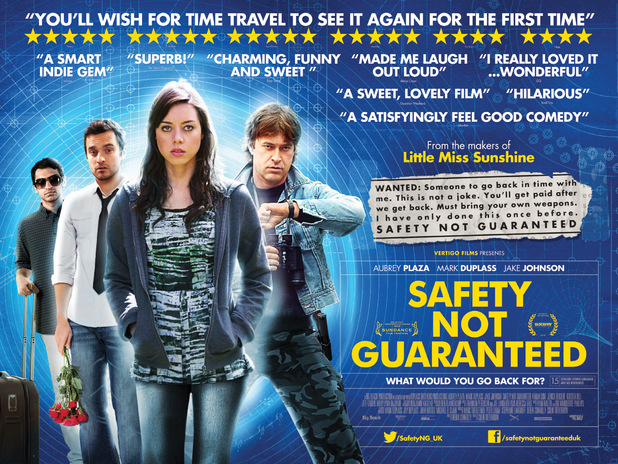
What are the chances I’d see two Mark Duplass movies back-to-back much less one I’d rate a 0 and one I’d rate a 5?  This is a sweet, whipsmart picture about three Seattle magazine employees – two interns (Aubrey Plaza and Karan Soni) and a writer (Jake Johnson) – who go to Northern California to do a piece on a guy (Duplass) who put out an ad to go back in time, looking for a companion.  The writer took the job solely to nail an old high school girlfriend he found on Facebook (Jeneca Bergere).  Plaza is along for the ride and Soni, a geeky Indian techie, only took the internship to round out his resume’.  Plaza becomes intrigued by Duplass, Johnson falls for his target, and it turns out time travel may be possible.

This is a dual story between four people looking to connect.  Duplass bonds with Plaza while Johnson and Soni engage in a mentor-mentee dance.  Best, what seems a goof assignment to write an ironic, hip piece on a quirky dude masks a couple of crises of conscience, place and purpose.

Everybody is excellent, but Johnson is particularly strong as an urban scammer who uses the story as a cover to hook up with a high school flame and realizes how empty he feels in the arms of a real woman.  She asks what he’s doing, he responds that he has an Escalade, she clarifies “no, I meant with your life” and he responds “I just told you.”

When she puts up her guard, points out the error of his idealization, and his fairy tale collapses, he runs to Soni and screams in the geek’s face to get off the Internet, away from his safety bubble and live a life.  Johnson’s character is emblematic of the maturity of the writing.  Normally, he’s the dick, the full-of-himself comic relief.  As a character, it’s an honorable job, ala’ Bradley Cooper in Wedding Crashers.  But Johnson (and really, all the characters) are given more depth in an economical fashion, making a very funny movie poignant and multi-layered.  One of the best films of the year.

It is in vogue to denigrate Will Ferrell, whose excess has long outlived its freshness. He’s slogged into one tiresome, repetitive project after another. Land of the Lost? A one-man show portrayal of George W Bush, The Other Guys, Casa di mi Padre, The Campaign, and soon, a repeat, Anchorman: The Legend Continues. His forays into a successful Jim Carrey-like branch-off started with promise (Stranger than Fiction) but his dramatic weaknesses were apparent in Everything Must Go. His last goofy semi-triumph was Step Brothers, which owed as much to the supporting efforts of the scene-stealing, diabolical Adam Scott and the inspired premise as to Ferrell’s adolescent sincerity as the arrested man-child, Brennan Huff.

Let us not forget, however, that when Ferrell was on a roll, it was an impressive one – Old School, Elf, Anchorman, Wedding Crashers . . . all a variation on the man-child theme, but classics nonetheless.

At the end of Ferrell’s run is Talladega Nights, the last hurrah, but what a hurrah.  Ferrell plays Ricky Bobby, an ignorant, flashy, uber-American NASCAR driver with a hot blonde wife (Leslie Bibb), a loyal race car compadre (John C. Reilly) who loves Ricky so much he happily takes second in every race, two horrific kids (Walker and Texas Ranger) and a gay French nemesis on the track (Sacha Baron Cohen). When Ricky is on top, it looks something like this:

When it all goes to crap after a brutal wreck, Ricky must re-connect with the itinerant father who abandoned him as a child (Gary Cole) and his old-school mother (Jane Lynch). With their help, and the help of a loyal, starstruck flunky (Amy Adams), Ricky regains his mojo and lives the VH1 comeback before our eyes.

The gags are inspired, the back-and-forth (much of which has to be improv, as evidenced by the bloopers in the credits) crackles, almost every supporting character delivers well (Molly Shannon as the boozehound wife of a corporate slime is particularly prime), and the chemistry between Ferrell and Reilly, which was very good in Step Brothers, is undeniable. After Ricky loses his nerve and then all, Cal replaces him, setting up in Ricky’s house and with his wife. But they do miss each other:

It’s uproarious, loaded with gem slogans (“If you ain’t first, you’re last”) and has as much fun as you can have with American excess. Even as silly an endeavor as this could have come off condescending and mean to “those NASCAR types” but Talladega Nights feels wholly respectful even as it goes to town on its target.

EBFDF7B9-9AE9-4195-8CD8-70BF9A2C66AB
Any film where the director kicks the Jesuitical screenwriter off set because the latter wants the film to be unequivocal in its conclusion that God triumphs over Satan is bound to be unique. As that screenwriter William Peter Blatty observed:

Like so many Catholics, I’ve had so many little battles of wavering faith over the course of my life. And I was going through one at that time. And when I heard about this case and read the details, that seemed so compelling. I thought, my God, if someone were to investigate this and authenticate it, what a tremendous boost to faith it would be. I thought, someday I would like to see that happen. You know, I would like to do it . . . the research into it affected me. And the novel, it very much strengthened my faith.

Director William Friedken had other ideas.

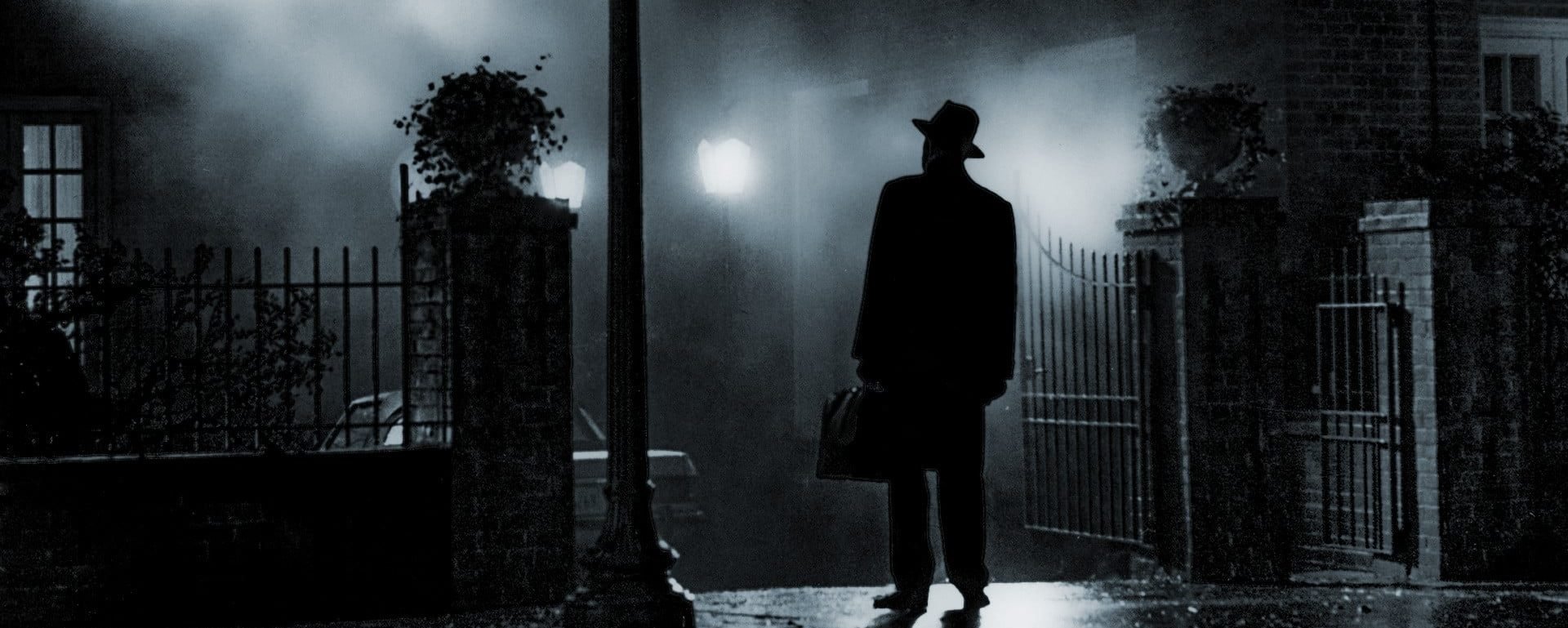
The film opens near an archaeological dig in Iraq. There, Friedken depicts a harsh and poverty-stricken world, where the blind are led by starving children, a widow grieves inconsolably, people work in small foundries like toilers in a fiery, oppressive Hell, and Father Merrin (Max Von Sydow) receives a sign that he will soon be meeting Satan.  We are then transported to Washington, D.C., where another priest – Father Karras (Jason Miller) – is in a modern Hell.  He is counselor to unsure and shaken Catholic priests.  He tells one, “There’s not a day in my life when I don’t feel like a fraud.” To another, “I think I’ve lost my faith.”  Karras’ mother is in her own nightmare, 1970s New York City.  She needs care, she lives in a slum, and Karras is wracked with guilt over her abandonment.

Friedken masterfully portrays the connection between a society sick by sin and the infestation of one little girl, Regan McNeil (Linda Blair), the daughter of a Hollywood actress (Ellen Burstyn) filming on location in D.C.  As Regan’s personality changes, she undergoes rigorous medical procedures (an arteriogram and a pneumoenchephalogram, to name two) that are graphic and invasive, as well as psychological probing (way before its time, the film has a doctor extolling the virtues of Ritalin).  Her father forgets to call her on her birthday, pointing up the damage of divorce.  Regan is alone and left to play by herself and eventually, an imaginary friend, in a foreign town and a rented townhouse.  She is the quintessential “modern” child.

Other characters are also on the point of a knife.  Father Karras nears breakdown after the death of his mother yet he continues to counsel other priests sick at heart and doubting of faith. The director of Burstyn’s “film in the film” (Jack MacGowran) is a lonely drunk cursed by memories of the Holocaust who scathingly brands Burstyn’s housekeeper of Germanic descent a closet Nazi.  Everything and everyone seem rife with wrong and discomfort, raw and vulnerable. Von Sydow is nothing less than a condemned man, awaiting his confrontation with Satan and dependent on nitroglycerin pills for his ailing heart. 

As Regan descends into the throes of possession, Friedken and Blatty smartly turn the world on its head: the physicians, once cocky, can offer Burstyn only the Jesuits, but only because a symbol of God might suggest salvation to Regan, the idea of faith, of course, being ridiculous. And when Regan talks to Karras (himself an Ivy League trained psychologist), the priest immediately sends her back to the doctors and recommends the child’s institutionalization. This is what modernity does when confronted by evil – denies it or locks it away. Friedken’s reservations aside, Blatty gets his morality play.

But it’s a morality play encased in a thrill ride. When the nature of Regan’s torment can no longer denied, and her abuse progresses, Friedken uses all means at his disposal to discomfort the viewer, from the foul, such as the vomit and green goo and the masturbation-with-crucifix (Blair had a stunt double who was used in the disturbing sexual scenes, for those who may have been wondering – double or no, it is still quite a shock to see a little girl utter the abomination “Let Jesus fu** you, let him fu** you”) to the subtle (the use of subliminal cuts, as when Father Karras dreams of his mother and sees a death mask and then, the same mask is overlaid on Regan’s face during the exorcism).  Friedken also had the set dropped to below freezing by placing a restaurant air conditioner across the top of the set, which he then ran all night. The effect on the actors is stunning – their fear is enhanced by physical cold and the steam of breath is another frightening component.

Understandably, Blatty fretted over Friedken’s depictions: “A large section of the audience probably came because something that shocking and vulgar could be seen on the American screen. Bill Friedken always said that would be the case; that they would come to see the little girl masturbate with the crucifix . . . At the time I didn’t believe it; I thought he was destroying the film. But when I perceived that he was absolutely right, I thought it was terribly depressing.”

Friedken, however, is not only a showman, he’s a damn good one. He sets one spooky scene after another, constantly tracking his characters slowly in a manner that feels as if they being enveloped … by something. Burstyn’s walk home from a film shoot in Georgetown, where she witnesses Karras furtively counseling one priest and then passes two nuns with the wind whipping their garb, lends an eerie sense of the foreign and the what is to come.  Much of the camera work is elegant tracking and slow zooms, soon to be punctuated by the occasional hand-held jolt (mostly, when characters are rushing to Regan’s room). The effect lulls the viewer, making the terror – when it occurs – all the more shocking.

Friedken understood that the spinning head was important but not as important as verisimilitude: “It’s set in the real world, with characters who are portrayed as humanly possible. So I think that the fact the story is portrayed realistically is what disturbs people about the events in it.”

The performances are poignantly measured, just on the edge of documentary. The film should be a Hollywood treatise on the exposition of minor characters. Blair is sweet and gentle as needs be, until – with the help of a stunt double, the guttural voice of Merecedes MacCambridge and various pulleys – she transforms convincingly into a leering, goading demon. Burstyn presents as a pampered star and mother at the end of her rope, but she grows to a hardened, more simple warrior. Von Sydow is appropriately ghostly as the doomed Father Merrin. McGowran and Lee J. Cobb are memorable as the murder victim and the murder policeman. Cobb’s gentle interrogations of Karras and McNeil are the kind of quiet respites necessary for such a tense film. Cobb also represents the skeptic and a rebuttal to any sense of despair. He is, after all, steeped in the evil that men do.  But he is also kind and supportive, looking for an autograph from Burstyn and a friend in Miller. His supporting performance is one of my favorites in all of film.

 The great turn, however, belongs to Miller (a playwright who succumbed to drink and never really did much as an actor after The Exorcist). His is a tortured existence, filled with doubt. His trepidation shows in his eyes. Physically, Miller plays as a man who fears his weakness is obvious to all, so he shrinks into himself so as not to be noticed. Merrin and Karras act like a men who know Satan is looking for them. The difference is that Merrin knows what is coming and solemnly accepts it. Karras thinks he can hide, and that is why he is so compelling. Friedken almost always films Miller hunched over, or huddled in talk, or sitting down, or crouched, or in a crowd, accentuating his need to be anonymous.

In the end, despite the tension between  Friedken and Blatty, the latter need not have worried. The film is a clear triumph of good over evil.  To save Regan, Karras defies the devil, “Come into me! Come into me!” The devil obliges, and for a moment, it looks as if Satan/Karras will kill Regan. Karras, however, summons his faith and hurls himself out of the window. He is given last rites, and later, a recovered Regan (having no memory or the possession) sees a priest and kisses him.

The Exorcist is a great popcorn flick but also a cinematic declaration that palpable, defined evil exists. It is an ultimate rejection of moral relativism, a harsh check on modern mores and technological advances. It is also, despite its slick sophistication, religious.  After all, you cannot really find “good” or “justification” or “well, sure . . . but” in Satan. There is no bargain, even as Burstyn asks a herd of befuddled doctors “You’re telling me that I should take my daughter to a witch doctor?” The answer is, yes, there is no modern skate or help for you. And Friedken, the carnival barker, effectively shows you just how frightening and insidiously entertaining Satan can be.

A closing note: Blatty wrote The Exorcist many years after attending Georgetown University in Washington, D.C.  One of his inspirations was newspaper reports of a real life exorcism of a boy in Mt. Rainier, Maryland.  That boy went to my high school, and you can read about his story here — http://www.strangemag.com/exorcistpage1.html  Enjoy.

The Straight Story movie review (1999) | Roger Ebert

David Lynch’s masterpiece is Blue Velvet, but the film produces near physical discomfort, much like Darren Aronofsky pictures, so it serves as a poor exemplar of his work.  Like Paul Thomas Anderson’s Magnolia, Lynch’s Mullholland Drive vied to be one of the finest first halves of a film ever made.  Then, inevitably, it became laughably obtuse and the whole thing unraveled.

That was in 2001 and since then, it’s been all shorts and documentaries for Lynch.  But before Mullholland Drive, Lynch directed his strongest film, a simple story about Alvin Straight (Richard Farnsworth)  who takes his ride-on lawn mower to visit his dying brother (Straight’s eyes are poor and he cannot drive a car) in Mt. Zion, Wisconsin.  The trip is 300 miles.

Lynch’s film is a testament to the small town communities of the Midwest.  Straight encounters nothing but kindness, empathy and assistance, none of it treacly or condescending or self-congratulatory.  As nicely put by Roger Ebert, “Lynch’s film is a lyrical beauty, and I cannot remember a picture more true to regular folk.”

There is a scene where Straight shares a beer with a man (Wiley Harker) in a bar.  They acknowledge their World War II service and then go to a place that evokes the horror they both encountered.  The scene is deeply delivered and is one of the most profoundly moving exchanges I’ve ever seen on film.

Farnsworth was deservedly nominated for an Academy Award for best actor.  Sadly, he was suffering from terminal bone cancer during the shooting of this film and he took his own life a year later at his ranch in New Mexico.  He could not have chosen a better epitaph than this film.

Certain films transcend criticism because of the place they hold in the national consciousness.  Saving Private Ryan is a forceful, indelible picture with opening and closing battle scenes so visceral I found myself ducking in the theater as a complete stranger in the seat next to me gripped my arm.  Shorn of the opening Omaha beach sequence and the fight for the town of Ramell, the film is just north of pedestrian.  Robert Rodat’s script is functional but hokey (the constant banter over Tom Hanks’ occupation is an example).  The characters – the intellectual, the caring medic, the goombah, the Southern, bible-loving sniper, the New Yahker, the Jew – are unrealistic archetypes.  The John Williams score is just so much syrup.

Who cares?  The picture means more than its parts and speaks to a certain time and sacrifice.     Every American high school kid should be forced to watch the damn thing the next time they bitch about the trials and tribulations of their lives.

In many ways, 9-11 was much like the day American soldiers alit from their Higgins boats onto Omaha.  We were wholly unprepared for the savagery of the attack, we reeled at its success, and then brave and innovative heroes, ordinary citizens all, adapted, driving one of the planes meant to decapitate the government into a field in Shanksville, saving the lives of hundred and perhaps thousands of others.  Paul Greengrass’s film depicting that day, however, suffers no flaws and accordingly, does not need to transcend criticism.

Greengrass made his mark with a style blending documentary and drama in his depiction of a 1972 Irish civil rights protest march and subsequent massacre by British troops, Bloody Sunday.  As in that film, in United 93, Greengrass keeps us just over the shoulders of the military authorities, the air traffic control personnel, and the passengers of United 93 as the horror of what is occurring dawns on them, paralysis sets in, and then the process of acceptance and adaptation commences.  We’re there, but we are not, and we feel thankful for both the intimacy and the remove.

The casting is brilliant.  A decision was made to use actors who are familiar but who are not stars.   You know you’ve seen many of these people, but they do not bring any recognizable persona, so they feel real.  For the passengers on the plane, Greengrass went out of his way to cast actors who looked like the person they were playing.  Moreover, he wanted people who had a tie to the project.  As explained by Greengrass, “What we did on this film was to gather together an extraordinary array of people wanting to get this film right, aircrew from United Airlines, pilots, the families of the people who were onboard, who gave us a sense of what their family member might have done given the type of person he or she was in any given situation; controllers and members of the military. We had a lot of expertise that in the end allows you to get a good sense of the general shape of events.”

Finally, Greengrass at no point indulges in communicating a larger message.  In Saving Private Ryan, Spielberg, as always, just couldn’t trust his audience.  He had to have Hanks tell Matt Damon “Earn it” even though the story was told skillfully enough to leave it unsaid.  Greengrass is a neutral, not in the ideological struggle of 9-11, but in the explication of evaluating these people at this critical time.  The result, for me, was a clearer vision of just how extraordinary the acts of heroism were.