Archive

5 stars

image

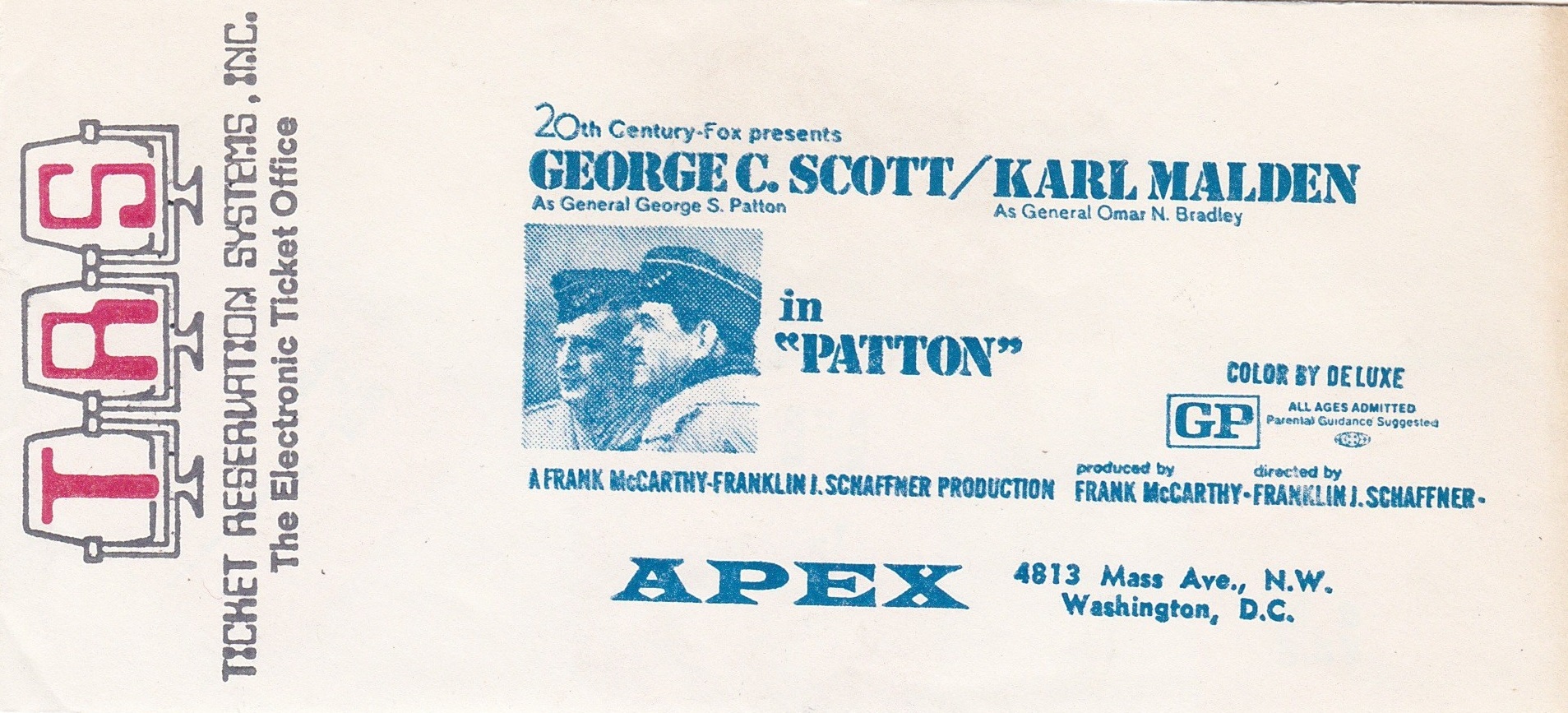
(actual ticket to a Washington, D.C. showing of the movie found in my father’s dresser drawer)

The quintessential biopic, Patton (which was co-written by Francis Ford Coppola) gets everything right.   Let me count the ways

It is content to present its subject without the context of some anachronistic cause. In Coppola’s hands, Patton is not emblematic of something larger and more ominous or glorious, be it the hubris of American imperialism, the degradation of war, blah blah blah. He is a flesh-and-bones person who grafted himself onto and shaped one of history’s more momentous times.

It is nuanced. Coppola never lets you get comfortable with Patton and by the end of the film, you remain torn as to the sum of his virtues and vices, which is so much more interesting than the hagiographies or hit jobs we see so often today.

It’s largely composed of true events. Patton did say the outrageous things attributed to him (if not in the form presented by the film), and he was every bit the preening ass and decisive, bold general portrayed in the film. The two incidents where Patton slaps soldiers are condensed into one, and Patton is given too much of a role in the plan to invade Sicily, but otherwise, the picture hews closely to history without becoming tedious. Most historical criticisms of the film zero in on what it doesn’t depict (much as with American Sniper), which is a legitimate criticism only if you give credence to the “I would have done it this way” school.  When it does take poetic license, it comports with other established facts. Patton did not shoot his pistol at attacking German aircraft, but the attack occurred just as he was berating the Brits for failure to provide air cover, and Patton’s risky bravado in the face of enemy fire was legendary. Patton did not shoot mules blocking a convoy, but he did order them shot and their cart dumped into the river.  Patton did not tell a British general that he had been in a battle centuries old, but he was a strong believer in reincarnation.  Indeed, he wrote a poem in 1922, “Through A Glass Darkly”, a stanza of which reveals his inclination:

Perhaps I stabbed our Savior
In His sacred helpless side.
Yet I’ve called His name in blessing
When in after times I died.

Patton is also noteworthy because the actor playing the subject gives a commanding performance. George C. Scott reportedly made a determined study of General Patton and by most accounts, captured him (save for Patton’s higher pitched voice). Incredibly, Rod Steiger, Lee Marvin, Robert Mitchum and Burt Lancaster all turned down the lead role.

It also looks authentic, in large part, because the producers rented out WWII-era materiel that had been sold to Spain and largely filmed the picture there.  Obviously, shortcuts were made (the Spaniards didn’t have a passel full of Tiger tanks), but director Franklin Schaffner (Planet of the Apes) does great work with what he has in terms of equipment and locale.

Finally, what a Jerry Goldsmith score.

The movie won 7 Oscars, including Best Picture, Best Actor, and Best Original Screenplay and sits at #89 in AFI’s top 100 films.

image

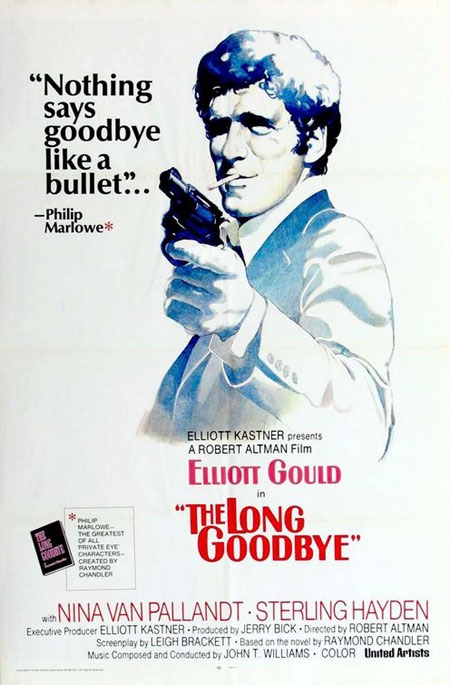
Robert Altman’s Phillip Marlowe (Elliot Gould) isn’t a hard-bitten cynic but rather, a seemingly scattered, chain-smoking hippie in a suit (his mantra? “it’s okay with me”), as bemused by the conservative cops who roughly bring him in for questioning (“Someday all the pigs are gonna’ be in here and all the people are gonna’ be out there. You can bet on that. You’re not in here. It’s just your body”) as the perpetually stoned yoga nudists who are his neighbors (“They’re not even there. It’s okay with me”). The truth is that much is decidedly not okay with Marlowe, in particular, his being used by old friend Terry Lennox (former NY Yankee pitcher and baseball whistleblower Jim Bouton) after the mysterious death of Lennox’s wife.  As Marlowe floats through a Los Angeles that feels desolate and burnt out, he moves closer and closer to the truth, navigating the authorities, hangers-on and brutes while standing by his friend.

Mark Rydell, who later became a decent director (Cinderella Liberty, On Golden Pond), stands out as a particularly chilling gangster who peppers his threats with loopy new age nonsense and boasts about his physical fitness regimen and the fact he lives near Nixon.

Altman and screenwriter Leigh Brackett aggressively revamp the source material, but Marlowe is still Chandler’s in many ways.  He needles the cops (“Is this where I’m supposed to say, ‘What’s all this about?’ and he says, ‘Shut up! I ask the questions’?”), can shake from his seeming fog to register a keen read on the situation, and when he arrives at the end of the journey, he is all Chandler’s Marlowe, with his own unyielding code.

Critic David Ehrenstein once told me that The Long Goodbye “was” Los Angeles and while the film doesn’t figure prominently in Los Angeles Plays Itself, it’s hard to argue it doesn’t have Hollywood in its marrow. Movie memorabilia can be found in Marlowe’s otherwise bare bones apartment (which was just recently available for rent), presumably from a prior occupant.  The security guard at a gated ocean community specializes in impressions, from Barbra Stanwyck to Jimmy Stewart to Walter Brennan.  The score is some version of the torch song “The Long Goodbye”, be it Muzak in a supermarket or a cocktail lounge piano number, the same ditty re-packaged as only Hollywood can.  Son of Old Hollywood Robert Carradine shows up as a jailhouse prophet and Altman exhibits prescience in his casting of Arnold Schwarzenegger as a mute thug.  LA itself seems an otherworldy ghost town, where everything seem to be trying to pass as a facsimile of the real thing.  As Ehrenstein noted, “Back then the city was a sprawling, sleepy, empty place — Altman’s The Long Goodbye capturing its ultra-casual look and feel perfectly.  ‘But there’s nothing there,” my east coast friends would say”).

This is a seminal picture, and a prime example of reinventing a genre.

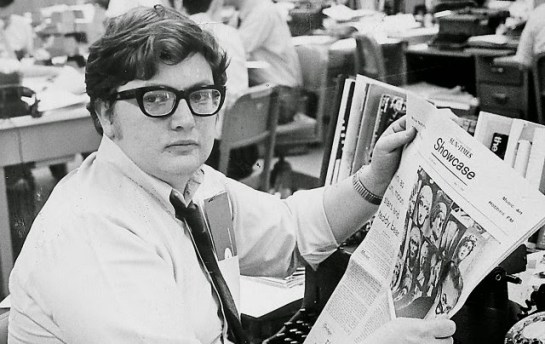
What stands out in Steve James’ engrossing documentary on Roger Ebert is not so much Ebert’s skill and status as a movie reviewer, but his absolute love of life.  It appears Ebert almost fell into his craft, found he had a knack for it (so much so he was awarded a Pulitzer), and thereafter, became a cultural icon, along with “frienemy” Gene Siskel, changing the way film criticism was perceived both by the public and Hollywood.  But when we are introduced to Ebert, he is in the midst of yet another of his trying medical travails near the end. Cancer has robbed him of his jaw (and, cruelly, his ability to speak), but he types ferociously and utilizes a voice-activated program to communicate.  And the prominent feature of his personality is not intellectual or esoteric; it is a lust for people and ideas.

We learn Ebert was a wunderkind college editor, then a hard-drinking Chicago newspaperman who swore off booze after one-too-many benders in his 30s, finding love in his 50s with a woman who already had children.  Ebert is also revealed as a know-it-all and, at times, petulant and self-important.  As James’s demonstrates, he was also a caring man, one whose passion was broad enough to encompass not only cinema but simple discussion and engagement.

Ebert has never been my favorite reviewer simply because I found him so mercurial, one moment intolerant of the offbeat, another celebrating it; I was looking for standards and signposts, and he wouldn’t oblige. But his best reviews were such a mix of accessible, earthy and honest, my expectations were unrealistic. Ebert could also smell a rat, and he had no problem going against the grain. Take, for example, his review of the highly touted anti-Vietnam War documentary Hearts and Minds, a celebrated work that greatly influenced documentary filmmaking. Ebert grants the film its due, but his caution, in 1974, is prescient:

My problem in writing about “Hearts and Minds” is how to go about separating the film’s images — which are sometimes heartbreakingly tragic, sometimes cruelly revealing — from the craft of the film itself. Here is a documentary about Vietnam that doesn’t really level with us on a simple technical level. If we know something about how footage is obtained and how editing can make points, it sometimes looks like propaganda, using such standard tricks as the juxtaposition of carefully selected but unrelated material to create a desired effect. And yet, in scene after scene, the raw material itself is so devastating that it brushes the tricks aside. . . The problem is that the film is at such pains to make its points that it doesn’t trust us to find our own connections. We see a tearful graveside scene in North Vietnam, for example, with a widow trying to throw herself onto her husband’s coffin, and then we get Westmoreland soberly explaining that Orientals don’t place a high value on life. In this and his other comments about what he calls “the Oriental philosophy,” Westmoreland comes over as not only racist and stupid, but incredibly lacking in awareness of how his remarks will sound. This man ran a war for years in a country he didn’t begin to understand. And yet placing these two pieces of film together — and the editing in “Hearts and Minds” consistently makes similar matches — finally only undermines the film’s effectiveness. It’s too heavy-handed. We’re bludgeoned by the point of view, we don’t like the feeling of manipulation we get. Yet there are scenes here of incredible power, even for a nation which watched this war on television every evening.

James’ documentary also shows Ebert to be the kindest and most giving of mentors and friends, which reminds me of Will Leitch’s piece on Ebert upon his death.  Leitch had edited the same college newspaper as Ebert, and Ebert’s generosity to him was astounding:

Because I was 19, I took this as an invitation to keep bothering Ebert, and over the next two years, I emailed him regularly, with questions about my career, with movie reviews I’d written and hoped he would offer tips on, with requests for advice on writing, on life, on the tough job market that awaited me upon graduation. Ebert wrote back to every single one, with lengthy and heartfelt missives that were far more than a snot-nosed kid clearly getting off on Knowing Roger Ebert deserved. I have no idea why he did it. He told me “that this is important to you as it is, that’s a very large percentage of what you need, really.” He emphasized that such ephemera like “career” and “success” were mostly beside the point. “Just write, get better, keep writing, keep getting better. It’s the only thing you can control.”

Ebert even recommended me for a job stringing movie reviews for the suburban Daily Southtown newspaper. For the first one — the Robert Downey Jr. movie Restoration — I borrowed my friend Mike’s car and drove up to a Chicago screening room. I didn’t know Chicago well and of course got lost, just sneaking into the theater right as the lights were going down. After the movie, I walked out to the elevator, and standing there, was Ebert.

“Sir,” I said, talking very fast. “I’m Will Leitch, from the DI. I wanted to thank you and say what an honor it is to me. I can’t thank you enough for what you’ve done. I promise not to abuse it.”

Ebert was bigger then, and his hand was meaty and sweaty.

“Of course, Will, I’m happy to help you in any way. You have talent, and anyone from the DI is a friend of mine,” he said. “Actually, I’m going to be in Champaign in a few weeks for a screening at the New Art, and I’d love to meet with you and some of the staff beforehand. Is Papa Del’s still open?”

Two weeks later, Ebert was entertaining me, my friend Mike and a few select editors — the fight to be included at the dinner was fierce and still angers some today — at Papa Del’s. (We had four pizzas, and Ebert ate 1 1/2 of them.) He took our questions, we talked about journalism and movies (he and I had a fierce debate as to whether or not Harry Connick Jr. was in the Holly Hunter movie Copycat: I was right, though nobody had an iPhone to prove it at the time), and he told us stories about the old days without ever romanticizing his good old days at the expense of ours. He was not Roger Ebert, the guy on television. He was just the fun guy eating pizza, dishing about Gene Siskel — he absolutely could not understand how that man could care so much about the Chicago Bulls, a stupid sports team — and having a grand time. We sat there for three hours. None of us wanted to leave, including him.

At the end of the night, Ebert took me aside. “I understand it’s your birthday tomorrow, Will,” he said. (It was. I was turning 20.) “Well, I have a gift for you. It’s a scoop. You can run it in the paper tomorrow. I received a print of a movie that’s not out yet to show at the theater tomorrow. You can have the exclusive: It’s Mighty Aphrodite, the new Woody Allen film.”

Yet, as Leitch shamefully admits, with the web exploding, “we [were] young turks . . . ready to kill our idols . . . we all thought we were hot shit.” In that vein, Leitch later wrote a piece for the web magazine Ironminds entitled, “I Am Sick Of Roger Ebert’s Fat F—-ing Face”, the thesis of the piece being that Ebert’s TV work was hurting his writing (with a few fat jibes included).

Ebert’s response, and his later correspondence with Leitch, is an epitaph to which we all should aspire:

Will —

I have always tried to help you, and you know that. I am not sure what you were trying to do with your piece — if you object to me being on television, there is a dial to the right that will take care of that problem for you — what issues you might be dealing with, but I am certain you will grow to regret writing it someday. If you were trying to make a point, I fear you are not in control of your instrument. I wonder if you feel shitty this morning, now that that piece is out there. I know that I do.

RE

Leitch wrote him back, completely backing down, apologizing, but the damage obviously had been done. I did feel shitty, instantly, and have ever since. A year later, I was working for Brill’s Content’s All-Star Newspaper . . . where I ran an early incarnation of a blog, linking to the best newspaper writers in the country every morning. As the job required me to do with all the writers we selected, I sheepishly emailed Ebert to tell him he was on the roster. He wrote back:

Does this mean you’re no longer sick of my fat fucking face? 🙂

It’s an honor. I hope you’re well.

RE

(Available on Netflix streaming)

Nick Broomfield’s (Kurt and Courtney, Battle for Haditha) documentary for HBO is a must-see for several reasons. First and foremost, I had no idea we had a modern serial killer of historical proportions in South Central Los Angeles, a killer of dozens and possibly over a hundred women over a 20 year period beginning in the 1980s. That, of course, is a large point of the story. Broomfield does an effective job of demonstrating that the dispossession of the citizens in that part of LA, coupled with the carnage occurring with the rise of crack cocaine, rendered the murders and disappearances of “crack whores” a rather low priority. After all, a majority of the women killed by local stolen car fixer and semi-strong man Lonnie David Franklin were likely lured to their deaths by the offer of drugs-for-sex, most meeting their ignominious ends in a camper parked at the back of his house.  I couldn’t shake wondering as to the numbers Jack the Ripper could have amassed if he’d kept to his Spitalfields hunting grounds and refrained from corresponding with the police.

The documentary is less an indictment of the police and government officials, who, when in “no comment” mode, always seem guiltier, than a singularly brave exploration of the urban condition in a rotted corner of the city. Broomfield, a Brit, is one of at least two white men poking their cameras in an area where white men generally fear to tread, and his endeavor results in incredibly revelatory footage. Franklin’s pals at first proclaim his innocence (he was set up by the cops, they swear), but as Broomfield spends more time with them, two open up, explaining that Franklin was indeed a suspicious character and that they were even involved in his kinks, so much so that they traded pictures of the naked street girls they photographed, almost as if in a local snapshot club. They were happy to party with the man, even if he was a brutal beast who preyed upon the addictions of so many street walkers. In this, Broomfield reveals that the neighborhood itself could be as blasé’ about the women as the authorities.  But he also captures the pain and regret of one friend, for whom the “hey, I didn’t know he was killing them after I left” explanation no longer fully suffices.

Broomfield also hits documentarian gold when he hooks up with a former crack addict/prostitute – Pam – who shepherds him through the dangerous streets, always introducing the crew to the locals as her “friends from England.” Her efforts actually lead the crew to women deemed “missing” by the LAPD after Franklin’s arrest (Franklin’s penchant for photography resulted in a 200+ picture sheet):

Pam’s tour of the neighborhood shows the depths of its depravity at its worst, but she has survived, now clean and out of the game, and there is fundamental decency about her, though encased in the hardest of shells, that is riveting.

Franklin goes to trial this summer.  Definitely catch this before you start reading about the case.

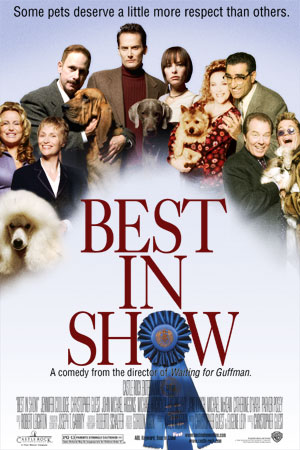
I caught this the other night and of the mockumentary films written and/or directed by Christopher Guest – This is Spinal Tap, Waiting for Guffman, A Mighty Wind, For Your Consideration – this is my favorite.  Perhaps not coincidentally, it’s also the sweetest on its subjects, an assortment of purebread dog owners who are competing at The Mayflower Kennel Club Show.  Catherine O’Hara and Eugene Levy stand out as the impoverished Florida couple who, unfortunately for Levy, run into O’Hara’s old lovers on their way north, but Jane Lynch shines as a driven, lesbian handler who has found a Sugar Mommy (Jennifer Coolidge) to fund her efforts, as well as the magazine American Bitch (“it’s a focus on the issues of the lesbian pure bred dog owner”).

But Fred Willard, as the disinterested but garrulous TV announcer, and Jim Piddick, who has to suffer him, steal the picture.

image

J.C. Shandor wrote and directed my favorite film of 2011, Margin Call, a verbose, intricate “what if?” financial thriller set before the crash of 2008. Last year, Shandor made the critically acclaimed All is Lost, a tale of survival on the sea starring Robert Redford and featuring a script of a mere 31 pages (it is now on Netflix streaming but I’ve neglected to see it). If there was any doubt, Shandor’s third film cements that he has no interest in doing the same thing again.  A Most Violent Year is the anti-crime picture, a meticulous thriller set in the suburbs of 1981 New York City revolving around the intricacies and corruption of . . . the home heating oil business. Oscar Isaac and Jessica Chastain are a married couple working to expand their reach in the business, in the face of union troubles, a prosecutor’s investigation, the hijacking of their trucks and the intimidation of their sales force. Isaac, an immigrant, is resolute in combating these obstacles in a legal and above-board manner. Chastain is the daughter of a mob boss, and her fealty to the straight-and-narrow is less stringent. As the screws turn, you think you can see where this is going.  You’re wrong.

Chandor’s medium cool meditation emphasizes Isaac’s passion, ethics, and larger vision and while the stakes are small in the scheme of things, to Isaac, they are everything, and Shandor effectively invests the audience in his struggle without infusing the narrative with the expected fleshy, pulpy, satisfying retributive violence. I’ll admit:  bloodletting is what I wanted and expected and as the tension mounted, Chandor’s resolution felt unsatisfying. In that way, Chandor transforms the genre.

This is an ingenious, unique movie.  Chandor’s feel for 80s New York is sharp, his pacing is tight and he never veers far from the heart of the picture, the unswerving devotion of Isaac and Chastain to their business and to each other. Their performances are riveting; they feel like a married couple who melded passionately but never addressed longstanding disputes in their view of the world.  Like a real married couple.

One of the best of the year.

image

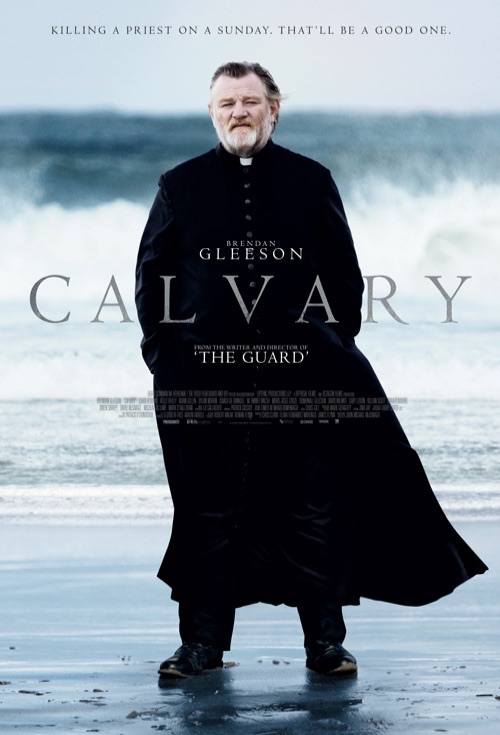
John Michael McDonagh’s The Guard was one of the best films of 2011, a sharp, wry, talky culture clash comedy that pitted straight laced federal agent Don Cheadle against the blustering, Irish provocateur Brendan Gleeson. In Calvary, Gleeson is again McDonagh’s center as a Catholic priest tending to an Irish seaside community. The film opens in the confessional, with a man telling Gleeson that in 7 days time, he will meet him on the beach and murder him. What follows is a depiction of Gleeson’s role in a town in transition culturally, economically and spiritually, where Gleeson’s faith is tested time and time again. McDonagh has crafted a compelling parable, deep with import.  It also stands as one of the few films that conveys the centrality of religion in a particular modern locale (The Apostle comes to mind but that was set in the American South, which is in many ways archaic)Yet, as much as the film is steeped in the story of the New Testament, it is thoroughly modern, as Gleeson is mocked, goaded and pitied by a flock that considers him a joke from days gone past yet are drawn to his authority and the promise of understanding and guidance.

This sounds very heavy and yet, McDonagh’s strength is his keen grasp of the unique Irish patter, with its unyielding thrust and parry.  The dialogue is razor sharp and bitingly funny, and when these characters get past the language that insulates them, an almost national dialogue, revelation of their pain is truly moving.  One of the best of the year, and while the crimes of the Academy are many, the omission of Gleeson and the screenplay for nominations is, keeping in a religious vein, an abomination.

image

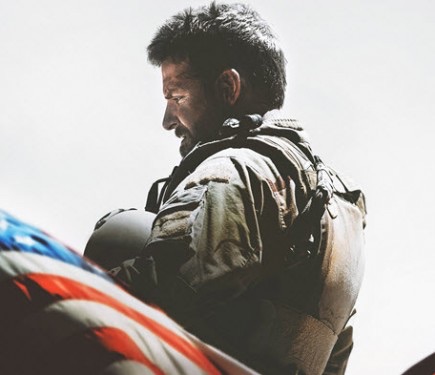
American Sniper is a spellbinding war film. Clint Eastwood conveys the simplicity of patriotism, the horror of war and its psychological toll when it is concluded, and the ambiguity of heroism, all encapsulated in a riveting re-creation of combat during the second Iraq War.  Bradley Cooper is the perfect vessel for Eastwood’s tale. As sniper Chris Kyle, Cooper projects a forthright assuredness that, as he is tested, wears down, not in the expected emotional breakdown or the hackneyed apologia and rejection of values, but physically, in the narrowing of his eyes, the long stare, the suspicion with which he greets even the most unthreatening of domestic events. It’s a haunting, restrained performance, completely at odds with Cooper’s manic turns in Silver Linings Playbook and American Hustle, and beautifully in tune with Eastwood’s anti-war, yet very much a war movie (the combat sequences are expert; in particular, a closing battle that Eastwood makes cogent and gripping even though the combatants are enveloped in a sand storm).

The picture is one of the most successful of the year, predictably eliciting a tired cultural debate as to its politics and its accuracy. The film’s political offense can be found in its marrow. There is no defense of the Iraq War.  There is no suggestion that the endeavor was worthy or advisable and the events depicted suggest otherwise.  Kyle’s own brother, while shipping out, looks hollow, telling Kyle “fuck this place” and Kyle’s first kills are regrettably a child and his mother. Ty Burr’s conclusion that it is a “tragedy in which American certainty comes to grief against the rocks of the real world, and it views its central figure as a decent man doing indecent things for what he keeps telling himself is a greater good” is perfectly defensible.

But Kyle is a Texan from a churchgoing family. His father teaches him to hunt and to be violent in defense of those who are weaker. Kyle is called to duty by the terrorism of the 90s and beyond, and he builds the rapport of the soldier with his fellow Seals, with all the machismo, camaraderie and xenophobia that entails. He is a patriot, unyielding in his views toward his country and his fellow soldiers. And that is one noxious stew for certain quarters. Hence the sniggering of Seth Rogen, Michael Moore, and Bill Maher, comfortable in their condescension and elevated station. When Howard Dean (who did his Vietnam tour in the snows of Killington) attributed the film’s success to anger and the Tea Party, he conveyed two certainties: he had not seen the film but he had read and heard a lot about it from like minded folk.  When dolts aren’t taking potshots at the culture Eastwood presents, others decry its lack of context, nothing more than the idiocy directed at Zero Dark Thirty, which ostensibly failed because it omitted the Surgeon General’s warning, “Torture is bad and no valuable intel ever came from it.”

The other controversy has centered on the picture’s accuracy. In a year when Selma took flak for creation of an LBJ-Hoover conspiracy to get Martin Luther King, it’s fair to expose American Sniper to some rigor. But as Slate‘s Courtney Duckworth points out, while Kyle may have been a fabulist in other areas of his life (Kyle, who embraced celebrity, said he killed two carjackers in Texas, sniped looters during Hurricane Katrina, and punched Jesse Ventura in the face), “more than any other strategy, omission keeps the film true to life.” Generally, what Eastwood filmed was true to Kyle’s memoir, though that truth was often subject to standard massaging and embellishment (a cell phone call to his wife mid combat, creation of one bad guy and expanded dramatization of another).  The truth is incredible enough:  over 250 kills, and survival of four tours, three gunshot wounds, two helicopter crashes, six IED attacks and numerous surgeries.

Instead of training in on the accuracy of what Eastwood depicts, there seems to be an expectation that Kyle as blowhard should have been plumbed.  I’m not sure how that would have worked thematically, and it could really only be justified as a caution about the wartime events he wrote about.  I have not read anything that suggests Kyle’s telling of that part of his life is assailable, so it would be like injecting JFK’s serial adultery into a Cuban Missile Crisis flick – enjoyable for those prone to  dislike Kennedy but otherwise awkward and misplaced.


image

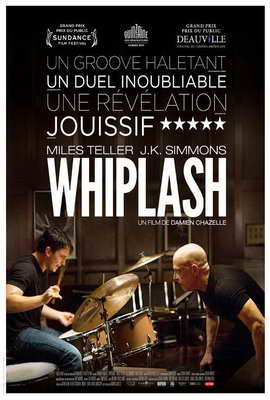
The best film in what has been a very strong year, writer-director Damien Chazell’s story of a 19-year-old jazz drummer (Miles Teller) and his relationship with his driven jazz teacher, played by J.K. Simmons, is flawlessly delivered and thought-provoking. Teller aspires to be the next Buddy Rich, and matriculates at the best music school in the country.  Simmons chooses him to join his ensemble, a stepping stone to greatness but also, an invitation to the meat grinder of abuse handed out by the demanding, mercurial instructor.

The story avoids every pitfall and expected plot turn of a feature film, yet it is not contrary for the sake of it. You can count on two hands the places a more pedestrian picture would take you, and the resolutions it would offer, but in service of a better narrative, Whiplash rejects the certainty of the tried and true, instead allowing the audience to come to their own conclusions.

The film is also about something, exploring the nature of greatness and what is necessary to achieve it; the limits of drive and the intersection of ego and cause; the meaning of teaching; and the changes and struggles between nature and nurture, raising children, molding character and demanding perfection. At one point, Simmons remarks, “There are no two words in the English language more harmful than good job,” and while that may play well to the instincts of some, he is such a flawed deliverer of the message, the audience is forced to question such an ethos knowing it will be practiced by such people.  I saw the film with my wife, my college-age daughter, and my high school-age son, and we talked about it – and I’m confident will continue to do so – for some time.

The film is evenhanded, a trait best represented in its depiction of minor characters. In a family dinner scene, Teller’s family, who appear casually condescending towards his achievements, are also perfectly decent, pushing back at his obnoxious “tortured artist” routine with annoyance but also concern and patience.  When Teller is approached by an attorney who represents a student allegedly harmed by Simmons’ practices, she does not lick her chops.

The picture is also stunningly confident, an achievement made even more impressive by its 19 day shooting schedule and $3.1 million budget.  Clint Eastwood released a film about music earlier this year, and he should have consulted Chazell about how to make Jersey Boys less static, less turgid. Whiplash is loaded with musical numbers played by stationary figures, but the camera riffs along with notes, constantly in motion, and like the art form it dramatizes, it is inventive and surprising.

I can’t commend the performances of Teller and Simmons enough.  They are both entirely natural and convincing, Teller conveying the conflicting hubris and hesitation of an ambitious yet shy young man, Simmons the grandiosity and brutality of the committed, brilliant instructor, inspiring one minute, petty the next.

Finally, Chazell has done something that is very rare in film. I suppose there are some folks who see Gladiator and think, “Hmmm. Roman history looks interesting. I might take a look into that.” But not many. Conversely, by his own depiction of the music, and the dramatization of love for it through the eyes of Teller and Simmons, I’m confident that many people who see Whiplash will one day look back at it as their entrée to jazz. That may be my enthusiasm for the picture talking (I’m not a jazz enthusiast myself), but I’m sticking with it.


There is trouble in the North Pole. Santa (Jim Broadbent) is listless and bored, barely phoning it in.  His oldest son and heir (Hugh Laurie) has digitized and corporatized Christmas, while his predecessor (Bill Nighy), retired, undermines him at every turn, dreaming of a return to glory.  His youngest son (James MacAvoy) has the spirit but lacks any discernible skill. When a gift from Santa goes undelivered, the fissures of this dysfunctional royal family emerge.

The computer animation is expert, the story enjoyable for kids and adults alike, and it’s even slyly subversive.  Santa Nighy is a misogynist, Laurie’s male elf assistant appears to have a crush on him, and the elves who man the North Pole have a denizen-of-Jonestown quality (so much so that the film threatens a mass elf suicide at the end).