
Archive

4 stars

Image result for reservoir dogs

\Quentin Tarantino’s debut picture has weaknesses, and it is in some ways showing its age, but many of the things that are good about it remain very good. The dialogue remains vivid, fetishizing pop-culture via tough guy patter. The conversations are irresistible, trading in on the vulgar, racist, homophobic pitch-and-catch of the red-blooded American male killer. Tarantino’s explanation of “Like a Virgin” (“It’s all about this cooze who’s a regular fuck machine, I’m talking morning, day, night, afternoon, dick, dick, dick, dick, dick, dick, dick, dick, dick”); Steve Buscemi’s theory on tipping; the back-and-forth “he’s trying to fuck me in front of my Daddy” between Chris Penn and Michael Madsen – it all crackles.

The machismo is undercut, however, when they get their aliases:

MR. PINK
Why am I Mr. Pink?

JOE
Because you’re a faggot, all right?

(Mr Brown laughs, Mr Blonde smiles)

MR. PINK
Why can’t we pick our own colors?

JOE
No way, no way. Tried it once, it doesn’t work. You get four guys all fighting over who’s gonna be Mr. Black. But they don’t know each other, so nobody wants to back down. No way, I pick. You’re Mr. Pink. Be thankful you’re not Mr. Yellow.

MR. BROWN
Yeah, but Mr. Brown, that’s a little too close to Mr. Shit.

MR. PINK
Mr. Pink sounds like Mr. Pussy. How about if i’m Mr. Purple? That sounds good to me. I’ll be Mr. Purple.

JOE
You’re not Mr. Purple. Some guy on some other job is Mr. Purple. You’re Mr. Pink.

MR. WHITE
Who cares what your name is?

MR. PINK
Yeah, that’s easy for you to say. You’re Mr. White. You have a cool sounding name. All right look, if it’s no big deal to be Mr. Pink, you wanna trade?

JOE
Hey, nobody’s trading with anybody. This ain’t a goddamn fucking city council meeting, you know. Now listen up, Mr. Pink. There’s two ways you can go on this job– my way or the highway. Now what’s it going to be, Mr. Pink?

MR. PINK
Jesus christ. Fucking forget about it. It’s beneath me. I’m Mr. Pink. Let’s move on.

The dialogue is even given its own soundtrack; Steven Wright’s droning as the “Super Sounds of the 70s” dee jay is our comic relief.

Until Gerry Rafferty’s “Stuck in the Middle With You” accompanying a torture becomes one of the scarier songs ever.

Tarantino also does so much with very little. No big action sequences. No big money.  Economical and still impressive.

Two things I didn’t like about the film. First,

You’re not to make a move till Joe Cabot shows up. I was sent in to get him. All right? Now you heard me. They said he’s on his way. Don’t pussy out on me now, Marvin. We’re just going to sit here and bleed till Joe Cabot sticks his fucking head through that door.

The idea that the cops are parked around the corner a block away waiting for mastermind Joe Cabot while two of their own are in the place as hostages (one actually dying, one being mutilated) is absurd.

Second, Tim Roth was bad. He was fighting his accent and he lost. I never bought him. Still don’t.

The Good Girl. Mike White and Miguel Arteta’s Chuck and Buck was a creepy, human story about the loneliness of a boy whose development is arrested by his mother, unfortunately, at the moment he had sex with his childhood pal. When the mother dies, Buck goes to the only other person he’s ever loved, the now grown-up neighbor boy (Chuck) who lives in LA. In The Good Girl, White’s protagonist, small town Texas sales girl Jennifer Aniston, evinces a desolation that is more pronounced. She tells us of her misery, her dead-end job, her stoner but loveable galoot of a husband, her inability to get pregnant, in voice-over. However, she too must decide if and where to go. The story is about Aniston confronting, as opposed to overcoming her surroundings, and making non-Hollywood compromises in the end. The film has several things going for it: Aniston is cooly effective; she alternates between wily/selfish and lost/depressed very well. John C. Reilly (the galoot), Jake Gyllenhaal, and Tim Blake Nelson play the men in her life, and they’re all distinctive and even soulful. Better, The Good Girl neither sanctifies or lampoons small town America. There are things to laugh at, but White writes each of his characters (including his own Bible-reading session advocating security guard) with dignity. No one is sneering, but John Mellencamp’s “Small Town” is not assaulting our sensibilities either. What I liked most was the languid pace (others may find it too sluggish) and its lack of easy, pat lesson.

Barbershop is It’s a Wonderful Life updated to modern-day Chicago and with bawdy humor and black people. This is a sharp, feel-good, ultimately sweet movie about tradition and honor and community, yet it never elevates the sermon over the humor and the story, nor does it ever get dour, trying to tackle the “bigger” issues. Very easy to watch, many solid laughs (Cedric the Entertainer as a conservative barber delivers material so priceless that Jesse Jackson mau-mau’ed the producers into an apology). The best thing about Barbershop is that it is a “black” movie, as opposed to a black movie. Like Baby Boy (a film that proved John Singleton had actually grown up), Barbershop makes very critical, non-p.c. observations all in the aid of the joke. Thankfully, however, Lawrence Fishburne is not wheeled in to lecture the barbershop about the white dominant culture or how brothers need to stay with their woman.

Cedric the Entertainer’s best line?

Jesse Jackson? Jesse Jackson? Fu** Jesse Jackson!

It’s all in the delivery.

The Emperor’s New Clothes. A real find with a great concept. Napolean (Ian Holm) sits on St. Helena, but makes his escape to reclaim his Empire by use of the services of a look-alike. The plan: Napolean gets to France, the double declares himself a fake, and Napolean stirs the national passions to his rise once again. Needless to say, things don’t work out that way, and Napolean has to get himself a real job. Holm is pitch perfect. The picture is well-paced and a lot of fun.

Scarface travels well and survives the excesses of Al Pacino and the 80s Vision Quest/Flashdance/Top Gun cheeseball musical interludes (as Tony Montana’s crime empire grows, we are treated to a flashy 80s number, “Push it to the Limit” by the estimable Paul Engemann). The plot is simple. Cuban Marielitos (Pacino and Steven Bauer) come to Miami, work their way up the drug trade, do too much blow, and flame out. Scarface is an exercise in excess equal to the appetites of its characters. Pacino’s performance is gruesomely cartoonish, the violence is extreme, and DePalma lovingly lingers on each grisly moment.

The film is also very funny, not as camp, but intentionally so. DePalma does what David Chase does with Tony Soprano on HBO – he shoves Tony’s barbarism in your face, but he surrounds Tony with even more despicable characters, so you can root for him. Oliver Stone’s script loads Tony up with his own set of Harry Callahan one-liners. When his one-time boss, Robert Loggia, begs for his life, Tony leans down and says “I not gonna’ kill you.” As Loggia kisses Tony’s feet and thanks him, Tony turns to Bauer and says “Shoot this fu**ing cock-a-roach.” It’s a funny moment. Later, Harris Yulin, the corrupt Miami cop, takes one in the gut from Tony and he’s stunned. “You can’t shoot a cop,” he says, as he looks at the hole in his belly. But then he puts his hand up, and screams “Wait!” I love that moment. He’s still in the game. He thinks he can still make a deal. And as Tony becomes more powerful and self-pitying, he announces himself with “Make way for the bad guy.”

Scarface is also very effective at creating tension. Scene after scene ratchet up a fair amount of dread, from Tony’s favor knifing in a Miami holding area; to the botched drug transfer, where Tony’s compadre is chopped up with a chainsaw; to an unsuccessful nightclub hit on Tony, to Loggia’s murder. The doomed love story between Bauer and Tony’s sister, Mary Elizabeth Mastrantonio, also works. They seem to have a real affection for each other, and while you may root for Tony with guilt, you really like Bauer, who seems a very sweet thug. It’s also good to see Pacino, F. Murray Abraham, Mastrantonio and Loggia taking a stab at Cuban. They all come out with a different interpretation. The ending is giddy and ridiculous. Tony has become a coked out Superman. As assasins swarm over his estate like . . . well, like cock-a-roaches, he emerges from a pile of blow to kill almost all of them, with a very big gun.

Atlantis: The Lost Empire.  I thought this was a good, very unique Disney movie.  A different style of animation, a little darker, tons of violence, with deaths in the hundreds (and a funeral to boot), and more than a little sex appeal.

It probably bombed because no animals talked and no heart-strings were tugged.  It did drag a little, but picked up quickly, and my only real complaint is that Michael J. Fox’s gee-willickers voice is grating.

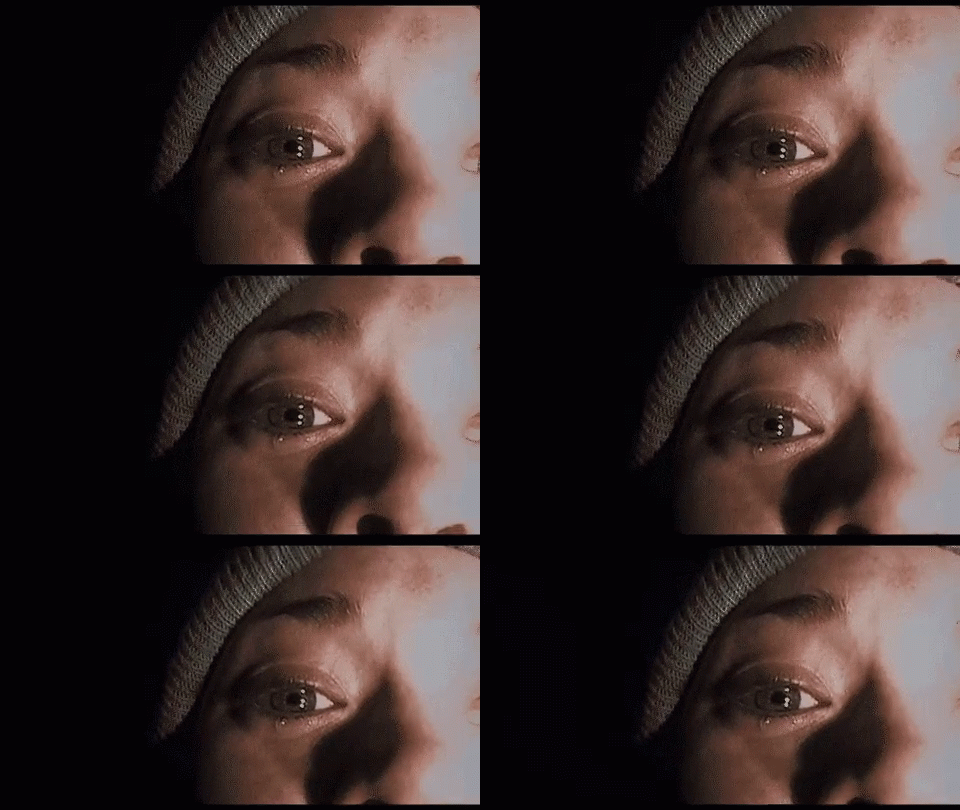
Blair Witch Cry GIF - Blair Witch Cry Scared - Discover & Share GIFs
Three student filmmakers are on the hunt in the woods of Maryland for a legendary evil that may or may not have murdered seven children and five men in the 1940s. They become lost.  Their footage – the film – is found.

The introduction – as the kids meet and speak with the townsfolk to unearth the mystery – is clever and utilitarian.  The snippets of information given during these mostly humorous encounters are valuable, and the interviews are indistinguishable from any conversation you might have with a resident of a small Maryland town.

When the trio move from the town to the woods, in search of the sites of the murders, make no mistake, it is horrifying.  And not in the Kevin Williamson “tongue-in-cheek, stylish and ironic” sense.  It is not violent, nor gross, but bare-bones and primal.  They are hopelessly lost.  They begin to break down. Something is tracking them.  Your vantage point is their clumsy vantage point, through the eyes of a film and a video camera.

The reviews of the film state that the actors were given minimal training with film and video cameras, and then they were let loose to act spontaneously along the lines of the plot.  This may or may not be true, but either way, all three actors convey realism, and the camera-work (well edited) intensifies the terror.

I also thought about this film more than I expected to.  One scene in particular, where the female filmmaker films an apology to her parents and the mothers of her two companions – runs your blood cold.  It stuck with me, because the actress seemed so bare and alone.

Finally, the ending scene is one of the most gripping I’ve ever seen.  Through quick visuals (in a dark melee) much is revealed that stitches The Blair Witch Project together, proving it not only creepy, but accomplished.

Two personal anecdotes.  Some folks may feel the film stagey because the filmmakers shoot their personal interactions, which obviously helps the plot.  I participated in student films in college, and everything, including banter, tends to get filmed because video costs nothing, the film allotment is free or subject to a huge reduction, college students making films are hopeless hams, and everyone wants to laugh at “The Making of . . . . ”

Second, I went to summer camp in Southern Maryland off the Wicomico River.  Legends abound of witchcraft, strange worship, murder, and the like, in the woods off the camp (the stories were, of course, amplified by sadistic camp counselors ).  That said, you hike too far in any woods an hour outside of Washington, D.C., you can get real lost, real fast.

This film is not for everyone.  Some folks behind me in the theater were exasperated by the hand-held camera (which can make you queasy) and loudly complained, ‘What was the big deal?”  My guess, and it is only a guess, is that they heard the buzz, thought to see the work of young auteurs, and had no idea they were walking into a stripped-down, cleverly realized supernatural Deliverance.

Forgetting Sarah Marshall harmonizes the best of The 40 Year Old Virgin and Knocked Up while jettisoning some of the excesses of the latter.  Jason Segal retreats to Hawaii to get over being dumped by his girlfriend, Sarah, who just happnes to be vacationing at the same resort with her new flame, Brit rock star Aldous Snow (Russell Brand).   All the characters are a scream, from Paul Rudd’s crunchy surf instructor to Bill Hader’s supportive friend, but this is Brand’s movie and he absolutrely kills in every scene.  He’s so good that when he’s not in a scene, the movie can drag a bit.

Sherlock Holmes.  I expected to be underwhelmed and perhaps even dispirited as the Holmes character was “re-envisioned” for a new generation. What a pleasant surprise.  Robert Downey, Jr. and Jude Law are effortless in their banter and prove a great, smart duo (equaling my favorite, Christopher Plummer and James Mason in Murder by Decree).  The story moves, the visuals are impressive.  The weak spot is Rachel McAdams. She’s beautiful and wholly overmatched.  Fortunately, she is required to do little more than fear for her life.

Up in the Air.  Critically acclaimed and rightfully so, Jason Reitman (Juno, Thank You for Smoking) adds to his impressive resume’.  George Clooney is so deft and smart he veers into Cary Grant territory, and when you are looking for sexual chemistry, the definition is Clooney and Vera Farmiga.  The message, about disconnectedness and love, is ready-made for debate over drinks after the movie, while the dialogue and the performances are uniformly crisp.

In a sea of asinine “I always get the bridesmaid dress, I’m a wacky misunderstood gal, hey, there’s my Romeo and whoda’ thunk I fall for such a Neanderthalic misogynist,” Up in the Air is a refreshing comedy about adults.  One other note, in what is becoming a hallmark of Reitman’s, there are 3 or 4 moments in the film where a lesser director or writer might have done something different and more obvious, and it would have been understandable, but Reitman does not and the film is much better for it.

Minor nits – the idea of outsourcing firings to a company specializing in same, including using them in face-to-face “we’re letting you go” encounters, seems contrived, and Anna Kendrick gets by with one too many facial tics (oh, that’s surprise!, of, that’s hurt!).