Archive

4 stars

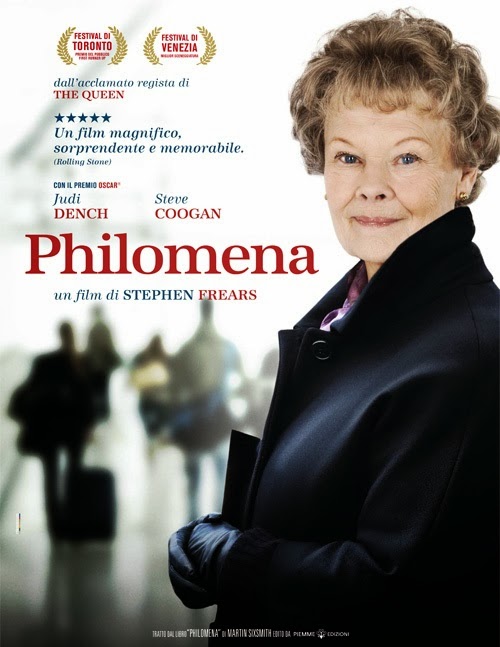
This Oscar nominated film got past me in 2013, and I am all the sorrier for it. Judi Dench is Philomena, a provincial, sweet Irish retiree in London who, living with her adult daughter, reveals a long-hidden secret – that she gave birth to a son in Ireland out of wedlock in the 1950s, and subsequently, was forced into labor in a Catholic abbey as penance while her child was relocated, at a price, to the United States. Philomena’s daughter enlists the assistance of a recently sacked Blair-administration official, Martin Sixsmith (Steve Coogan), who, grudgingly and rather condescendingly takes on her “human interest” story to find her son. What follows is a trip (yes, another Steve Coogan trip movie), first to the abbey, and them after receiving no help there, to America. Along the way, Coogan’s cynicism, self-importance and emptiness tangles with Dench’s faith, sincerity and essential decency.

This is a beautiful, kind-hearted, witty movie. Dench is moving as a mother haunted by the absence of a child she kept firmly in her mind (the nuns at the abbey allowed the shamed mothers to visit their children an hour a day, making their inevitable separation even more traumatic), and Coogan is firmly cold-hearted and self-pitying without being a caricature. Their scenes together are sensitive and comedic without lapsing into treacle or schmaltz, and the impact each has on the other is believable.  My only mild criticisms are a few too-cute moments for Dench and a juiced-up ending, pouring it on the nuns.  While it works dramatically, it paints a picture even the real Philomena was uncomfortable with, and upon reflection, it’s too much (we are provided an evil nun who spits a final rejoinder of, “self-denial and mortification of the flesh is what brings us closer to God. These girls have no one to blame except themselves”).

Nonetheless, this is largely true to the incredible true story, and I can’t recommend it enough.
image

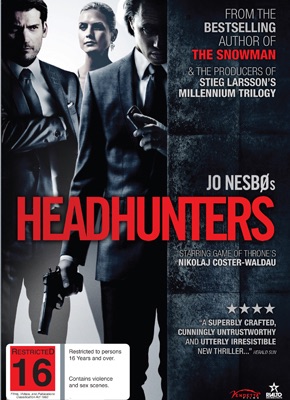
If you want to learn how a little-known director gets a big budget, Oscar-bait vehicle, watch Headhunters, a clever, fast-paced thriller about a corporate recruiter/art thief who gets in over his head financially and otherwise.  An engrossing thrill ride with a “wrong man” Hitchcockian vibe, the film’s only stumble is an overly intricate initial plot device that introduces the protagonist to his tormentor.  Otherwise, this is a cool, steady, occasionally grisly film in the vein of Blood Simple.

Headhunters was a massive success in Norway, which translated to about $14 million foreign but just over a mere million here in the U.S.  Still, Hollywood noticed and selected director Morten Tyldum to helm a picture that had absolutely nothing in common in style, substance, or feel with his breakout movie, the woeful The Imitation GameOf course, that film was nominated for Best Picture, so what do I know.  I just hope Hollywood similarly rewards Jeremey Saulnier (Blue Ruin) and Jennifer Kent (The Babadook).

Available on Netflix streaming.

A hilarious mockumentary done in the style of The Real World and other reality dramatizations of domestic life. Four mates, distinct in style and manner, share a house in Wellington, New Zealand, and a documentary crew shadows them for a period of months to capture their lives. In the style of the genre, we get to witness petty fights about house rules, dirty dishes, who can have friends over and which clubs to frequent on the weekends. The twist is that our flat mates are all vampires of varying ages, and soon, they add a fifth (Nick) to their coterie, which rapidly undoes their dynamic. As the youngest, Nick is my second favorite, simply because he is so enthused by his new powers, repeatedly telling anyone who will listen that he is a vampire. My favorite of the household, however, is the oldest, Petyr, for the obvious reason that he is a Nosferatin curmudgeon who cannot speak and presents a brilliant deadpan:

This is consistently funny, with particularly great bits about the vampires’ fascination with technology and run-ins with self-improving werewolves.

Currently available on Netflix streaming, this almost 3 hour documentary essay presents as both art exhibit and graduate course (it is written and narrated by the sleepy-voiced Thom Anderson, a filmmaker and film theory and history teacher at the California Institute of the Arts).  Los Angeles Plays Itself is textually interesting, the visuals of the city’s depiction in film are always entertaining, and accompanied by Anderson’s incisive narration, often illuminating.

Anderson can also be very funny, in a dry “this is Carlton, your doorman” way. On a scene from Michael Mann’s Heat:  

 [In Heat, Neil McCauley (Robert DeNiro) is briefing two members of his gang. He tells them, “Saint Vincent Thomas Bridge, that’s escape route number one.“]  Vincent Thomas was San Pedro’s representative in the state assembly for many years, but he hasn’t been canonized yet, not even in Pedro.

And on the perpetual destruction of LA in the movies:

Mike Davis has claimed that Hollywood takes a special pleasure in destroying Los Angeles, a guilty pleasure shared by most of its audience. The entire world seems to be rooting for Los Angeles to slide into the Pacific or be swallowed by the San Andreas fault. …In Independence Day, who could identify with the caricatured mob…dancing in idiot ecstasy…to greet the extraterrestrials? There is a comic undertone of ‘good riddance’ when kooks like these are vaporized by the earth’s latest ill-mannered guests.  But to me the casual sacrifice of Paris in Armageddon seems even crasser. Are the French being singled out for punishment because they admire Jerry Lewis too much? Or because they have resisted Hollywood’s cultural imperialism too fervently?

Of course, if you let an academic talk long enough without interruption or query, he’ll eventually meander into overstatement and grandiosity, and as Anderson moves from LA’s history, architecture, sprawl and patterns in film to politics, race and class, we get poetic broadsides, against the cops and the modern Noah Crosses and skyscrapers. This is all part of the condescension of most any “true” city dweller who presumes to know the authentic heart that beats in his city, and for the most part, that’s part of Anderson’s charm.  Anderson has a grievance, as he concedes at the outset:  That’s another presumption of the movies: that everyone in Los Angeles is part of their industry or wants to be. Actually, only one in forty residents of Los Angeles County works in the entertainment industry. But the rest of us simply don’t exist.  We might wonder if the movies have ever really depicted Los Angeles.

But doleful mouthfuls like “White America had declared a crisis of the black family as a cover for its campaign of incremental genocide against its expendable ex-slave population, rendered superfluous by immigrant labor power, so black film-makers responded by emphasizing families and children” are waiting at the end, so you have been warned.

Though it limps a little at the finish, I really dug this movie, and it is a must-see for any film buff.


Image result for fury

A traditional war picture depicting the harrowing experiences of an American tank unit at the close of World War II, this white-knuckle drama alternates between the well-trodden verisimilitude of Band of Brothers and Saving Private Ryan and the cynical outlook of The Thin Red Line and Flags of Our Fathers. Brad Pitt commands a tank crew that includes Shia LaBeouf (the religious gunner), Jon Bernthal (the profane Southerner), Michael Pena (the sly Mexican) and Logan Lerman (the baby-faced clerk/typist accidentally assigned to the unit). Lerman undergoes a baptism by fire, as Pitt attempts to de-sensitize him on the fly in an effort to make him more effective. This includes light beatings, a few sermons and, eventually, much worse. That pretty much does the trick, and the rest of the film consists of the unit taking on two missions, both of which are visually audacious and nerve-wracking. In particular, the battle between three under-matched Sherman tanks and a Tiger tank is a thing of beauty.

Writer/director David Ayer (End of Watch) occasionally veers into the hackneyed, but the actors elevate the material with a cohesion that seems genuine. They actually feel like a unit cramped together for three years, especially when they engage in everyday banter, such as “best job I ever had.” Ayer also writes a haunting scene where Pitt and Lerman spend a quiet meal with two German women, only to have the rest of the crew bluster in angrily to join them, a reminder of their grotesque existence.

One the downside, Steven Price’s score is bizarre and bombastic, better suited to a Lord of the Rings pic than a grim war film.  The final battle scene is also a bit too protracted and incredible, at odds with the grimy realism of what preceded it.

This is a solid picture and one I was surprised was made (the budget was over $60 million but at last count, it had grossed over $80 million domestic and over $200 million total).  Apparently, there’s an audience for this kind of story (unless Pitt still has that kind of box office juice).

A beautiful film, lovingly rendered by Richard Linklater, who has an affinity for passage of time and coming of age stories.  His Julie Delpy-Ethan Hawke Before trio of films similarly plumbed a relationship over the years and Dazed and Confused is perhaps the best coming of age film ever made. Shot a short period of every year over a 12 year period, Linklater presents the life of a family (Patricia Arquette, Ethan Hawke, son Ellar Coltrane and daughter Lorelie Linklater) from 2002 through 2013.  We see the kids grow up before our eyes, as well as mother Arquette through two post-Hawke relationships and father Hawke through maturation from free spirit, bohemian divorcee’ to a more grounded, traditional man, with a second wife and child.  The exchanges are utterly believable and poignant, in particular, those between Coltrane and Hawke. The leads, with an exception below, are very good, and the authenticity of the endeavor is enhanced by their restrained performances.  Linklater’s treatment of the transient characters – Arquette’s two troubled husbands, the boy’s high school teacher and boss at work, and the others who comprise his support group – is deft and even-handed.  Missing are the histrionics of most any family drama or the easy lessons and dawnings that infect the coming of age genre.

There are two problems with the picture, neither insignificant nor crippling. First, unlike Hawke, who appears to have meticulously studied his character as a changing being, Arquette is static in her role as the boy’s mother. Some of this is attributable to the stolid nature of her character, but when, as Coltrane is about to depart for college, she breaks, Arquette doesn’t have the chops to deliver the scene, and what Linklater has her deliver – a surprising, almost narcissistic “what about me?” plea – is atonal and off-putting.  The film is also too long. The last stretch, covering the son’s high school and entry to college, traverses from languid to drowsy.

Still, a deserved Best Picture nominee and groundbreaking in its production.  As Linklater noted in a recent interview, “you talk to business people, and they couldn’t get their heads around it. They were like, ‘What? We can’t see any of the film before it’s finished? And we don’t get our money back for 13 years?’ All of that makes people insecure . . . The idea that an executive at a company anywhere in this business would green-light it and still be there 12 years later – that’s a statistical anomaly. So if a film like this never gets made again it’ll be for those reasons.”

The Trip to Italy - Movies on Google Play

Michael Winterbottom’s The Trip was a charming buddy flick/travelogue through the north of Britain, though these buddies (Steve Coogan and Rob Brydon) are British comedians and master impersonators (I still can’t decide who does the best Michael Caine).  I couldn’t imagine the first film lending itself to a sequel.  I was wrong.  The Trip to Italy is derived from a TV show on BBC Two, like the first film, and it is every bit as funny.  Though the banter of Coogan and Brydon is a tad staler, what comes through in their uncanny ability to riff is a deep affection, all set in the beauty of Italy from Liguria to Rome to Capri to Naples.  Winterbottom also grounds the characters with occasional but insightful reference to their domestic lives.

I confess I laughed much harder than my wife, which reminded me of a funny scene from Knocked Up.

The back and forth between Coogan and Brydon is only a bit more highbrow, but what they are engaging in is not so much conversation as a mixture of shit-giving, competition, and entertainment comprised of variations on old themes and bits.  Their discourse eschews any quiet moment, rejects a detour into anything serious, is decidedly male and, I suspect, has a very short shelf life for females, who, let’s face it, are more highly evolved.

Still, this is funny shit . . .

image

Very funny, very raw, often insightful comedy written and directed by Chris Rock. Rock stars as a facsimile of himself, a Hollywood success straight out of the mean streets of NYC, returned home on the eve of his made-for-Bravo wedding to a reality star (Gabrielle Union) and the opening of his shot at a serious film after making his fortune in broad comedies (the most successful of which is the Hammy the Bear series, which delivers a running joke, as everywhere Rock goes, you hear “hey, Hammy!”). Four years sober, Rock is accompanied on his return by a New York Times reporter (Rosario Dawson).  A convincing love story ensues as Rock opens up to her about his rise, fall, fears and regrets.

The film starts off a bit choppy, mainly due to the fact that Rock has to carry most if it. Rock has a winning smile and a wicked perceptivity, but he carries the armor and remove of a lot of comics, so his manner is a bit stiff, forestalling investment. But soon, Rock gets in his element, as he is surrounded by a dozen very good comics to play off. He loosens up in the second half, which allows him to reach deeper to connect with Dawson.

Rock borrows liberally from Judd Apatow’s Funny People and evokes Woody Allen’s chatty vibe (Rock’s back and forth with Dawson on the real reason for Martin Luther King’s assassination is alone worth the ticket and emblematic of their clever repartee) but he also writes strong, emotional moments which resonate stronger and longer than the gags, in particular, Rock’s reconnection with his father.

I was alerted to this film by David Thomson’s tribute to its writer, R.I.P. Alan Sharp, a Writer Too Dark for Hollywood.  Thomson credited two Sharp films, Ulzana’s Raid and Night Moves:  “Neither of them was nominated for anything, and only Ulzana’s Raid did any business.  But if you want to experience the richness of American films in the early 1970s, they are worth tracking down. You will be surprised how complex they are and how tense. They seem to understand movie narrative in a way so few films do today: He used mystery to draw audiences into his stories, trained them to answer the small puzzles, and then had them ready to grasp the implications he preferred not to underline. And both films are tough, bitter, and bleak, bearing the imprint of an unusual and talented outsider.”

Whenever we watch a movie from the 70s, my wife sighs and asks, “Is everybody going to die in this one?”  Night Moves is indeed a dark film, but Thomson is also dead-on in identifying its allure.  Gene Hackman plays a former pro football player turned private detective who is hired by an aging Hollywood not-quite-a-star (a dissipated but crafty Janet Ward) to find her wayward 16 year old daughter (Melanie Griffith, reprising her jailbait, tart role in The Drowning Pool, minus the malevolence).  Griffith has taken flight, bouncing between movie sets in Arizona and her creepy stepfather’s (John Crawford) compound in the Florida Keys.  In the meantime, Hackman discovers that his wife (Susan Clark) is having an affair, so he is in essence conducting two investigations, only one of which is really private.  The picture is leisurely and intricate, until, as Thomson notes, a “deeply upsetting” end.

Hackman turns in an interesting version of the traditional private investigator, part canny but part limited.  He is clever, but not the sharpest knife in the drawer.  He’s also very human, a vulnerability.  Along with Elliott Gould’s Phillip Marlowe in Robert Altman’s The Long Goodbye, Hackman’s p.i. is a marked and welcome departure from the type.

Sharp’s dialogue is noteworthy, especially in some of the exchanges between Hackman and Clark as they confront the state of their marriage and the import of her infidelity.  Hackman is also given some wonderful lines:

Ward: Are you the kind of detective who, once you get on a case nothing can get you off it? Bribes, beatings, the allure of a woman…

Hackman: That was true in the old days. Before we had a union.

* * *

Paula: How do you resist Delly?

Hackman: Oh, I just think good, clean thoughts, like Thanksgiving, George Washington’s teeth.

* * *

Crawford: (on his nubile stepdaughter Griffith)  You’ve seen her.  God, there should be a law.

Hackman:  There is.


image

*WARNING – SPOILERS*

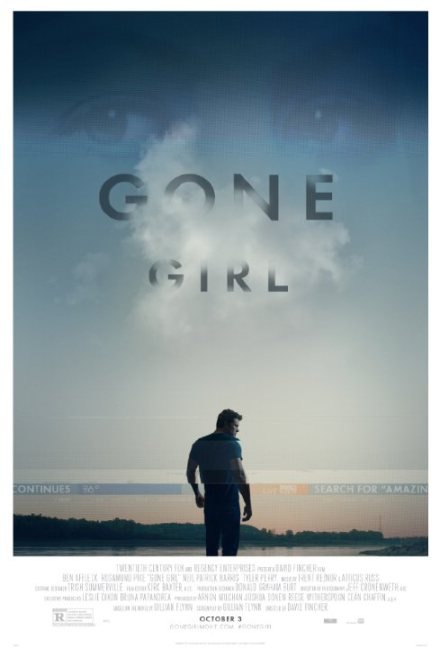
David Fincher’s adaptation of Gillian Flynn’s novel works as a procedural, a domestic drama, and a meditation on modern tabloid culture. It is patient, methodical and mostly interesting, though contemporaneous commentary notwithstanding, it has nothing serious to say of love, marriage or the waning of romance, which is what it purports to examine. Sure, there is perfunctory sex, Pike’s voiceover vituperation over the rigors of being the junior partner, and some suggested physical violence, all of little import.  In the end, it’s a monster movie, an elegant, crisp, well-acted monster movie in the hands of one of our more meticulous directors, but a mere monster movie nonetheless.

The monster’s victim is Ben Affleck, who is surprisingly savvy as the husband set up for the ultimate fall by his seemingly perfect wife (Rosamund Pike). Affleck is an apt choice for a weak man searching for a lifeline while his world crashes around him. Affleck the actor has often failed due to a lack of depth, a certain surface charm that has nothing beneath it, and here, he uses that to his advantage. He is complemented by Carrie Coon, who plays his loyal but disapproving sister, and Kim Dickens (Deadwood), the skeptical detective investigating the disappearance of Pike.

There are two strange casting choices, one that works out and one not so much. Tyler Perry has been trying to shake off Madea, and as a high profile, cable news ready criminal defense attorney, he does so, bringing some real wit to the role. As Pike’s former paramour, however, Neil Patrick Harris is thin, almost lost.  He is too strongly rooted in broad comedy and he works to overcome that persona with a deliberate, cautious performance that is creepier and more distracting than it should be.

The story, however, is riveting, told first from the vantage point of the increasingly beleaguered Affleck and the flashbacks of Pike as she narrates from her diary. Theirs is a storybook romance that eventually succumbs to the pressures of money, familiarity and recrimination. Except for one difference. Pike is nuts, a serial fantasist who destroys anyone who rejects her.

Pike’s predecessors – Glenn Close in Fatal Attraction and Bonnie Bedelia in Presumed Innocent – were in their own ways every bit as batshit crazy, but both women were decidedly more nuanced. Close’s jilted one-weekend stand refused to be ignored by Michael Douglas, but there was a discernible crack in her facade that made her sympathetic. Like Pike, Bedelia not only wanted to torture her husband and insisted upon his fealty after the fact, but her rebellion against the invasion of the impossibly attractive Greta Scacchi was sold as the aging frump protecting her castle and its king, Harrison Ford. Pike, however, is The Terminator (or maybe Rebecca De Mornay in The Hand That Rocks the Cradle), so psychopathic that she sets up all her former paramours when they as much as back away. Accordingly, any observation she or the film offers on the nature of marriage or relationships are no more than the ravings of a lunatic, even if this particular lunatic is cool, calm and seemingly accomplished. She’s loathsome and it’s hard to care much about the fate of Affleck, who chooses to sally forth with her even after she tries to destroy him. Which makes for an ultimately silly movie, but one that is a great deal of fun arriving at its pointlessness.