Archive

4 stars

image

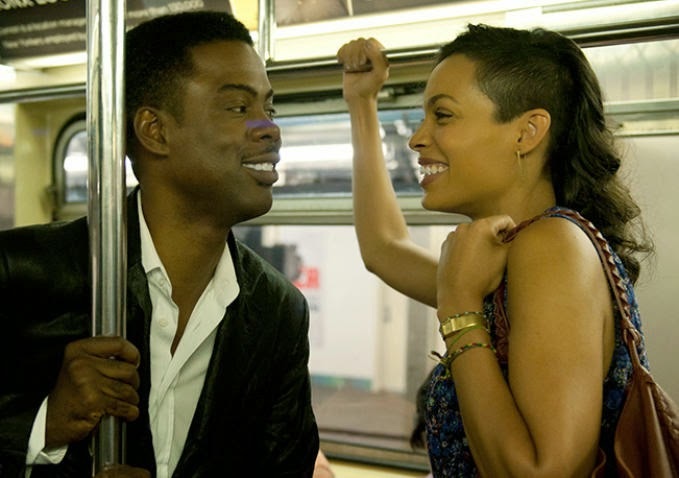
Very funny, very raw, often insightful comedy written and directed by Chris Rock. Rock stars as a facsimile of himself, a Hollywood success straight out of the mean streets of NYC, returned home on the eve of his made-for-Bravo wedding to a reality star (Gabrielle Union) and the opening of his shot at a serious film after making his fortune in broad comedies (the most successful of which is the Hammy the Bear series, which delivers a running joke, as everywhere Rock goes, you hear “hey, Hammy!”). Four years sober, Rock is accompanied on his return by a New York Times reporter (Rosario Dawson).  A convincing love story ensues as Rock opens up to her about his rise, fall, fears and regrets.

The film starts off a bit choppy, mainly due to the fact that Rock has to carry most if it. Rock has a winning smile and a wicked perceptivity, but he carries the armor and remove of a lot of comics, so his manner is a bit stiff, forestalling investment. But soon, Rock gets in his element, as he is surrounded by a dozen very good comics to play off. He loosens up in the second half, which allows him to reach deeper to connect with Dawson.

Rock borrows liberally from Judd Apatow’s Funny People and evokes Woody Allen’s chatty vibe (Rock’s back and forth with Dawson on the real reason for Martin Luther King’s assassination is alone worth the ticket and emblematic of their clever repartee) but he also writes strong, emotional moments which resonate stronger and longer than the gags, in particular, Rock’s reconnection with his father.

I was alerted to this film by David Thomson’s tribute to its writer, R.I.P. Alan Sharp, a Writer Too Dark for Hollywood.  Thomson credited two Sharp films, Ulzana’s Raid and Night Moves:  “Neither of them was nominated for anything, and only Ulzana’s Raid did any business.  But if you want to experience the richness of American films in the early 1970s, they are worth tracking down. You will be surprised how complex they are and how tense. They seem to understand movie narrative in a way so few films do today: He used mystery to draw audiences into his stories, trained them to answer the small puzzles, and then had them ready to grasp the implications he preferred not to underline. And both films are tough, bitter, and bleak, bearing the imprint of an unusual and talented outsider.”

Whenever we watch a movie from the 70s, my wife sighs and asks, “Is everybody going to die in this one?”  Night Moves is indeed a dark film, but Thomson is also dead-on in identifying its allure.  Gene Hackman plays a former pro football player turned private detective who is hired by an aging Hollywood not-quite-a-star (a dissipated but crafty Janet Ward) to find her wayward 16 year old daughter (Melanie Griffith, reprising her jailbait, tart role in The Drowning Pool, minus the malevolence).  Griffith has taken flight, bouncing between movie sets in Arizona and her creepy stepfather’s (John Crawford) compound in the Florida Keys.  In the meantime, Hackman discovers that his wife (Susan Clark) is having an affair, so he is in essence conducting two investigations, only one of which is really private.  The picture is leisurely and intricate, until, as Thomson notes, a “deeply upsetting” end.

Hackman turns in an interesting version of the traditional private investigator, part canny but part limited.  He is clever, but not the sharpest knife in the drawer.  He’s also very human, a vulnerability.  Along with Elliott Gould’s Phillip Marlowe in Robert Altman’s The Long Goodbye, Hackman’s p.i. is a marked and welcome departure from the type.

Sharp’s dialogue is noteworthy, especially in some of the exchanges between Hackman and Clark as they confront the state of their marriage and the import of her infidelity.  Hackman is also given some wonderful lines:

Ward: Are you the kind of detective who, once you get on a case nothing can get you off it? Bribes, beatings, the allure of a woman…

Hackman: That was true in the old days. Before we had a union.

* * *

Paula: How do you resist Delly?

Hackman: Oh, I just think good, clean thoughts, like Thanksgiving, George Washington’s teeth.

* * *

Crawford: (on his nubile stepdaughter Griffith)  You’ve seen her.  God, there should be a law.

Hackman:  There is.


image

*WARNING – SPOILERS*

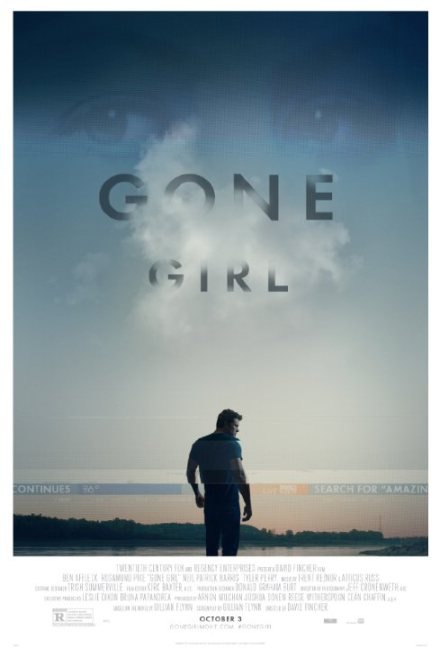
David Fincher’s adaptation of Gillian Flynn’s novel works as a procedural, a domestic drama, and a meditation on modern tabloid culture. It is patient, methodical and mostly interesting, though contemporaneous commentary notwithstanding, it has nothing serious to say of love, marriage or the waning of romance, which is what it purports to examine. Sure, there is perfunctory sex, Pike’s voiceover vituperation over the rigors of being the junior partner, and some suggested physical violence, all of little import.  In the end, it’s a monster movie, an elegant, crisp, well-acted monster movie in the hands of one of our more meticulous directors, but a mere monster movie nonetheless.

The monster’s victim is Ben Affleck, who is surprisingly savvy as the husband set up for the ultimate fall by his seemingly perfect wife (Rosamund Pike). Affleck is an apt choice for a weak man searching for a lifeline while his world crashes around him. Affleck the actor has often failed due to a lack of depth, a certain surface charm that has nothing beneath it, and here, he uses that to his advantage. He is complemented by Carrie Coon, who plays his loyal but disapproving sister, and Kim Dickens (Deadwood), the skeptical detective investigating the disappearance of Pike.

There are two strange casting choices, one that works out and one not so much. Tyler Perry has been trying to shake off Madea, and as a high profile, cable news ready criminal defense attorney, he does so, bringing some real wit to the role. As Pike’s former paramour, however, Neil Patrick Harris is thin, almost lost.  He is too strongly rooted in broad comedy and he works to overcome that persona with a deliberate, cautious performance that is creepier and more distracting than it should be.

The story, however, is riveting, told first from the vantage point of the increasingly beleaguered Affleck and the flashbacks of Pike as she narrates from her diary. Theirs is a storybook romance that eventually succumbs to the pressures of money, familiarity and recrimination. Except for one difference. Pike is nuts, a serial fantasist who destroys anyone who rejects her.

Pike’s predecessors – Glenn Close in Fatal Attraction and Bonnie Bedelia in Presumed Innocent – were in their own ways every bit as batshit crazy, but both women were decidedly more nuanced. Close’s jilted one-weekend stand refused to be ignored by Michael Douglas, but there was a discernible crack in her facade that made her sympathetic. Like Pike, Bedelia not only wanted to torture her husband and insisted upon his fealty after the fact, but her rebellion against the invasion of the impossibly attractive Greta Scacchi was sold as the aging frump protecting her castle and its king, Harrison Ford. Pike, however, is The Terminator (or maybe Rebecca De Mornay in The Hand That Rocks the Cradle), so psychopathic that she sets up all her former paramours when they as much as back away. Accordingly, any observation she or the film offers on the nature of marriage or relationships are no more than the ravings of a lunatic, even if this particular lunatic is cool, calm and seemingly accomplished. She’s loathsome and it’s hard to care much about the fate of Affleck, who chooses to sally forth with her even after she tries to destroy him. Which makes for an ultimately silly movie, but one that is a great deal of fun arriving at its pointlessness.

image

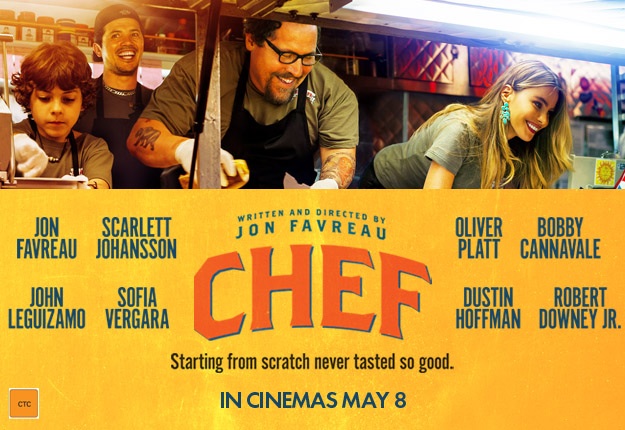
There’s not much to this Jon Favreau film, and it certainly doesn’t break new ground, but it is a charming, dare I say “feel good” comedy about a chef (Favreau) who stumbles spectacularly via the internet and Twitter (one of the funniest memes in the film is Favreau’s cluelessness about social media) and makes a comeback with a food truck. Favreau clearly has great fondness and respect for the subject matter and the loving depiction of cooking is one of several strengths of the film. Others include an enviable supporting cast (Scarlett Johansson, John Leguizamo, Sofia Vergara, Robert Downey Jr., Oliver Platt, Bobby Cannavale and Dustin Hoffman) and an unexpectedly moving but understated father-son dynamic between Favreau and his 10 year old, Percy (Emjay Anthony), worked out on a road trip.

image

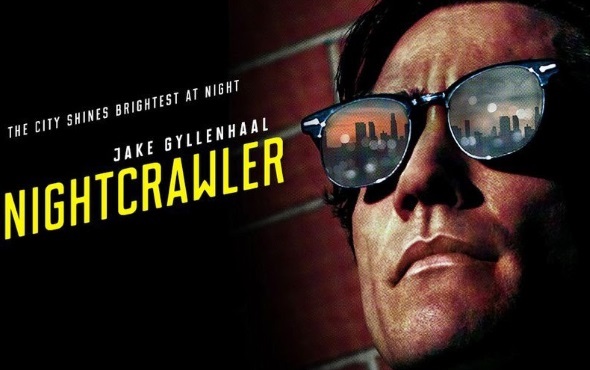
A clever black comedy that emphasizes story over a message (“if it leads it bleeds”), Nightcrawler works in large part to Jake Gyllenhaal’s riveting performance as an aspiring freelance videographer who haunts LA at night, capturing its brutality for sale to local TV news. Gyllenhaal is a mixture of King of Comedy‘s Rupert Pupkin, Rushmore‘s Max Fischer, and Jim Carrey’s Cable Guy, a driven cipher who spouts business motivational doctrine and relentlessly pushes further and further over the line of acceptable journalistic practices in capturing people in crisis or even death throes. You guiltily root for him because he is so compelling and his Dale Carnegie pitch, even unmoored from any concept of morality, comes off as an earnest entrepreneurial pitch. But by the end of the film, a series of tense crime scenes invaded by Gyllenhaal, his philosophy is both corrupting and lethal. He makes it bleed even more that it otherwise would, and as a result, he excels.

It’s a simple tale, well told, but there isn’t a lot to this picture other than Gyllenhaal, who exudes a real inner force (while his character is certainly different, I kept coming back to De Niro in Taxi Driver). He has two co-stars; Renee Russo, a hard-bitten struggling TV producer whose star rises with Gyllenhaal’s footage, and LA at night, which writer director Dan Gilroy shoots as a haunted ghost land of deserted streets and foggy canyons. Gilroy is a longtime writer of pretty bad films (Freejack, Two for the Money, Real Steel), but he directs this thriller with pace and verve.

image

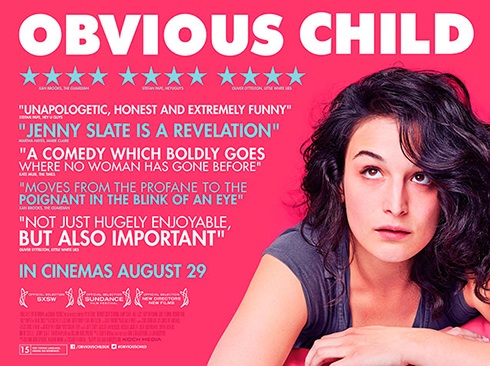
A romantic comedy set around an abortion requires a deft hand, and there are times when first time writer-director Gillian Robespierre navigates her lead, sweet but spoiled comedian and former SNL alum Jenny Slate, into some questionable waters. Slate is a comic, a regular at a Williamsburg club, who has a one night stand with seemingly buttoned up Jake Lacy. Her “thing” as both a stand up and as a potential mate is to be self revelatory and outrageous, and so we get a full helping of bon mots about vaginal yeast, farts and the like. That can be a little trying, as is Slate’s callous treatment of Lacy.

But it works. Slate is very good, exhibiting the in-between status of a grown woman trying to live her own life and the little girl still vulnerable and attached (financially and emotionally) to her divorced parents. Slate is very much modeled after Lena Dunham’s Hannah Horvath from Girls, with, thankfully, precious little of Horvath’s navel-gazing excess. But when Slate gives voice to her fear and confusion, she is natural and sympathetic.  Conversely, when Horvath is flat on her back on on the canvas, you most always feel pretty happy about it.  Lacy is also quite touching as the gentle and confused hook-up who warms Slate’s butter pats and brings flowers to Planned Parenthood.  He knows that among the smart set, the joke may be on him, but he’s game and his backhand is effective.

While I’m not sure if Robespierre meant for Slate to be only kind of funny, that works as well, because it feels real. She seems like a young comic, still working on material up until the moment she takes the stage, and that contributes to the verisimilitude of her circumstances.

This could have been arch and maybe even preachy. Gaby Hoffman, as Slate’s roommate, comes close to giving a stemwinder against the Supreme Court and society’s “patriarchy” but she is blunted by Slate’s giggles and a mild pushback from a gay friend who retorts, politics aside, that he would want to know if he got someone pregnant.

No matter the edgy subject matter, the end is syrupy sweet and hopeful, paying homage to the rom-com rules.

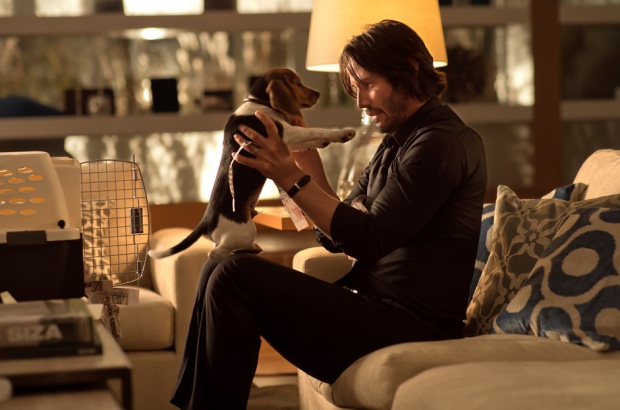
Terrific shoot ’em up, mindless yet smart, thrillingly violent yet tasteful. John Wick (Keanu Reeves) is a retired hitman, at least until the snot-nosed son of New York City’s crime boss steals his car and destroys the last gift given to him by his beloved, deceased wife.

image

Oh, and then it’s on. The film sports sixty to eighty beautifully choreographed deaths (the co-directors are seasoned stunt coordinators), a few funny lines, and a clever depiction of a criminal underground with its own rules, parlance and neutral Switzerland. Reeves plays Wick straight and dead serious, so we are not tormented by smirks, tag lines or witty asides. And the bad guys are, as they should be, the most interesting characters in the film.  If there is a criticism, it’s this: whatever the final count, it’s about 20% over the killings the film should have.  Nobody can employ that many henchmen in this economy.

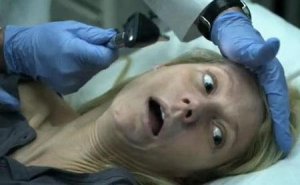
I avoided this film because of an aversion to dramas about viruses and plagues and because I was still shellshocked at the total crappiness of the 1995 Dustin Hoffman vehicle Outbreak (guess what?  The military did it!).  Unless the eventual outcome of a filmic plague is zombies, 21 Days Later-esque “rage” victims or altered humans ala’ The Omega Man, count me out.

But you’ll watch most anything in a hotel, and Contagion had three extra things going for it – it was the $4.99 special, a few friends recommended the picture and it was directed by Stephen Soderbergh.  Despite my reticence, I was treated to an engrossing, intelligent and moving drama about what a 1918-like worldwide plague (where the entire world lost 1% of its population) would look like today.  The answer through Soderbergh’s eyes is — not pretty, but not hopeless.

The films starts with poor Gwyneth Paltrow, who is the second carrier of an infection transmitted by touch.  Once she is identified as Patient 1 (a Chinese cook is actually Patient 0 – he touched the pig who ate the bat got that started this whole mess, and then he shook Paltrow’s hand), we follow her from China through Chicago and to Minneapolis, where she has touched at least a dozen people  And an epidemic starts.

Soon, the government (Laurence Fishburne at the CDC, Bryan Cranston at Homeland Security) swings into action, regular CDC folk (Kate Winslet, Jennifer Ehle) act heroically, an internet crackpot become a messiah (Jude Law), and Paltrow’s husband and many other regular folk have to deal with a paralyzed world.  Lawlessness increases because law enforcement is sparse; fear runs rampant; trash piles up in the street; and people hole up waiting for aid and/or a vaccine.

This is a gripping, sober thriller, thankfully bereft of the normal tropes of the genre.   The government did not create the virus for military purposes; almost every character is doing the best they can under difficult circumstances; and while society does break down, it also holds up.

All the actors are very good and very believeable.  Special kudos to Matt Damon, who continues to be the least-appreciated American actor of his generation.  He had the misfortune of being outshined by Jude Law in The Talented Mr. Ripley and Jack Nicholson and Mark Wahlberg in The Departed.  They got the nominations and Damon, who carries both films with decidedly more difficult roles, got squat.  Here, he serves as the father who has lost a wife and son and seeks to ensure his surviving daughter is not affected while at the same time giving her some life of normalcy. The scene where he is told his wife is dead is particularly moving.

Final note:  Gwyneth Paltrow gets the Lifetime Achievement Award for Actress Who Allows Herself to Be De-Glamorized to Best Serve the Role (you’ll know what I mean when you see it).


Martin Scorsese’s surreal nightmare of one man’s (Griffin Dunne) ill-advised late-night trip into lower Manhattan is painfully funny and, at times, genuinely unsettling. Dunne is beset by a quintent of quirky, if not outright dangerous females (Roseanna Arquette, Linda Fiorentino, Teri Garr, Catherine O’Hara and Verna Bloom), a fact that will one day be Exhibit X in his anticipated trial for misogyny.  His torture is lovingly photographed by Michael Ballhaus, giving SoHo’s grimy exterior a dream-like quality (and there is no greater horror than being hunted by a mob that has commandeered a Mister Softee truck).

Dunne is very good and much like Steve Carell, except he’s not burdened at all by the imprint of a long-running character, and where Carell is childlike and vulnerable, Dunne is sympathetic, but sexually opportunistic.

Bonus: if anyone asks you, “What movie casts the parents from Home Alone, one of whom went to filmvetter’s high school?”, now you know.

50 Years Ago: 'The French Connection' Helps Kick Off '70s Cinema

Today, William Friedken’s 1971 Academy Award winner seems better-than-standard cop fare, but this is an extremely influential film, notable for its verisimilitude, grit and movement. Shot on the mean streets and ugly haunts of decrepit New York City, Friedken follows two detectives, Popeye Doyle (Gene Hackman) and Buddy Russo (Roy Scheider), as they try and take down a huge heroin shipment. No prior American film seemed as immediate or aggressive. Friedken’s camerawork is frenetic and edgy, and his virtuoso car chase scene is still one of the best in all of film.  Here is Friedken on the chase, which took 2 weeks to shoot.

Friedken’s insistence on visual authenticity extends to Ernest Tidyman’s script. Doyle is a casual racist and a simplistic bully, Scheider a slightly more pleasant accomplice. They are neither archetypes or anti-heroes. They’re just dogged, unremarkable cops. What is a little mystifying is the Best Actor win and Best Supporting Actor nomination for, respectively, Hackman and Scheider. These performances are almost 100% sweat, the equivalent of thespian calisthenics. There is no arc or development, and I don’t believe there has been this much running in any film save for Chariots of Fire, The Gods Must Be Crazy and any film about Steve Prefontaine.  Roger Ebert disagrees about Hackman’s performance, writing: “As Popeye Doyle, he generated an almost frightening single-mindedness, a cold determination to win at all costs, which elevated the stakes in the story from a simple police cat-and-mouse chase into the acting-out of Popeye’s pathology.”

Interestingly, Friedken didn’t want Hackman (they fought constantly and as Friedken writes in his memoir, “His outbursts [onscreen] were aimed directly at me… more than the drug smugglers”). But Paul Newman and Steve McQueen were too pricey, Peter Boyle objected to the film’s violence and Friedken’s first choice – Jackie Gleason! – was deemed unsuitable by the studio.

To the moon, drug dealers  To the moon!