Archive

2 stars

Image result for finding forrester

You can find this flick in the Scent of a Woman aisle, next to all the other “Young man taught life lessons by crippled mentor, but it looks as if the crippled mentor could learn a lesson or two as well” films.  Except, this time, nobody says “Hoo-wa!” but rather, “Punch the keys!”

Al Pacino is played by Sean Connery, who plays William Forrester, a crotchety, haunted J.D. Salingeresque recluse who befriends a gentle student.  His charge is a fresh-faced underclass kid (Rob Brown) who is attending a tony NY private school.

In both films, the nemesis is a priggish, empty-suit of an educator who does his dastardly deeds mainly out of insecurity and spite. The bad guy here (F. Murray Abraham) is actually really, really bad.  Not only does he try to railroad our hero by accusing him of plagiarism (Brown is writing under the tutelage of Connery), he actually whispers to Brown,  “Don’t ever embarrass me in front of my class again.”

In Scent of a Woman, the day is saved by the appearance of Pacino at the honors trial of poor, fresh-faced Chris O’Donnell.  In this film, Connery makes the same entrance at the school, but instead of speaking up for the boy, he (SPOILER) slits F. Murray Abraham’s throat with an unseen dagger.

Okay, Connery doesn’t do that  He pretty much does the same thing Pacino did, he just doesn’t say “Hoo-wa!”

By-the-numbers schmaltz, made just a little more bearable because director Gus Van Sant makes things visually interesting; rapper Busta’ Rhymes is around for a few yucks; and, Pacino is not in it.

Beautiful and sumptuous, the picture marked the end of Terrence Malick’s 20+ year absence from film.   Ostensibly about an offensive during the Guadalcanal campaign, the film follows Privates Bell (Ben Chaplin) and Witt (Jim Caviezel) as they are deposited on a Pacific island to take an enemy air base deep inland.  They are accompanied along the way by Private John Savage, Sergeants Sean Penn, Woody Harrelson and John C. Reilly, Lieutenant John Cusack, Captains Elias Koteas and George Clooney, Colonel Nick Nolte, General John Travolta and a host of other young actors playing infantrymen.  

The first time I saw this picture, the characters did not register.  It seemed like a glut of talent working with limited space, and the result was disjointed and, at worst, high falutin’.  I wrote:

Koteas and Cusack register, the former as a humanistic officer who cannot accept the slaughter of his men for a greater good and the latter as a brave underling who shows true leadership in a grave hour.  Nolte is standard spit and scream (it is truly amazing how red he can make his face).  Penn, Harrelson, Clooney, and Travolta are cardboard, and Reilly is given a short, hackneyed speech on how he has become hardened by the war.  Savage in particular is really, really bad as a soldier who has cracked under the strain of combat.  It’s hard to believe that Savage, so good in 1978’s The Deer Hunter, was revived for such histrionics 20 years later.

I was harsh and/or wrong.  On re-viewing, most of the characters do register, and they often make lasting imprints with little screen time.  Further, Malick’s use of the voice-over in their heads, which initially struck me as a distracting cheat, is much more than that.  It’s an ambitious technique to not only get us in their minds practically (which, in combat, would likely be an inner monologue of “oh fuck, of fuck, oh fuck, oh fuck”) but philosophically as they wrestle inner demons and regrets while negotiating external hostility.   

The film is lush and visually riveting, from the beauty of the ship cutting through the Pacific prior to disembarkation of its armed cargo (filmed directly down from the prow), to the stark image of a dismembered mine team, alone among the peacefully covered foliage (the first carnage the company witnesses) to the killing of two men by a Japanese sniper – they fall poignantly in the tall grass before the vista of a misty, impossibly beautiful hillside.  Malick’s juxtaposition of the wonders of nature and the blight that is the intrusion of combat is jaw-dropping.

Hanz Zimmer’s score supports the sense of dread and beauty, intertwining the exotic of the island and the tick-tic-tick of the danger therein.

Malick does makes some fundamental errors that, I’m sure, seem niggling in the light of the ambition of the project.  For example, Witt and Bell look alike and they kind of sound alike and when two men are running around in battle and doing voice overs, that becomes problematic.  The cameo factor can also be distracting because actors are trying to make their mark in the short time allotted.  As such, Travolta is weird as an ambitious general, and Clooney shows up at the end for a few lines (since you still haven’t seen Clooney until the end of the picture, you fear he may be pivotal and you have that much longer until the end).  

Still, nits aside, this is a worthwhile epic.


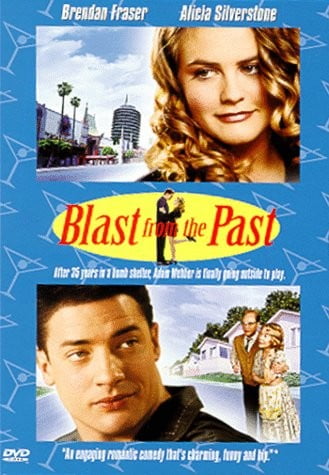
Image result for blast from the past"

Brendan Fraser plays a 35 year old man mistakenly vaulted in a bomb shelter with his parents (Sissy Spacek and Christopher Walken) since the early 60s. Now, he’s out in modern L.A., and he’s wearing a windbreaker and calling black people “Negroes.”

While Fraser is pretty funny, and Walken and Spacek are properly “kooky” as conservative parents who took to the fallout shelter and never came out during the Cuban Missile Crisis, this romantic comedy lags.  Alicia Silverstone, as the love interest, is dull and plump, a bad actress with weak comic timing (didn’t she come and go in a hurry?). Dave Foley, of “Kids in the Hall,” plays Silverstone’s gay, advice-dispensing roommate, but he’s forced, and he’s given none of the snappy patter of a Cam or Mitchell from “Modern Family” (and if you needed someone to play the gay roommate from “Kids in the Hall”, why not Scott Thompson?)

In the end, fish-out-of-water can only get you so far.

I am getting muthafu***** tired of these muthafu***** sharks!

Deep Blue Sea. Researchers at a deep sea lab experiment on sharks by making their brains huge (4 times a normal size) so they can extract a secretion that will cure Alzheimers. The sharks (computer generated) get very smart. Too smart. A hurricane gives them an opportunity to hunt down several stock characters on the isolated station. None of the characters is “bankable” so their gruesome ends are ho hum. Samuel L. Jackson makes an appearance, and LL Cool J is the sea station cook who says things like “Damn, muthaf***a'” and “Peace out, bitc*” and “Open wide, you nappy toothed fu**a’.” And there is a Jacqueline Bisset look-a-like and damned if her diving suit doesn’t allow for ample cleavage.

There are three sharks, and they are all dispatched in manners strikingly similar to the Jaws films. Figure that.

All that said, this film can be fun and Jackson’s “give the sharks hell” speech is memorable. Snakes on a Plane memorable.

Summer

Summer of Sam. Spike Lee’s disjointed pastiche of the summer of ’77 in NYC fails on just about every level. Still, because of the nature of Lee’s failures (they tend to be interesting and sometimes spectacular failures), there are worse bad films you could go rent.

NYC in the summer of the Son of Sam is a hot, violent, steamy, stupid place, populated by an unfaithful, disco hairdresser (John Leguizamo), his confused and sexually unsatisfied wife (Mira Sorvino), loose trash from the Queens neighborhood that serves as our setting (Jennifer Esposito), an Italian kid getting into the punk scene (Adrian Brody), a mob boss (irascible Ben Gazarra, who just died, RIP), a local cop who came from the streets (Anthony LaPaglia), Leguizamo’s sharp tongued paramour and boss (Bebe Neuwirth), a bunch of Lee’s standard Italian thugs, and of course, David Berkowitz (Daniel Badalucco from TV’s “The Practice”) who is going stark raving mad and taking it out on everyone else by shooting them.

Lee’s first mistake is his attempt to capture the milieu of too many totems of ’77 NYC. So we get the Queens disco, punk haven CBGB, Plato’s Retreat, Studio 54, Yankee Stadium, the looting. It’s all too much, too scattershot, and in trying to depict so many hallmarks of the time, it feels rushed and inauthentic. (Boogie Nights stands in sharp contrast in that it conveyed a convincing feel of late 70s, early 80s LA without having to take you on a Map of the Stars – Burt Reynolds’ backyard pool party was quite enough).

It’s a minor problem, as it turns out, because Lee’s characters – to a person – are uninteresting morons. Leguizamo is a conflicted Lothario with a bad case of the madonna-whore complex – he can nail anything in heels but his wife, with whom he must couple both quickly and without fanfare. That we have to suffer this semi-believable inadequacy in the late swingin’ 70s (repeatedly, as Lee cannot get enough of long, boring arguments between Sorvino and Leguizamo) is unfortunate. That Leguizamo is the main character, and emotes his fu**in’ love for his wife, his fu**in’ confusion, and his fuc**n’ fear of that fu**in’ Son of fu**in’ Sam, is excruciating. Worse, Leguizamo’s character lapses into drug abuse. The actor takes the opportunity to vomit all over his shoes in expressing his confusion and angst.

No one else is much better. Sorvino is dull and whiny as a wife who tries to please her husband and then gets fed up – no, make that fuc**n’ fed up. Brody, who was just another Italian goombah in the neighborhood, now sports a dog collar and spiked hair. He is forgettable, mainly because Lee never gives him a chance to explain why he changed, what about punk rock has transformed him in both spirit and style. He is bisexual, gets cash for having sex with men, dances at a gay strip house and does porno. And if he’s angry, he’ll smash a glass against his own forehead. Why? No real reasons are given for Brody’s anger. It seems that he does these things merely because it is hot in NYC.

Naturally, the Italian toughs – looking to keep the streets safe from Sam – decide that Brody is the killer. And that is the story.

There are cultural false notes as well. For example, Brody digs punk and articulates that The Who are his discovery. Anyone into punk rock in ’77, however, would have found The Who much too radio and establishment. You can tell that Lee just wanted to use the band’s anthems (he does so twice) in the movie, so presto, The Who become a punk icon. Additionally, when Brody’s band plays at CBGB, they are much too polished and pop to be a convincing 1977 punk act. Finally, Lee casts himself as a television reporter, which makes for painful watching (let’s just say Lee’s elocution is closer to Gerry Cooney than Max Robinson – he could not have gotten job announcing winners at a race track, much less being the “man on the street” for a local NYC station).

Other problems: Lee clumsily injects race into the mix in a street interview with black residents of Bed-Sty. Specifically, Lee allows the rant of one woman, who screams that the greatest race war ever would have ensued had the Son of Sam been black. She then chides Lee’s reporter character for acting white. The effect is unintentionally laugh out loud, because no matter the film, you feel Lee’s childish compulsion to sacrifice story for slogan.

In the end, Summer of Sam struck me as oddly subversive. You get the sense that Lee is most sympathetic to Berkowitz, who spends his days screaming at a neighbor to muzzle a barking dog (this same dog was the one who told him to kill, kill, and kill again). But the sum of Lee’s picture is creepy: given all the characters of NYC in that muggy summer of ’77, no wonder Berkowitz started shooting people. You loathe them, and Lee makes you complicit in empathy for Berkowitz (at least, you figure, I can get a break from these dimwits if he gets back to the killer).

So why see it? Lee is a gifted director who is crippled mainly because he has no real feel for story. Of his films, only two stand out – Crooklyn and Clockers – the latter because the reminisces of childhood in Brooklyn lend themselves to film by disconnected vignette, and the former because it was built solidly on the work of Richard Price. Like He Got Game, Summer of Sam is a mess, but interspersed in the carnage (and there is plenty of that, by the way, because Lee chooses to lovingly film almost every grisly shooting) are well-realized visions. Included are a montage of the characters’ summers to The Who’s “Teenage Wasteland” a smart dance scene between Sorvino and Leguizamo, and the recurrent pan shot of a tormented Berkowitz who spells his maniacal rants on his walls, with children’s blocks, and in conversation with a barking dog. Lee captures these, and many other moments, with ingenious motion (his strong suit) and smart editing.

Unfortunately, as usual, his skill cannot overcome an inane script, a corral of overactors and his own excesses.

Image result for perfect storm

Twister but only marginally better acted.

The first 30 minutes is devoted to character development, so we can invest in our crew of six fishermen who will weather the storm of the century. There is the romantic captain on a bad streak (George Clooney); the young turk in love (Mark Wahlberg); the divorced father of one fighting to maintain a relationship with his son though he is a “man ‘o the sea” (John C. Reilly); the poor white trash outcast (William Fichtner); the old salt who just met true love in the form of a lonely, overweight woman at the bar (John Hawkes); and the superstitious guy (Allen Paine). Fichtner and Reilly don’t get along for reasons that make little sense, except that one must thereafter save the life of the other, which is exactly what happens.

We also meet the women who love the men who bring us fish fillets: a hard-bitten divorcee (Diane Lane) who curses the day a sail was set; a harder-bitten tavern owner and mother of two of our ill-fated crew (Sherry Jones); the competing hard-bitten captain who wants to transfer Clooney’s heart from the sea to her stern (Mary Elizabeth Mastraontonio); the hard-bitten overweight woman with two kids who waits for the old salt (Rusty Schwimmer); the ex-wife of Reilly; and some floozie who shacks up with the superstitious guy.

To a person, the characters are hackneyed and lame. Hollywood goes to Gloucestor and gets a Gorton’s fisherman accent.

As for the storm, it’s technologically impressive and makes the film watchable. The film is also helped by a gripping subplot involving a Coast Guard air/sea rescue (the insights into the pilots of the rescue helicopter are better communicated through a few lines during stress than all of the preceding soliloquies of the main characters).

But even during the technical wizardry, we are treated to two godawful bids for supporting actress nominations by Lane and Mastroantonio.  Big, gloppy, weepy, leaden and ultimately, unconvincing speeches.

The film even has an old sea captain making salty pronouncements at the bar.

“Ayyy matie! Let me tell you about the storm on ’62.”

The entire schmaltz-fest is coated in a gooey James Horner score. At end, rather than dab a tear from your eye, you are more inclined to go out for seafood and question the heroics of six men who risked life and limb (theirs and those of rescuers) so they could make a buck (they risk the storm because the ice machine on their boat broke, and if they wait the storm out, the fish will rot).

And they don’t wear life preservers.

Final note: the film is about sword fisherman, but they assure us that no animals were harmed during its filming, which means most of the picture’s budget was expended on wiggly, rubber fish.

Magnolia. Clocking in at 3 hours and 11 minutes, the first half of Paul Thomas Anderson’s follow-up to Boogie Nights is ambitious, engaging, and risky. Sadly, the remainder of the film is self-indulgent, infantile, maddening, and, ultimately, an assault.

Basically a pastiche of several intersecting stories in Los Angeles, Magnolia recounts a day in the lives of earnest galoot cop John C. Reilly, woman-hating television Svengali Tom Cruise, cancer-ridden game show icon Philip Baker Hall, his wife Melinda Dillon, his daughter Melora Walters, cancer-ridden and dying television magnate Jason Robards, his mentally ill wife Julianne Moore, Robard’s nurse Philip Seymour Hoffman, game show child wunderkind Jeremy Blackmon, his father Michael Bowen, and former game show child wunderkind William H. Macy.

The first problem is structural. Anderson has chosen a story with countless characters who are at the point of a knife in their lives. Drug abuse, fear of dying, dying itself, mental illness, abandonment . . . these are but a few of the issues confronting these characters. As such, scene after scene of high-pitched melodrama makes for a trying time.

The first problem leads to the second: overacting. Because the script is in many ways a collection of speeches at emotional high points, the actors tend to dispense with any hint of subtlety (save Hoffman and Hall, who are notable for their restraint), opting to instead screech at the screen. Cruise (who was nominated and was infinitely better in the clunky Eyes Wide Shut), Moore, Walters, and disappointingly, Macy, are the prime offenders. Cruise’s deathbed scene with Robards is damn near unbearable, as is Macy’s “I have love to give” barroom soliloquy.

The third problem is visual. Anderson is clearly comfortable with the camera, and he refuses to see movement as reserved for action and/or exclamation. His world is both fluid and frenetic, and the style has its merits. But very rarely does he simply stop. No shot is so mundane that it cannot be a dolley-shot or a snakelike track. In the end, it is too much.

Finally, Anderson makes two truly awful choices in the second half of the film. First, he besmirches one of the nice things about his film (Aimee Mann’s songs – like those of Elliot Smith in Good Will Hunting, she has produced several simple, literate and haunting tunes that match the mood of the film) by having his characters actually sing some of the lines to one of her ditties. The effect is awkward. I laughed. Literally, we have Jason Robards on death’s door, singing along with Aimee Mann.

The second is unbelievable and just flat out bizarre: frogs fall out of the sky. Not figuratively, but literally. Big, fat, gloppy frogs.

Image result for Big bad mama

Five things recommend this film.

1) Angie Dickinson is both beautiful and naked in the picture. First, with a very young Tom Skerritt and next–

2) with William Shatner, who is also semi-naked in the picture, which significantly detracts from Dickinson being naked.

3) Angie Dickinson is one helluva woman.

4) It is an exploitation, low-budget picture that tried to be period (1930s Texas).  It is worth the rental alone to watch the modern 70s pop up in the 1930s.

5) This is Steve Carver work. Lone Wolf McQuade? Yes. That Steve Carver.

If you’re in a hurry, Dickinson’s naked scenes are about halfway through (it’s only 83 minutes).

P.S.  I saw this picture when I was 12 or 13 at my father’s apartment (he had the earliest version of cable-ready movies, which would show “racy” movies on weekend nights, so when we’d be at his apartment for the weekend, and he’d gone out, me and my brother got to see Russ Meyer movies, or movies with a naked Police Woman, from Big Bad Mama to Pretty Maids All in a Row, or Jacqueline Bisset in Secrets).  So, there’s that.

Ed Norton’s clunky directorial debut about two childhood friends – a rabbi (Ben Stiller) and a priest (Norton) – who reconnect with a third, Jenna Elfman. Hijinx, romantic entanglements and hurt feelings ensue. A few funny moments, but Elfman’s hyper-active me-me-me-ism is distracting, and Stiller is lost as a romantic lead. Worse, Norton knows nothing of pace.

BlowEh.  Johnny Depp is convincing as drug dealer George Jung, but George Jung’s life, even as he amasses $60 million in cocaine profits and pals around with Pablo Escobar, is tedious.  In the last fourth of the film, Depp is outfitted with a paunch.  Is that a pillow under his shirt?  It looks ridiculous and it is distracting.