Archive

2 stars

The charm of high school kids (and now, regular folk) moonlighting as super heroes remains, and the battle royale at the end of Kick-Ass 2 is inventive and funny.  But the follow-up to the kinetic Kick-Ass is weighed down by a boring, predictable subplot involving Hit Girl (Chloe Grace Moretz) trying to go civilian in high school in the midst of bitchy, it girls (the story could have dovetailed into her role in this summer’s Carrie remake). Other blights: the cartoon villains in the employ of criminal mastermind Red Mist, now “The Motherfucker” (Christopher Mintz-Plasse) are given short shrift; the action is less explosive and uneven; and in a sentence I never imagined I’d write, Jim Carrey is no Nick Cage.

Few Stephen King books or short stories are successfully translated on screen, and only one is brilliant – The Shining (it speaks volumes about the author that he felt Stanley Kubrick got it wrong, so wrong he made another version, with one of the two leads from the sitcom Wings in Nicholson’s role).

Carrie, Salem’s Lot, and Misery are very good, and Stand by Me is competent, if treacly. Dolores Claiborne, 1408, Christine, and Silver Bullet are pedestrian, but have their moments.  The Shawshank Redemption is a wildly overrated, ridiculous film, but deserves mention because the great weight of authority deems it a near masterpiece.

Then you have a big pile of crap–

  • 1982 – Creepshow
  • 1983 – Cujo
  • 1984 – Children of the Corn
  • 1984 – Firestarter
  • 1985 – Cat’s Eye
  • 1986 – Maximum Overdrive
  • 1987 – The Running Man
  • 1989 – Pet Sematary
  • 1990 – Graveyard Shift
  • 1990 – It
  • 1991 – Golden Years
  • 1991 – Sometimes They Come Back
  • 1992 – Sleepwalkers
  • 1993 – The Dark Half
  • 1993 – Needful Things
  • 1993 – The Tommyknockers
  • 1994 – The Stand
  • 1995 – The Langoliers
  • 1995 – The Mangler
  • 1995 – Stephen King’s Nightshift Collection
  • 1996 – Thinner
  • 1998 – Apt Pupil
  • 1999 – The Green Mile (yes, this sucks)
  • 1999 – Storm of the Century
  • 2001 – Hearts in Atlantis
  • 2002 – Rose Red
  • 2003 – Dreamcatcher
  • 2003 – The Diary of Ellen Rimbauer
  • 2004 – Secret Window
  • 2004 – Riding the Bullet
  • 2006 – Desperation
  • 2006 – Nightmares and Dreamscapes
  • 2007 – The Mist
  • 2009 – Dolan’s Cadillac
  • 2011 – Bag of Bones 
  • 2013 – The Reaper’s Image
  • 2013 – Cain Rose Up
  • 2013 – Willa

So, where does David Cronenburg’s The Dead Zone fit in?  Three-fourths of this story in about a man who can see your future and your past after he touches you, I’d have ranked it just below The Shining.  Cronenberg creates a creepy atmosphere made even more unsettling by the unique performance of Christopher Walken, and the bleak misery of his existence as a crippled freak stuck in a small town is haunting.  Striking visuals add to the spooky feel:

Then, the damn thing falls apart due to two ridiculous storylines.  First, Anthony Zerbe plays a rich man who hires Walken to tutor his son, knowing full well Walken’s gift of second sight.  So, what does Zerbe do when Walken sees the boy and his friends crashing through the ice during hockey practice and warns him accordingly?  Wounded that his son has rejected his judgment about skating on the pond, Zerbe conducts hockey practice anyhow, and two boys die.  The decision is bananas yet in keeping with King’s low esteem for parents (the father in Stand By Me practically tells poor Will Wheaton, “the wrong kid died” like the father in Walk Hard: The Dewey Cox Story).

Second, Walken is introduced to senatorial candidate Martin Sheen and sees Sheen’s future as a messianic president of the United States, instigating a nuclear conflagration.  Sheen plays the character so oily and low it is hard to imagine anyone would vote for this cretin.  And when Walken thwarts his ambition, the manner in which Sheen self-immolates is so broadly stupid the film is near ruined.

Still, it coulda’ been a contender.

The premise is about as plausible as Escape from New York. If crime can increase so much that Manhattan must be cordoned off as a separate, lawless prison, than the nation could establish a 12 hour period annually where its citizens can “purge” and commit any crime without punishment. The purge is a mix of a social reform (by allowing one night of consequence free crime, we have no other crime the rest of the year) and patriotic-religious act. But it occurs in 2020, and as bad as either Bush or Obama has been, I can’t see that kind of institution gaining traction so quickly. Frankly, it is unlikely the government could get the website for The Purge up and running in 6 years. In the end, the filmmakers don’t really invest much in the concept, and as my son remarked, “the problem with the movie is that you didn’t need The Purge to make it.” He’s right. When the killers looking to take advantage of their wild night surround the well fortified home of Ethan Hawke and his really stupid family (note to self; on Purge night, make sure your foolish son doesn’t get all Good Samaritan and lift the security gates), they may as we’ll be zombies or Manson family members or the bad guys in The Strangers or You’re Next. There is no reason to go high concept if you have no intention of exploring that concept.

Or maybe not. On a budget of $3 million, it made $64 million.

The central conceit of Ain’t In it for My Health, the documentary of The Band’s recently deceased drummer, Levon Helm, is that its subject is compelling enough to sustain interest in his daily chatter, visits to the hospital and scattered observations. It’s not.

Helm is closed off, we learn from a fellow musician, because “Levon’s got demons he’s struggling with over this whole Band legacy.”

If you dropped Fat Boy over Japan, I can see you struggling with demons over your legacy.  In contrast, it is tough not to juxtapose Helm’s bitterness with an excerpt from a recent article I read on Bob Dylan: “Now, though, he was out on his own – after eight years’ abstinence, just as rock touring reached new debauched depths. The Band had roadies take Polaroids of girls wanting to get backstage, poring over potential beauties like horse-traders. Cast-offs were handed to the crew.”

Still, I was game.  Helm’s issues with The Band and posterity’s treatment of same could be interesting.  Of Robertson, Manuel, Danko and Hudson, their travels and impact, Helms says that . . . . “the credits and the money” on the third Band record was a “screw job” (Robertson was the writer and got the royalties) and after that, well, it was pretty much all over.

That’s the whole of it.

Otherwise, Helm just broods and ambles and lounges amongst younger acolytes (including Billy Bob Thornton) and these scenes are interspersed with nature photography of Helm’s property in Woodstock, NY.  Near the end, surviving wives and girlfriends tell us that the real downfall of The Band was drugs and alcohol.

Mind. Blown.

On the plus side, there’s some nice old footage of The Band, some later footage of Helm who played live not long before his death, and the portrait of the musician at the end of his career, with cancer ravaging his voice, can be poignant

Frances Ha (2012) Review |BasementRejects

In the first ten minutes, you realize this is going to be a melange of a Woody Allen black-and-white paen to New York and Lena Dunham’s HBO sensation Girls. Dunham’s show is an entertaining but often frustrating characterization of four girls, post-college, making their way in the world of New York City via witty, self-satisfied rejoinders and copious infusions of cash from their parents. Loaded with self-esteem but no brightly discernible skill, Dunham’s quartet negotiate the shoals of a hip, ever-changing landscape while coming to the realization that every girl with a B.A. from Oberlin is not destined to be a smash in the literary and art worlds. It’s hard to like her characters, especially, Dunham herself, whose Hannah is so grotesque, self-involved and deluded that you’re often left cringing or sputtering in amazement. Or, at almost 50 years of age and closest in sensibility to her poor beleaguered parents on the show, I am.

Still, Girls is a solid work, surprisingly addictive, and it always elicits a great discussion that can range from generational rot to what the cool kids are into these days. I also credit Dunham with either knowingly or unknowingly crafting a sharp indictment of extended, subsidized adolescence, and despite her ridiculous persona as her star ascends, I think she knows it. Or she should.

If Girls were a quintet, the protagonist of Frances Ha, Greta Gerwig, would play the mopey, co-dependent would-be dancer. Unfortunately, Frances is not in the hands of Dunham, who could effectively compensate for Frances’s pathetic existence with humor or humanism. Instead, she’s in the hands of a filmic sadist, Noah Baumbach, whose characters are often so vile and/or degraded that you wonder if the point of the exercise is solely to make the audience feel better about themselves. As the divorcing parents in Baumbach’s The Squid and the Whale, Laura Linney and Jeff Daniels are positively toxic, as is Nicole Kidman’s abusive, miserable mother in Margot at the Wedding. Ben Stiller’s Greenberg is similarly noxious, though at least Baumbach offers some redemptive qualities near the end of that film.

The difference between those characters and Frances, however, is that they are in varying positions of power, whereas as a 27 year old Vassar grad who is as much a dancer as I am a power forward, Frances is at the mercy of her surroundings and singularly ill-equipped to handle them. You can feign amusement at her plight in the various uncomfortable situations Baumbach creates for her only so long before you feel guilty. Baumbach may have caught on to his excess, because in the last five minutes, Frances develops character, self-esteem and a place in this world for no apparent reason other than to avoid a mass suicide at the local cineplex.

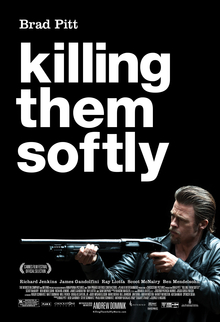
Killing Them Softly - Wikipedia
The Assassination of Jesse James was a wildly impressive American debut by director Andrew Dominik, but the director’s dreamlike, meditative style does not lend itself to a basic, gritty crime story. This tale of a hitman (Brad Pitt) laboring under the fiscal corner-cutting and meddling of his employers on a pedestrian job is dull, and no amount of pretty slow-motion photography can change that fact. The story is also awkwardly juxtaposed against the 2008 financial crisis and the ascendance of Obama, seemingly all for one supposedly killer line by star Pitt that closes the film. Specifically, referring to Obama’s victory speech, Pitt rejoins: “This guy wants to tell me we’re living in a community? Don’t make me laugh. I’m living in America, and in America, you’re on your own. America is not a country; it’s just a business. Now fucking pay me.”

Oof.  I mean, wince.  Sigh. Then, oof.

If the movie has worth, it is to see James Gandolfini (as a hitman who has lost his nerve) in one of his few post-Sopranos film roles.  

While there are a few scary moments, and the young actor who plays the “disfigured baby” grown up is, in fact, truly terrifying, there are just too many problems to recommend the picture, including–

*  thematic confusion – is this a comedy?  Because if it is, casting such a frightening actor as the demon is a mistake.  Why is the screenwriter wearing sunglasses inside in the middle of winter?  Why is the neighbor wearing a Virginia Tech hoodie?  And why does he smile so much and then screech intermittently?

*  mumble mouth dialogue from the young actor playing the neighbor (he tells us the story of the house but we can’t understand him) and over-acting (“Who could that be?”) from the protagonist, who distrusts the script and opts for a play-by-play narrative.

*  sloppy editing – why use tracking shots if your actors are going to be looking back as if being chased by the camera?

*  poor scene locations – the haunted house is dank and scary, but it seems that a young screenplay writer who just moved into it would not have a Batman pillow case and  a life size figurine of Batman.

*  Will Larroca’s insistence on playing the lead was too much of a distraction.  He seems to be giving non-verbal direction to the camerman.

Again, this is a shame, because the actor playing “The Monster” is bone-chillingly good.

Word on the street is that the writer/director/star is in pre-production for another horror film, and he has some money behind it.  It may be make or break.

UPDATE:  My review has been reviewed, and rather unkindly

David Chase’s The Sopranos was a titanic television achievement, a violent, rich soap opera centered on a New Jersey crime family, adroitly crossing into the areas of everyday life of “civilians” and finding common cause in the political, familial, and cultural. But Chase was more an organizer of talent than a creator – he wrote very few of the episodes and only directed two. This is not a knock, but it may be relevant in evaluating Chase’s first underwhelming feature length film, Not Fade Away.

The picture opens with the chance first meeting of Keith Richards and Mick Jagger but quickly swings back to 1960s New Jersey, where another band is forming. Chase captures the awkwardness of the early house show; the various personalities (the guitarist who always needs more time for the band to be “ready” and the jealous former frontman, sidelined to back-up because of a weaker voice); and the juice of a well-played song.

But just when you think the story might go somewhere, Chase reverts back to the lead singer’s (James Magaro) depressing home life, where his dying father (James Gandolfini) harangues him for his long hair and his mother kvetches in full Livia Soprano mode. When we get back to the incremental steps of the band, we are again diverted to the domestic woes of Magaro’s girlfriend (Bella Heathcoate) and her own miserable homelife (her Dad is a scotch-swilling GOP square and her sister is a free spirit soon to be forcibly institutionalized).

The leads are weak. As the band’s budding lead singer, Magaro provides no more than smarm and edge, though he performs a convincing transformation from dork to Dylanesque cool. His mercurial girlfriend Heathcoate is leaden and charmless.

Worse, very little happens in this dark (and by dark, I mean inexplicably dimly lit, as if the 60s is best evoked by dingy exposition), moody, mostly joyless picture. We get some affecting vignettes and then what feels like filler after there is no follow up. The end is a preposterous paen to the power of rock n’ roll that is more peculiar than poignant.*

That said, had this been the first two episodes of a miniseries, who knows? I certainly would have continued to watch.

*. Having just read this sentence, I am forced to add “so put that in your pipe and puff on it, Pancho.”

1993's "True Romance" | Films complets, Film, Affiche film

Quentin Tarantino’s bona fides, established by the success of Reservoir Dogs, led to production of his script for Tony Scott’s overpraised and over-copied True Romance, a deafening whiz-bang, shoot ’em up.  A comic book store clerk in Detroit, Clarence (Christian Slater) happens upon a whore named Alabama (Patricia Arquette) in a movie theater during a triple feature of kung fu flicks.  Alabama likes kung fu flicks, a true romance is born, and Slater is driven to confront her pimp (Gary Oldman, playing black), in the process unknowingly stealing a million dollars worth of cocaine from the mob. He and Alabama are soon off to L.A. to sell the coke, and bloodshed ensues.

Tarantino’s voice is dominant, and we get a steady dose of racial epithets, tough guy jargon borrowed from previous genres, movie references (two on Steve McQueen) and the like. On the plus side, we also get a few taut and funny exchanges, the best being the fencing between Slater’s father (Dennis Hopper) and the mob underboss (Christopher Walken).

Unfortunately, the actors all appear to be vying for the Best Supporting Actor in a Quirky Scene of Tarantinoesque Patter, and many are not up to the task. Hyped-up cops Tom Sizemore and Chris Penn are particularly awful, but Gary Oldman’s excess nears embarrassing and Saul Rubinek’s Hollywood producer is a tiresome cliche’ of every oily movie mogul you’ve ever seen in film. While Walken and Hopper can do something with Tarantino’s writing, they are aided by their set piece scene, which is essentially two monologues. Those who are asked to act have a rougher go.

Which bring me to the leads. Slater handles the tough-guy patois but there’s no heart. He’s a loser but doesn’t feel like one. He’s a tough guy but doesn’t project. Mainly, he’s a nasally Nicholson wannabe who becomes increasingly grating. Arquette is better, but she’s not good, nor is she much more convincing. Her “whore with a heart of gold” is trite and cloying, and it isn’t until a later scene, where she fights for her life with the psychotic hit man James Gandolfini (in prep for Tony Soprano), that she communicates any depth.

Recently deceased director Scott (Top Gun, Crimson Tide, Enemy of the State and numerous other flashy, soulless action pictures) papers over the dull leads with a brisk pace, but his super shootout clusterfu** of a finale is laughable. It’s hard to identify what is worse – the implausibility, the slo-mo explosions, or the fluttering feathers from shot up pillows – but coupled with Tarantino’s by now played out macho dialogue (before an execution, Penn actually says, “this is for Cody”), this is as bad as it gets. Sadly, this kind of thing spawned a generation of allegedly hip, super violent copycat films.

A barely competent remake, James Mangold’s follow-up to Walk the Line pits brutal and charming highwayman Ben Wade (Russell Crowe) against desperate and pitiful rancher Dan Evans (Christian Bale). Bale is scratching a living out of the barren Arizona earth, debilitated by a war injury, harassed by a businessman who wants his land for the railroad, and scorned by a 14 year old son (Logan Lerman) who thinks his father is a coward. When his path crosses with Crowe, Bale takes the high-paying gig of joining a crew ferrying Crowe to town and on the train to justice, harried the entire way by Crowe’s gang, led by Charlie Prince (Ben Foster). Unfortunately, Bale is so stolid he borders on dull, and Crowe’s lethal charm is in short supply, though he does have a moment seducing a local barmaid.

Mangold keeps the story crisply moving and his action sequences are first-rate.  While the leads don’t shine, the support is strong. Foster’s serpentine, scary right hand is matched by the crusty and seemingly indestructible Pinkerton subcontractor Peter Fonda and the precise Dallas Roberts as the main Pinkerton and leader of the endeavor.

The film, however, is nearly undone by an implausible ending wherein Crowe and Bale bond through a series of mutual confessions (Crowe’s mom abandoned him, Bales was shot by his own man in the war, and Bales’s son is sick with tuberculosis) and Crowe repents, assisting Bale in his own ferrying to the hangman’s noose.