Archive

0 stars

Th signature achievement of the reign of John Hughes.  During his run, Hughes wrote and/or directed the following teen dramedies– Pretty in Pink, Sixteen Candles, The Breakfast Club, Weird Science, Ferris Bueller’s Day Off, Some Kind of Wonderful, Uncle Buck and Career Opportunities.

Hughes offered a certain corporatized schmaltz and sentiment, and there are worse Hollywood epitaphs.  Hughes also provided a silly, devil-may-care ethos for affluent suburban high schoolers (Hughes grew up middle class in tony Grosse Pointe, Michigan) and he could deliver a bravura screwball scene, such as Ferris Bueller’s rock out during a Chicago parade or John Candy crashing a teen party in Uncle Buck. At the end of his films, a trite lesson was always learned, and opposites always came together for a hug of understanding.

Nestled in this treacle, however, was a bit of nastiness fully realized in The Breakfast Club.  A group of kids – the geek (Anthony Michael Hall), the jock (Emilio Estevez), the weirdo (Ally Sheedy), the hood (Judd Nelson), and the “it” girl (Molly Ringwald) – all must spend a Saturday in detention together.  It becomes a group therapy session, and the archetypes – initially hostile to each other – soon find solidarity in their hatred of the school administrator (Paul Gleason) and the fact that it appears they each have something in common – an oppression at the hands of their cretinous parents.  Nelson is burned by cigarettes (given the school, one presumes Dunhills); Hall is so pushed to succeed academically he has contemplated suicide; Estevez is also driven by his overbearing father, and his torture is so great he actually starts to punch himself ; and Ringwald explains her homelife thusly when asked if she can go to a party:

                            CLAIRE
I don’t know, my mom said I was [grounded] but my dad told me to just blow her off.
                           ANDREW
Big party at Stubbies, parents are in Europe.  Should be pretty wild…
                           CLAIRE
Yeah?
                          ANDREW
Yeah, can you go?
                           CLAIRE
I doubt it…
                         ANDREW
How come?
                           CLAIRE
Well ’cause if I do what my mother tells me not to do, it’s because because my father says it’s okay.  There’s like this whole big monster deal, it’s endless and it’s a total drag.  It’s like any minute… divorce…
                            BENDER
Who do you like better?
                            CLAIRE
What?
                            BENDER
You like your old man better than your mom?
                            CLAIRE
They’re both strict.
                            BENDER
No, I mean, if you had to choose between them.
                            CLAIRE
I dunno, I’d probably go live with my brother.  I mean, I don’t think either one of them gives a shit about me…it’s like they use me just to get back at each other.


Hall adds: “…I don’t like my parents either, I don’t…I don’t get along with them…their idea of parental compassion is just, you know, wacko!”

Then it is the jock’s turn:  “Um, I’m here today…because uh, because my coach and my father don’t want me to blow my ride.  See I get treated differently because uh, Coach thinks I’m a winner.  So does my old man.  I’m not a winner because I wanna be one… I’m a winner because I got strength and speed.  Kinda like a race horse.  That’s about how involved I am in what’s happening to me.”

Cue the tough, doing his own impression of his house:  “(as his father) Stupid, worthless, no good, God damned, freeloading, son of a bitch, retarded, bigmouth, know it all, asshole, jerk!  (as his mother) You forgot ugly, lazy and disrespectful.”

The jock rejoins, explaining that he taped a classmate’s ass together.  Why?  “I did it for my old man…I tortured this poor kid, because I wanted him to think that I was cool. He’s always going off about, you know, when he was in school… the wild things he used to do . . . it’s all because of me and my old man.  Oh God, I fucking hate him!  He’s like this…he’s like this mindless machine that I can’t even relate to anymore…’Andrew, you’ve got to be number one!  I won’t tolerate any losers in this family…Your intensity is for shit!  Win.  Win!  WIN!!!’  You son of a bitch!  You know, sometimes, I wish my knee would give…and I wouldn’t be able to wrestle anymore.  And he could forget all about me…”

Just to make sure we get the message, Gleason is the biggest prick in the world, an amalgamation of every insecure, bullying teacher in the continental United States.

There’s not a genuine moment in the picture nor a hint of deviation from its blame-shifting orthodoxy.

Hughes has always included some of this foolishness – the parents in Uncle Buck are too committed to their jobs, Alan Ruck’s father in Ferris Bueller’s Day Off cares more for his sports car than his son.

But The Breakfast Club’s attack on the cruel, neglectful parents is the primary theme of the picture and Hughes uses it to portray these five kids (three of whom do appear to be sh**heads of the highest order) as victims.

Look, children can be obnoxious, and teens doubly so, but there is perhaps nothing more unpleasant than encountering a self-pitying teen who bemoans his vaunted station just as he nears the age when lesser forebears were jumping into a hot LZ in Vietnam.

Hughes died recently of a heart attack.  He was a bit of a recluse in his later years.  I wonder if the stereotype of the suffering, whining rich kid he presented in The Breakfast Club contributed to his distress, either because he was prescient and had to live with it or he felt he had a hand in cementing the mold.

In a Vanity Fair piece after Hughes’s’ death, David Kamp wrote “As hoary as it sounds, The Breakfast Club spoke to a generation.”

Unfortunately, it appears they were listening.

My boy read that The Expendables 2 had gotten decent reviews, we both appreciate a good shoot ’em up, and The Expendables was available streaming on Netflix.  We made it about 30 minutes in to this star-studded, macho story of a group of mercenaries bound together by brawn, honor, anabolic steroids, and in some cases (leader Sylvester Stallone, rival Arnold Schwarzennegger, and tattoo artist/operation facilitator Mickey Rourke), plastic surgery. 

We couldn’t understand Stallone, Rourke or Schwarzenegger half the time, the action was unimaginative, and the banter was either painful (Randy Coutre of the UFC is given lines instead of grunts, and the results are not pretty) or uncomfortably homoerotic.  This not-safe-for-work clip begs the question – are these guys gonna’ fight or kiss?

But what do we know?  Domestic and foreign, it grossed a quarter of a billion dollars.


Having seen The Avengers, I’m backtracking to the source movies. The first Iron Man was clever; the second near incomprehensible. Thor was above average. The Hulk movies will have to wait, be it the Ang Lee Hulk movie starring Eric Bana or the later version with Edward Norton. I still can’t get over how, if you have a mutation that makes you really big, your pants expand as well.

They didn’t do that in Watchmen.

Moving on.  Captain America tells the story of a rail thin kid (Chris Evans) whose had plenty of sand kicked in his face.  All he wants to do is go to Germany and fight Nazis, which is particularly pressing because one Nazi (Hugo Weaving) is fooling around with the supernatural to become even stronger and more diabolical than Hitler (see Raiders of the Lost Ark, Hellboy).  Stanley Tucci, the German-American doctor who sees the gentility in Evans, puts him in a machine and soon, Evans is buff and ready to take on Nazis.  He has an inexplicable British gal minder, Hayley Atwell, and a gruff regular army foil, Tommy Lee Jones.  All characters are boring and stock, particularly Evans, who has the face and demeanor of soft butter. A lot of stuff happens after his transformation, but full disclosure – we turned it off after an hour.

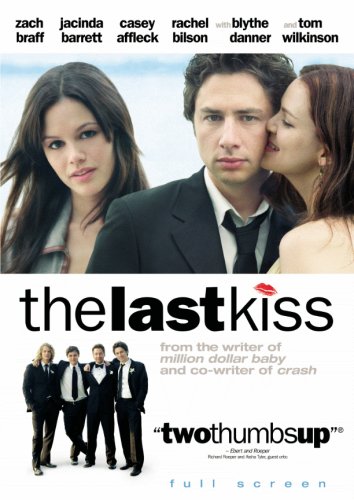
Amazon.com: The Last Kiss (Full Screen Edition): Zach Braff, Jacinda  Barrett, Rachel Bilson, Casey Affleck, Michael Weston, Eric Christian  Olsen, Marley Shelton, Lauren Lee Smith, Harold Ramis, Blythe Danner, Tom  Wilkinson, David

Zach Braff’s gruesome, false dramedy about a guy in his twenties who “has everything” but gets the jitters when his long time girlfriend (Jacinda Barrett) becomes pregnant.  He then recklessly beds a college hottie (Rachel Bilson), and the audience is treated to the extended punishment of his shrieking girlfriend, his unctuous attempts to elicit forgiveness, and side-stories of friends and family similarly bollixed by love, which, as I understand it, reduces everyone to shrieking hysterics.

This indeed may be the way of love for many people, but I sure don’t want to watch it, even with an implausible, redemptive, happy ending.  Braff’s responsibility is minimized.  He only starred in and co-wrote this disaster, with, shockingly, Oscar-winning screenwriter and Scientology attacker Paul Haggis (perhaps this is an excess of Scientology?)

But a curse is a curse, and his post-The Last Kiss, non “Scrubs” work is a cautionary tale — one Canadian movie (The High Cost of Living) and a cameo on a 2012 episode of “Cougar Town.”  He played the pizza delivery guy.

A precocious Welsh teen narrates his way through what director Richard Ayoade clearly hoped would be his Rushmore.  Submarine is no Rushmorefirst and foremost because, unlike Wes Anderson’s Max Fischer, Ayoade’s protagonist, Oliver Tate, is a charmless, boring, dolt whose observations about the world around him are unconvincing, banal, and strain so hard to be wise that they come off as too cute by half.  I should have seen it coming, as the film opens with an obnoxious written note to American audiences from the character of Tate introducing us to Wales and thanking us for not invading his country.  Thereafter, Tate’s dull voiceover intones that he does not like scenery, he believes his neighbors are ninjas, he can only see himself in a “disconnected reality” and other like observations meant to be charming and insightful.  He’s also monitoring the sexual activities of his parents by checking their bedroom dimmer switch. Full disclosure: my son and I turned it off after 11 minutes.

Former police officer Jack Nicholson is haunted by the murder of a little girl, so much so it tests his sanity.  He finds the love of a good woman (Robin Wright Penn), who has a little girl as well, but he remains haunted and, as near as I can tell from this complete mess of a movie, goes insane.

Sean Penn directed this picture, which was released in 2001 (he directed another similarly dark mess of a movie released that same year, The Crossing Guard, so perhaps this was a phase).  The film is clumsy, uninvolving and disconcertingly showy.  Penn can’t just have a cop walk into a room without cross-cuts to the ticking clock and the face of a fat, stupid common clerk telling us something (but what?).  Nicholson can’t drink at a Nevada airport bar without pointless flash cuts to whirring slot machines.  Not only does all this jazz lead to continuity problems (Nicholson’s scotch miraculously becomes a beer), it is annoying.

The Pledge also demonstrates Hollywood’s disdain for the working class.  Set in the flatland of Nevada, Robin Wright Penn, Sean’s then-wife, is a vessel of all Hollywood presumptions about regular folk.  She plays a barmaid.  She has a gnarled front tooth.  She is a little dim.  She wears a lot of flannel.  And when her savior Nicholson comes to love both her and her daughter, we know that they will commune because  . . . Nicholson fixes her tooth!  I mean, let’s not take this working class thing too far.  We can’t expect Jack Nicholson to have sex with woman with a gnarled tooth.

Ewwwwwwwwwwwwwwww.

Another problem?  Penn uses top actors for single scenes, so each feels compelled to ACCCCCCCCCCCTTTTTTTTTTT! like there’s no tomorrow.  Benicio Del Toro, Vanessa Redgrave, Mickey Rourke, Helen Mirren, they all emote for a brief, generally unnecessary scene, and boy do they make the most of it.  Also, the little girl is killed on the day of Nicholson’s retirement party.  If Penn directs a war picture, God help the character who shows his platoon mates a picture of the gal he has at home waiting for him.

That said, I was a big fan of Penn’s more restrained and mature Into the Wild, directed 6 years later, so I chalk The Pledge up to practice.

This boring, blaring, hackneyed remake of The Poseidon Adventure cost $160 million to make and made $181 million at the box office.  It was nominated for a best visual effects Oscar, but I have questions:

1.  Who casts Kurt Russell as the former mayor of New York City?  San Pedro, maybe.  But The Big Apple?  Look at this guy?

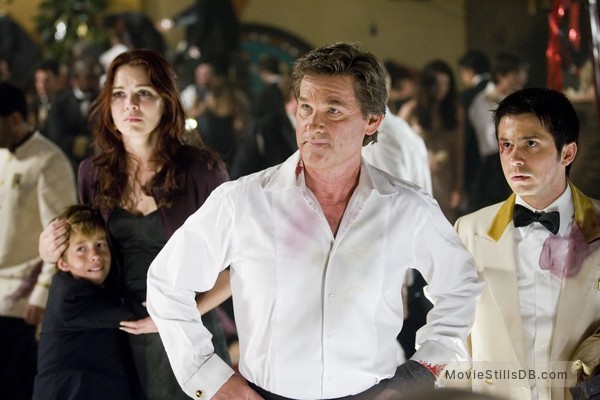
Poseidon - Publicity still of Kurt Russell & Emmy Rossum

2.  How good is Kevin Dillon?  He walks right in as Johnny Drama from HBO’s “Entourage”, says “Look at me, I’m Mr. Lucky” and then he dies.  $1 million?

3.  Fergie is the singer.  But she doesn’t sing “There’s Got to Be a Morning After.”  Huge mistake.

4.  I miss Shelly Winters.  Why couldn’t she cameo?  She died the year it was released, but still . . . .

5.  I liked Andre Braugher as the new captain.  But why he didn’t get to say “Oh My God” as the wave hit, like Leslie Neilson?

Now this was a movie!

Amazon.com: Glory Road [Italian Edition] : derek luke, jon voight, james  gartner: Movies & TV

It is hard to find a worse sports movie than the hackneyed and overwrought Remember the Titans, but after Glory Road, I was almost wistful for the homespun wisdom of Denzel Washington and the beatific look on Will Patton’s face as racial understanding dawns upon him.

No matter what you may think of the delivery of Remember the Titans, and I think very little of it, with a few exceptions, it hewed however loosely to actual historical events. There was a high school football team in Alexandria, Virginia. The school was recently desegregated. The team did get a black coach and he did make the whites sit with blacks on the bus and the team did win the championship. Sure, the film exaggerated racial tensions, but that much is to be expected. It can’t be “feel good” if at first we don’t “feel bad.”

Glory Road is every bit as maudlin and formulaic as Remember the Titans (both films were produced by Jerry Bruckheimer, blast Motown, show the trading of racial culture between young men in the form of dance moves, and teach us valuable lessons about what’s “in here”) but it is also a perversion of history that goes way over the line.  Yes, 5 black men played on the 1965-66 Texas Western NCAA winning basketball team and yes, they were coached by Don Haskins.  This much is true.

But it wasn’t that big of a deal.  A decade before Texas Western won, the undefeated 1955-56 University of San Francisco team won the NCAA championship with a team that played four blacks — Bill Russell, K.C. Jones, Hal Perry and Gene Brown.  In 1958, the coaches’ All-American team was all black — Wilt Chamberlain of Kansas, Oscar Robertson of Cincinnati, Bob Boozer of Kansas State, Guy Rodgers of Temple and Elgin Baylor of Seattle.  In 1962, the University of Cincinnati started four black players when it won the NCAA championship.  Loyola University of Chicago started four when it won in 1963.

We also have the sports announcer screaming, “Who ever heard of Texas Western?”

A lot of people. Texas Western was a regional third place finisher in the 1964 NCAAs.

So, that sucks, but it gets worse.

The reason 5 black players got the start (and 7 played) was mundane – Haskins thought they were the best players.

Not so in the film.  Instead, we get some p.c. twaddle wherein Haskins tips his desire to make a statement to the team and the white players actually agree not to play so a larger societal point can be made.

How the screenwriter came to the conclusion that it was more edifying to make the achievement a gift from whites rather than earned by blacks, well . . . that’s for another day.

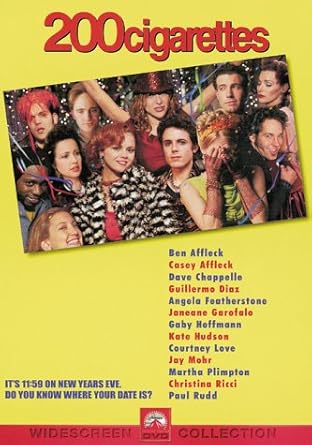
Image result for 200 Cigarettes"

From IMDB: “A collection of twentysomethings try to cope with relationships, loneliness, desire and their individual neuroses.”

Oh goodie.

A ponderous picture about one New Year’s Eve in the early 1980s and the intersection of a bunch of New Yorkers in the city on that night. They chatter and say cute things and go on and on about the meaningless of it all. They also over-emote and incessantly navel-gaze.

They started making these ensemble/group hug/chit chat/why are we here? movies after the insidious The Big Chill which spawned the terrible Reality Bites.

Nothing is funny – save one Janeane Garafolo line (“These matches are disappointing me”) and one Ben Affleck attempt at a pick up line (“How do you like your eggs in the morning? Scrambled or fertilized?”). Other than that, the film is awful. Everyone is bad, but special merit for over-the-top histrionics goes to Christina Ricci, Martha Plimpton, and Paul Rudd.

The director, Risa Ramoan Garcia, wasn’t given another film to helm for 11 years. He has, however, paid the bills as a casting director for CSI.

The writer, Shana Larsen, never wrote another movie.

Enough said.

Denzel Washington plays a high school football coach in 1970s Alexandria, Virginia. Washington is given the head coaching job in the middle of the integration wars. Making matters worse, he replaces Will Patton, the soft-spoken former coach, who responds with a bruised ego but a determination to stay on as an assistant coach for “his boys.” There are racial tensions between Washington and Patton and between the now integrated high school football team.

No worries, though. All those tensions are erased by group sings, group hugs, group showers, the iron-fist of the strict Washington, and the velvet touch of the gentle Patton.


“THIS IS A VALUABLE TEACHING MOMENT, SON.”

The lessons are fired into your brain with the subtlety of a nail gun, and the cliches pile up quicker than you can say After School Special.

The black players can sing and dance, and they soon turn those slow-footed white boys into singers and dancers.

The black defensive captain is angry and he lacks the concept of team, so the white defensive captain shows him what teamwork really means.

Washington is a “My way or the highway” kind of guy, yet Patton shows him that improvising and being receptive to new ideas can make him a better coach.

Patton is too gentle on the black players, a repressed form of condescension, so Washington points this out, and dag gummit, Patton learns to be tough.

Oh, and for the most part, the story is a concoction churned out by the Hollywood folks who gave you the slow clap, “don’t you die on me!” and racial healing via dancing to Ain’t No Mountain High Enough.

As for what one would hope could be a saving grace in a sports picture, the football is laughably inauthentic. Altman filmed better sports footage in M*A*S*H.

If your intelligence isn’t insulted, as the screenwriter might observe, “Houston, we have a problem.”