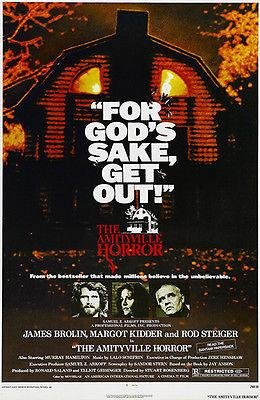
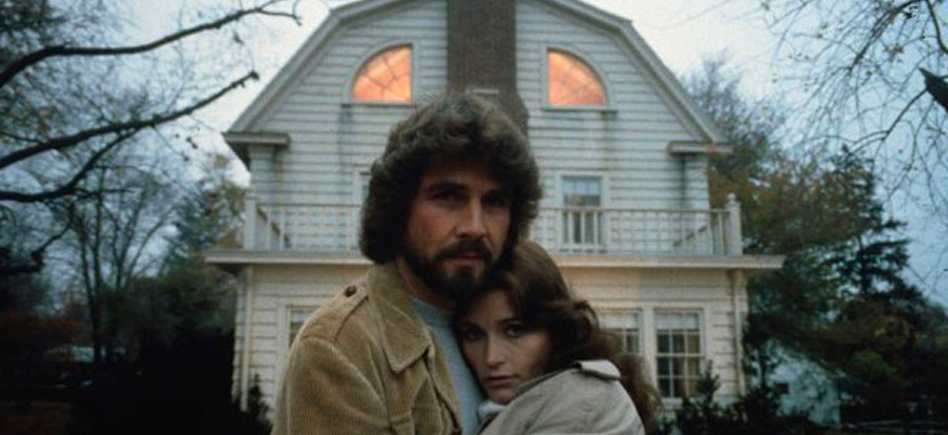
Often listed as a top picture in the horror genre, this 1979 release is rather dull and clunky. Based on a “true” story that is decidedly untrue, the Lutz’s (James Brolin and Margot Kidder) move into a cheap dream house in Long Island knowing full well a 20 year old murdered his entire family there the year before. When their local priest, Rod Steiger, comes to bless the house, the demons therein drive him out and eventually, blind him. The house soon possesses Brolin, and Kidder (and her three children) are endangered.
The house itself is awfully creepy and the score features a chilling sing-songy ghostly whisper of children’s voices. But Brolin is flat and ridiculously coiffed, even for 1979, Kidder is uninvolved, the children may as well have been mannequins, and Steiger overacts the hell out of his role.
Performances aside, the movie just isn’t that scary. Sure, flies congregate, the walls bleed, creepy eyes shine in the window, and there appears to be a guy dressed as the devil behind a wall in the basement, but these features come off about as frightening as a decently prepared house on Halloween. Director Stuart Rosenberg, who helmed some interesting films (Cool Hand Luke, The Drowning Pool) is clearly uncomfortable with the genre, and apart from some disturbing externals of the house, offers very little visually. It’s a blocky, uninteresting picture, and the ending (Brolin goes back for the dog!) is ridiculous, though not as ridiculous as when locals tell Brolin he is the spitting image of the 20 year old killer.
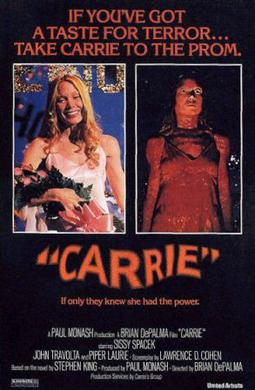
Carrie is often listed as one of the scarier films of all time (untrue) and one of the better adaptations of a Stephen King scary novel (true – in fact, The Shiningand Salem’s Lot are the only rivals). It certainly has a staying power, so much so it has spawned two remakes and a Broadway musical.
The story is simple. Untutored by her religious zealot/lunatic of a mother (Piper Laurie), Carrie gets her period in the shower after gym class, naturally freaks out and is humiliated by her classmates. When one of the more thoughtful ones (Amy Irving) tries to make amends by having Carrie escorted to the prom by her popular boyfriend (William Katt), one of the less thoughtful ones (Karen Allen) doubles down on the humiliation. Carrie, who has become increasingly aware of her telekinesis, responds, er, inappropriately.
Brian DePalma caught a much deserved rap for overly-aping Alfred Hitchcock, especially in his early films, and Carrie, his breakout picture, is Exhibit A. It opens with a shower scene, Pino Donaggio’s score is Bernard Hermann through-and-through (Hermann was supposed to score the picture but died before filming), and when Carrie uses her powers, we hear the 4 note violins of Psycho. The scene leading to Carrie’s ultimate indignity, where a bucket of pig’s blood is spilled on her head, speaks for itself (and much of Hitchcock’s oeuvre). Some mock the picture for this fealty, but there are worse directors to copy.
Hitchcock aside, Carrie stands on its own, even if some of its filler seems cheezy and dated. Laurie is riveting in her fanaticism (and her depressing prescience – they all did laugh at her), Irving and Katt offer an unheralded sweetness to the story, and the prom scene, projected with a gutsy and effective split-screen technique, is loaded with indelible, nightmarish visuals.
But the engine of the picture is Spacek, who DePalma makes downright homely and spooky. We all knew a kid like that in school. A few tormented her. A few were kind. Most ignored her, perhaps tactically, or laughed meekly when she was catching hell. Or, you just looked right through her. Spacek shows her pain and her promise, which is viciously crushed by the bullies.
So, it’s hard to root against her, even in the midst of her wanton slaughter.
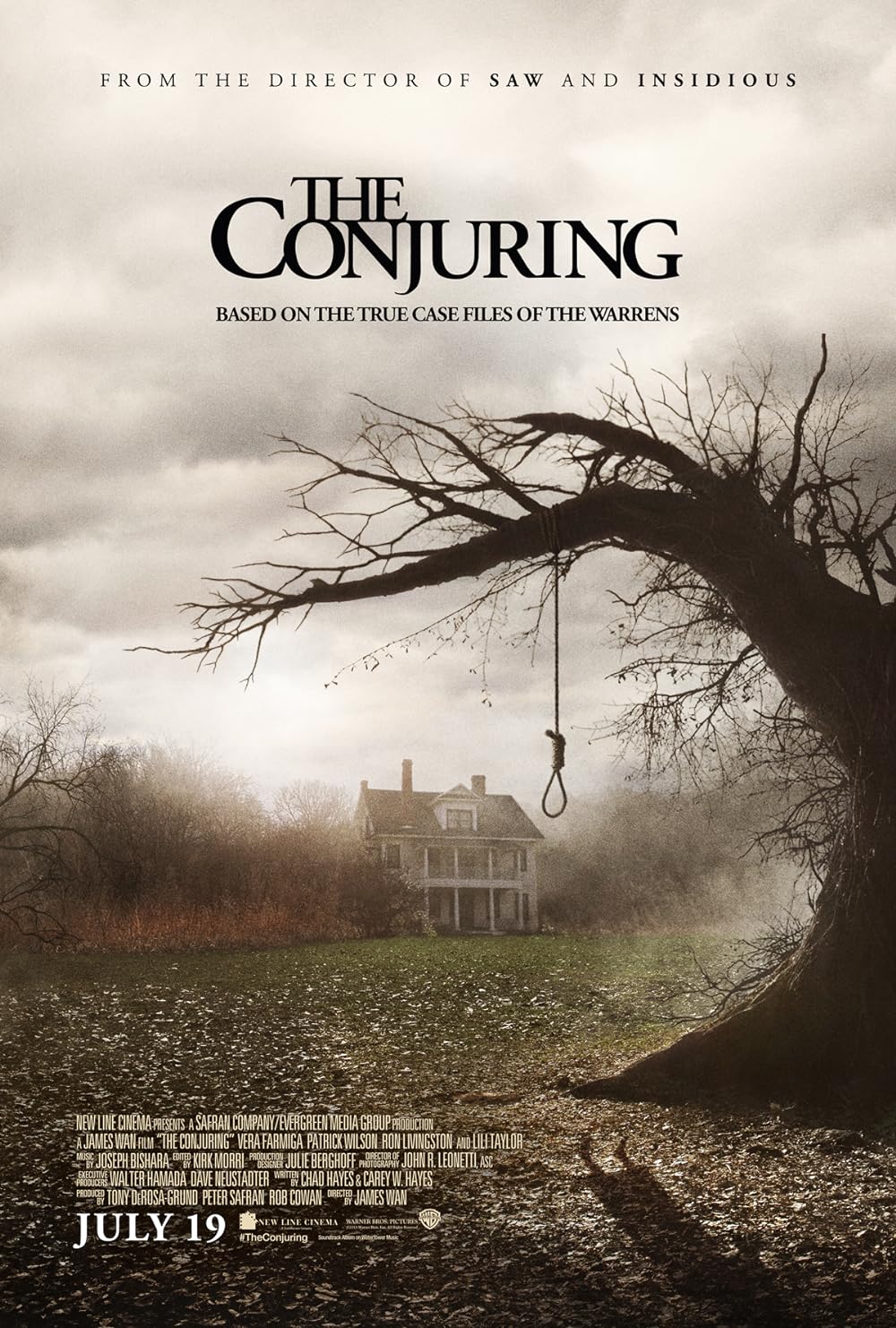
An old-fashioned, creepy mash up of The Amityville Horror and The Exorcist, the film opens with rare restraint, and it remains for the most part intelligent and taut. When it gets going, like director James Wan’s prior, impressive Insidious, it can freak you the hell out.
Two minor criticisms.
While Vera Farmiga (as the medium who, along with her demonologist husband Patrick Wilson, makes a living of studying/expelling ghosts) is very eerie and committed, the actual homeowners (Ron Livingston and Lili Taylor) seem a bit too calm and even dull. Livingston, of Office Space fame, is really no more than a smirk, a smaller budget’s Ryan Reynolds, and the haunting of his home and terrorizing of his children comes off as humdrum to him. Wilson is similarly uncommitted, and two characters included for presumably comic relief, a sheriff and student who assist in monitoring the house, make little impression.
The movie also seems rushed. 20 more minutes devoted to uncovering the history behind its malevolence would have been well spent. Instead, Farmiga has its entire history laid out like she Googled it. The movie, however, is set in 1971, when there were no search engines. Not even Ask Jeeves!
This is a gripping, dystopian roller coaster ride, intelligent but not dense. Marc Forster, who showed action skill in Quantum of Solace, opens with an enthralling scene. Brad Pitt, wife Mireille Enos, and two daughters are stuck in downtown Philadelphia traffic as a fast-moving rabies epidemic sweeps the city, and by fast, I mean that people are transformed into frenetic, vicious predators 10 seconds after a bite. Complete societal breakdown follows, but Pitt, who has experience as a U.N. global crisis expert, is extracted and tasked with investigating the source in an effort to combat the epidemic.
There are some ragged connections as Pitt goes from the U.S. to South Korea to Jerusalem to Cardiff, but his journey is packed with thrills and terror. Better, there is none of the preaching and sophistry so typical in modern dystopian films. Screenwriter Matthew Michael Carnahan (State of Play), with an assist from a couple of the writers of Lost, stays focused on moving the story forward and avoiding cliche’, showing no interest in the standard “what have we done?” crapola. I kept waiting for the suits to show, explaining that things just got out of hand when the military tried to weaponize and/or the evil corporation tried to monetize. Thankfully, they did not.
Forster’s judicious use of CGI is also to be commended. While the digital monsters of I Am Legend became less terrifying the more you watched them up close, Forster only uses CGI in broad scope, to show the mass of humanity infected, moving almost as an ant colony. Up close, real people play these very gruesome zombies, and they are frightening.
Finally, the film embodies an “every man for himself” quality that is refreshing and eschews the hackneyed twin of “what have we done?”, the dreaded “what have we become?” When an 18 wheeler tries to make his escape from Philadelphia at high speed, crushing innocents left and right, Pitt pulls his car into the lane opened up to escape, marveling at his good fortune. When the authorities, ensconced in a naval ship, believe Pitt has died in his efforts, his family loses their most favored civilian status and are evacuated to the more dangerous site of a refugee camp in Nova Scotia. This is the moment when a bad screenwriter would have penned Enos’ “how could you?” speech to the chastened authorities. Instead, she stoically accepts the verdict.
Finally, the set piece, and there are several, are finely drawn. The scene in the airplane is particularly memorable.
I recently saw a “filmumentary” on Jaws and realized I had not reviewed the greatest summer movie ever made, an astonishing, deep blend of adventure, terror, and action, communicated by Stephen Spielberg’s great eye, the deft casting of three disparate principal actors, and a John Williams score that evokes fear and exhilaration.
Spielberg at the advent of Jaws was hardly a wunderkind. Like William Friedken before The French Connection, Spielberg had a pedestrian resume’ — a Columbo, a few TV movies and an okay feature (Sugarland Express). With a production plagued by everything from the mechanical failures of the shark to the tax problems of star Robert Shaw (if he spent more than a certain amount of time in the U.S. he would face a tax liability, so he was flown to Canada on his days off), Spielberg took Peter Benchley’s piece of summer pulp and fashioned a moving, ingenious film, evident from the opening scene credits, which give us a shark’s point of view in what is the still and peaceful deep, an image followed by the jarring, horrifying massacre of the shark’s first victim, alone, at night, where none of us ever want to be.
Like Friedken in The Exorcist, who prefaces the introduction of the demon in the child only after an hour of exposition, Spielberg waits quite some time to show us the shark in full, making what is happening beneath the water all the more frightening. Indeed, when we see the second fatality (a little boy on a raft), it is from the vantage point of a beachcomber lazing in his chair, a brief, violent act that immediately makes the viewer question, “what the hell was that?”
After Spielberg stuns the audience, he introduces them to poor Chief Brody (Roy Scheider), a landlubber from New York who marshals for the summer town of Amity, As the bodies pile up, it is Brody who succumbs to the pressure of the townsfolk dependent on summer dollars, only to be shamed by his malleability. Emboldened and in need of reclamation, Brody is assisted by the articulate and passionate wisecracker, oceanographer Matt Hooper (Richard Dreyfus) and old salt Quint (Robert Shaw). The former wants the scientific find of the century, the latter is a modern Ahab, seeking his white whale, as explained in the famous scene written not by screenwriters Benchley and Carl Gottlieb (a comic writer who presumably penned some of the very funny exchanges in the picture) , but John Milius (writer of Dirty Harry, Apocalypse Now and creator of HBO’s fantastic Rome).
The experience of the three men from their separate vantage points, with their different motives and backgrounds, is the fuel of this picture, not the shark. As good as Milius’ Indianapolis speech is, or Shaw’s monologue to the town leaders opened by his nails on a chalkboard, the scene where Shaw’s grit runs up against Dreyfus’s privilege and Scheider’s quiet authority is better:
HOOPER You’re going to need an extra hand…
Quint turns to see this new voice, and starts walking towards him.
BRODY This is Matt Hooper…
QUINT I know who he is…
BRODY He’s from the Oceanographic Institute.
HOOPER I’ve been to sea since I was 12. I’ve crewed three Trans-pacs —
QUINT Transplants?
HOOPER — and an America’s Cup Trials…
QUINT I’m not talking about day sailing or pleasure boating. I’m talking about working for a living. Sharking.
HOOPER And I’m not talking about hooking some poor dogfish or sand shark. I’m talking about a Great White.
QUINT Are you now. I know about porkers in the water — (throws him some rope) Here. Tie me a sheepshank.
Hooper ties the knot effortlessly.
HOOPER I don’t need to pass basic seamanship.
QUINT Let me see your hands…
He takes Hooper’s hands in his own big bloody fists, and feels them as he talks.
QUINT Ha. City hands. You been counting money. If you had a $5000 net and $2000 worth of fish in it, and along comes Mr. White, and makes it look like a kiddy scissors class has gone to work on it and made paper dolls. If you’d ever worked for a living, you’d know what that means.
HOOPER Look, I don’t need to hear any of this working class hero crap. Some party boat skipper who’s killed a few sharks…
BRODY (interrupting) Hey. Knock it off. I don’t want to have to listen to this while we’re out there…
QUINT What do you mean ‘We…?’
BRODY It’s my charter. My party.
QUINT All right, Commissioner. But when we’re on my ship, I am Master, Mate and Pilot. And I want him… (indicates Hooper) …along for ballast.
BRODY You got it.
During shooting, Shaw rode Dreyfus very hard, making fun of everything from his star status, stature and his ethnicity. Any hostility was used to great effect on-screen.
As good as these three actors are, they are more than ably supported by Lorraine Gary (as Brody’s wife), Murray Hamilton (as the oily mayor) and a boatload of locals who lend the film a great air of authenticity. Again, kudos to the script, because it allows dignity for Hamilton in the aftermath of his grave error, when, shaken at the hospital, he says to Brody, “Martin . . . my kids were in that water too.”
Finally, Williams’ score is a mixture of dread and adventure, the simplicity of dark repetition (“duh, nuh . . duh, nuh . . . dun dun dun dun dun dun dun”) followed by a near-swashbuckling romp as the men seek their quarry.
I never tire of this film and always find some new marvel or nuance when I watch it. If only the Hollywood shit that is shoveled in summer these days could sport 1/10 of the chops of Jaws, the town wouldn’t be losing its shirt.
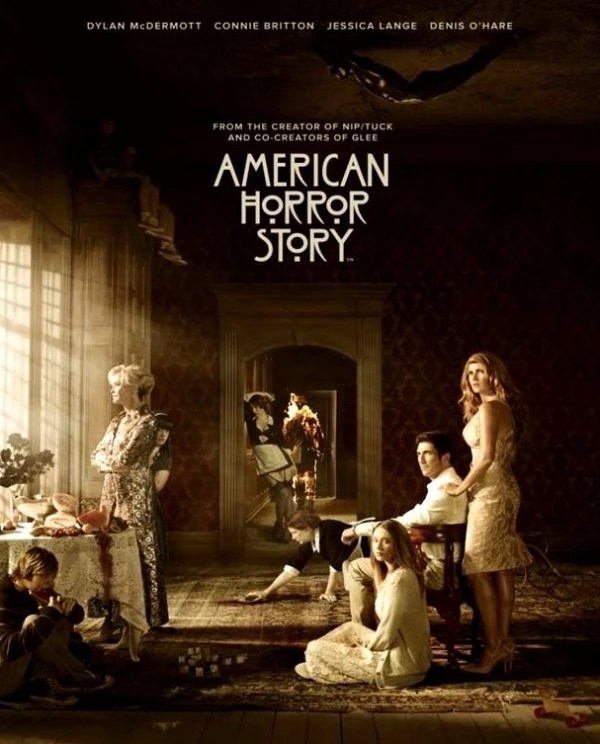
Who would have expected this creepy gem to have come from Ryan Murphy and Brad Falchuk, writers and producers of Glee? Available on Netflix streaming, this 12 episode ghost story is frightening, well-paced, extremely well-acted and on occasion, darkly funny.
The set-up is familiar. Husband and psychiatrist Dylan McDermott and wife Connie Britton flee Boston for LA with their teenage daughter (Taissa Farmiga) after McDermott’s long-term affair with a younger woman (Kate Mara) is revealed. They, of course, find the perfect home at the perfect price, save for an overbearing neighbor (Jessica Lange) who is more than a little tied to the house. It is soon revealed the home is the resting place of numerous decidedly restless ghosts. It’s even a stop on an L.A. “Murder House” tour.
The writers overcome the central problem of any haunted house yarn by first emphasizing the financial duress of the inhabitants (they don’t have the resources to live elsewhere) and then, when anyone in their right mind would live in a cardboard box rather than stay, credibly demonstrating that each family member is possessed in different ways by the ghosts who haunt the place. It sometimes feels like too much of a stretch, and all the balls in the air can be an obvious distraction, but these are nits.
The series is also graced with a plethora of strong character actors, too many to name, but a few notables include Eric Stonestreet (Modern Family), Zachary Quinto (Star Trek), Frances Conroy (Six Feet Under), Dennis O’Hare (Michael Clayton, True Blood), Morris Chestnut (Boyz n the Hood) and Mara (House of Cards). These characters – tied to the house but with differing agendas – provide the backbone of the series.
It’s also clever. For example, Frances Conroy plays the housekeeper, and to Britton, she appears as a stern but reliable partner in the bitter war she is having with her husband.
But to McDermott, the housekeeper presents as a much younger Alexandra Breckenridge, posing a larger problem for the straying husband
An example of the perverse humor – when Farmiga catches her father in a compromising position with the cleaning lady, she sees Conroy, not Breckenridge.
An ingenious concept undone by a tedious pace, a dull heroine, an indecisive tone, and a cheezy feel.
First, the concept. The world is post-apocalyptic and zombies mill about, waiting to eat human brains. One twist – when they eat the brains, they get a rush of the memories of the prior owner. Our protagonist. Nicolas Hoult (About a Boy, X-Men: First Class) eats the brains of Dave Franco (brother to James), fiance’ to Teresa Palmer, and immediately falls in love with Palmer. So, he saves Palmer’s life and an unlikely romance ensues. So far, so good.
Palmer, clearly an acolyte of the Kristen Stewart school of acting, makes no impression. She’s all smarm and attitude and lacks any depth necessary for material deeper than Glee. It may seem like niggling but it is not, because she has to convey that she has fallen for a zombie. She doesn’t come close.
With Palmer failing to communicate a romance, what is left is the scary. It is not scary, at all, and the use of CGI skeletors – really evil zombies who have lost all their flesh – suggests the old stop motion visual effects of the Harry Hamlin Clash of the Titans – and not in a good way.
Since it is not scary, it should be funny. After all, talk about your clash of cultures. But it is only occasionally amusing. Hoult, whose speaking is necessarily rudimentary, mainly mumbles and moons at Palmer. While he is given a voiceover to explain what he feels and sees, the observances are pedestrian.
The picture looks just awful – again, not in a good way. The post-apocalyptic world looks more like a Meadowlands dump, the encampment where the humans are holding out looks like the porn set of a parody (Dawn of the Head? apologies)*, and in comparison to Zombieland or even The Walking Dead, the feel just seems chintzy.
It’s also deathly slow. At only 90 minutes, I started to feel like the zombies themselves, numb and mindlessly staring at the TV, waiting desperately for something to chew on.
While there are a few scary moments, and the young actor who plays the “disfigured baby” grown up is, in fact, truly terrifying, there are just too many problems to recommend the picture, including–
* thematic confusion – is this a comedy? Because if it is, casting such a frightening actor as the demon is a mistake. Why is the screenwriter wearing sunglasses inside in the middle of winter? Why is the neighbor wearing a Virginia Tech hoodie? And why does he smile so much and then screech intermittently?
* mumble mouth dialogue from the young actor playing the neighbor (he tells us the story of the house but we can’t understand him) and over-acting (“Who could that be?”) from the protagonist, who distrusts the script and opts for a play-by-play narrative.
* sloppy editing – why use tracking shots if your actors are going to be looking back as if being chased by the camera?
* poor scene locations – the haunted house is dank and scary, but it seems that a young screenplay writer who just moved into it would not have a Batman pillow case and a life size figurine of Batman.
* Will Larroca’s insistence on playing the lead was too much of a distraction. He seems to be giving non-verbal direction to the camerman.
Again, this is a shame, because the actor playing “The Monster” is bone-chillingly good.
Word on the street is that the writer/director/star is in pre-production for another horror film, and he has some money behind it. It may be make or break.
This Guillermo del Toro produced ghost story is scary, judiciously using the shock techniques of The Woman in Black, and intriguing, developing an actual mystery behind the horror. First time director Andres Muschietti is confident, evoking the creepy feel of The Ring, and Jessica Chastain and Nikolaj Coster-Waldau (Jamie Lannister in Game of Thrones) are convincing as the caretakers of two girls found abandoned in a Virginia cabin 5 years after their father (Coster-Waldau’s brother) absconded with them and disappeared. Upon discovery, it turns out the girls have been adopted by a new, more sinister force. A little more patience and exposition prior to the gripping finale, and less of a CGI bonanza during that finale, could have made this a horror classic. As it is, it’s pretty damn good.
The Bay had a few things in its favor going in. Director Barry Levinson is no slouch. The “found media” approach is appealing to me, as is evidenced by my affection for the Paranormal Activity movies. And the premise – a small Maryland town is plagued by a bacteria that cuts through it on a July 4th celebration – had promise. Two factors, one personal to me and the other a colossally stupid decision on Levinson’s part, resulted in my turning the flick off about a third in.
I’ll take my lumps first. I can handle slashers (if not gore porn), serial killers, unsettled ghosts, zombies . . . you name it. But a plague of pustules and vomiting blood and boils? A very, very hard ask. And then, there were afflicted children. Damn, this better be good.
It wasn’t. Levinson was more interested in making an eco-horror tract than an actual scary movie. As such, once his narrator (a witness to the July 4th disaster who is video-blogging) introduces us to the source of the plague (apparently, chicken shit being run off into the Chesapeake Bay), we learn that near everybody but our narrator dies. At the outset! She even points out people in the collated footage and says, “he dies” and “he doesn’t survive the day.” So, within 15 minutes, the audience knows the source of the killings and pretty much who dies.
Hell if I’m going to sit through pustules and boils on children under such circumstances.