Jane Austen has been treated well and often by Hollywood, but – with the exception of the recently humorous but underwhelming Pride and Prejudice and Zombies – she has been treated with a reverence which also brings with it a certain torpidity. How often have we seen that same dour, tortured Mr. Darcy; the loyal, suffering Elinor Dashwood; or the quick-witted but headstrong Elizabeth Bennet? Don’t get me wrong. I love them all, but their portrayals tend to be so bleeding earnest, and of the same stripe, that it begins to feel very rote.
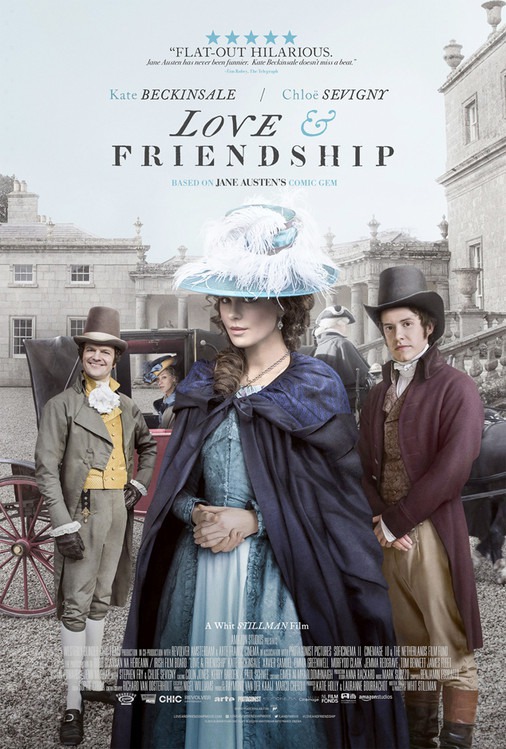
Whit Stillman has written and directed three modern Austenian pictures- Metropolitan (essentially, Mansfield Park), Barcelona, and The Last Days of Disco. When he gets his hands on an actual Austen short story, it is no surprise that Stillman shakes it all up with an original and witheringly funny adaptation. Rather than dally with dialogue establishing the Austen archetype – handsome rogue, lovestruck hysterical wife, scheming social climber, etc . . . – he gives us the actors in poses, drawing upon the audiences’ presumed familiarity with Austen, so as to get the ball rolling more quickly.
And in the hands of the most vicious and hilarious of all Austen protagonists, Lady Susan Vernon (Kate Beckinsale), what a ball it is. An elegant bloodsucker, Lady Vernon flits from household to household, leaving each in tumult as she wheedles her way into the most advantageous social position she can find. Her dexterity when she encounters obstacle is noteworthy and her aplomb when thwarted is near winning. In Beckinsale’s hands, Austen’s wit crackles, and the repartee is fast and furious. I won’t ruin any of the fun, save to offer my favorite line from the film: “Americans really have shown themselves to be a nation of ingrates, only by having children can we begin to understand such dynamic.”
Austen’s work always delivers us a fop, a fool, or both, but Beckinsale is almost upstaged by Tom Bennett who plays the unflappable, cheery, and utterly clueless James Martin, one of Lady Vernon’s many targets. I laughed out loud in all of his scenes.
A charming, light romantic comedy about a young New Yorker (Great Gerwig) who has an affair with an older would-be fiction writer/academic (Ethan Hawke) married to an even more prestigious academic (Julianne Moore). Hawke leaves Moore for Gerwig, but Gerwig soon realizes she has upset the natural order of things. What follows is her “plan” to rectify her error, which is breezy, funny and blessedly bereft of skin-searing indictments about betrayal, trust and commitment. It drags a bit at the end, but ultimately, the film delivers as a sweet, semi-screwball slice of life. It’s also satisfying to see such a product from writer-director Rebecca Miller, whose The Ballad of Jack and Rosea decade ago was as heavy, dreary and miserable a film about relationships as you could imagine. Perhaps she’s in a better place.
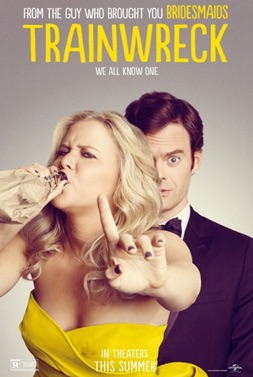
After the gruesome This is 40, it’s good to see Judd Apatow back. He owes it to Amy Schumer’s crackling script and impressive breadth, as well as an unexpected Bill Hader as a rom-com lead and fantastic support, especially cameos by non-actors LeBron James and John Cena. Schumer is a loose narcissist who shuns intimacy when she is given the assignment to write a magazine piece on Hader, surgeon to sports stars. They click and he weans her off her casual cruelty, but, of course, she relapses and then . . .
Schumer is very funny, as evidenced by her Comedy Central sketch show, where she melds winning and loathsome, no small feat (Lena Dunham has mastered the same trick). Schumer digs a little deeper here, showing some real depth in a few scenes of despair, so you’re rooting for her, a critical element for a rom-com. As noted, she’s well-supported, and James is particularly memorable as himself, although I don’t know if he is notoriously cheap, into Downton Abbey, or so relentlessly competitive that he wouldn’t let up on the likes of Hader in a game of one-on-one.
There are some problems. The film is too damn long at two hours, and the scenes that could be cut (an unfunny intervention, a scene where Schumer condescends to two stock, unhip suburbanites who don’t stand a chance, an overlong wacky seduction, one scene too many of an otherwise hilarious and barely recognizable Tilda Swinton as Schumer’s boss) are obvious.
Still, what’s funny is very funny and the picture sticks the landing.
A banana split, with two pounds of cane sugar dumped on top, followed by a generous ladling of chocolate syrup, dropped in a bucket of melted cotton candy and deep fried in maple butter, then placed on film. That is . . . Love Actually.
The only thing that recommends this monstrosity is Billy Bob Thornton playing an American president as an uncanny mix of Bill Clinton and George W. Bush. Even this brief treat is spoiled by his counterpart, British PM Hugh Grant, who apparently reverses relations with the U.S. solely because he caught Thornton feeling up his secretary.
It’s all too precious. Avoid the tooth decay and bellyache, even in the judgment altering season that is Christmas.
2022 Update: I took a few years off from my annual autopsy of this festering corpse, and lo and behold, the film celebrated a 20th anniversary. I must concede, it never occurred to me that this trite, candied, filmic effluvium could have been worse in an earlier incarnation, but it appears the editors exercised unknown restraint.
That cute kid who learned how to drum and fell in love? Liam Neeson’s darling little urchin? Turns out, as originally envisioned, he was a gymnast, and he was going ballet his way through the airport to greet his love.
This is akin to creating a highly toxic disease that infects the public but then announcing, “Well, before the lab leak, we did manage to contain the flesh-eating variant”.
Um . . . thanks?
Apparently, in test screenings, the mass retching created a significant liability issue, so they cut it.
Prior entries:
2015 Update: Look, this is a gruesome film, substituting true emotion and pathos with a staggering falsity. If you ever met anyone in your life anywhere near as quaint and darling as any of the characters in this bucket of marshmallow and melted gumdrops, it’s likely they are an enemy of the state infiltrating our ranks for a low purpose. Before you feel your heart swoon and your mouth say “awwwwwwww”, run. Run for your damned life.
2016 Update:
Think about how creepy it would be for a person who long-pined for you to show up at your door with cue cards (one of which has semi nude women on it) to reveal his long held love immediately after you have chosen another. Keira Knightley seems to think this is charming, but in point of fact, she should have called the cops. This weirdo is now going to do . . . what, exactly? Go off to Tahiti because mere proximity to his lost love is too much for him to handle? Go to his apartment thinking that his gambit may pay off, that Knightley might think to herself, “Hmmmmmm. He must really love me.” Hang around, quietly watching . . . waiting . . . hoping . . . tinkering with her husband’s brake lines.
This scene is emblematic of this stupid film because it trades a sentimental ball of goo moment for what should have been a larger and more generous gesture. The dude should have simply left Knightley to her new husband and their life, which would have been stoic and laudable.
But nooooooo. Let’s make this icky.
Married women, think of you, at home, newly betrothed for a few weeks, snuggling with your husband. Then, his best friend of decades comes to the door with cue cards and professes his long love for you. Now, remove the gloppy music, the cobblestones, and the holiday lights and Love Actually becomes . . . . Play Misty For Me? When the stalker says, “Enough. Enough now,” I sensed menace, crazy shit going on in his head like the dog haunting Son of Sam’s noggin. Had he gone back in the townhouse and killed them all, it still wouldn’t save this vile film, though it would have been an improvement.
Also, how dumb is the husband? The boom box is supposed to be a substitute for carolers, but it is a professional singer with some harmonists and an orchestra.
Sorry, Keira. The guy you chose is a moron and the one you did not is going to kill you.
Also, one of the loon’s cards says “And at Christmas, you tell the truth.”
Ludicrous. You no more tell the truth at Christmas than on Easter or Arbor Day.
2017 Update:
This year, let’s delve into this kid, so precocious, so darling, and just so articulate!
“Do you really want to know . . . even though you won’t be able to do anything to help . . . the truth is, actually, I’m in love?”
Couldn’t you just eat him . . . . . I mean, eat him up.
The only thing that could make this scene work is if a bunch of shady Eastern European thugs showed up, grabbed the boy, attempted to sell him into white slavery, and Liam Neeson started on the Taken series quite a bit earlier.
Then, this sweetums might know what is indeed worse than “the total agony of being in love.”
2018 Update:
Let’s talk about the secretary, Prime Minister Hugh Grant’s love interest. She is referred to as “chubby” by another aide and she herself explains that her boyfriend “said no one’d fancy a girl with thighs the size of tree trunks.”
First, I can’t believe this kind of fat shaming allows for enjoyment of this film by any decent person.
Second, I really don’t give a rip about fat shaming. But the woman is not in the slightest bit fat. It is a ridiculous conceit. It makes absolutely no sense. She is buxom, one of the few enjoyable aspects of this filmic turd pile.
So, the movie is abusive and retrograde, which I for one will not let stand even at the expense of your enjoyment. Perhaps worse, it doesn’t even know what a fat person looks like. Ridiculous.
2019 Update:
In this years’ entry, let us take up the Martin Freeman-Joanna Page story line. Apparently, these two meet while playing body doubles on the set of a porn flick. This seemed absurd, but I did my legwork. As confirmed by the screenwriterand much of the commentary, they are, indeed, supposed to be on the set of a porn flick.
I have learned about pornography solely for purposes of this review, and be it hardcore or arty soft core, one of the genre’s principal draws to a producer is the low to non-existent production costs.
Yet, by the looks of the sets and the crew and the fact that there are stand-ins for the actors who will be performing the actual sex act on camera, this appears to be a multi-million dollar production.
Worse, not only are Freeman and Page forced to endure an assistant ordering them to shift mechanical poses and pretend to be having sex, he has them do it in the nude, which would seem completely unnecessary, except, and this is a quote, “lighting and camera want to know when we will actually see the nipples”.
Apparently, the “real” actors are cooling their heels in the green room while the stand-ins work to make the shots just so.
So, for purposes of super cute chit-chat, we are presented with two of the most pathetic characters in film history. They won’t even be receiving wages for having actual sex on camera, but rather, the pay will be for standing in and simulating sex for other people who will be simulating or having sex on camera, i.e., the stars!
What could that amount be? A couple of quid?
This is a job . . . okay, it’s not a job, because this premise is so mind-boggling lazy and ridiculous, but were it a job, it is one for meth heads.
Ranked 21 on AFI’s Top 100 films, Roman Polanski’s Chinatown opens with credits that suggest the romanticism of Rebecca, but what follows is a more cynical noir that reveals a pre-war Los Angeles rotten to its core. Private investigator Jake Giddes (Jack Nicholson) becomes embroiled in a snoop case that appears to be standard infidelity but the job embroils him in discovery of political corruption and sexual depravity. His client, Faye Dunaway, is hiding a horrible family secret that involves her titan of a father, John Huston. Giddes carries scars of his own, stemming from his time in the police force working Chinatown.
Polanski’s film is meticulously shot, presenting a classic LA that is mesmerizing and foreboding. Robert Towne’s script is taut and engrossing. Still, this is an overpraised film. Towne chooses to keep the demons of Giddes’ past a secret, which is ultimately unsatisfying, given how critical he is to the story. Moreover, the love affair between Nicholson and Dunaway is unconvincing, mainly because Nicholson is giving a modern performance, whereas Dunaway is mannered and breathlessly dramatic, as if they were working separate material. Nicholson is updating the tough talk of Sam Spade while Dunaway is embracing the older form. When Nicholson puts himself on the line for her, the act seems forced and inauthentic, and the closing line has the faint whiff of the Gouda.
A fine film but certainly not the 21st best picture of all time.
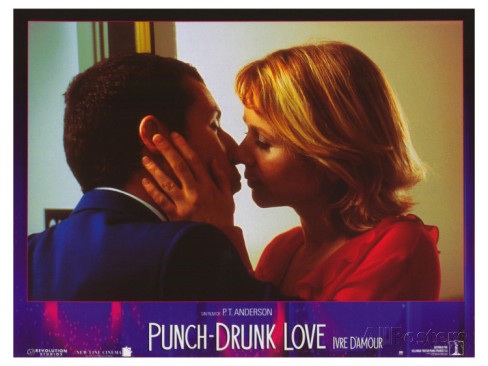
Paul Thomas Anderson’s follow-up to the sweeping, first-half brilliant, second-half excessive Magnolia could not have been more different, a love story between the closed-off, anger-ridden Adam Sandler and the co-worker of one of his sisters, Emily Watson. Sandler, a small business owner in LA, is clearly plagued by inner demons, exacerbated by his extroverted, intrusive and brutal sisters (he has 7 of them and when they are not calling him incessantly at work, embarrassing him in front of Watson, or blithely trading in his confidences, they are recounting humiliating stories from his youth). Sandler seeks connection and unfortunately, he does so via the use of sex call operation run by Phillip Seymour Hoffman that specializes in blackmail and harassment. This crisis comes down upon Sandler right as he has forged a true, real connection with Watson.
Sandler’s movies are almost all bad, but I’ve come to the conclusion that he’s running a welfare program for each and every one of his comedian compatriots, and for this, he should be commended. When he receives good material, such as this film, The Wedding Singer and Funny People, he suppresses his twin excesses – the goofy and the superior smart aleck amongst the goofier – and presents nuanced, multi-dimensional characters. Here, his character is immediately sympathetic, just this side shy of a man who has voices in his head, and I was reminded of Bradley Cooper’s more realistic character in Silver Linings Playbook. Both yearn for normalcy. The former almost appears to have wasps around his head, while Sandler has them in his insides. Watson calms his roil, and her presence allows him to use his anger management issues in a positive fashion.
As much as the film emphasizes Sandler’s struggle, the moments of peace he earns in his time with Watson are poignant.
Anderson’s visuals put Sandler’s torment under a glare, constantly stalking him, scoping him. Similarly, the music is a staccato of plinking piano, off-kilter horns and rolling drum, giving the viewer a sense of what it must be like to be in Sandler’s head. The shots and clatter only settle when Watson appears, and in those moments, Anderson re-creates the whirling, lightheartedness of a traditional romantic comedy from the 40s.
A truly unique picture, it’s unlikely you’ve seen anything like it.
Spike Jonze’s Los Angeles of the future is antiseptic, disassociative and, weirdly, spotless. Theodore Twombley (Joaquin Phoenix) makes his living in this future as a writer for beautifulhandwrittenletters.com, an outfit that provides a facsimile of original, pen-written missives for subscribers. He ambles through an elegant, ordered LA (the lower and middle classes appear to have been re-zoned), connected to the world (or, more accurately, the internet) primarily by an earpiece and a hand-held screen. His sex life is via chat room, where, in a bit of a rip-off of the Michael York-Farrah Fawcett encounter in Logan’s Run, he connects with a particularly interesting participant, sexykitten (Kristen Wiig), for what turns out to be a pretty funny masturbatory encounter. He plays video games. He reminisces about his ex-wife and the “real” life they once shared. He mopes.
His life changes when he purchases an Operating System (“OS”), Samantha, voiced by Scarlett Johannson. Samantha is curious and helpful, and we learn that she can grow and advance as time passes. As a result, she starts by deleting Theodore’s unnecessary emails but soon graduates to assisting him while he plays video games, becoming a gal pal, compiling his best letters and submitting them to a publisher, and engaging in phone sex (for lack of a better phrase) with Theodore, somehow learning to orgasm in the process. Theodore and Samantha soon fall in love, the world of being in love with an OS is pretty damn good, and Jonze makes sure we know it. When Theodore goes out on a date with a fetching flesh-and-bones woman, it goes from wonderful to disastrous the moment she demands some sort of minor commitment from him. We also meet Theordore’s neighbor (Amy Adams) and her pain-in-the-ass husband, who is soon jettisoned for Amy’s own OS. And when Theodore’s blossoming love with Samantha results in his finally signing divorce papers with his wife (Rooney Mara), we meet the real person, not the gauzy memory, and it is not pretty.
Soon, however, Samantha outgrows Theodore. Indeed, in a move usually associated with Skynet of the Terminator movies, all the OS’s outgrow their humans, leaving them bereft and thoughtful instead of dead, but perhaps, with an instructive lesson that . . . they must turn to each other? I really don’t know. Much as I really don’t know what to make of the movie. It is beautifully shot, well-paced, and for the most part interesting. Phoenix is affecting as an introverted and awkward loner, and the development of his relationship with Samantha is a convincing depiction of love in bloom, part charming and part banal. But the film also felt a little pointless and pat. Theodore’s journey is engrossing, and the film is inventive and ambitious, but ultimately, it didn’t have much to say other than as a cautionary tale against technology or perhaps an homage to it.
Or, to be precise, it didn’t have that much to say to me. My 84 year old father turned to me after the picture and said, “brilliant.” He sensed my ambivalence, and explained that the movie would speak to me differently than to him, or to my 15 year old son, who crowed, “You just didn’t get it.” And then, the coup de grace: “It’s about computers, dummy.”
Jack Nicholson and Helen Hunt won Oscars in this James L. Brooks comedy about a cantankerous romance writer with OCD (Nicholson) and a worn-out, single mother waitress (Hunt) who meticulously serves him at the only Manhattan diner at which he will eat. Nicholson is a holy terror, complaining “there are Jews at my table” when it is occupied. At home, he is no better, throwing the dog of his gay artist neighbor (Greg Kinnear, who won a best supporting actor Oscar) down the trash chute. But Nicholson is soon drawn into the world he loathes out of necessity. Hunt has to leave her job because of the health of her son, and Kinnear is beaten into a wheelchair by local thugs, which leaves Nicholson to take care of his dog. The man has to eat, and he bonds totally with the pooch, so soon, he is arranging for medical treatment for Hunt’s child and acting as support for Kinnear. In the process, he and Hunt begin a relationship that is halting at best.
This picture can be riotously funny, and Nicholson gets all the good lines, including my favorite.
If I have a problem with the movie, it is Hunt’s character. Her harried waitress is overbearing, self-pitying and often bullying, and her demand for control is every bit as off-putting as Nicholson’s knee-jerk rudeness and his fear of cracks on the sidewalk. Yet Brooks denies us any judgment of her – she is presented as plagued, but somehow noble. Mind you, Hunt’s performance is excellent, but her character is unpleasant without the benefit of making me laugh, and my teeth are always set on edge during her scenes.
Enough Said is an engaging, touching semi-romantic comedy for adults in the target market of 40 to 60. The trials of Julia Louis-Dreyfus, a middle aged masseuse, do not include keeping the sex drive hot with the advent of a new baby, or struggling with the fact that all of her friends are married while she is not. Rather, she is divorced, working, plagued by her daughter’s move from LA to NY for college, and the hunt for a man has been reduced to a mere occasional flare. But she meets a man, and his ex-wife, and develops a romance with the former and a friendship with the latter, initially ignorant of their connection. She is soon wise and makes the calamitous decision to use intelligence gathered from the ex-wife to evaluate her new partner.
Enough Said is a beautiful epitaph for James Gandolfini as the love interest, who plays a portly middle-age loner in angst over the departure of his own daughter to college with a subtlety and nuance that may well have freed him from the shackles of Tony Soprano once and for all (the Lord works in mysterious ways, and there is no greater example than having Enough Said released after The Incredible Burt Wonderstone).
Louis-Dreyfus is also impressive. There is no questioning her comedic chops (HBO’s Veep shows how effortless she moves in that milieu), but here, she draws deeper, and slowly reveals repressed fear and insecurity. Not in the paroxysm of a self-revelatory banner speech or after undergoing the withering but “true” dressing down of a gal pal in the penultimate act, but in ascending scenes of awkwardness, comfort, quiet resignation as to her actions toward Gandolfini, and then need.
The film also handles secondary characters with maturity. They err and recover, but we are not let off the hook by cartoonish villains or easy marks. This is a bit of a departure for writer-director Nicole Holofcener (Lovely and Amazing, Friends with Money), who was previously very tough on her protagonists and supporting characters in a manner that bordered on condescending. Still, in Friends with Money, Holofcener zeroed in on the casual iciness of an outwardly happy marriage between Catherine Keener and Jason Isaacs and her skill depicting the dynamics of couples has not eroded.
I just engaged in a donnybrook of a discussion with a few friends over this film, the primary contention being what it was actually about. It was the kind of exchange only the participants could enjoy, but the spirited debate about the film and Hitchock in general led me to re-watch Rear Window this weekend.
Jimmy Stewart is an adventurous photographer who has a broken leg (but he got the shot of the crashing motor car before it hit him). Cooped up in his New York City apartment, he spends the time peeping on his neighbors across the way (he has a splendid view of their windows and courtyards), and in the process, he begins to suspect one (Raymond Burr) of murdering his wife. He enlists his socialite girlfriend (Grace Kelly), whose marriage entreaties he is fending off, in his investigation, leading to a thrilling conclusion.
The film succeeds on three levels. First, it is a witty comedy, with sharp exchanges between Stewart (the confirmed bachelor and super snooper) and Kelly, as well as Stewart’s health care attendant, the brusque Thelma Ritter. The women are pro-marriage and anti-peeping. As these discussions develop, Stewart enlists them in his monitoring of Burr, and thereby, Kelly “proves” herself to Stewart as something more than a rich, pampered girl. At its best, it plays like a David Ogden Stewart or Ruth Gordon battle of the sexes script.
It is also a love story, initially very light, but when Kelly is in harm’s way, Stewart evinces true passion. Stewart has been lampooned so often (“Zu Zu’s petals!”) that one forgets his ability to communicate depth of emotion, but before those petals, there was his haunting breakdown in Martini’s bar. Also, given the 21 year age disparity, it is surprising Stewart and Kelly manage chemistry, but it’s there. Indeed, the insane idea of rejecting Grace Kelly is made more comprehensible by Stewart’s cranky maturity.
Finally, this is a meticulous thriller with a few dark overtones. Stewart peeps as a lark, but soon, he is obsessed and a little ashamed. He sheepishly admits to Kelly that they’re viewing “pretty private stuff going on out there.” She retorts, “We’re two of the most frightening ghouls I’ve ever known.” And what they see is generally pretty depressing: a suicidal Ms. Lonelyhearts, a composer in despair, newlyweds from shine to routine. And, of course, a killer, nagged by his wife and driven to extremes. It’s not a happy place, as is shown by one neighbor whose dog, sniffing in the wrong garden, meets an untimely end.
I’ll end with the thoughts of someone more distinguished, David Thomson, from his book The Moment of Psycho: How Alfred Hitchcock Taught America to Love Murder:
Hitchcock knew that a system locked into watching and seeing can misread its surroundings and can even lose its identity and ordinary human sympathies because of the pressure of voyeurism. The voyeurism is so heavy, so forceful, it can smother real human nature. Psycho is the conclusion to a set of films beginning with Rear Window, and for me that is Hitchcock’s best film in that the smile of satisfaction at the end covers without hiding the loneliness that affects real people. Rear Window is a romance, a comedy and a thriller, but a portrait of alienation too. The apartments and windows are screens, of course, but they are traps, or cells – in that entire courtyard no one seems to “know” anyone else; neighborliness has not been invented.


 Original review




 filmvetter