Archive

Genre

Modern political movies are a tough sell.  Last year, George Clooney provided the dry, obvious and somber The Ides of March (no one got stabbed – but boy, as dull as it was, it would have helped).  The American President was execrable, a love letter sent to suburban progressives who must not only follow but adore their leaders, preceding the advent of The West Wing and Martin Sheen as President Awesome.  The most recent good political movie was the rollicking Charlie Wilson’s War, which Mike Nichols directed.

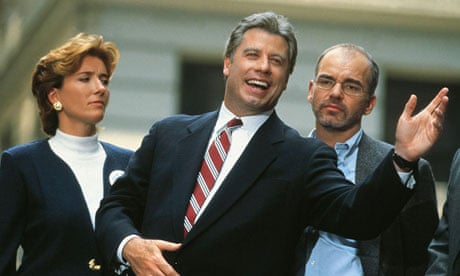
Nichols must have a knack for it.  Primary Colors is Nichols’s cinematic mirror on the rise of the Clintons, an adept story of the tension between political values, electoral success and human frailty, all wrapped up in a big, fun yarn populated by larger than life characters (one of whom served as our regularly entertaining president from 1992 to 2000). There is no need to discuss the plot.  It tracks history loosely, but it will be familiar.

It is also an actor’s film and those actors are aided by a very tight, yet breezy screenplay.  The characters talk the talk of political campaign work, yet we are not burdened by the mundane or weighty.  Better, divergence into the philosophical is not stilted or preachy.  Adrian Lester, the true believer sucked into the expedience and fervor of a presidential race, serves as our somewhat wide-eyed guide.  He exudes the right amount of awe and moral ambivalence.  Billy Bob Thornton is James Carville, and he utters my favorite line about politicians to Lester:  “That’s what these guys do. They love you and then stop lovin’ you.”  Emma Thompson is the increasingly embittered and mercenary Hillary; she is determined, yet both fragile and icy.  Larry Hagman delivers a nice turn as a morally tainted dark horse challenger, and Kathy Bates keeps the fun in the picture as a political operative who knows the terrain of small town politics gone national.

Now, playing a president is a hard job.  Jeff Bridges was nominated for best supporting actor for his Clintonian president in The Contender, but he was so charming and wily as to feel false.   Michael Douglas was painfully self-pitying in the The American President and while Kevin Kline’s president in Dave wasn’t supposed to be realistic (if you’ll recall, Dave was a look-alike brought in to replace the real president, a heartless prick who I much preferred), he was so “aw shucks” Opie I found myself rooting against him.

Even harder is playing a president we know.  Kennedy does not count, because most filmgoers didn’t live through his presidency, and even if they did, JFK is difficult to separate from a Hollywood character (in fact, Kennedy is the only president to have a film released about him during his presidency, and you can rest assured that PT-109 did not show Jack screwing the pooch by letting his ship get rammed by a Japanese destroyer).  So, we are convinced by awesome hair and a few “Bahstans” and “Cubers.”  Oliver Stone gave us two grotesque caricatures — Anthony Hopkins made Nixon a sweating bundle of nerves and ambition in Nixon (Frank Langella’s Nixon in Frost/Nixon was so much better) and Josh Brolin as a clownish, frat boy/oaf in W (I’m still waiting for the casting of Gerald Ford in The Mayaguez Incident).

This leaves John Travolta as Clinton.  Granted, I have been spoiled by the real Clinton, a masterful communicator and tactician, and in my judgment, perhaps the greatest American retail politician.  But Travolta misses Clinton’s flashes and confluence of weakness and sincerity, warmth and opportunism, self-pity and bitterness.  It is a tall order to fill, Travolta does his best, but mimicry is often what he is forced to rely upon.  When he is adored by crowds in the movie, I thought, “Oh come on. How could they be buying this?”  Granted, I usually had those thoughts when the real Clinton spoke to adoring crowds.  But I rarely questioned the sanity of others who were thinking “Yes! He feels my pain” while I was rolling my eyes.

Still, Travolta does well enough, and Nichols smartly never gets you rooting for him or anyone else.  That is critical to the film.  You may like Travolta and Thompson, but you feel tarnished for doing so.  You may hate them, but you recognize their failures in yourself and politicans you admire.
A crime family, one of the five that runs New York post World War II, negotiates the fall of its patriarch, the aging Don Corelone (Marlon Brando), and the transfer of power to the son who was supposed to the family’s representative in the legitimate world, Michael (Al Pacino). Francis Ford Coppola takes Mario Puzo’s potboiler and creates a rich, operatic, and layered crime saga.  As the film opens, it depicts the family’s strong ties to the old world of loyalty and blood with the marriage of the Don’s daughter (Talia Shire), and economic introduction of the hierarchy of the family: hot-headed oldest son Sonny (James Caan), sensitive and simple middle son (John Cazale), the adopted chief advisor son Tom (Robert Duvall) and Michael, who introduces his love Kay (Diane Keaton) to his family, all the while explaining that he is not them.  Indeed, he is in uniform, having distinguished himself in World War II. The disconnect is beautifully evoked in the back-and-forth between the primal Sonny and the advanced Michael.

What follows is the inevitable slow decline of the family as Michael is corrupted and deformed, becoming a Sonny, but with a perverted, soul-sapping sense of “blood” and “family.”

The casting is flawless and given the later body of work of the players, it may be the strongest ensemble in film history. Brando won best actor, and Pacino, Caan and Duvall were nominated for best supporting actor. Other character actors are brilliant in smaller but integral roles, like Richard Castellana and Abe Vigoda as the Don’s chief lieutenants; Al Letieri as a rival who tries to get the Don to bankroll him in the future of drugs; Sterling Hayden as a crooked NYC police captain who serves as Letieri’s guard; and John Marley as the Hollywood mogul and Alex Rocco as the Vegas founder who won’t bend to the desire of the Corleone family until they are made offers that cannot be refused.

Perhaps the best of the bunch is Cazale as the weak, disturbed Freddo. Cazale died of lung cancer after only five films, but what a career: The Godfather, The Godfather II, Dog Day Afternoon, The Conversation, and his last film, The Deer Hunter. If you have not seen it, I strongly recommend the documentary on Cazale, I Knew it Was You.

Mob stories are difficult to resist.  The allure of the criminal life, with its excess, dizzying violence and the seductive freedom to do whatever one pleases without retribution, makes for captivating viewing. The Ray Liotta character in Goodfellas is emblematic of the theme; he was intoxicated by the life and ended up being just an every day schmo, a schlub. The Sopranos melded soap opera and commentary on the modern that, while overpraised, was consistently sharp and engaging. But, oh, the moments when Tony does the things we all wish we could do. Like all mob figures in the movies and TV, the draw is the freedom and the power, consequences of the ethos over time be damned!

The Godfather, however, works as both Shakespearian tragedy and pulp. While providing a seamless criminal power struggle and family drama, Coppola articulates the creeping rot.  The degradation comes in many forms, but Pacino’s haunting performance exhibits it best in Michael.  He starts as a fresh face, canny, even altruistic, but determined to be separate.  Yet, by the end of the film, Michael is hollow, almost physically transformed, as if he has been poisoned slowly by an internal disease.  It’s an incredible turn, solitary and meticulous, so utterly different from the excess of what would come later in Scarface and Scent of a Woman.

The look of the film is stunning, perfectly attuned to the material. Gordon Willis’s cinematography is classic nostalgia.  Willis shoots in a darker hue as the story becomes more ominous and sinister.  Martin Scorsese has called it a trick so influential that “every director of photography over the last 40 years owes [Willis] the greatest debt for changing the style completely.”  The art direction is also noteworthy.  Whether it is an art deco bar that serves as the meeting ground where an enforcer is offed or the sumptuous estate of a problematic Hollywood mogul, every setting feels timeless.  Coppola is also crafty, shooting old New York tightly (his budget was not huge).  Nonetheless, iconic wide shots (a Long Island expressway and causeway, a Times Square street) make up for the lack of sweep.

For enthusiasts, Mark Seal’s book is a must read:

Leave the Gun, Take the Cannoli: The Epic Story of the Making of The  Godfather by Mark Seal

The film is no. 2 on AFI’s top 100. It should be no. 3, after The Godfather, Part II.

Are You Not Entertained?! 15 Most Iconic Quotes From Gladiator

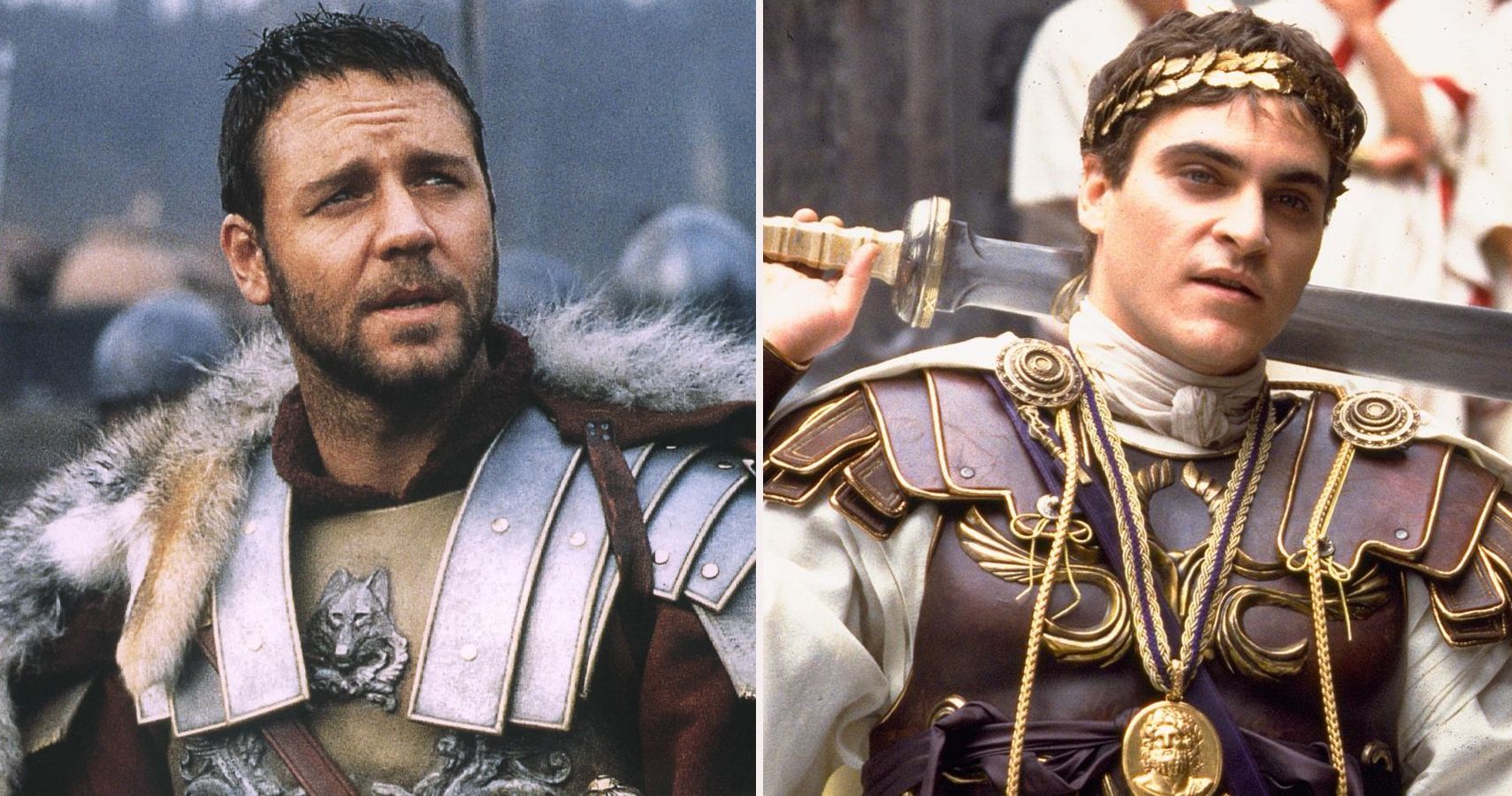
Are you not entertained? You should be. While the script is cobbled together and shallow (it was being written during filming and it shows) and is reliant on the life breathed into it by the players, there is plenty of life, as Russell Crowe, Richard Harris, Derek Jacobi and Joaquin Phoenix do wonders for a leaden draft. Though Oliver Reed is bloated and battered as Crowe’s owner, he also gamely pitches in (he died in a Malta bar during filming).

All the action sequences are riveting. From an impressive opening battle sequence in Germania, to Crowe’s first gladiatorial experience, to a great Ben Hur-ish sequence where a troupe of over-matched gladiators under Crowe’s command exceeds expectations in their first visit to the Coliseum, to a nice one-on-one between Crowe and another famed fighter, with tigers thrown into the mix . . . all are thrilling. There’s also enough of a story to get us from action sequence to action sequence.

Crowe commands the movie and seems “in time” (obviously, I couldn’t possibly know if Crowe acted like a Roman, but I assure you, it feels more authentic than Tom Cruise as a Civil War veteran or Kirsten Dunst as Marie Antoinette). But it is Phoenix as the mad usurper who steals the movie in what could have been a throw-away performance, the weak son to the strong emperor. Instead, Phoenix is genuinely touching (when he seeks his father’s favor and is spurned) and frightening (when he seeks a different kind of favor from his sister, threatening the life of her son in the process). You almost feel for the guy when the mob turns on him.

Michael Mann’s crime opera clocks in at over 3 hours. It is too long, but not by much. The trimming of one plot line could have made this cool and intricate crime drama excellent. Instead, it is merely very good.

Robert De Niro and his crew of criminals (which includes Tom Sizemore and Val Kilmer) are master thieves in LA.  Al Pacino and his crew of cops (which includes Wes Studi and Mykelti Williams) are master thief busters. The criminals plan and execute three jobs, and the cops try and stop them, while juggling family, wives/girlfriends, and the hazards of the professions.

The opening and closing heists are brilliantly staged by Mann, especially a bravura bank job gone wrong in downtown LA.  De Niro’s crew tears through the police, making Swiss cheese of them in a several block, by-car and then on-foot getaway. I had always assumed the scene was based on a real-life North Hollywood shootout where 2 heavily armed men In body armor robbed a bank, were confronted by lightly armed police and injured a dozen of them before being shot down.  In fact, the real-life robbery came two years after the movie.

The story also smartly weaves the stories of a three secondary characters (a member of De Niro’s crew who was kicked out and seeks revenge; a crooked investor for drug interests who takes exception to being ripped of by De Niro’s crew; and, a recently paroled criminal trying to stay out of the game), all of whom intersect with and enhance the primary plot.  Pacino’s relationship with his third wife and her emotionally fragile daughter (Natalie Portman) is also handled well. The wife is not a stoic sufferer but a modern, divorced and frustrated character who is too focused on Pacino to the detriment of her child.

I have three complaints. First, Pacino goes a little too Scent of a Woman. He is so ferocious at times that it is hard to stifle a chuckle, and his accent is strangely southern, then it is not. He is either very good in the movie (his low-key confrontation over coffee with De Niro is one such moment) or he is cartoonish (the entire scene with his informant is bizarre; Pacino looks like he might start speaking in tongues and “Hoooooo-AHHHHHH” never seems far off).


ACTUAL STILL FROM THE PICTURE

Second, the attempt to humanize De Niro by introducing a forced love interest with Amy Brenneman is a mistake and it interrupts the pace. The relationship is unconvincing and as such, does not explain certain choices De Niro makes at the end.  Given the brutality of De Niro (by my count, he kills or wounds a dozen cops and orders the execution of a security guard), it is enough for us to root for him only when he is pitted against others of his ilk. But the attempt to make the audience empathize with his lonely life of crime is several bridges too far.

Third, Val Kilmer’s escape is unconvincing, making a police character we’d been led to believe was sharp look borderline incompetent.

Otherwise, this is a stylish, gripping picture.  And for music fans, Henry Rollins and Tone Loc get minor roles.  Also, it features a young Ashley Judd, who bravely allowed herself to look as worn and haggard as the wife of a brutal, volatile and uncommunicative criminal should.

The Artist. I was not excited to see a silent film, and it took a little while for me to warm up to it, but this is a natural, funny and beautifully shot picture, a riches-to-rags-to riches love story with enormous heart.

The movie is almost entirely dependent on its two leads, Jean Jujardin and Bérénice Bejo, both of whom are nominated for Academy Awards, and deservedly so. Dujardin is a silent film king who gives Bejo her big break, falling in love with her in the process. She ascends in the talkie era and he fades away. Particularly affecting is the scene of Dujardin in his last gasp movie, lost in quicksand:

Dejardin’s descent dragged a little bit, but that is the only criticism I have.

Dejardin and Bejo are aided by a plucky performance by a dog and the contributions of John Goodman as the studio mogul and James Cromwell as the loyal chauffeur. But they carry the film and their performances, which could easily have been big and over-the-top, are subtle and moving. The scene where they fall in love – a series of takes where Dujardin dances with then-extra Bejo, each take becoming more entranced – is captivating.

This is the favorite to win Best Picture tonight and it is the second best picture of the year.

Margin Call, nominated for best original screenplay, is still at the top of my heap.

The movie starts off trying your patience with an overlong introduction of clarinet music and scenes of modern Paris. We are then introduced to American screenwriter Owen Wilson and his nagging, dispiriting fiancee, Rachel McAdams. Wilson is nervous and nasally and a noodge. McAdams is flat out hostile to Wilson. The idea that these two would ever be engaged is absurd. I kid you not, McAdams says to Wilson, “You always take the side of the help.” So, Wilson is married to a monster, doesn’t seem to know it, and yet, Allen wants us to care about him.

Worse, McAdams travels with her ugly American parents, who are (gasp) Republicans, distrustful of the French and country club obnoxious.

Allen makes the modern so unpleasant you can’t wait for Wilson to be transported to the 1920s. Sadly, we have to go to the 1920s with Wilson. And he’s doing Woody Allen, but whinier. He meets F. Scott Fitzgerald, Cole Porter, Ernest Hemingway, Salvador Dali, and Gertrude Stein says, “I was just telling Pablo . . .”

The greats are condescending, self-satisfied characters and they lord their superiority over all. Allen does the same thing, hiding it in his puny, nebbish persona, so his portrayal of them makes sense.

This movie is terrible. Perhaps Allen can still make a good picture. Match Point (2005) was a revelation and Vicky Christina Barcelona (2008) was charming, but he’s about done, and the nomination of this movie as best picture is ridiculous. The nomination as best screenplay is an affront. Perhaps Allen’s digs at Bush and The Tea Party explain it, but if not, and the Academy wanted to give him an unwarranted accolade, isn’t that why the Irving Thalberg award was created?

Some gems: “How long have you been dating Picasso. I can’t believe I’m saying that.”

Hemingway: “Have you ever shot a charging lion . . . Who wants to fight!”

“I wouldn’t call my babbling poetic, though I was on a roll there.”

“500 francs for a Matisse? I wouldn’t mind getting five or six.”

“The present is unsatisfying because life is unsatisfying.”

Yeesh.

There are some funny moments when Wilson lapses into Seinfeldian chatter and the folks from the 1920s look at him funny. Adrien Brody is a hoot as Dali. The movie is also very pretty.

That’s not enough, notwithstanding the Academy and a 93% rating on Rotten Tomatoes.

Image result for blast from the past"

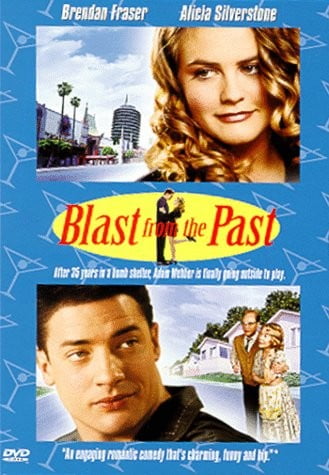
Brendan Fraser plays a 35 year old man mistakenly vaulted in a bomb shelter with his parents (Sissy Spacek and Christopher Walken) since the early 60s. Now, he’s out in modern L.A., and he’s wearing a windbreaker and calling black people “Negroes.”

While Fraser is pretty funny, and Walken and Spacek are properly “kooky” as conservative parents who took to the fallout shelter and never came out during the Cuban Missile Crisis, this romantic comedy lags.  Alicia Silverstone, as the love interest, is dull and plump, a bad actress with weak comic timing (didn’t she come and go in a hurry?). Dave Foley, of “Kids in the Hall,” plays Silverstone’s gay, advice-dispensing roommate, but he’s forced, and he’s given none of the snappy patter of a Cam or Mitchell from “Modern Family” (and if you needed someone to play the gay roommate from “Kids in the Hall”, why not Scott Thompson?)

In the end, fish-out-of-water can only get you so far.

Image result for 200 Cigarettes"

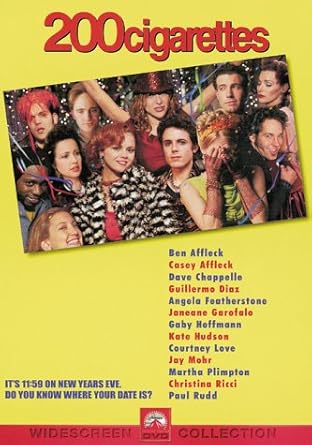
From IMDB: “A collection of twentysomethings try to cope with relationships, loneliness, desire and their individual neuroses.”

Oh goodie.

A ponderous picture about one New Year’s Eve in the early 1980s and the intersection of a bunch of New Yorkers in the city on that night. They chatter and say cute things and go on and on about the meaningless of it all. They also over-emote and incessantly navel-gaze.

They started making these ensemble/group hug/chit chat/why are we here? movies after the insidious The Big Chill which spawned the terrible Reality Bites.

Nothing is funny – save one Janeane Garafolo line (“These matches are disappointing me”) and one Ben Affleck attempt at a pick up line (“How do you like your eggs in the morning? Scrambled or fertilized?”). Other than that, the film is awful. Everyone is bad, but special merit for over-the-top histrionics goes to Christina Ricci, Martha Plimpton, and Paul Rudd.

The director, Risa Ramoan Garcia, wasn’t given another film to helm for 11 years. He has, however, paid the bills as a casting director for CSI.

The writer, Shana Larsen, never wrote another movie.

Enough said.

John Frankenheimer’s Ronin was a primer on film car chases, equaling William Friedken’s set pieces in The French Connection and To Live and Die in L.A. and surpassing Peter Yates in Bullitt (though, The Seven Ups has the best car chase scene in film history).

In James Foley’s The Corruptor, you can see the worst car chase in all of film, a 25 mile per hour snorefest through the alleys of NYC’s Chinatown. One straight line, very low speed, back and forth, back and forth. One Adam 12 had wilder high speed pursuits.

The “chase” is indicative of Foley’s ineptitude with the action genre (Foley’s best work has been in the non-action category – Glengarry Glen Ross and After Dark, My Sweet. His principals – Mark Wahlberg and Yun Fat Chow – kill everyone in sight with handguns, loaded by their inexhaustible supply of clips. And if you are firing at Wahlberg or Chow with a machine gun, you will miss, but you will also break a lot of glass. Indeed, the opening action sequence is a shootout in a lamp and ceramic store.

So, the action is ham-handed and sadly, the script sucks. In a nutshell: Old vet meets young rookie, who has been assigned to Chinatown. Old vet tells young rookie, “You don’t change Chinatown. It changes you.” Or something like that, because Chow’s English is a little iffy, so the line may come across as follow: “Ru don chanse Chintown. It chanses ru.” Thereafter, we hear the patented “dow, dow, ding” of Chinese massage parlor music.

Chow’s principal strength is the ability to make his eyes go all crazy just before he’s about to shoot a bunch of guys.

Wahlberg, who can be effective when leashed very tight, merely sleepwalks through this muddle.

No matter the gravity of the historical event, be it the assassination of JFK or the Cuban Missile Crisis, Kevin Costner raises the hard question.

“What the hell kind of accent is that? Did Jim Garrison and Kenny O’Donnell have speech impediments?”

As to the movie, Thirteen Days is the historically inaccurate drama of the Cuban Missile Crisis told through the eyes of former JFK advisor Kenny O’Donnell, who most historians agree was more of a gofer and pal than a policy force. While it is not unreasonable to inflate the involvement of a tertiary character in historical drama, if you’re going to make stuff up, then do it smart. Make O’Donnell from Delaware, so Costner doesn’t have to butcher an accent. And make him interesting. As written here and played by Costner, O’Donnell is dull as dishwater, has poor political instincts and the temperament of a teen. Indeed, his primary motivation seems to be to have the Kennedys (as played by Bruce Greenwood and Stephen Culp) really, really like him (upon reflection, given the sycophancy surrounding the Kennedys, that motivation may be more in line with actual history than I surmised).

Blocky, uniform, anti-climactic, and predictable (it even uses black-and-white reverence to Camelot), you’d do much better with the classic teleplay The Missiles of October, which had William Devane as Jack and Martin Sheen as an angry, blustering Bobby.

Thirteen Days (2000) - IMDb

Cub-er, Cub-er, Cub -ah – er”

The only thing that recommends the film is Greenwood, who does a fine job conveying President Kennedy’s angst and his sense of isolation. Conversely, Culp’s Bobby Kennedy is portrayed as borderline stupid with impulse control issues (again, on reflection, maybe they got the history right there as well).

Even when the film does pick up a little speed (after all, it is the story of the nation on the brink of nuclear holocaust), Costner’s O’Donnell re-enters with his domestic issues and bizarre elocution, to grind it to a halt.