Baseball season is upon us, so a review of a Sam Raimi baseball movie (?) is apropos. Raimi, whose credits include three Evil Dead movies, three Spiderman movies, and Drag Me to Hell, proves a strange choice to helm a love story-via-flashback, as an aging starter (Kevin Costner) thinks on his love life while trying to pitch a no-hitter.
I am no Costner-hater. He is limited but does what he does well – affable, with a flash of anger and occasional stoicism. Get him outside his comfort zone (Robin Hood, JFK, 13 Days) and you got problems. But he was a fine, goofy golfer in Tin Cup and as the sweet but violent and repressed killer in Open Range. Here, he’s Tin Cup but replaces goofy with taciturn.
Costner is not the problem. In fact, his time on the mound is compelling. But when he gets to thinking about that woman of his – Kelly Preston (wife of John Travolta, poor thing) – things go to pot. Preston is thin, harpy and jittery, and her pitch is, “you need to settle down with serious people like me instead of living the life of a little boy.” Her case is not strong. Even though she has a nice daughter (Jenna Malone), it does not seem conceivable that a good-time, easygoing jock like Costner would be enticed by her invitation. And thus, the movie is undone (and at 2 hours and 17 minutes, very trying).
Postcript: this is supposed to be a baseball movie, and while I understand that athletes get injured in the off-season performing everyday tasks, Raimi has Costner slicing his hand on a router. A pitcher making $15 million a year is not working in the shed with his Black and Decker (hell, he is likely contractually prohibited from self-gratification).
The film also has the manager putting guys up in the bullpen while Costner, who is at the end of his career, IS PITCHING A PERFECT GAME for a team no longer in the pennant race!
With Terms of Endearment, Broadcast News, and As Good as it Gets on his resume’, James L. Brooks commands the respect of viewing one of his movies, even if it was not well-reviewed. So, I watched How Do You Know, the story of a 31 year old Olympic softballer (Reese Witherspoon) who is cut from the team and thereafter, alternates between two romantic futures – a freewheeling, rich, fun and unserious Major League baseball pitcher (Owen Wilson) and a nervous, polite, endearing corporate-type under federal investigation (Paul Rudd). Rudd’s predicament stems from the wrongdoing of his father (Jack Nicholson) and ultimately, he must choose jail for himself or Dad.
The film is fine in parts, and it has its funny moments, almost all of which come from Wilson and Nicholson, but it doesn’t catch hold or intrigue.
The chemistry between Wilson and Witherspoon and more acutely, Witherspoon and Rudd, is just not there. Wilson is his daffy, charming self (though as much a baseball pitcher as I am an astronaut), so he’s trying, but Witherspoon is horribly miscast as a jock who doesn’t buy into a future of love. She is not at all jock material, and she seems to know it. Her response is confusion. This is a younger Sandra Bullock role. And Rudd so overplays his mooning infatuation that you soon hope he does not get the girl and, in fact, is jailed. Most times, Rudd’s sweet mug works, but too often in this movie, you just want to smack him in the mouth.
There’s also too many cutesy scenes and quirky characters, where everybody has the witty line. The scene in a delivery room (Rudd’s secretary has a baby and gets a marriage proposal from a cookie cutter galoot) is so precious you may retch. Even the relationship between Nicholson and Rudd, which has some pretty good laughs, is too broad and thus unconvincing.
There are, however, funny moments and some very good lines even beyond the ones in the trailer. And I’ve certainly seen worse romantic comedies.
Paul Thomas Anderson’s opus chronicles the American porn industry in the late 70s via the story of a loose family of weaklings, caught up in the speed, confusion and excitement of sex, drugs and fleeting fame in the bleaching sun of Los Angeles (Anderson took some license here, as the porn industry started in San Francisco and NYC, but his film requires that feel of promise and wasteland that is LA).
The patriarch is porn director Jack Horner (Burt Reynolds), and the story revolves around his LA retreat, a gaudy ranch-styled haven for his coterie of misfits. There are the young rejects: porn star and mother Amber Waves (Julianne Moore), her teen charge Rollergirl (Heather Graham), studs Reed Rothschild (John C. Reilly) and Buck Swope (Don Cheadle) and lesser stars Jessie St. Vincent (Melora Walters) and Becky Barnett (Nicole Ari Parker); the film crew (William H. Macy, Ricky Jay and Phillip Seymour Hoffman); the money men, The Colonel (Robert Ridgely) and Floyd Gondolli (Phillip Baker Hall); and a host of hanger-ons (club owner Luis Guzman and troublemaker Thomas Jane).
Into this world comes Mark Wahlberg, a young kid who works at Guzman’s nightclub and comes to the attention of porn director Horner after Rollergirl has an encounter with him and reports back his massive endowment. Horner offers the boy a place in the family. Wahlberg becomes Dirk Diggler, porn superstar, escaping from a toxic home to the warm embrace of pseudo-stardom in fuck films. In the world of porn, he finds acceptance, friendship and a certain form of celebrity.
Diggler is based on famed porn star John Holmes, and while Anderson doesn’t take Dirk Diggler down Holmes’s exact path of The Wonderland Murders and AIDS, the trip tracks close enough. Hubris and drugs take Diggler from the safety of Horner and his new family to the street, where he ends up turning tricks, beaten by punks, desperate to score drugs and nearly murdered by a psychotic drug dealer (Alfred Molina).
To a person, these people are none-too-bright, but they cleave together in a life that mirrors celebrity, though it is gaudy and flimsy, glitz on the cheap. They briefly flourish in a fantasy world within a fantasy world, where their work is deemed art, and their talent is certified as genuine. Despite the self-delusion, Anderson shows how the family actually provides support to these outcasts never found elsewhere.
The film is visually audacious and features several flowing scenes without a cut for long stretches, including a 3 minute opening scene which introduces most of the characters. Anderson’s filming of two separate parties at the Horner house is boundless and reminiscent of Altman’s opening scene in The Player as well as Scorcese’s casino scenes in Casino. The effect meshes with Wahlberg’s entrance on the scene, as he steps into a world where he is the golden child. You see the wonder – beautiful young people drugs, a swimming pool! and despite better instincts, you become intoxicated along with Dirk.
The screenplay by Anderson is authentic and resonant, evoking David Mamet, but without the showiness. A prime example is the discussion between Horner and Floyd Gondolli on the changing business of porn:
The music by Michael Penn is evocative of the time as well, and the cuts chosen for each scene are spot on, from Andrew Gold’s “Lonely Boy” (revealing Amber Waves as a mother) to the Beach Boys “God Only Knows” providing the coda for the characters, to “Sister Christian”, which now serves as a sinister song, as used in the film’s most harrowing scene, much like “Stuck in the Middle with You” after Reservoir Dogs.
Finally, the performances are uniformly stellar. Julianne Moore was nominated for best supporting actress (she was beat out by Kim Basinger in LA Confidential, a great film and a fine performance, but still, Moore was robbed). Burt Reynolds was also nominated and rightly so. Interestingly, after seeing a rough cut of the movie, Reynolds fired his agent for casting him in Boogie Nights, but Burt’s artistic choices have never been stellar. Wahlberg stands out, exuding the perfect blend of charm, wonder, cluelessness and want. Anderson is lucky Leonardo DiCaprio turned down the role to work on a little picture called Titanic. DiCaprio’s a fine actor, but he’s a little too savvy and wary. Wahlberg was perfectly open, trusting and innocent. The scene where his mother berates him as worthless and stupid, forcing him out of the house, is heart-wrenching.
This is a classic film of America sprawl, ascent, decay, and fall. One of my favorites and one of the top 20 ever made.
An engaging and surprisingly even picture about a simplistic, homophobic ex-NY cop (Robert De Niro) living in the same apartment building as a drag queen (Phillip Seymour Hoffman). De Niro has a stroke and needs the drag queen’s assistance as a voice coach (she teaches singing) so he can learn to talk again. This is two fish, different waters. You’ve seen it. But through the skills of Hoffman and De Niro, it works really well, and review of the picture allows a meditation on Hoffman. I remember him as the spoiled rich fink in Scent of a Woman, the unfortunate thief in the remake of The Getaway and the dunce with a badge in Nobody’s Fool. Even in such small roles, he resonated. Soon came absolutely indelible and brilliant supporting turns, as the closeted and adoring fan of Dirk Diggler in Boogie Nights and rich visiting playboy Freddie Miles who smells a rat in The Talented Mr. Ripley. Leads came next, including a best actor Oscar for Capote, but Hoffman is in the club with Duvall and Hackman – he can play the lead, but he’s more often better in support or ensemble, be it the outrageous Lester Bangs in Almost Famous, the chilling priest in Doubt, or the stubborn manager Art Howe in Moneyball. He’s pitch-perfect and makes everyone around him better.
His role here is actually a very different character for Hoffman. He’s flamboyant, wildly emotional and central. These are easy roles to botch, but Hoffman communicates both the external vamp and internal insecure deftly (his hysteria as his boyfriend abuses him is particularly touching). He’s very moving, and De Niro (who is also good as the disabled grump) does not get in his way.
Clint Eastwood plays a divorced father of two and homicide detective in New Orleans who has a penchant for prostitutes. The prostitutes are murdered, each one shortly after being visited by Eastwood. Eastwood doesn’t exactly have range, but he is not Dirty Harry in this one (The New York Times dubbed him Kinky Harry). Rather, he’s a bit of a scared rat, as he realizes that his secret (some form of S&M/bondage; Clint was ahead of his time in these the days of “Fifty Shades of Gray”) is revealed and worse, he has been unintentionally marking these girls for murder.
Genevieve Bujold is the rape crisis counselor who tries to assist Eastwood professionally in the hunting down of the killer, and emotionally, by turning him from his sexual demons.
It’s a mixed bag. Eastwood is clearly stretching, which is to be commended, but he never fully commits. Al Pacino had the same problem in the controversial Cruising, where he was tracking down a killer of gays in the S&M subculture of New York. Unable to fully get in the skin of their characters, Pacino and Eastwood play it zoned out, which distances the audience.
Nothing new to report, except that installment three is even scarier. One particular trick of note: while trying to capture the “ghost” on videotape and cover two rooms, our hero puts a camera on an oscillating fan, so it goes from left to right and back again slowly. Brilliant. Everytime you get that vantage point, you’re terrified of what will be in frame.
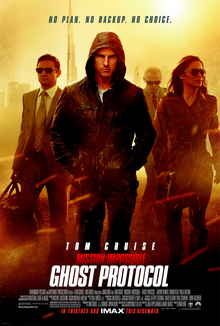
Cruise is BACK! But is it likely you missed him? His super spy Ethan Hunt is doggedly disinteresting. So, fantastic action set pieces (a breakout from a Russian prison, a break-in and demolition of the Kremlin, a car chase in a sandstorm, a finale in a modern multi-story parking garage) are made less exciting because you’re not invested The action sequences are first-class, especially a high wire act outside the Burj Khalifa, but if you don’t care if Cruise falls, does it matter?
Cruise spends huge chunks of this picture running really fast and very far (it’s more The Gods Must Be Crazy than Casino Royale). Endurance becomes the primary facet of his character. Moreover, 2/3 of his team (Paula Patton and Jeremy Renner) are very dull (Simon Pegg, as the technical wizard, is not and provides most of the laughs).
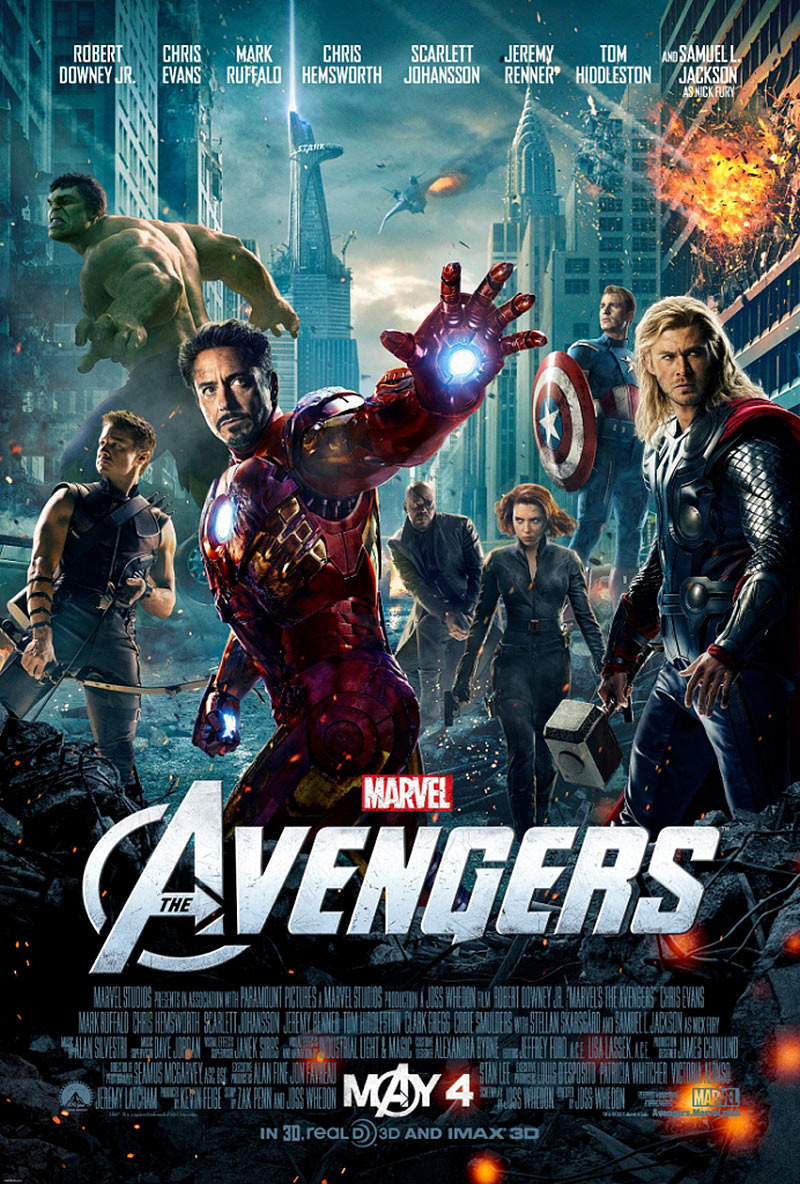
With the exception of the upcoming Dark Knight picture, The Avengers is of the same stripe as the films previewed before it (Spiderman, Battleship) – loud, visually thrilling, punctuated by the wisecracks of people in a maelstrom, and … loud. The Avengers includes a slew of Marvel characters, almost all of whom have had their own loud, visually thrilling films: Iron Man, Captain America, Thor and The Hulk join The Black Widow, Nick Fury and Hawkeye to fight Thor’s power-hungry brother Loki. Since they are a varied group of personalities, they bicker, trade philosophy (Fury would be the Dick Cheney of the group; Iron Man the Barack Obama), and crack wise (Robert Downey’s Iron Man/Tony Stark gets almost all the nifty lines).
Loki comes to rule and it takes the Avengers fighting his flying army of space creatures in NYC to demonstrate that Earth is not some defenseless denizen of sheep.
Really though, he is not nearly scary enough (he looks like the second banana in Wham!) and you never get the sense he’s that big a threat.
The picture is dizzying, occasionally funny, well-paced but really, really long and immediately forgettable.
Walter Hill is a workmanlike director. He makes some decent and intriguing films (The Warriors, Southern Comfort, Geronimo), and a fair amount of bad ones (Red Heat, Last Man Standing, Extreme Prejudice) and good or bad, the pictures are little more than macho shoot ’em ups where brawn and bullets win the day. Hill’s commercial pinnacle was probably 48 Hours, the buddy-cop film that vaulted Eddie Murphy into the stratosphere.
The Long Riders is his masterpiece. The story of the James-Younger (and Miller) gang, Hill cast the Keaches as Frank and Jesse James, the Carradines as the three Youngers, and the Quaids as the Millers (he also throws in the Guest brothers as the duo who eventually shoot Jesse). It comes off not in least bit gimicky. Hill comfortably alternates the mythic and the mundane about the brothers, and there is a naturalness to the interplay between the men that makes every scene easy and true. Brothers in life portray convincingly as brothers in film.
Hill also provides a rich facsimile of Peckinpah-style screen violence, while setting forth a keen depiction of rural tradition and family loyalty . His scenes in the Missouri woods, while the gang hides out, are well-crafted and authentic, his Texas bar fight by Bowie knife is inspired Western legend, and the Northfield, Minnesota bank debacle is unforgettably haunting. Hill shoots high speed escape by horse interspersed with slow-motion shots of the gang being shot up, commensurate with an eerily slow-soundtrack that purports to track the actual bullet and its impact above the slooooooow distorted sounds of hoof beats, screams, horse whinnies, and thuds. The scene is bravura, a milestone in action filmmaking.
The tensions between the gang, and the brothers, are summed up in the woods outside of Northfield, where Frank and Jesse -w who can move – and the Youngers, who are too shot up to escape, say their bitter yet still faithful farewells, most of it non-verbally.
The best feature is Pamela Reed as Belle Starr. She steals the movie from the brothers, presenting as of the time. Reed is not beautiful by a long shot, but her strength is undeniably alluring. Her exchanges with Robert Carradine are memorable, especially the second one, as she sits, dressed to the nines on her carriage in the street, uninvited to a Younger wedding.
I love this picture because it has one foot in the myth of the West and another in its grimy, brutal reality, it is at once entirely unsentimental and yet, through the understated depictions of the family, moving.
2. The Patriot is a revenge movie set during The Revolutionary War. Revenge movies are fine. But a revenge movie fails if the person upon whom revenge must be visited is blase’ about his own life or death. In The Patriot, the villain (a British officer played by Harry Potter baddie Jason Isaacs) is a vicious killing machine with no desire to live other than to burn women and children alive. So, short of having his skin peeled off, there can be no satisfaction in his demise. And there is none. Which, in the words of Donald Rumsfeld, makes this a very long, hard slog.
3. The Patriot veers wildly from the manipulative (excess depictions of crying and/or dying children) to the sitcomish (Saving Private Ryan screenwriter Robert Rodat uses tension-breaking quips between men-in-war and then expands them into broad cartoonish gag scenes worthy of “The Jeffersons”) to near-spoofs of beer commercials (the slow-motion as men high-five after winning the big battle is missing only the bosomy blondes and frothy pitchers of ale, and the scene where Gibson gets romantic with Joely Richardson is a replica of Corona commercials).
4. The best part of the movie is when Gibson appears heroically, flag in hand, and all the militia scream “Huzzah!” but it sounds exactly like “Wazzzzzzzzzuuuuuuuuup!”
5. The Patriot is predictable. If you don’t know whose life the stoic black-man-fighting for his freedom will save; if you don’t know that the moment Gibson gives his daughter-in-law a necklace, it is proof of her death; if you don’t know the “trick” played on the Brits to gain the release of American militia; if you don’t know the fate of a warship off in the distance as the Brits live the high-life and General Cornwallis (Tom Wilkinson moans about his less-than-spectacular uniform), you are not very observant.
6 There are a few historical inaccuracies. My favorite is the use of exploding cannonballs. They hadn’t been invented yet, but you can just see Emmerich screaming “I vant it BIGGER!!!!!!” And when Isaacs character burns an entire church filled with women and children, based on an incident from World War II when Nazi soldiers burned a group of French villagers alive, I’m sure Emmerich was there screaming, ‘I vant him MEANER!!!!!!”.







 filmvetter