Archive

Historical

Another sweeping war epic from my past, along with Waterloo and Zulu, this one introduced me to the “stiff upper lip” Brit.  Unlike those films, this picture just doesn’t hold up at all.  Directed by Guy Hamilton (who had a much better time of it with four Bond films), the film is overly reliant on air battles that perhaps seemed impressive at the time, but now, are flat, difficult to comprehend (you rarely know which character is in which plane) and without drama.   Worse, what happens on the ground is remarkably staid and uninvolving.

It is, however, loaded with the cream of British actors (Michael Caine, Michael Redgrave, Ralph Richardson, Trevor Howard, Laurence Olivier, Christopher Plummer, Edward Fox and Robert Shaw, to name a few), and of particular note, it features a strikingly handsome Ian McShane, who aged into the craggy, rough Al Swearengen of Deadwood.  You can see what Emmanuelle’s Sylvia Kristal saw in him.

Battle of Britain: Ian McShane's RAF Uniforms » BAMF Style

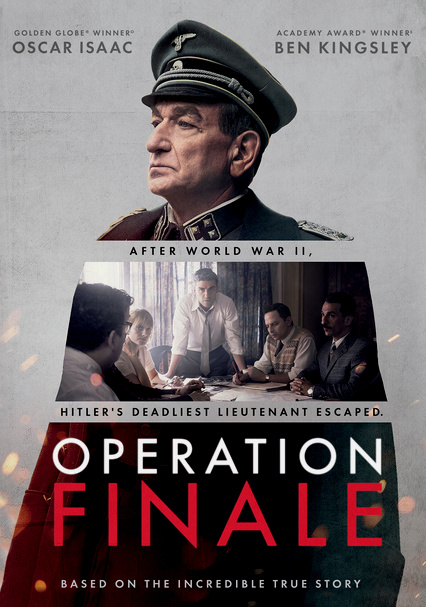
Image result for Operation Finale

Chris Weitz’s (About a Boy) largely faithful recreation of the capture of Adolph Eichmann is sober, competent and a little dull.  Peter Malkin (Oscar Isaac) is the focus of a several member Israeli infiltration team sent to grab Eichmann (Ben Kingsley) from Argentina and covertly spirit him away to Israel for trial.  All well and good, even if the film drags until they actually get to South America.  When on the ground, the film picks up, but there really isn’t much to the operation.  They jump Eichmann at night as he gets off his bus and keep him in a safe house, where his removal is delayed for several days, thus allowing Isaac (whose sister, niece and nephew were killed in the Holocaust, which we see in flashback) to engage the monster in an effort to get his signed consent to extradition.  The best part of the picture is Kingsley, who conveys Eichmann’s urbane precision and amorality in equal parts.  But there isn’t much to the exchange.   Isaac seems too much the professional to be flustered by the engagement, and Weitz is too cautious in the opportunity.

Perhaps sensing the film’s lethargy, Weitz adds a fictional Argo-like race to the airport, but it lacks any real punch.

A perfectly inoffensive picture.  Wait until it’s free and you have little in the way of alternative entertainment options


D63D4F6A-7EC1-493E-A2E0-52D923FCE904

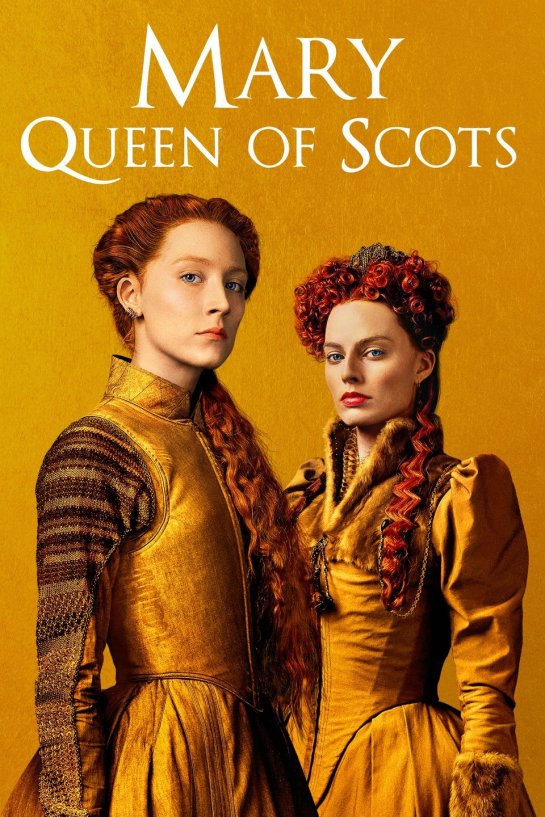
I had the misfortune of catching half of Cate Blanchett’s fun, sumptuous and engaging Elizabeth recently. The comparison makes this turdfest even more unbearable.

Sairose Ronan is fiery, wild eyed, and indignant as Mary Queen of Scots, perpetually perturbed and always speechifying.  Margot Robbie is her nemesis Elizabeth, but Robbie appears way out her depth. She acts like she’s in a high school production.

The performances, however, are the least of this picture’s woes.

The script is charmless and dull. Intrigue has no deftness. People just argue briefly, declare and then act.

The lone battle scene is so badly handled, you don’t know what the hell is happening.  It presents like kids playing war in the backyard.

The script is also obsessed with its feminist hot take, particularly with Mary, who is put-upon by a man’s world and way ahead of the curve.  Mary’s ladies in waiting are like The View, and Mary is forced to rape her homosexual husband (very unconvincingly) to have an heir.  John Knox inveighs against Mary, not because she was a Catholic, but because she was a damnable woman who enjoyed sins of the flesh (he calls her “whore of Babylon”, “strumpet” and “harlot” in one speech).  We even get to see Mary menstruate.

Elizabeth gets in on the act as well, hectoring her male advisors with “we could do well worse” than Mary as queen and bemoaning Mary’s fate with “How cruel men are.”

Girl power, apparently, trumps Power power.

Indeed, when they eventually meet, there is no enmity. Just a couple of gals dishing on inequity, the glass ceiling and the unfairness of it all.

Until Mary gets wild-eyed and entitled and the girl power card loses its oomph.

Then, bitches get stitches and Mary is locked away, eventually to be beheaded.

The writer secures revenge in the post-script, however, lording Mary’s fertility over Elizabeth’s mere 44 year reign.

Modernity infects this dog in many other ways. When Mary’s gay attendant stops just short of breaking into a show tune, and pulls himself up short, the modern and reformed Catholic soothes him with a “be whoever you wish to be with us” (when he sleeps with Mary’s husband, kneels before her and begs for forgiveness, she soothes him again – “you have not betrayed your nature”).  Before battle, she assures one of her Protestant soldiers that should they die, they will all see the same God.

Best line. “I will not become a lady Henry VIII dispensing husbands as he did wives.“

A massive bag of crap. And no fun!

1BE80664-A59C-438D-94BE-1558746C7053

Finally got a chance to see this. It’s bad. Green Book bad.

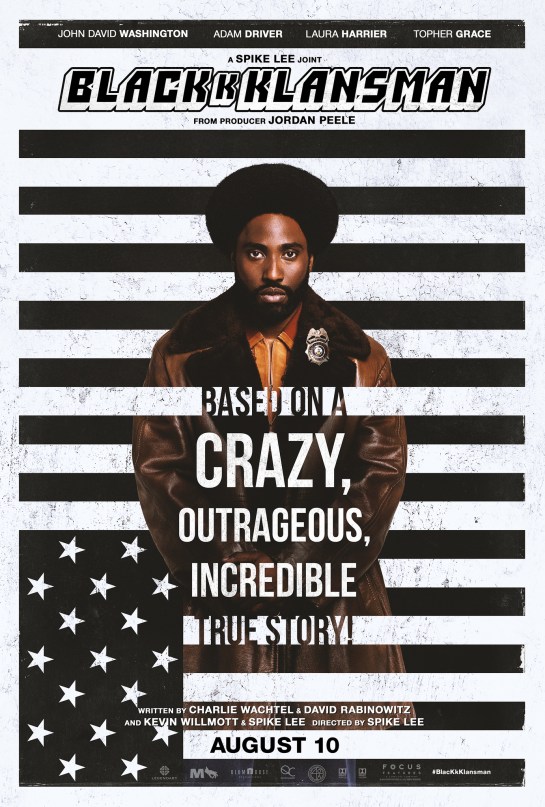
It starts as a mildly amusing, slick sit-comish comedy structured on a ridiculous premise – in the 1970s, black Colorado cop Ron Stallworth (John David Washington) calls the KKK to join up, and they are eager to have him, so after first contact, he has to use his white partner (Adam Driver) for face-to-face meetings, which creates unnecessarily close shaves.

Why not have Driver simply make the calls and handle the meets?

The answer is – wacky hijinx!  And there’s plenty of that.

Eventually, the funny gets less funny and the picture lapses into an absurdist procedural punctuated by overt, earnest philosophical discussions that would make kids in an Oberlin coffee house roll their eyes.  

Perhaps sensing the lightness of the fare and his own elapsing clock, Lee goes heavy at the end, utilizing actual footage from the Nazi rally in Charlottesville.  It’s like appending pictures of James Meredith’s shooting at the end of a poignant Different Strokes.

It’s a cheap ploy that seeks to elevate the zany caper that preceded it to serious statement.  Worse, as pointed out by Boots Riley, director of the infinitely better Sorry to Bother You, Lee’s film is based on a true story, and a less convenient aspect of that story might be that the real Stallworth was infiltrating black organizations to their detriment.

Ah well.  

You gotta’ give it to Lee, though. He knows his audience and he oversauced this goose good. Heck, he almost pulled it off. 

Alas, Oscar found another cheesy race fable to take home the gold. 

Curses!

7C9B9607-6014-41E4-8234-36FA8FCA7AC5

A filmmaker who can communicate his vision entirely is a rare thing, even if the vision is too reliant on cruelty.  Yorgos Lanthimos’ The Lobster was as original as it gets, but also sterile, unfeeling and unpleasant. The Favourite, a period piece of court intrigue, is more traditional but it shares The Lobster‘s iciness.

Rachel Weisz and Emma Stone attend court and vie for the attentions and favor of Queen Anne (Olivia Coleman). Weisz wants power, Stone security. They share a weary, dim view of their male dominated world; the men are for the most part fops, suck-ups, and/or brutes, and it is amusing to watch Weisz and Stone endure them.  And while their war has its moments, their single-minded pursuit of the upper hand is rooted solely in the base instincts of survival, so it’s hard to gin up any empathy. You’re detached from their fates, and the accompanying pain. They flash as human, but they don’t really seem it.

The performances, however, are stellar.  Coleman’s turn as the mercurial and insecure queen, for which she won the Oscar, is a masterful blend of the sympathetic and comic. She is the ultimate tormentor, but ironically, she’s the only one you feel bad for.

It’s a technically adept yet a frigid and un-involving picture.  Lanthimos (who reminds me of Darren Aronofsky in his penchant for brutalization) also has a morbid fascination with bodily functions, which doesn’t help.

EFDFA64D-0815-48BE-B103-65A482CB8851

When Spike Lee acted like a petulant fool after BlackKKlansman lost Best Picture to Green Book, it seemed silly, and given the mediocrity of his own picture, a sad stunt.  But I get it Spike. I apologize.

The story of classical pianist Dr. Don Shirley (Mahersheela Ali) who enlists Italian bouncer Tony Lip from New Yawk (Viggo Mortenson) for a Southern swing of concerts in 1962 is so chock full of cliche’, it borders on spoof.  Ten minutes in, you know that the hotheaded Tony will hit a cracker cop, the cultured Shirley will play boogie woogie in a honkey tonk, and they will teach each other, oh, so many things.

Sadly, it is not a spoof.

This picture is atrocious. Simplistic, repetitive, nonsensical, and boring.  It has no idea what it wants to be. A civil rights era Odd Couple?  A moral tract about role reversal and rejection by one’s own race?  A road movie?  It does none of it well.

But it has a white guy teaching a black guy the joys of fried chicken, so, there’s that.

The characters lack any consistency. When black men perform repairs at his apartment, Tony throws away the glasses the men drink water from, such is the viral nature of their cooties. But in the blink of an eye, he is driving a black man around, comfortable not only with his boss’s skin color, but his homosexuality.

’Cause he’s been around nightclubs, and tings, day get, complicated. Mangia, manigot, caprese, spumoni, to da’ moon, Sbarro!

And while Shirley is supposedly working the southern swing in solidarity with Nat King Cole, who was beaten years earlier for playing white music, he also inexplicably plays private affairs at the homes of cartoon bigots. For what, I don’t know. Cash?  Self flagellation?  And when rich Southerners have a cultured pianist perform at their homes and eat dinner at their table, he is still sent to the wooden outhouse to pee.  Jesus, even in The Help, the bathroom had plumbing.

Making matters worse, Viggo Mortenson’s tough guy driver from da’ Bronx is so broad, so exaggerated, you can’t believe what you’re seeing. He’s half Joey from Friends, half The Fonz. He actually says Ba Fongool.  Or Ba Fon Goo. Or whatever they say in Chef Boyardee commercials.  He’s brutal to watch, yet, a thing to behold.

It ends sweet and there is charm in its insouciance as to its own plausibility or depth, but that gets you exactly one star.

Oscar?  Fuggedaboutit!!!

88500353-FBE8-4895-81A4-D9BC86BE1862

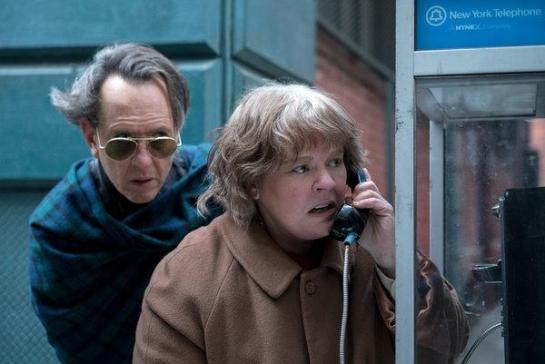
One of the best of the year, powered by Melissa McCarthy’s misanthropic turn as a struggling biographer in the leanest of times. Unemployed, unpublishable and unliked, McCarthy (playing writer Lee Israel) hits upon a scheme to forge letters from the ranks of Noel Coward and Dorothy Parker and soon, her money woes are over. The endeavor also fills an artistic void. She takes pride in her turns of a phrase and bon mots, her work put in the mouths of giants, and she is invigorated. It all goes bad, as it must, but it is eventually to the good.

I can’t say enough about McCarthy. She inhabits the skin of Israel, with a vicious self-protective quality and a reflexive meanness. Yet you invest in her. Her bitter exchanges with her agent and attorney are both hilarious and poignant.

There is good in her, and a hell of a lot of hurt, both of which are unearthed by her chance friendship with an elegant scammer and libertine, Richard E. Grant.  McCarthy and Grant were rightfully nominated for Oscars and it is a joy to watch him match McCarthy’s desire to be left alone with an insistence that they will be friends.  Their hi-jinx and commiseration are the heart of the film.

I was blown away by the fact that this is director Marielle Heller’s first major feature.  It felt like the work of an old hand, steady, confident and mature. The movie skips with ease but pauses for moments of true beauty and consideration.

This is an elegant movie, folding how much people need each other into a very funny, well-told story.

190D5A0E-F567-4FE3-ABF0-126B8A846388

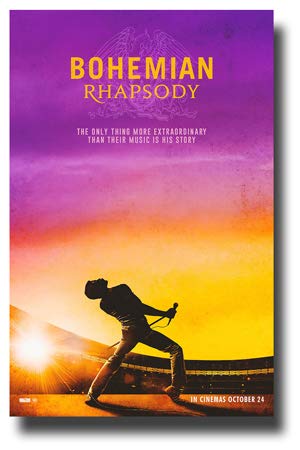
I always thought Queen was camp, a goof, and their primary contribution was “We are the Champions” and “We Will Rock You” which you sang in the bleachers during CYO basketball games. When I realized some people thought they were a great band, I was surprised. So, I walked into this as if it were a biopic of Emerson Lake & Palmer. Or Kansas.

Still, a great movie does not have to be about a great band. This, however, is not a great movie. It is cookie cutter, inoffensive, as risk-averse a biopic as you’ll find (it’s clear why Sacha Baron Cohen was jettisoned from the project), but well-paced and energized by the erstwhile Bryan Singer and made a little more interesting by Rami Malek’s weird, lizard-like performance (he’s just this side of Bela Lugosi, you never know if he’s just about to bite someone on the neck).  To be fair, Malek is also very moving towards the end.

The scenes of the band playing live and in studio are silly. The scenes of the band talking about the music and themselves are like a slightly more serious episode of the Monkees.  The rendition of the creative process is hilarious.

The primary feeling you’re left with is foreordained watching any story sanctioned by its subjects (the band had script approval) – it’s pleasant.  Rock and roll, drugs, cats and AIDS, brought to you by Disney.  It’s formulaic, harmless and overlong at two hours and fifteen (ending with an extended scene of their set at Live Aid, which is dull in that Malek is lip-synching), but not unentertaining.

Image result for First man

Damien Chazelle has directed two gems (Whiplash, La La Land) that could not be more different, and his third picture is every bit as accomplished and even further afield tonally from his prior movies.  On the surface, the film is the story of Neil Armstrong (Ryan Gosling) and the Moon landing, but this is not the gripping, white-knuckle paean to American ingenuity that was Apollo 13 or the sweeping, ironic The Right Stuff, both exquisite films in their own right.  Instead, this is the personal story of Armstrong and his wife Janet (Claire Foy), who, after having lost a young daughter to a malignant tumor, forge ahead in the space program, where calamity is a daily feature.  It’s a beautiful, personal picture, seamlessly melding the grit and determination of one family with an overarching, monumental and patriotic (more on that below) achievement.  It is one of the more moving yet subtle films I’ve ever seen.

Two addenda.  First, the omission of Gosling and Foy in the acting categories for the Oscars is, in my view, the filmic version of the Saints-Rams no-call.  Gosling’s driven and emotionally-stunted introvert is meticulous and engrossing, a master class in precision (think Casey Affleck in Manchester by the Sea).  Foy, as the wife holding it all together, is simply heartbreaking.

Second, this film caught some flack for failing to depict Armstrong planting the American flag on the Moon.  When asked (and never ask an actor anything), Gosling took as stab at an answer, observing that the landing “was widely regarded in the end as a human achievement” and that he didn’t think Armstrong “viewed himself as an American hero.”

And . . . .kaboom!  The culture dummies – this time on the right – went after the picture, as some sort of anti-American agitprop.  Little Marco Rubio was particularly incensed:  “This is total lunacy. And a disservice at a time when our people need reminders of what we can achieve when we work together. The American people paid for that mission,on rockets built by Americans,with American technology & carrying American astronauts. It wasn’t a UN mission.”

The criticism is moronic.  Films are not required to meet a quota of patriotic content.  Worse, though, the charge is false.  The singular American achievement of the landing is represented by footage of JFK literally crowing over, well, the race to that achievement.  Moreover, there is footage of a French woman who observes, “I always trust an American. I knew they wouldn’t fail.”

As if that idiocy wasn’t enough, the left weighed in to label the film a right wing fetish object with a “misbegotten political premise that America used to be greater—and that the liberating and equalizing activism of the sixties ignored, dismissed, and even undermined that greatness” or, gasp!, potentially dangerous for reinforcing the “pervasive notion about achievement—that it occurs when people toughen up and don’t let feelings impair their judgment.”

What a bunch of fucking losers.

image

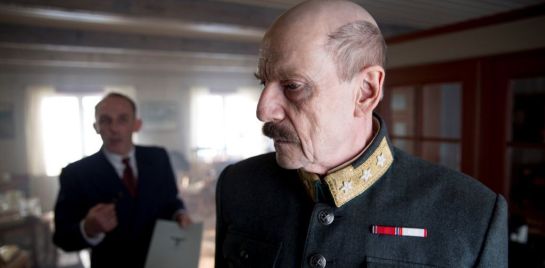
Just as Dunkirk was an ode to English pluck and a representation of the viscerally brutal and arbitrary nature of war, The King’s Choice serves the dual purpose of a national homage to Norway’s resistance in the face of a Nazi invasion and the strain placed on the powerful and the ordinary in such circumstances.  Norway’s King Haakon VII, is a sweet, doting grandfather who is constitutionally deferential to a democratic body that is crumbling under the weight of events.  He must bolster the government while staving off the more muscular, ambitious desires of his son, which carry with them an implicit criticism of his father as weak.  Indeed, as the king suffers from a bad back, we often see him in a fetal position on the floor or a bed.  Meanwhile, the German attaché, who is juxtaposed favorably with the uncompromising Wermacht, desperately pleads with the king to accede to Hitler’s demand for submission, knowing that failure to do so totally will mean the deaths of many innocents.   The tension is palpable, the pace gripping, and the quiet moments – especially the scenes showing the effect on the families – poignant.