Archive

Drama

Image result for the farewell
A touching and heartfelt tribute to a matriarch.  Smart, deep and without an ounce of treacle, this is the holiday movie you should watch instead of the grotesque Love, Actually.  Upon hearing of the terminal cancer diagnosis for her Nai Nai (grandmother), Billi (Awkwafina), who left China when she was seven, returns from New York with her family (along with other family members from abroad) to say their goodbyes.  The twist is that, per custom, no one can reveal the diagnosis so as not to upset Nai Nai in her final months.  Indeed, Billi, a struggling student who has just been rejected for a fellowship, was specifically asked not to make the trip because her parents thought she was too emotional and incapable of adhering to the compact.

What follows is a loving and funny rendering of Billi’s family as well as her own immersion into Chinese culture and the clash that comes with it.  First time writer-director Lulu Wang’s second feature is confident and multi-layered, and her visual sense, depicting China in an almost dreamlike state, emphasizes Billi’s trepidation and confusion.  The film is also slyly funny, capturing the idiosyncratic bond of family that survives no matter the time apart or the geographical separation.  One of the best of the year.

3FAD71C5-B170-4650-9B10-800F47532251

Awfully slow and occasionally deadly dull. It’s 3.5 hours, 1.5 hours of which is trying to get Jimmy Hoffa (Al Pacino) either to his senses or a meeting.

The length and pace, however, may be the least of the film’s problems.  The movie depicts the rise of mob killer and union boss Frank Sheeran (Robert De Niro) and his relationship with his mob sponsor (Joe Pesci) and Hoffa. The novelty is the technological ability Martin Scorsese uses to make his actors younger, but the effect is only so successful. They can only make them so young.  So, you have a 76 year-old man playing a 40 year old man who looks like a 56 year old man who has a six-year-old daughter. Worse, when they are rendered young in the face, they remain old in the body. One scene, where a digitally younger De Niro beats a man, emphasizes the point.  It looks like Bad Grandpa is delivering an ass kicking.

But perhaps the worst part of the film is the fact that there is simply no drama, no tension. Every single character is the exact same person he was from beginning to end. In Goodfellas, De Niro and Pesci were a constant force, but the drama came from watching Ray Liotta and Lorraine Bracco rise and then try to survive.  In Casino, the entire film centered around the significant changes to the personalities of De Niro, the bookmaker made casino king in fledgling Vegas, and Pesci, the enforcer who gets too big for his britches and in-over-his-head alone in the desert.  The history of those films was compelling, but it did not have to do all of the lifting.

Here, De Niro is the same throughout. Sociopathic, steady, soulless and somnambulant.  It does not make for enthralling viewing.  Your eyes will move to the IPhone more than once.

It looks good, though. Damn good. I’ll give it that.  And there are a few exchanges in Steve Zallian’s (Moneyball, A Civil Action) script that are subtly sharp. But it’s not nearly enough.

AA793056-C74F-4C1B-8F88-9ACBF5CB6B27

It’s fine. There is no need to see it in the theater, but this story of former driver and automobile designer Carroll Shelby (Matt Damon) and driver Ken Miles (Christian Bale) being subcontracted by Ford to take on Ferrari at LeMans is entertaining and fast-paced. Besides, Damon and Bale would be easy enough to watch grilling hot dogs, and Tracy Letts as Henry Ford II steals the picture in one scene.

That said, the movie is a tad too formulaic and cute and it has some thematic and structural problems. Bale’s overly precious relationship with his wife (Caitriona Balfe) is plagued by money woes and that seems to be the source of any dissension in theri union.  But then, all of a sudden, she goes bats because he apparently isn’t communicative enough, which comes out of nowhere (up until this point in the film, Bale is presented as aCockney loudmouth who can’t keep his trap shut about anything). Additionally, the relationship between Damon and Bale is unsupported, and we actually know little about either of them before their joint endeavor begins.  Some background, other than stoic and abrasive, respectively, would have helped.

But most problematic is the depiction of the Ford company, a corporate behemoth we are asked to loathe and root for at the same time.  The whiz kid who comes up with the idea of taking on Ferrari is Lee Iacocca, and as played by Jon Bernthal, he barely registers. Worse, as Ford’s no. 2, Josh Lucas is just this side of twirling a mustache. His treachery is over-the-top ridiculous.

The race footage is exciting and when you see this when it streams, you’ll be pleased, though Ron Howard’s Rush is a better racing film.

51515837-D519-4B3F-B49B-E4FBDB50A194

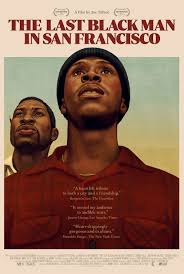
A beautiful, creative meditation on what home is, what your place is, and how both can become foreign, lost or taken right under your feet.  The picture is subversively political without one overt pronouncement. Writer-director Joe Talbot’s first time feature is also so assured and deeply thought out, it is astounding.

Jimmy, a native San Franciscan, reclaims his boyhood home in the city, which he has been surreptitiously tending to for years, after the owners vacate it in an estate dispute.  He just moves in. His bond is familial and aesthetic, as much to the house as the city, which has transformed right under his feet.  The house is a stand-in for the community which becomes fractured and fungible, but community is never what you thought it really was.

This is an art film, but it is linear and focused. Moving and audacious, Talbot is a massive talent. I hope they give him an Avengers franchise.

Yes, that may be against the grain and ethos of the film, but he can still do art films!

E7F37A5D-79A5-4BD3-805B-E7F98B533CA4.jpeg

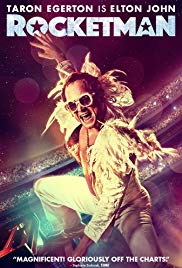
The first half is a blast. Following the model of Across the Universe, director Dexter Fletcher incorporates Elton John’s music into boffo biographical song and dance numbers (the movie takes the current model and reverses it; it is ready made for Broadway), and Taron Egerton is winning as our shy, brilliant, budding rock star. The depiction of his rise is light, whimsical and fun.

But the second half of the movie, much like the middle third of John’s life, is a bummer. The choreographed song and dance numbers give way to trippy, psychedelics that are not only a drag, but repetitive and tiring.  John drinks, drugs, orgies, wears more and more ridiculous outfits and goes lower and lower, much like your eyelids.

It ends precocious, as John confronts his annoyingly minor demons (overbearing mother, distant father, not-as-advertised first lover)  in a rehab group therapy.

Not quite where a film-goer wants to end up, even if it worked out for John.

Klute' Dramatizes the Exploitation of Women | Cinema Faith

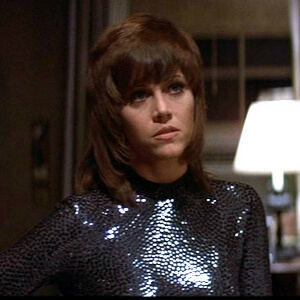
Alan Pakula’s sexual thriller is still a little jarring in its frankness, even today.  In the age of “sex tape as career move”, very little can astound or shock, but Jane Fonda’s electric and vulnerable turn as a call girl hunted by a killer gives the viewer entrée not only into the precariousness of her world, but in her own vulnerability.  She plays Bree Daniels, a struggling actress who considers her sexual exchanges mini-dramas, where she gets control, something she clearly needs desperately, even if it is self-destructive.  When we see her in action, she’s powerful and pitiable, all the while exhibiting how effective and alluring a good call girl can be.

Daniels is saved on more than one occasion by a laconic John Klute (Donald Sutherland), a police officer turned p.i. who is investigating the disappearance of a businessman who may or may not be her stalker.  Naturally, they develop a relationship.

Pakula (The Parallax View, All the President’s Men) has a keen eye for the shadows and menace in otherwise humdrum, pedestrian environs.  He also has great patience, which results in very understated, moving scenes, such as when Fonda flips through the catalogue of homicide photos of dead prostitutes, and her character and the viewer see her face in all of them.  The scenes where Fonda attempts to seduce Sutherland in order to establish control are similarly subtle, and Pakula places you directly in the dilemma of not wanting to be played but being enticed all the same.

There are problems.  Fonda is so good (she won Best Actress) I thought the scenes of her in therapy were unnecessary.  She’s strong in them, but she’s better expressing her foibles and fears in the context of the story.   As the detective, Sutherland runs into the opposite problem.  He is fully unexplored, a quiet mechanism for Fonda’s growth and nothing more.  I  wanted to know more about him.  Not tons, but something.

Still, this a very strong picture that holds up well, especially given the subject matter.

Image result for Once Upon a A time in Hollywood [poster

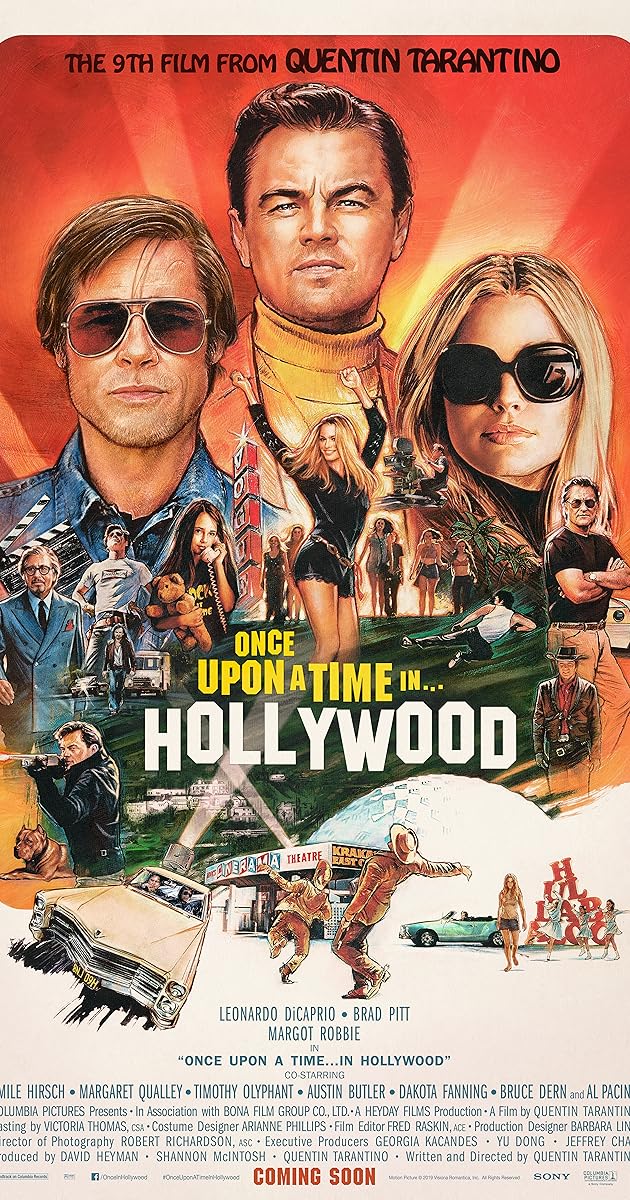
Twenty minutes in, my brother whispered to me, “I don’t know if this is going to be a good movie, but it’s a beautifully curated movie.”  He was dead on.  Quentin Tarantino doesn’t just re-create the look of 1969 Hollywood, he does it in a manner that somehow straddles classic homage and the hazy recollection of a local.  The town seems both wondrous and pedestrian.  Never were neon lights for Taco Bell or the Musso and Frank Grill so compelling.

Tarantino places a fading movie star and his stunt man/go-fer (Leonardo DiCaprio and Brad Pitt) in the midst of this mesmerizing visual portrait, the former playing an “almost made it” leading man reduced to working for cameos during “pilot season” and the latter his loyal companion.  And wouldn’t you know it, DiCaprio lives next to none other than Roman Polanksi and Sharon Tate, and hey, who was that scraggly hippie who skulked by the other day?

The film could have been cutesy or overly reverential, and when the likes of Steve McQueen, Bruce Lee and Mama Cass make appearances, I’ll admit, I was apprehensive.  But their scenes are both fun and important.  They assist in Tarantino’s portrait of Tinseltown as a much larger Mayberry, where everyone knows each other just to say howdy, but a lot of those everyones are someone.

Enmeshed in the slow-building run-up to the tragedy seared in our national consciousness (I don’t know about you, but when I was a kid I devoured Vincent Bugliosi’s “Helter Skelter”, and somehow, those white cut-outs of the bodies on Cielo Drive were more horrifying than any actual murder photo) are the stories of DiCaprio, who has lost his swagger and is negotiating his way down; Pitt, a man with a notorious reputation necessarily affixed to the fading star; and Tate (Margot Robbie), the ingénue representing the audience, agog at the magic around her and so excited about her future she can barely contain herself.  There is not a minute of their stories that isn’t engaging, and Tarantino leisurely walks them though the company town.

This is also Tarantino’s funniest film.  His dialogue has always been crackling, but he has moved on from bravura speeches and cool pop culture references, instead writing much more measured and subtle, with real heartfelt exchanges (his last film, The Hateful Eight, was a quantum leap in his maturity as a writer).  And while excess is Tarantino’s hallmark, and often his downfall, you may not believe me, but this picture is an exercise in restraint.

I would like to say more, but I don’t want to spoil anything or preview one of the more enjoyable movies I have seen in years.   Go now.

02B1BEE6-2DA4-4B9F-9402-1A9E8425D54F

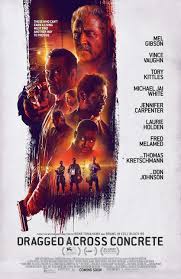
A solid, slow potboiler of a crime caper, Mel Gibson and Vince Vaughn are cops suspended for excessive force (caught on IPhone) who, beleaguered by low pay and lack of support, decide to pull a heist of a heist. Their decision runs them smack into Tory Kittles, just out of prison and enlisted to be a wheelman, in over his head as a contractor for brutal thieves.

The film is expertly paced, if languorous, and engrossing.  Director-writer S. Craig Zahler can draw out the eating of an egg salad sandwich, the preparation for a bank job, and the tailing of a getaway vehicle with an exactitude and care that sucks you in to all three events.

The picture is also literate, sometimes too much so as the characters have a lot of time to jabber on stake out. There are some machismo clunkers as the officers weigh the morality of the endeavor, the unfairness of their lot and the contours of loyalty. But there’s mostly good in the script, particularly between Kittles and the boyhood friend (Michael Jai White) who hooked him into the heist as they reminisce and try and work themselves out of what becomes a hellish jam.  Zahler has a nice touch handling the easy banter of his characters.

The film has been slagged for its portrayal of allegedly racist characters and themes, which to your average movie reviewer means that the Gibson and Vaughn characters do not parrot ACLU pamphlets in discussion of their milieu or the tenor of the times.  I sense Zahler is in for the David Mamet treatment.

The criticism is a joke but what are you gonna’ do?  These folks are the types who lauded The Wire but likely understood none of it and are the progeny of Pauline “I live in a rather special world. I only know one person who voted for Nixon. Where they are I don’t know. They’re outside my ken” Kael.

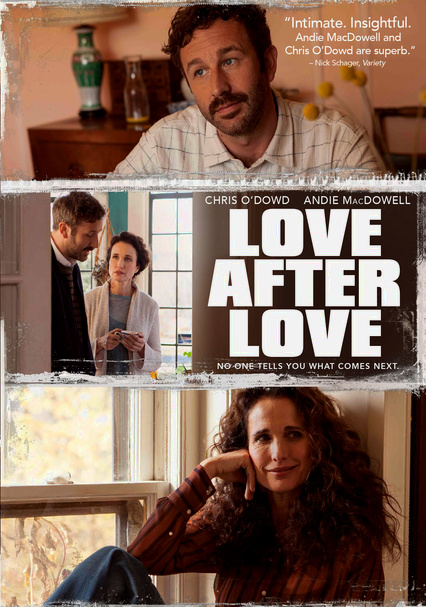
A bit of a critic’s darling, I can see what impressed: the raw feel of the characters, and the film’s unstinting portrayal of loss to a mother (Andie MacDowell) and her two adult sons (Chris O’Dowd and James Adomium) after their husband and father succumbs to a long term illness.  We see the family at different intervals before, during and after the disease, and there are moments of real tenderness and pain that affect each of them.  In particular, MacDowell, an acting teacher, has a wonderfully realized moment where she cruelly unleashes on a student during a read, and Adomium references larger issues of death in a stand-up routine that starts uncomfortable and then rights itself.

What’s bad?

O’Dowd.  He’s way too overt as the weak son, the charmer who resents his mother for any number of reasons, but perhaps mostly, because she is strong.  O’Dowd plays it much too Oedipally, and he oozes rather than acts.

The segmentation of the story into pieces is also problematic, a double-edged sword.  A few scenes seem like well-presented one-acts.  But more often, the characters are doing things that are not supported by what we have seen before.  We are left to fill in the gaps.  One such rather unforgivable one is the absence of the relationship of the characters with the deceased.

Finally, if you take all the high-stress, histrionic and embarrassing scenes of a family’s life for a few years, and make a movie of them, they will not come off as relatable, but rather, alien and masochistic.

Another sweeping war epic from my past, along with Waterloo and Zulu, this one introduced me to the “stiff upper lip” Brit.  Unlike those films, this picture just doesn’t hold up at all.  Directed by Guy Hamilton (who had a much better time of it with four Bond films), the film is overly reliant on air battles that perhaps seemed impressive at the time, but now, are flat, difficult to comprehend (you rarely know which character is in which plane) and without drama.   Worse, what happens on the ground is remarkably staid and uninvolving.

It is, however, loaded with the cream of British actors (Michael Caine, Michael Redgrave, Ralph Richardson, Trevor Howard, Laurence Olivier, Christopher Plummer, Edward Fox and Robert Shaw, to name a few), and of particular note, it features a strikingly handsome Ian McShane, who aged into the craggy, rough Al Swearengen of Deadwood.  You can see what Emmanuelle’s Sylvia Kristal saw in him.

Battle of Britain: Ian McShane's RAF Uniforms » BAMF Style