Archive

Drama

Amazon.com: Glory Road [Italian Edition] : derek luke, jon voight, james  gartner: Movies & TV

It is hard to find a worse sports movie than the hackneyed and overwrought Remember the Titans, but after Glory Road, I was almost wistful for the homespun wisdom of Denzel Washington and the beatific look on Will Patton’s face as racial understanding dawns upon him.

No matter what you may think of the delivery of Remember the Titans, and I think very little of it, with a few exceptions, it hewed however loosely to actual historical events. There was a high school football team in Alexandria, Virginia. The school was recently desegregated. The team did get a black coach and he did make the whites sit with blacks on the bus and the team did win the championship. Sure, the film exaggerated racial tensions, but that much is to be expected. It can’t be “feel good” if at first we don’t “feel bad.”

Glory Road is every bit as maudlin and formulaic as Remember the Titans (both films were produced by Jerry Bruckheimer, blast Motown, show the trading of racial culture between young men in the form of dance moves, and teach us valuable lessons about what’s “in here”) but it is also a perversion of history that goes way over the line.  Yes, 5 black men played on the 1965-66 Texas Western NCAA winning basketball team and yes, they were coached by Don Haskins.  This much is true.

But it wasn’t that big of a deal.  A decade before Texas Western won, the undefeated 1955-56 University of San Francisco team won the NCAA championship with a team that played four blacks — Bill Russell, K.C. Jones, Hal Perry and Gene Brown.  In 1958, the coaches’ All-American team was all black — Wilt Chamberlain of Kansas, Oscar Robertson of Cincinnati, Bob Boozer of Kansas State, Guy Rodgers of Temple and Elgin Baylor of Seattle.  In 1962, the University of Cincinnati started four black players when it won the NCAA championship.  Loyola University of Chicago started four when it won in 1963.

We also have the sports announcer screaming, “Who ever heard of Texas Western?”

A lot of people. Texas Western was a regional third place finisher in the 1964 NCAAs.

So, that sucks, but it gets worse.

The reason 5 black players got the start (and 7 played) was mundane – Haskins thought they were the best players.

Not so in the film.  Instead, we get some p.c. twaddle wherein Haskins tips his desire to make a statement to the team and the white players actually agree not to play so a larger societal point can be made.

How the screenwriter came to the conclusion that it was more edifying to make the achievement a gift from whites rather than earned by blacks, well . . . that’s for another day.

I had dinner with a critic friend, David Ehrenstein, around the time this picture was released.  He said something to the effect of, “A movie about these people had not been done yet.  It was its time.”  He was right, but before getting to the film, I wanted to note that the folks who did publicity for Curtis Hanson’s follow-up to L.A. Confidential should have been lined up and shot.   The previews portrayed the movie as a screwball comedy with a bespectacled Michael Douglas playing a wise and ultimately grating character, a classier Weird Science with a bigger star.

Wonder Boys is nothing as it was presented.  Instead, it is a literate comedy of manners with the setting of higher education, and it is principally about the businesses of teaching and writing.  Douglas is a professor working on his second novel (his first, a successful work, was published seven years prior), which has ballooned to a deathless 2200 pages.  His agent (Robert Downey, Jr.) is en route to WordFest, a weekend of literary activities, to read the novel.  In the meantime, Douglas is dealing with one peculiar but gifted student (Tobey Maguire), one gorgeuous student, who also happens to rent a room in his house and who is coming on to him (Katie Holmes), and the chancellor of the department, with whom he is having an affair (Frances McDormand).  Bad thing upon bad thing happens, but within the very funny travails, Hanson develops strong relationships between the characters.  He also gives more than a glimpse into the soul of writing and teaching, and Douglas actually grows, and grows convincingly, given what could have been events offered solely for their madcap nature.

The film also makes great use of the city of Pittsburgh, which has always deserved better than —

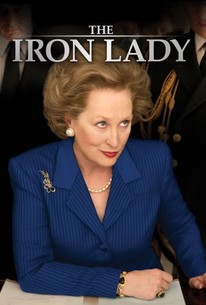
The Iron Lady (2011) - Rotten Tomatoes

First, I really have no idea as to the historical accuracy of the movie. To the extent there are historical nits to pick, I concede.

Second, this is two films.  One, very personal and touching, speaking to the loss of a loved one and an individual’s weakening ability to remember, a great thinker’s capacity to articulate and rationalize.   Meryl Streep’s turn as a woman infected by Alzheimer’s is frightening, poignant and moving.

Third, it works less well as a political biography.  The young Thatcher is a simplistic spouter of conservative bromides.   As prime minister, she’s almost ridiculously “iron” with the men about her always clucking like nervous nellies.  Worse, particular challenges are handled via music video montages and newsreel footage. It lends a certain cheap and easy feel to the endeavor.  During The Falklands War in particular, she is the lone Joan of Arc amidst jelly bellies. Speech follows speech, with great, grand pronouncement. It gets silly.  We even have the obligatory review of the casualty figures and the personal letter-writing histrionics.

Fourth, Streep is beyond convincing in the role and when assessing the body of her work, the idea that she is not the finest actress in the history of film is laughable.  There is no Magic Johnson to her Michael Jordan. It’s not even close. And she only gets better.  As the nun in Doubt, she completely captured the nuns of my early education, and as Julia Child in Julia and Julia, a role that like Thatcher could have been hammy and overt, she is vibrant and real.

This is a charming first love story, different in that the first love is Marilyn Monroe and her suitor is a third assistant director (a glorified gofer) on her 1957 picture The Prince and the Showgirl.  The picture co-starred and was directed by Laurence Olivier, who is played by Kenneth Branagh.  Branagh was fine and nominated, though I’m not sure deservedly so.  His primary posture is one of exasperation.

It is Monroe who exasperates Olivier, because she is tardy, skittish, unprofessional and seemingly over-handled by her method acting coach and her business manager.  Pills are used to control her.  Thus, she seeks companionship and escape with the gofer, played with wide-eyed innocence but occasional steel by Eddie Redmayne (Redmayne is a little distracting – he has lips that rival the collagen-induced monstrosities of Barbara Hershey, Meg Ryan, at al.)

Williams was nominated and deservedly so.  She’s a perfect confluence of beauty, sensuality, naivete’ and whore.  At times, she was so stunning that you could understand the entire Monroe worship.

Best, the story is sweet but not sugary, and economical.  It also has a great sense of time and sports some nice supporting turns by Dominic Cooper and Toby Jones as her weasel management and especially Julia Ormond as Olivier’s aging and jealous wife at the time, Vivien Leigh.  Leigh is obviously wary of Olivier working with Monroe which results in a great exchange with the smitten gofer:

VIVIEN

Of course, Larry would never leave me. (Pause) But, if anything were to happen, you would let me know, wouldn’t you?

COLIN

I’m sure he loves you very much.

There is a flash of sudden anger in her expression.

VIVIEN

Oh, don’t be such a boy!

COLIN looks shaken and she touches his hand in contrition.

VIVIEN (cont’d)

At least you still adore me, don’t you?

COLIN

Of course. Everyone does.

There is a wintry bleakness in her face for a second.

VIVIEN

I’m 43, darling. No one will love me for much longer. Not even you.

To the extent there is a weakness in the picture, however, it is implicit in the character of Monroe and not the film.  Monroe is so iconic as to be both beguiling and ridiculous.  Her end was tragic and elicits the syrup ladled out by Elton John’s “Candle in the Wind” (which can be dusted off and updated for a Princess Di and had Elton and she been friends, probably Anna Nicole Smith).  Luckily, we are spared the cruelties that lay in store for Marilyn, but the film does take for granted her absolute boundless and radiating talent.

It’s a tough sell.  Monroe was beautiful and seductive and had the ditzy blond bit down pat.  But had she not been such a notorious pain in the and piece of ass, vexing Olivier and Gable and bedding DiMaggio, Miller and two Kennedys, would she be the goddess of today or . . . Anna Farris?

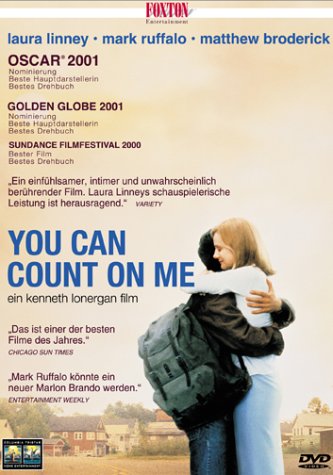
You Can Count on Me (2000)

In 2000, writer-director Ken Lonergan had just come off of making the estimable The Adventures of Rocky and Bullwinkle.  His follow-up, You Can Count on Me, is one of the strongest written and acted family dramas ever made.  Go figure.

Laura Linney and Mark Ruffalo are siblings whose parents died in a car accident when they were children (I’d say 8 and 11).  Once that fact is established (with a sparse care that should be required viewing for all writers of family drama), we see them as adults.  Linney is divorced with an 8 year old son, and she lives in her parent’s house and works in her upstate New York hometown.  Ruffalo is an irresponsible drifter who comes home to visit.  Both are not emotionally crippled, but they are certainly products of the trauma, the communication of which is never overt.  We get no long, laborious revelations or speeches, no explosive healings or verbal re-opening of old wounds.  These people are hurt, but aren’t we all?  Lonergan subordinates the pain to the hard truth that they have to live their lives like the rest of us.

Linney’s pain can be seen in how she prepares for her brother’s return, in her desire for order in all things, and in her penchant for the reckless (as long as such recklessness is papered over by a seemingly staid conservative existence).  Ruffalo, on the other hand, just floats in and out of situations.  Linney’s son (another in a long line of Culkins) is a bridge between the siblings.

There are few lessons learned.  But the beauty and pain of family is perfectly expressed throughout.  Better, You Can Count On Me eschews stock secondary characters, infusing each (Linney’s boss Matthew Broderick, her minister, her boyfriend, her ex-husband, the town sheriff) with actual distinguishing qualities and natural impulses.  The film takes the time to linger on the emotional registers of these people in reaction to Linney and Ruffalo, as opposed to simply having them act in a standard fashion to further amplify the angst of the leads.

The original music is haunting cello and the soundtrack features a heavy dose of roots rock, alt-country and Americana (Steve Earle, Marah, and my favorite unsung band, The V-Roys).

Before The Hunger Games, and its depiction of a televised death match for teens, there was Network, perhaps the most prescient film ever made.  Released in 1976, Network foreshadows the gruesome future of television as it slides nearer and nearer to county fair freak show.  Caustic, incisive and at times frightening, if modern writers managed half of Paddy Chayefsky’s lines in Network, we’d all be better off for it.

The plot is simple.  A network is going down the tubes and in order to save it, the reckless, soulless and brilliant Faye Dunaway is given free reign over programming.  She forwards numerous efforts, the most popular being The Howard Beale Show, a nightly venue given to a network news anchor (Peter Finch) who is slowly going mad.

The script bogs down a bit in the last quarter, mainly, I think, because the medium of film does not handle monologues for two hours, and in between Chayefsky’s smart dialogue, this is essentially a film of well-delivered speeches.

The movie is filled with gems.  Finch making his mark with an on-air nervous breakdown (“I’m mad as hell and I’m not going to take it anymore!”) or corporate titan Ned Beatty thundering to Finch that he has meddled with “the forces of nature” after one of his on-air screeds affects an oil investment.  A scene that is unparalleled involves the activists from the Ecumenical Liberation Organization, a quasi-Symbionese Liberation Organization, upon which Dunaway is basing a “reality” show.  These revolutionaries for the proletariat are soon perverted by the influence of TV and begin squabbling as to points and percentages off the back end.   There are also wonderful pitch scenes for shows that in 1976 would have seemed outrageous, but would now be ho hum.

There are some weaknesses.  The romance between Dunaway and William Holden, the old network bull, is unconvincing.  It is easy to understand a older man-younger woman dalliance, but in this case, Dunaway plays as a frenetic shark.  Her character freely admits she is a lousy lay and then demonstrates as much with Holden.  Dunaway’s character is about power and moving up (when a young, non-powerful man kisses her shoulder, Dunaway’s sharp “Knock it off” tells you all you need to know), and the fact that Holden does not see it is problematic.

Perhaps it was Holden trying to understand the future, or he was waning and wanted a taste of youth.  It’s possible that Dunaway, like televison, is empty but still capable of beguiling Holden for a time, like Beale’s viewers.  But the relationship seems peculiar and off-kilter. That said, some of Chayefsky’s best lines are during their conversations, so the curious nature of the couple can be forgiven.

Network is deservedly ranked 64 on AFI’s Top 100 movies.

Stanley Kubrick’s last film opens with an affluent married couple – Tom Cruise, a doctor, and his wife, Nicole Kidman  – at a Christmas Party, during which he flirts with two models (and later revives the host’s prostitute girlfriend, who has overdosed) .  Meanwhile, Kidman gets tipsy in the hands of a mysterious foreigner who does his damndest to get her away for a quickie.  The experience leads to a later conversation, during which Kidman gets stoned and cruelly informs Cruise that she once was so overcome by desire for a stranger that she would have given away everything – husband, child, life – to be with the man.  Cruise is destabilized.  Stunned, he walks the streets of New York, bouncing from sexual odyssey to sexual odyssey.

Kubrick had no business making a film about modern sexual issues.  Having read a “Vanity Fair” piece on Kubrick shortly after his death, his disconnection with his subject matter is no mystery.  He appeared to have been a semi-recluse with no social skills, much less any romantic experience.  I was reminded of the incongruity of presumably celibate Catholic priests who advise young parishioners on marital issues.  Including sex.

Cruise and Kidman are like some 1950s couple dressed in 90s clothes.  After his wife’s revelation, Cruise is menaced by the recurring image of her being ravished by the stranger, as if a wife sharing her fantasy with her husband is some great cataclysm.  Yet, Cruise is strangely immune to the manner in which Kidman mocks and taunts him with her fantasy.  Her cold and unloving manner – she roils on the floor pointing at Cruise, doing her level best to castrate him with her secret – appears to be no problem for Cruise.  Rather, it is the image of someone sleeping with his wife that drives him batty.  As for Kidman, she’s just mean and icy. 

Then there is the plot, which is non-existent, thus making for a droning, tedious ride. Cruise does his best with what he’s given, and he is particularly effective early, when he performs the minuet of explaining to his wife why he would never bed the two models. She summarily shreds his rationale.  Kidman, however, is consistently awful throughout, forced to play drunk at the party, stoned during her humiliation of Cruise, and then, in a completely over-the-top bit, frightened by a sexual dream she experienced.  She hits all the wrong chords, her drunk being sloppy, her stoner being vicious, and her post-dream persona annoyingly overwrought.   This is a performance ruined by bad choices.

Kubrick’s other forays into the pastiche of modern sexuality are laughable.  The man who would get Kidman away for a tryst at the Christmas Party is an unintentionally hilarious Hungarian.  Any minute, you expect him to say, “I vant to suck your blood.”  Prostitutes who entice Cruise from NYC streets are Kate Moss hot, with hearts of gold to boot.  The famed orgy scene is chortle inducing (everyone wears goofy yet frightening masks).  I’ve seen more effective soft core on late night Showtime.

“ARE THERE ANY SNACKS AT THIS ORGY?”

If you were not inclined to laugh at certain parts, the film is accompanied by perhaps the most distracting soundtrack ever scored – a single note piano plinking that can destroy even the most stoic.

Visually, Kubrick is painfully reliant on one trick in his bag – an endlessly repetitive floating tracking shot.  On the plus side, he does make a passable New York City out of London.   But this was a bad way to go out. 

Modern political movies are a tough sell.  Last year, George Clooney provided the dry, obvious and somber The Ides of March (no one got stabbed – but boy, as dull as it was, it would have helped).  The American President was execrable, a love letter sent to suburban progressives who must not only follow but adore their leaders, preceding the advent of The West Wing and Martin Sheen as President Awesome.  The most recent good political movie was the rollicking Charlie Wilson’s War, which Mike Nichols directed.

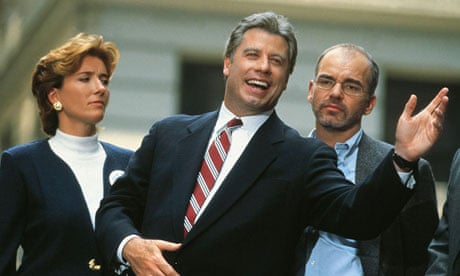
Nichols must have a knack for it.  Primary Colors is Nichols’s cinematic mirror on the rise of the Clintons, an adept story of the tension between political values, electoral success and human frailty, all wrapped up in a big, fun yarn populated by larger than life characters (one of whom served as our regularly entertaining president from 1992 to 2000). There is no need to discuss the plot.  It tracks history loosely, but it will be familiar.

It is also an actor’s film and those actors are aided by a very tight, yet breezy screenplay.  The characters talk the talk of political campaign work, yet we are not burdened by the mundane or weighty.  Better, divergence into the philosophical is not stilted or preachy.  Adrian Lester, the true believer sucked into the expedience and fervor of a presidential race, serves as our somewhat wide-eyed guide.  He exudes the right amount of awe and moral ambivalence.  Billy Bob Thornton is James Carville, and he utters my favorite line about politicians to Lester:  “That’s what these guys do. They love you and then stop lovin’ you.”  Emma Thompson is the increasingly embittered and mercenary Hillary; she is determined, yet both fragile and icy.  Larry Hagman delivers a nice turn as a morally tainted dark horse challenger, and Kathy Bates keeps the fun in the picture as a political operative who knows the terrain of small town politics gone national.

Now, playing a president is a hard job.  Jeff Bridges was nominated for best supporting actor for his Clintonian president in The Contender, but he was so charming and wily as to feel false.   Michael Douglas was painfully self-pitying in the The American President and while Kevin Kline’s president in Dave wasn’t supposed to be realistic (if you’ll recall, Dave was a look-alike brought in to replace the real president, a heartless prick who I much preferred), he was so “aw shucks” Opie I found myself rooting against him.

Even harder is playing a president we know.  Kennedy does not count, because most filmgoers didn’t live through his presidency, and even if they did, JFK is difficult to separate from a Hollywood character (in fact, Kennedy is the only president to have a film released about him during his presidency, and you can rest assured that PT-109 did not show Jack screwing the pooch by letting his ship get rammed by a Japanese destroyer).  So, we are convinced by awesome hair and a few “Bahstans” and “Cubers.”  Oliver Stone gave us two grotesque caricatures — Anthony Hopkins made Nixon a sweating bundle of nerves and ambition in Nixon (Frank Langella’s Nixon in Frost/Nixon was so much better) and Josh Brolin as a clownish, frat boy/oaf in W (I’m still waiting for the casting of Gerald Ford in The Mayaguez Incident).

This leaves John Travolta as Clinton.  Granted, I have been spoiled by the real Clinton, a masterful communicator and tactician, and in my judgment, perhaps the greatest American retail politician.  But Travolta misses Clinton’s flashes and confluence of weakness and sincerity, warmth and opportunism, self-pity and bitterness.  It is a tall order to fill, Travolta does his best, but mimicry is often what he is forced to rely upon.  When he is adored by crowds in the movie, I thought, “Oh come on. How could they be buying this?”  Granted, I usually had those thoughts when the real Clinton spoke to adoring crowds.  But I rarely questioned the sanity of others who were thinking “Yes! He feels my pain” while I was rolling my eyes.

Still, Travolta does well enough, and Nichols smartly never gets you rooting for him or anyone else.  That is critical to the film.  You may like Travolta and Thompson, but you feel tarnished for doing so.  You may hate them, but you recognize their failures in yourself and politicans you admire.

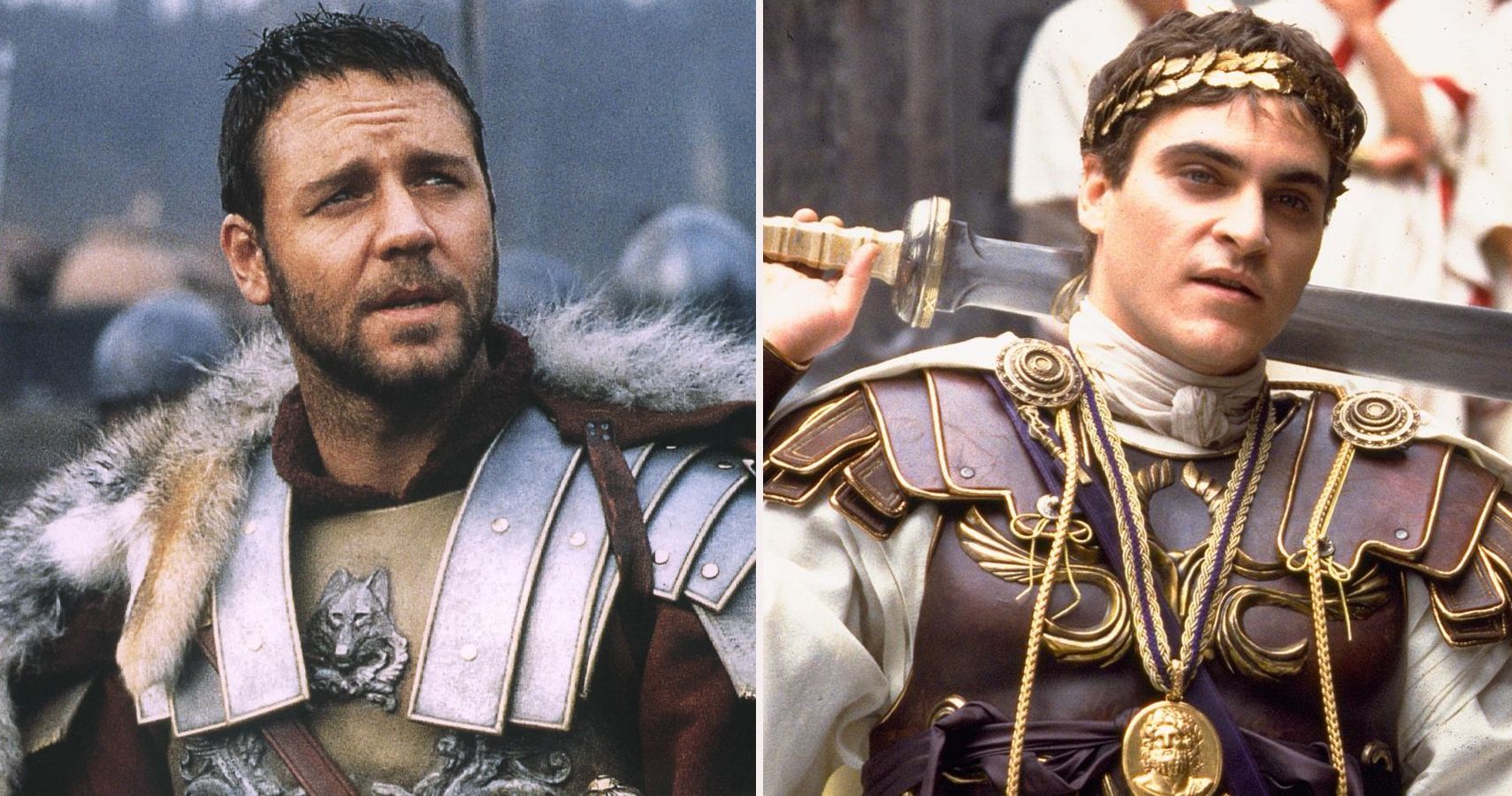
Are You Not Entertained?! 15 Most Iconic Quotes From Gladiator

Are you not entertained? You should be. While the script is cobbled together and shallow (it was being written during filming and it shows) and is reliant on the life breathed into it by the players, there is plenty of life, as Russell Crowe, Richard Harris, Derek Jacobi and Joaquin Phoenix do wonders for a leaden draft. Though Oliver Reed is bloated and battered as Crowe’s owner, he also gamely pitches in (he died in a Malta bar during filming).

All the action sequences are riveting. From an impressive opening battle sequence in Germania, to Crowe’s first gladiatorial experience, to a great Ben Hur-ish sequence where a troupe of over-matched gladiators under Crowe’s command exceeds expectations in their first visit to the Coliseum, to a nice one-on-one between Crowe and another famed fighter, with tigers thrown into the mix . . . all are thrilling. There’s also enough of a story to get us from action sequence to action sequence.

Crowe commands the movie and seems “in time” (obviously, I couldn’t possibly know if Crowe acted like a Roman, but I assure you, it feels more authentic than Tom Cruise as a Civil War veteran or Kirsten Dunst as Marie Antoinette). But it is Phoenix as the mad usurper who steals the movie in what could have been a throw-away performance, the weak son to the strong emperor. Instead, Phoenix is genuinely touching (when he seeks his father’s favor and is spurned) and frightening (when he seeks a different kind of favor from his sister, threatening the life of her son in the process). You almost feel for the guy when the mob turns on him.

The movie starts off trying your patience with an overlong introduction of clarinet music and scenes of modern Paris. We are then introduced to American screenwriter Owen Wilson and his nagging, dispiriting fiancee, Rachel McAdams. Wilson is nervous and nasally and a noodge. McAdams is flat out hostile to Wilson. The idea that these two would ever be engaged is absurd. I kid you not, McAdams says to Wilson, “You always take the side of the help.” So, Wilson is married to a monster, doesn’t seem to know it, and yet, Allen wants us to care about him.

Worse, McAdams travels with her ugly American parents, who are (gasp) Republicans, distrustful of the French and country club obnoxious.

Allen makes the modern so unpleasant you can’t wait for Wilson to be transported to the 1920s. Sadly, we have to go to the 1920s with Wilson. And he’s doing Woody Allen, but whinier. He meets F. Scott Fitzgerald, Cole Porter, Ernest Hemingway, Salvador Dali, and Gertrude Stein says, “I was just telling Pablo . . .”

The greats are condescending, self-satisfied characters and they lord their superiority over all. Allen does the same thing, hiding it in his puny, nebbish persona, so his portrayal of them makes sense.

This movie is terrible. Perhaps Allen can still make a good picture. Match Point (2005) was a revelation and Vicky Christina Barcelona (2008) was charming, but he’s about done, and the nomination of this movie as best picture is ridiculous. The nomination as best screenplay is an affront. Perhaps Allen’s digs at Bush and The Tea Party explain it, but if not, and the Academy wanted to give him an unwarranted accolade, isn’t that why the Irving Thalberg award was created?

Some gems: “How long have you been dating Picasso. I can’t believe I’m saying that.”

Hemingway: “Have you ever shot a charging lion . . . Who wants to fight!”

“I wouldn’t call my babbling poetic, though I was on a roll there.”

“500 francs for a Matisse? I wouldn’t mind getting five or six.”

“The present is unsatisfying because life is unsatisfying.”

Yeesh.

There are some funny moments when Wilson lapses into Seinfeldian chatter and the folks from the 1920s look at him funny. Adrien Brody is a hoot as Dali. The movie is also very pretty.

That’s not enough, notwithstanding the Academy and a 93% rating on Rotten Tomatoes.