Zach Braff’s gruesome, false dramedy about a guy in his twenties who “has everything” but gets the jitters when his long time girlfriend (Jacinda Barrett) becomes pregnant. He then recklessly beds a college hottie (Rachel Bilson), and the audience is treated to the extended punishment of his shrieking girlfriend, his unctuous attempts to elicit forgiveness, and side-stories of friends and family similarly bollixed by love, which, as I understand it, reduces everyone to shrieking hysterics.
This indeed may be the way of love for many people, but I sure don’t want to watch it, even with an implausible, redemptive, happy ending. Braff’s responsibility is minimized. He only starred in and co-wrote this disaster, with, shockingly, Oscar-winning screenwriter and Scientology attacker Paul Haggis (perhaps this is an excess of Scientology?)
But a curse is a curse, and his post-TheLast Kiss, non “Scrubs” work is a cautionary tale — one Canadian movie (The High Cost of Living) and a cameo on a 2012 episode of “Cougar Town.” He played the pizza delivery guy.
David Mamet-speak is one thing. There is nothing quite like the staccato of the pitiable salesman in Glengarry Glen Ross, and Alec Baldwin’s thunderous sermon to those below him has become so ubiquitous that a generation of frat boys can now recite it – or parts (“coffee is for closers!”) – verbatim.
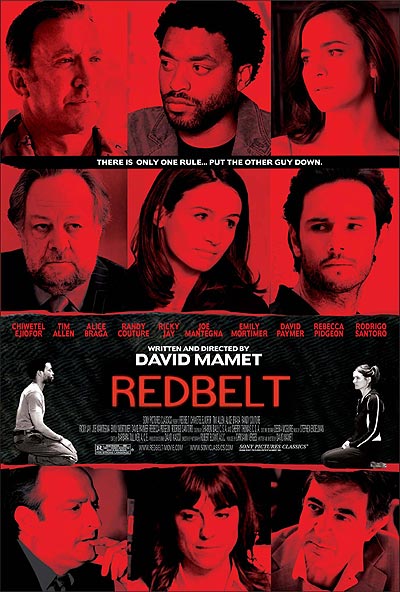
But Mamet-speak has it limits and when coupled with Mamet’s macho honor philosophy, the results can be toxic. And thus, we have Redbelt, a bizarre modern moral tale about a martial arts enthusiast (Chiwetal Ejiofor) who spouts a lot of Kung Fu b.s. while negotiating through a plot so byzantine and ridiculous that were I to attempt to encapsulate it, I’d have a stroke.
So, I’ll let Wikipedia do it for me:
While closing his Jiu-jitsu studio one evening, Mike Terry (Chiwetel Ejiofor) is approached by attorney Laura Black (Emily Mortimer), who is seeking the owner of the vehicle she accidentally sideswiped. Off-duty police officer Joe Collins (Max Martini), who was receiving a private lesson from Mike, sees that Laura is distressed and tries to take her coat. Startled, Laura grabs Joe’s gun and fires it; shattering the studio’s front window. To avoid having Laura charged with attempted murder, Mike and Joe agree to conceal the event.
Mike’s insurance, however, will not cover his act of God claim that the window was broken by a strong wind. Mike’s wife Sondra (Alice Braga), whose fashion business profits are the only thing keeping the struggling studio afloat, requests that Mike ask for a loan from her brother Ricardo (John Machado), a mixed martial arts champion. At Ricardo’s nightclub, Mike meets with Sondra’s other brother, Bruno (Rodrigo Santoro), and learns that Joe quit as the club’s bouncer because Bruno never paid him. Mike confronts Bruno about the situation but is rebuffed. Mike then declines Bruno’s offer to fight on the undercard of an upcoming match between Ricardo and Japanese legend, Morisaki (Enson Inoue), which could potentially pay out $50,000. Mike believes competitions with money as the incentive are not honorable and weaken the fighter.
Meanwhile, aging Hollywood action star Chet Frank (Tim Allen) enters the nightclub without security and is accosted by a man with a broken bottle. Mike intervenes and subdues three men in the process. The following day, Mike receives an expensive watch and an invitation to dinner from Chet. Mike gives the watch to Joe to pawn in lieu of his unpaid salary at the nightclub. At the dinner party, Chet’s wife Zena (Rebecca Pidgeon) arranges an informal business deal to buy a large amount of dresses from Sondra’s company. Chet, impressed by Mike, invites him to the set of his current film. As Mike and Sondra leave the dinner, Mike explains his unique training method to Chet’s business associate Jerry Weiss (Joe Mantegna). Before a sparring match, each fighter must draw one of three marbles, two white and one black; whoever draws a black marble has to fight with a handicap.
Mike uses his military experience to answer a few technical questions for Chet on the film set and is offered the role of co-producer. That evening, Mike faxes the details of his training methods to Jerry so they can be used in the film. Joe arrives at the studio and informs Mike that he was suspended from duty for pawning the watch, which turned out to be stolen. During their dinner that evening, Mike relays the information to Jerry who excuses himself to handle the matter, but never returns. At home, Mike learns that the phone numbers that Zena gave Sondra have been disconnected. Sondra is panicky, having borrowed $30,000 from a loan shark to order the fabric for the dresses. As he meets with the loan shark to discuss an extension, Mike notices Bruno and Marty Brown (Ricky Jay) on television using Mike’s marble-drawing method as a promotional gimmick for the undercard fights of Ricardo’s match.
Mike hires Laura to sue, but Marty’s lawyer threatens that if they do not drop the lawsuit, he will give the police an empty shell casing with Laura’s fingerprints, as proof that she attempted to kill an off-duty cop. He also threatens Mike as a witness who covered up the crime by bribing the cop with a stolen watch. When told of the situation, Joe feels responsible and kills himself. Mike feels obligated to help Joe’s financially struggling wife and, in desperate need of money himself, decides to compete as an undercard fighter in the upcoming competition.
At the arena, Mike discovers the fights are being fixed via a magician (Cyril Takayama) using sleight of hand to surreptitiously switch the white and black marbles. Disgusted by this revelation, Mike confronts the conspirators: Marty, Jerry and Bruno who confirm that unknown to the competitors, the fights are handicapped by the fight promoters so as to ensure winning bets. They also reveal that Ricardo is intentionally losing the fight to Morisaki so they can make money on the rematch. Jerry tells Mike that Sondra is the one who told them about Laura shooting the window and Bruno justifies her betrayal by explaining that his sister is too smart to stay with someone who cannot provide for her.
As Mike is exiting the arena, he meets Laura. Their conversation is not audible, but it ends with Laura slapping Mike. Mike then re-enters the arena. He incapacitates several security guards trying to stop him and is ultimately engaged by Ricardo. The audience and camera crews take notice as Mike and Ricardo face off in the arena’s corridors. Inspired by the Professor, an elderly martial arts master attending the match, Mike manages to slip a difficult choke hold and defeats Ricardo. He is approached by Morisaki, who awards Mike with his ivory-studded belt, previously referred to as a Japanese national treasure. Mike is then approached by the Professor himself, who awards Mike the coveted Redbelt.
As my Mom might say, “Jeez-o-flip!”
I am not a Mamet hater. Oleanna, Glengarry, Homicide, State and Main, House of Games, The Spanish Prisoner, these are all very good films, and Mamet displays an authentic American voice in their telling. His work on films he did not direct, or which did not come from one of his stage plays, such as The Verdict, The Untouchables, The Edge, Hoffa and Ronin, is vivid and accomplished.
Redbelt, however, came out in 2008, about the time someone needed to tell Mamet that his mystical machismo and rat-a-tat dialogue had not only reached their expiration date, but had become as embarrassing as a driver’s hat and leather gloves on a newly divorced man.
Since Redbelt’s release, and critical failure, Mamet has written a few shorts, and episodes for his TV show “The Unit.” He also wrote a very interesting book explaining his “conversion” from Hollywood liberal to a member of the right, “The Secret Knowledge: On the Dismantling of American Culture,” as fine a read as you’ll get if you want to understand the nuts-and-bolts philosophy and precepts of a modern conservative (beyond the human sacrifices of panhandlers and the ritual rape of the land). Perhaps he’s done with film writing, but if so, Redbelt is both Mamet’s pathetic coda and a testament to his loss of the gift.
Steve McQueen’s Shame offers the story of Michael Fassbender, a New York City something or other, who is a sex addict. We learn this because he flirts with women on the subway, engages prostitutes, and masturbates/watches porn morning, noon and night. When his unbalanced sister, Carey Mulligan, comes to visit, his equilibrium is shattered, either because she is nude in his apartment, she sleeps with his boss, or she references their childhood. No matter. This is the kind of film that is destined to have as a penultimate scene Fassbender on his knees, in the rain, with a “will he or won’t he crawl back into sex addiction?” finale.
Why is Fassbender this way? As Mulligan says, “we’re not bad people. We just come from a bad place.” However, that place is actually identified in the script as either Ireland or New Jersey. And that is the sum and substance of motivation, backstory or reason.
In place of exposition, McQueen provides pointless, overly showy scenes, including a long, several block Fassbender jog through the streets of NYC; a preposterous nightclub song by Mulligan (she sings “New York, New York” and sports a Marilynesque “Happy birthday, Mr. President” skintight dress); and, a ridiculous threesome with Fassbender and two women that is half Obsession by Calvin Klein, half Showtime soft core.
“I know how you feel, pal.”
My wife summed it up beautifully: “I don’t even think he was a sex addict.” Her comment is akin to watching Raging Bull and declaring, “I don’t even think he was a boxer.”
Also, Hans Zimmer should sue the composer, Harry Escott, who ripped his work off on The Thin Red Line damn near note for note.
The 1.5 stars are awarded because our good friend’s sister is in the picture and the movie looks great.
This critically-acclaimed 2011 release purports to be a psychological study of its protagonist, Martha (Elizabeth Olsen), who becomes a member of an upstate New York commune/cult led by the charismatic John Hawkes (nominated for an Academy Award for his role in Winter’s Bone). The film opens with Martha’s escaping the collective farm, though Hawkes and the other members of the commune (a motley assortment of women who serve him and a few young men) don’t do very much to stop her flight. Martha ends up 3 hours away, at the Connecticut lake home of her wealthy sister and her new husband. There, we learn of her ordeal through flashback (sexual abuse, violence, co-opting and subordination to the whole) while she struggles to adapt to life outside the cult. She provides tension to her sister’s household as she brings bad habits from the commune with her (swimming nude, curling up in the bed of her sister and brother-in-law while they are having sex, condescending to them about their lifestyle) and undergoes post-traumatic stress that manifests itself in panic attacks, wetting herself and refusal to discuss what happened.
All of which makes for a frustratingly monotone of a movie. Martha is treated with such sensitivity by her sister that you sympathize most with the husband, who has to endure a recalcitrant, moody weirdo in his midst without anyone ever saying, “What the hell happened?” Worse, while it is clear that Martha undergoes trauma, her behavior after she endures it suggests a person who was under the sway of the commune since childhood. In fact, Martha was there for two years. Also, the key to a psychological study is an explication of why Martha was lured into the life, but we get no clue as to what Martha was looking for when she voluntarily allowed herself to be part of Hawkes’ crew and scant information on what the cult is really about. Martha seemed shallow and dull in flashback and during present-day, she seems shallow, dull and jittery. Moreover, Martha says some very terrible things about and to her sister (“You’re going to be a terrible mother”), who has the patience of Job, suggesting she was a first-class turd even before she went to the commune. This is not conducive to empathy. Finally, the picture reveals a Manson-esque quality to Hawkes very late, which is awkward and unconvincing.
Another problem is Olsen’s performance. Yes, she does better work than her sisters ever did on television’s “Full House”, but it is still a one-note, amateurish turn.
Roberto Begnini’s Academy Ward-winning fable is in two parts. First, the love-at-first-sight courtship of a sweet and funny man and a beautiful schoolteacher, followed by a tale of a father’s love for his wife and son and the lengths to which he will go to spare them the cruelty of a Nazi concentration camp. Both halves of the film seamlessly meld, and the picture travels a road from sunny to tense to dire, with Begnini at the heart, lending dignity as he dances faster and faster.
Begnini’s film is neither historically accurate or particularly reality-based. Indeed, the half of the film occurring in the concentration camp could have taken place over a period of months, weeks or days, and Begnini’s character essentially creates a daily circus to shield his boy from the horrors that surround them, behavior not even Colonel Kilnk would have allowed. For this reason, Life is Beautiful came in for criticism from some quarters who believe that a Holocaust movie should not necessarily be the backdrop for a comedy, however bittersweet, and/or that Begnini trivializes and historically mutated the reality of Italian Jews during World War II.
Nuts. The overarching theme of the film is a father’s attempt to protect his son from death, both physical and spiritual, effectively conveyed in a respectful manner. Complaints of inaccuracy or improper tone are misplaced and rigid, as if there is some politically correct blueprint for a Holocaust film. Conservative film reviewer John Podhoretz recently followed this line, attacking the latest X-Men movie – which traces Magneto’s powers and philosophy to his treatment at the hands of the Nazis – thusly: “Genocide and supernatural powers don’t mix”.
Nuts to him too.
Shoah has been made. So too Schindler’s List and The Wansee Conference. Go see them, I implore you, and make your own judgments (and while you are at it, check out Enemies, A Love Story, which actually mines a Holocaust survivor’s post-trauma love triangle for a couple of chuckles). But don’t stilt artistic vision in the name of grim devotion to past horror.
These criticisms smack of paternalistic preaching that might make The Catholic Standard proud. Tarantino and Stone “glorify” and thus perpetuate violence. Lolita makes child molestation all the more probable. And Begnini’s work, according to Slate‘s David Edelstein, similarly offends: “Imagine Harpo Marx giving the hot foot to a pompous official, who takes out a machine gun and blows him away: That’s how cheap Benigni’s hash of farce and tragedy is. It’s a gas, all right.”
Edelstein earned his “I’m A Sensitive Keeper of the Grim Tenor of Concentration Camp Flicks” ribbon. And with that award goes a free ticket to Showtime’s offering, The Devil’s Arithmetic – Kirsten Dunst is transported from modern day history class, where she passes notes and ignores the teacher’s recitation of the the extermination, to a WWII-era Poland. Or The Twilight Zone, where Vic Morrow’s modern day bigot was carted off in a train headed, presumably, to Treblinka.
Controversy aside, the film begins in brilliant color but mutes to near-black and white as the story continues its necessarily sorrowful pace. I can say little about the direction as my eye was trained on Begnini. His performance as an unserious man at the most serious of times mirrors Chaplin (another person we could criticize – how dare he benefit from physical comedy while aping the creator of the concentration camp, Adolf Hitler). His carefree and whimsy is tested as he becomes separated from a rich life, his wife is torn from him, and every day becomes a struggle to personally survive and protect his son. Everyone else is quite good and the son is particularly affecting (the Italians get me every time – seeCinema Paradiso).
Former police officer Jack Nicholson is haunted by the murder of a little girl, so much so it tests his sanity. He finds the love of a good woman (Robin Wright Penn), who has a little girl as well, but he remains haunted and, as near as I can tell from this complete mess of a movie, goes insane.
Sean Penn directed this picture, which was released in 2001 (he directed another similarly dark mess of a movie released that same year, The Crossing Guard, so perhaps this was a phase). The film is clumsy, uninvolving and disconcertingly showy. Penn can’t just have a cop walk into a room without cross-cuts to the ticking clock and the face of a fat, stupid common clerk telling us something (but what?). Nicholson can’t drink at a Nevada airport bar without pointless flash cuts to whirring slot machines. Not only does all this jazz lead to continuity problems (Nicholson’s scotch miraculously becomes a beer), it is annoying.
The Pledge also demonstrates Hollywood’s disdain for the working class. Set in the flatland of Nevada, Robin Wright Penn, Sean’s then-wife, is a vessel of all Hollywood presumptions about regular folk. She plays a barmaid. She has a gnarled front tooth. She is a little dim. She wears a lot of flannel. And when her savior Nicholson comes to love both her and her daughter, we know that they will commune because . . . Nicholson fixes her tooth! I mean, let’s not take this working class thing too far. We can’t expect Jack Nicholson to have sex with woman with a gnarled tooth.
Ewwwwwwwwwwwwwwww.
Another problem? Penn uses top actors for single scenes, so each feels compelled to ACCCCCCCCCCCTTTTTTTTTTT! like there’s no tomorrow. Benicio Del Toro, Vanessa Redgrave, Mickey Rourke, Helen Mirren, they all emote for a brief, generally unnecessary scene, and boy do they make the most of it. Also, the little girl is killed on the day of Nicholson’s retirement party. If Penn directs a war picture, God help the character who shows his platoon mates a picture of the gal he has at home waiting for him.
That said, I was a big fan of Penn’s more restrained and mature Into the Wild, directed 6 years later, so I chalk The Pledge up to practice.
Baseball season is upon us, so a review of a Sam Raimi baseball movie (?) is apropos. Raimi, whose credits include three Evil Dead movies, three Spiderman movies, and Drag Me to Hell, proves a strange choice to helm a love story-via-flashback, as an aging starter (Kevin Costner) thinks on his love life while trying to pitch a no-hitter.
I am no Costner-hater. He is limited but does what he does well – affable, with a flash of anger and occasional stoicism. Get him outside his comfort zone (Robin Hood, JFK, 13 Days) and you got problems. But he was a fine, goofy golfer in Tin Cup and as the sweet but violent and repressed killer in Open Range. Here, he’s Tin Cup but replaces goofy with taciturn.
Costner is not the problem. In fact, his time on the mound is compelling. But when he gets to thinking about that woman of his – Kelly Preston (wife of John Travolta, poor thing) – things go to pot. Preston is thin, harpy and jittery, and her pitch is, “you need to settle down with serious people like me instead of living the life of a little boy.” Her case is not strong. Even though she has a nice daughter (Jenna Malone), it does not seem conceivable that a good-time, easygoing jock like Costner would be enticed by her invitation. And thus, the movie is undone (and at 2 hours and 17 minutes, very trying).
Postcript: this is supposed to be a baseball movie, and while I understand that athletes get injured in the off-season performing everyday tasks, Raimi has Costner slicing his hand on a router. A pitcher making $15 million a year is not working in the shed with his Black and Decker (hell, he is likely contractually prohibited from self-gratification).
The film also has the manager putting guys up in the bullpen while Costner, who is at the end of his career, IS PITCHING A PERFECT GAME for a team no longer in the pennant race!
Paul Thomas Anderson’s opus chronicles the American porn industry in the late 70s via the story of a loose family of weaklings, caught up in the speed, confusion and excitement of sex, drugs and fleeting fame in the bleaching sun of Los Angeles (Anderson took some license here, as the porn industry started in San Francisco and NYC, but his film requires that feel of promise and wasteland that is LA).
The patriarch is porn director Jack Horner (Burt Reynolds), and the story revolves around his LA retreat, a gaudy ranch-styled haven for his coterie of misfits. There are the young rejects: porn star and mother Amber Waves (Julianne Moore), her teen charge Rollergirl (Heather Graham), studs Reed Rothschild (John C. Reilly) and Buck Swope (Don Cheadle) and lesser stars Jessie St. Vincent (Melora Walters) and Becky Barnett (Nicole Ari Parker); the film crew (William H. Macy, Ricky Jay and Phillip Seymour Hoffman); the money men, The Colonel (Robert Ridgely) and Floyd Gondolli (Phillip Baker Hall); and a host of hanger-ons (club owner Luis Guzman and troublemaker Thomas Jane).
Into this world comes Mark Wahlberg, a young kid who works at Guzman’s nightclub and comes to the attention of porn director Horner after Rollergirl has an encounter with him and reports back his massive endowment. Horner offers the boy a place in the family. Wahlberg becomes Dirk Diggler, porn superstar, escaping from a toxic home to the warm embrace of pseudo-stardom in fuck films. In the world of porn, he finds acceptance, friendship and a certain form of celebrity.
Diggler is based on famed porn star John Holmes, and while Anderson doesn’t take Dirk Diggler down Holmes’s exact path of The Wonderland Murders and AIDS, the trip tracks close enough. Hubris and drugs take Diggler from the safety of Horner and his new family to the street, where he ends up turning tricks, beaten by punks, desperate to score drugs and nearly murdered by a psychotic drug dealer (Alfred Molina).
To a person, these people are none-too-bright, but they cleave together in a life that mirrors celebrity, though it is gaudy and flimsy, glitz on the cheap. They briefly flourish in a fantasy world within a fantasy world, where their work is deemed art, and their talent is certified as genuine. Despite the self-delusion, Anderson shows how the family actually provides support to these outcasts never found elsewhere.
The film is visually audacious and features several flowing scenes without a cut for long stretches, including a 3 minute opening scene which introduces most of the characters. Anderson’s filming of two separate parties at the Horner house is boundless and reminiscent of Altman’s opening scene in The Player as well as Scorcese’s casino scenes in Casino. The effect meshes with Wahlberg’s entrance on the scene, as he steps into a world where he is the golden child. You see the wonder – beautiful young people drugs, a swimming pool! and despite better instincts, you become intoxicated along with Dirk.
The screenplay by Anderson is authentic and resonant, evoking David Mamet, but without the showiness. A prime example is the discussion between Horner and Floyd Gondolli on the changing business of porn:
The music by Michael Penn is evocative of the time as well, and the cuts chosen for each scene are spot on, from Andrew Gold’s “Lonely Boy” (revealing Amber Waves as a mother) to the Beach Boys “God Only Knows” providing the coda for the characters, to “Sister Christian”, which now serves as a sinister song, as used in the film’s most harrowing scene, much like “Stuck in the Middle with You” after Reservoir Dogs.
Finally, the performances are uniformly stellar. Julianne Moore was nominated for best supporting actress (she was beat out by Kim Basinger in LA Confidential, a great film and a fine performance, but still, Moore was robbed). Burt Reynolds was also nominated and rightly so. Interestingly, after seeing a rough cut of the movie, Reynolds fired his agent for casting him in Boogie Nights, but Burt’s artistic choices have never been stellar. Wahlberg stands out, exuding the perfect blend of charm, wonder, cluelessness and want. Anderson is lucky Leonardo DiCaprio turned down the role to work on a little picture called Titanic. DiCaprio’s a fine actor, but he’s a little too savvy and wary. Wahlberg was perfectly open, trusting and innocent. The scene where his mother berates him as worthless and stupid, forcing him out of the house, is heart-wrenching.
This is a classic film of America sprawl, ascent, decay, and fall. One of my favorites and one of the top 20 ever made.
An engaging and surprisingly even picture about a simplistic, homophobic ex-NY cop (Robert De Niro) living in the same apartment building as a drag queen (Phillip Seymour Hoffman). De Niro has a stroke and needs the drag queen’s assistance as a voice coach (she teaches singing) so he can learn to talk again. This is two fish, different waters. You’ve seen it. But through the skills of Hoffman and De Niro, it works really well, and review of the picture allows a meditation on Hoffman. I remember him as the spoiled rich fink in Scent of a Woman, the unfortunate thief in the remake of The Getaway and the dunce with a badge in Nobody’s Fool. Even in such small roles, he resonated. Soon came absolutely indelible and brilliant supporting turns, as the closeted and adoring fan of Dirk Diggler in Boogie Nights and rich visiting playboy Freddie Miles who smells a rat in The Talented Mr. Ripley. Leads came next, including a best actor Oscar for Capote, but Hoffman is in the club with Duvall and Hackman – he can play the lead, but he’s more often better in support or ensemble, be it the outrageous Lester Bangs in Almost Famous, the chilling priest in Doubt, or the stubborn manager Art Howe in Moneyball. He’s pitch-perfect and makes everyone around him better.
His role here is actually a very different character for Hoffman. He’s flamboyant, wildly emotional and central. These are easy roles to botch, but Hoffman communicates both the external vamp and internal insecure deftly (his hysteria as his boyfriend abuses him is particularly touching). He’s very moving, and De Niro (who is also good as the disabled grump) does not get in his way.
You can find this flick in the Scent of a Woman aisle, next to all the other “Young man taught life lessons by crippled mentor, but it looks as if the crippled mentor could learn a lesson or two as well” films. Except, this time, nobody says “Hoo-wa!” but rather, “Punch the keys!”
Al Pacino is played by Sean Connery, who plays William Forrester, a crotchety, haunted J.D. Salingeresque recluse who befriends a gentle student. His charge is a fresh-faced underclass kid (Rob Brown) who is attending a tony NY private school.
In both films, the nemesis is a priggish, empty-suit of an educator who does his dastardly deeds mainly out of insecurity and spite. The bad guy here (F. Murray Abraham) is actually really, really bad. Not only does he try to railroad our hero by accusing him of plagiarism (Brown is writing under the tutelage of Connery), he actually whispers to Brown, “Don’t ever embarrass me in front of my class again.”
In Scent of a Woman, the day is saved by the appearance of Pacino at the honors trial of poor, fresh-faced Chris O’Donnell. In this film, Connery makes the same entrance at the school, but instead of speaking up for the boy, he (SPOILER) slits F. Murray Abraham’s throat with an unseen dagger.
Okay, Connery doesn’t do that He pretty much does the same thing Pacino did, he just doesn’t say “Hoo-wa!”
By-the-numbers schmaltz, made just a little more bearable because director Gus Van Sant makes things visually interesting; rapper Busta’ Rhymes is around for a few yucks; and, Pacino is not in it.








 filmvetter