Archive

Drama

image

*WARNING – SPOILERS*

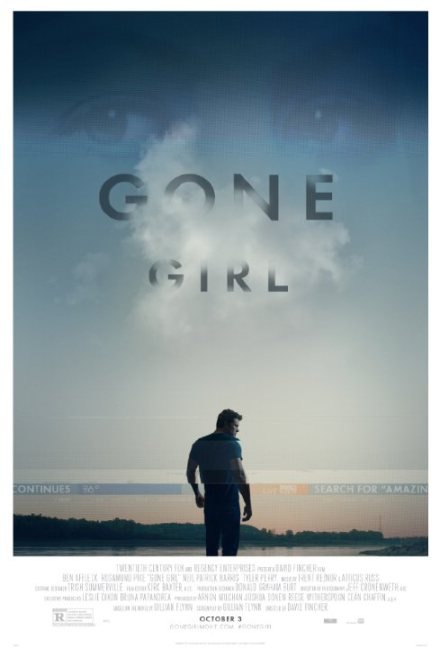
David Fincher’s adaptation of Gillian Flynn’s novel works as a procedural, a domestic drama, and a meditation on modern tabloid culture. It is patient, methodical and mostly interesting, though contemporaneous commentary notwithstanding, it has nothing serious to say of love, marriage or the waning of romance, which is what it purports to examine. Sure, there is perfunctory sex, Pike’s voiceover vituperation over the rigors of being the junior partner, and some suggested physical violence, all of little import.  In the end, it’s a monster movie, an elegant, crisp, well-acted monster movie in the hands of one of our more meticulous directors, but a mere monster movie nonetheless.

The monster’s victim is Ben Affleck, who is surprisingly savvy as the husband set up for the ultimate fall by his seemingly perfect wife (Rosamund Pike). Affleck is an apt choice for a weak man searching for a lifeline while his world crashes around him. Affleck the actor has often failed due to a lack of depth, a certain surface charm that has nothing beneath it, and here, he uses that to his advantage. He is complemented by Carrie Coon, who plays his loyal but disapproving sister, and Kim Dickens (Deadwood), the skeptical detective investigating the disappearance of Pike.

There are two strange casting choices, one that works out and one not so much. Tyler Perry has been trying to shake off Madea, and as a high profile, cable news ready criminal defense attorney, he does so, bringing some real wit to the role. As Pike’s former paramour, however, Neil Patrick Harris is thin, almost lost.  He is too strongly rooted in broad comedy and he works to overcome that persona with a deliberate, cautious performance that is creepier and more distracting than it should be.

The story, however, is riveting, told first from the vantage point of the increasingly beleaguered Affleck and the flashbacks of Pike as she narrates from her diary. Theirs is a storybook romance that eventually succumbs to the pressures of money, familiarity and recrimination. Except for one difference. Pike is nuts, a serial fantasist who destroys anyone who rejects her.

Pike’s predecessors – Glenn Close in Fatal Attraction and Bonnie Bedelia in Presumed Innocent – were in their own ways every bit as batshit crazy, but both women were decidedly more nuanced. Close’s jilted one-weekend stand refused to be ignored by Michael Douglas, but there was a discernible crack in her facade that made her sympathetic. Like Pike, Bedelia not only wanted to torture her husband and insisted upon his fealty after the fact, but her rebellion against the invasion of the impossibly attractive Greta Scacchi was sold as the aging frump protecting her castle and its king, Harrison Ford. Pike, however, is The Terminator (or maybe Rebecca De Mornay in The Hand That Rocks the Cradle), so psychopathic that she sets up all her former paramours when they as much as back away. Accordingly, any observation she or the film offers on the nature of marriage or relationships are no more than the ravings of a lunatic, even if this particular lunatic is cool, calm and seemingly accomplished. She’s loathsome and it’s hard to care much about the fate of Affleck, who chooses to sally forth with her even after she tries to destroy him. Which makes for an ultimately silly movie, but one that is a great deal of fun arriving at its pointlessness.

image

The main draws of the first two Hunger Games movies were the thrilling and terrifying nature of the games themselves and the frivolous corruption of the Capitol. Katniss (Jennifer Lawrence) was our guide, and after her selfless act (volunteering to take her sister’s place in the games), she served mainly as an action hero. As those movies progressed, Katniss became romantically tied to her teammate, Peeta (Josh Hutcherson) and her tie to him remains strong in this third installment. Unfortunately, this picture has neither games nor Capitol nor action. Instead, there’s a lot of Katniss pining for Peeta.

As the film opens, Katniss is ensconced in a drab underground facility that hides rebels under the leadership of the steely and completely uninteresting Julianne Moore. The primary conflict is whether Katniss will assist the rebels for propaganda purposes, and when she balks because of their hostility towards Peeta, who appears to be a collaborator, it is annoying. When she continues to prove difficult after surveying the carnage wrought against her own district (90,000 dead) and witnessing the Capitol bombing a rebel hospital she had just visited, it is very annoying. Her actions might be better accepted if she didn’t seem so mature; Katniss of the books is a teen while Lawrence is mid twenties.

There are bright spots. Phillip Seymour Hoffman, Elizabeth Banks and Woody Harrelson return, providing the film necessary humor and spark. And this is clearly a set-up for what one hopes to be a big finale. Let’s just hope Lawrence doesn’t appear to be in her early 30s, still reluctant to play a featuring role in the rebellion because she is mooning over Peeta.

It was on.  Nothing else was on.  An old recipe–

*2 tsps. hunk from “The Wall” on Game of Thrones (Kit Harrington)

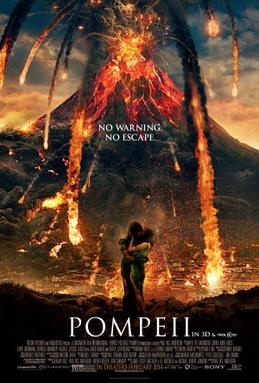
*1 lb. Gladiator, including a contest in the arena based on a Roman conquest where our hero commands an ahistorical result, an African gladiator who becomes our protagonist’s friend and soul mate, a knock-off of the ghostly Hans Zimmer score, and a baddie (Kiefer Sutherland) who wants to put his thumb down but must turn it up lest he lose the favor of the people

*1/2 lb. Titanic, including star-crossed lovers from different backgrounds, looming disaster, a chase through the beleaguered city as time runs short, and laugh-out-loud funny anachronistic dialogue, mostly from our Kate Winsletian heroine, Emily Browning (“Men killing each other for amusement is not a sport”; “Senator, you have mistaken me for the kind of woman who drapes herself across your lap in Rome“; “He made me feel… safe. “

* 12 lbs. of crazy ass CGI

It cost $100 million to make and made $110 million at the box office worldwide, so Pompeii II: The Reaping has probably been avoided.

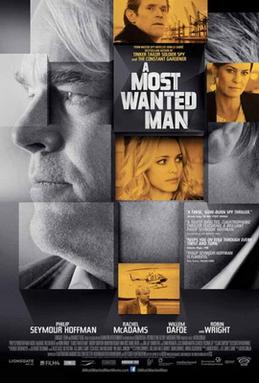
On the plus side, this moody, meditative adaptation of a John le Carre’ novel is intelligent yet explicable (unlike the rushed and byzantine Tinker Tailor Soldier Spy) and anchored by one of the greatest actors of a generation, the late Phillip Seymour Hoffman. On the downside, while it is compelling in parts, it is hurt by a weak Rachel McAdams performance and an inapt one by Robin Wright.  More problematic, the grim resolution seems a cop-out, an easy resolution that makes the viewer wonder what the hell this was all about.

Hoffman is a German intelligence officer who leads an anti-terror unit in Hamburg. Like Jessica Chastain in Zero Dark Thirty, he is haunted by an intelligence failure from his past. He is tracking two terror suspects, one a potential bomber and the other a funder, when he formulates the idea of baiting the latter with the former. McAdams plays a lefty lawyer representing the suspected bomber and, as usual, she is thin, distractingly glamorous and, when asked to buckle under the weight of seclusion and interrogation, inept and unconvincing. Wright, as a CIA counterpart to Hoffman, is merely odd. She’s much too high brow, playing a minor variation of her character in Netflix’s excellent House of Cards, fine for a First Lady but not so much for a spook.

Hoffman, however, is stellar, whether keeping a frightened mole from turning, managing his younger team, or lecturing McAdams on the naivete of her politics. He is supported ably by Willem Dafoe as a banker caught in the middle of Hoffman’s gambit. Dafoe exudes the fear and discomfort of a “civilian” dragged into the high stakes of thwarting terror.  If the film’s end is somewhat ho hum, both actors are more than worth the watch, especially since this was Hoffman’s last finished picture.

image

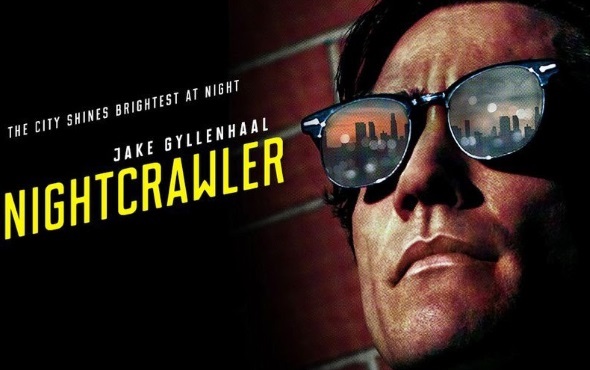
A clever black comedy that emphasizes story over a message (“if it leads it bleeds”), Nightcrawler works in large part to Jake Gyllenhaal’s riveting performance as an aspiring freelance videographer who haunts LA at night, capturing its brutality for sale to local TV news. Gyllenhaal is a mixture of King of Comedy‘s Rupert Pupkin, Rushmore‘s Max Fischer, and Jim Carrey’s Cable Guy, a driven cipher who spouts business motivational doctrine and relentlessly pushes further and further over the line of acceptable journalistic practices in capturing people in crisis or even death throes. You guiltily root for him because he is so compelling and his Dale Carnegie pitch, even unmoored from any concept of morality, comes off as an earnest entrepreneurial pitch. But by the end of the film, a series of tense crime scenes invaded by Gyllenhaal, his philosophy is both corrupting and lethal. He makes it bleed even more that it otherwise would, and as a result, he excels.

It’s a simple tale, well told, but there isn’t a lot to this picture other than Gyllenhaal, who exudes a real inner force (while his character is certainly different, I kept coming back to De Niro in Taxi Driver). He has two co-stars; Renee Russo, a hard-bitten struggling TV producer whose star rises with Gyllenhaal’s footage, and LA at night, which writer director Dan Gilroy shoots as a haunted ghost land of deserted streets and foggy canyons. Gilroy is a longtime writer of pretty bad films (Freejack, Two for the Money, Real Steel), but he directs this thriller with pace and verve.

image

A romantic comedy set around an abortion requires a deft hand, and there are times when first time writer-director Gillian Robespierre navigates her lead, sweet but spoiled comedian and former SNL alum Jenny Slate, into some questionable waters. Slate is a comic, a regular at a Williamsburg club, who has a one night stand with seemingly buttoned up Jake Lacy. Her “thing” as both a stand up and as a potential mate is to be self revelatory and outrageous, and so we get a full helping of bon mots about vaginal yeast, farts and the like. That can be a little trying, as is Slate’s callous treatment of Lacy.

But it works. Slate is very good, exhibiting the in-between status of a grown woman trying to live her own life and the little girl still vulnerable and attached (financially and emotionally) to her divorced parents. Slate is very much modeled after Lena Dunham’s Hannah Horvath from Girls, with, thankfully, precious little of Horvath’s navel-gazing excess. But when Slate gives voice to her fear and confusion, she is natural and sympathetic.  Conversely, when Horvath is flat on her back on on the canvas, you most always feel pretty happy about it.  Lacy is also quite touching as the gentle and confused hook-up who warms Slate’s butter pats and brings flowers to Planned Parenthood.  He knows that among the smart set, the joke may be on him, but he’s game and his backhand is effective.

While I’m not sure if Robespierre meant for Slate to be only kind of funny, that works as well, because it feels real. She seems like a young comic, still working on material up until the moment she takes the stage, and that contributes to the verisimilitude of her circumstances.

This could have been arch and maybe even preachy. Gaby Hoffman, as Slate’s roommate, comes close to giving a stemwinder against the Supreme Court and society’s “patriarchy” but she is blunted by Slate’s giggles and a mild pushback from a gay friend who retorts, politics aside, that he would want to know if he got someone pregnant.

No matter the edgy subject matter, the end is syrupy sweet and hopeful, paying homage to the rom-com rules.

The Family Stone - Wikipedia

My August: Osage County review elicited an email from my friend and mentee, Xmastime:

worse than this steaming turd

My reply:  “Nothing is worse than that steaming turd.   Osage is a standard, Southern shoutfest, with as much authenticity as Hee HawThe Family Stone, however, is a pat-its-own-back paen to womyn, disabled homosexuals, showy profanity by people wearing flannel, and New England flintiness.  The cancer ravaging Diane Keaton couldn’t come fast enough.  I am pleased to say that its writer director didn’t get another project until 6 years after The Family Stone and that was a Selena Gomez joint.  Justice.”

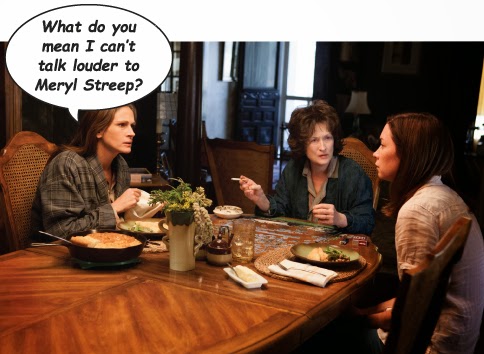
A grueling, gloppy, false film. A poet father (Sam Shepard) goes missing (and then dies) and the family is summoned to bury him. They proceed to vomit all over each other as the matriarch (Meryl Streep) goads and undermines the lot of them.

It is based in Oklahoma, which elicits exaggerated heartland/Southern accents and theatrical, hokey back-and-forth (Julia Roberts’ “get tough” bit with her mother, Streep, is laughably unconvincing). There are confrontations and serial reveals of family secrets, followed by more wailing and teeth-gnashing, and that’s about the whole of it.

The film is adapted from a stage play, which encourages overacting. Streep and Roberts are particularly culpable, the former not so much in technique but in volume and size. She positively leers at her stupid family, and horns near come out of her head. Naturally, the Academy nominated them both for Oscars, but nobody in their right mind would spend another minute with these women after the mildest of their taunts or insults.  But there this family of dolts sits, taking it just like the audience.

There’s not a genuine moment in this monstrosity.

image
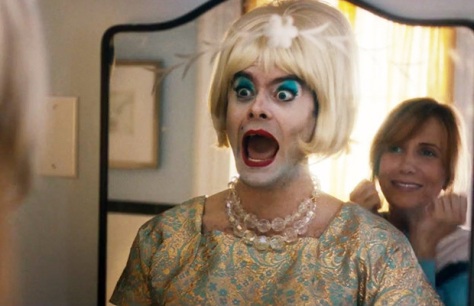
When the two major characters of a film attempt suicide in the first scene, by the end of the picture, you’re not supposed to regret their lack of success. The Skeleton Twins is a ragged, cloying, mannered dramedy starring entirely-out-of-their-depth SNL alums Kristen Wiig and Bill Hader as estranged siblings brought together by near tragedy. Wiig is utterly lost here, and all her tics and quivers cannot make up for substance. Hader is a little better, if a facsimile of a gayer Sean Hayes from Will & Grace is the aim.

The siblings are the children of tragedy, their father a suicide and their mother a hackneyed New Age narcissist introduced only to make her children seem noble. They are presented to us as seeming losers who have lost their way and their special bond on the rocky road of life. They come alive in a weirdly incestuous routine of replaying bits and hijinks from their childhood, and the watching (particularly, a drawn out stoned scene featuring Wiig’s HI-larious flatulence and a lip-synch duet brazenly stolen from Bridesmaids, sans humor) is cringeworthy. These two are as likely to be siblings as Olivier and Midler, but as foreign as they seem, the real problem is that they are fundamentally disinteresting to anyone but each other. It’s like spending an evening with two dull people who constantly crack each other up with reference to inside jokes and childhood excesses (burps, farts, hopes and dreams). Um. Check please.

As for the story, it is a lurching mess, serving primarily to highlight ridiculous and arty visuals, such as a slow dance in Halloween costumes that is finger-down-your-throat precious. When nothing happens (the film feels interminable), a character says or does something clunky and overt, and we slog forward. One example: Wiig is unhappy in her marriage to Luke Wilson and surreptitiously takes birth control pills while they are “trying” to get pregnant. Hader tips Wilson off after a HI-larious scene where hetero Wilson takes homo Hader rock climbing, which is funny because . . . gay. The clue? Sometimes my sister hid things when we were kids. And off Wilson goes to find the pills in a basket of decorative soaps.

An awful hipster picture with nary an authentic moment in it. Makes Zach Braff seem like Cassavettes.

I avoided this film because of an aversion to dramas about viruses and plagues and because I was still shellshocked at the total crappiness of the 1995 Dustin Hoffman vehicle Outbreak (guess what?  The military did it!).  Unless the eventual outcome of a filmic plague is zombies, 21 Days Later-esque “rage” victims or altered humans ala’ The Omega Man, count me out.

But you’ll watch most anything in a hotel, and Contagion had three extra things going for it – it was the $4.99 special, a few friends recommended the picture and it was directed by Stephen Soderbergh.  Despite my reticence, I was treated to an engrossing, intelligent and moving drama about what a 1918-like worldwide plague (where the entire world lost 1% of its population) would look like today.  The answer through Soderbergh’s eyes is — not pretty, but not hopeless.

The films starts with poor Gwyneth Paltrow, who is the second carrier of an infection transmitted by touch.  Once she is identified as Patient 1 (a Chinese cook is actually Patient 0 – he touched the pig who ate the bat got that started this whole mess, and then he shook Paltrow’s hand), we follow her from China through Chicago and to Minneapolis, where she has touched at least a dozen people  And an epidemic starts.

Soon, the government (Laurence Fishburne at the CDC, Bryan Cranston at Homeland Security) swings into action, regular CDC folk (Kate Winslet, Jennifer Ehle) act heroically, an internet crackpot become a messiah (Jude Law), and Paltrow’s husband and many other regular folk have to deal with a paralyzed world.  Lawlessness increases because law enforcement is sparse; fear runs rampant; trash piles up in the street; and people hole up waiting for aid and/or a vaccine.

This is a gripping, sober thriller, thankfully bereft of the normal tropes of the genre.   The government did not create the virus for military purposes; almost every character is doing the best they can under difficult circumstances; and while society does break down, it also holds up.

All the actors are very good and very believeable.  Special kudos to Matt Damon, who continues to be the least-appreciated American actor of his generation.  He had the misfortune of being outshined by Jude Law in The Talented Mr. Ripley and Jack Nicholson and Mark Wahlberg in The Departed.  They got the nominations and Damon, who carries both films with decidedly more difficult roles, got squat.  Here, he serves as the father who has lost a wife and son and seeks to ensure his surviving daughter is not affected while at the same time giving her some life of normalcy. The scene where he is told his wife is dead is particularly moving.

Final note:  Gwyneth Paltrow gets the Lifetime Achievement Award for Actress Who Allows Herself to Be De-Glamorized to Best Serve the Role (you’ll know what I mean when you see it).