Archive

Documentary

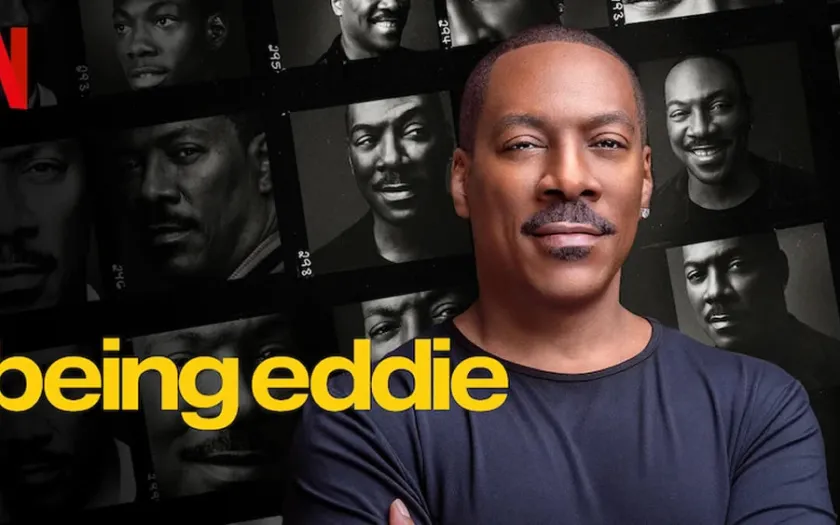
Did you know Eddie Murphy was funny? That he always knew he would be a star? That he inspired many a black comic? That he was angry at SNL when David Spade took a dig at him?

If so, you’re good to go.

If you insist on watching this tepid Netflix documentary, prepare for what seems to be a retrospective about a funny man that inexplicably does not show him being all that funny.

There is no delving into his craft, no in-depth discussion of how he matured in stand-up or established himself in films.

There are no great stories of Hollywood.

There is, really, very little insight at all. 

Rather, Murphy is presented as a pleasant, sensible fellow, a bit of a homebody, guarded but practiced in the art of bland recollection.

It is all very boring, and made more so by the likes of Arsenio Hall, Michael Che’, Dave Chappelle, Kevin Hart, Jerry Seinfeld, Pete Davidson, Jamie Foxx, Chris Rock, and others basically blowing so much elegiac smoke up Murphy’s ass that he seems more demigod than man. Which is weird when you see his oeuvre laid out, and his sermon on the mount is playing so many characters in The Nutty Professor who can fart.

Look, I love Eddie Murphy. When I saw 48 Hours, I was blown away by his presence and the interplay with Nick Nolte, a buddy cop flick with real comedic teeth in the articulation of racial tension. I also thought Murphy was overlooked in Dreamgirls, though I was pleased to see his Best Supporting Actor nomination and was dying to hear him explain how he evoked a true falling star, and one with substance abuse issues, given his own clean living. As for his unheralded classic, Bowfinger, all we get is how it was nice for him to walk to lunch with Steve Martin.

The endeavor is generic, Commissar-approved dreck through and through. Though I give it 1 star for a few clips of Eddie’s hilarious, now deceased brother, Charlie.
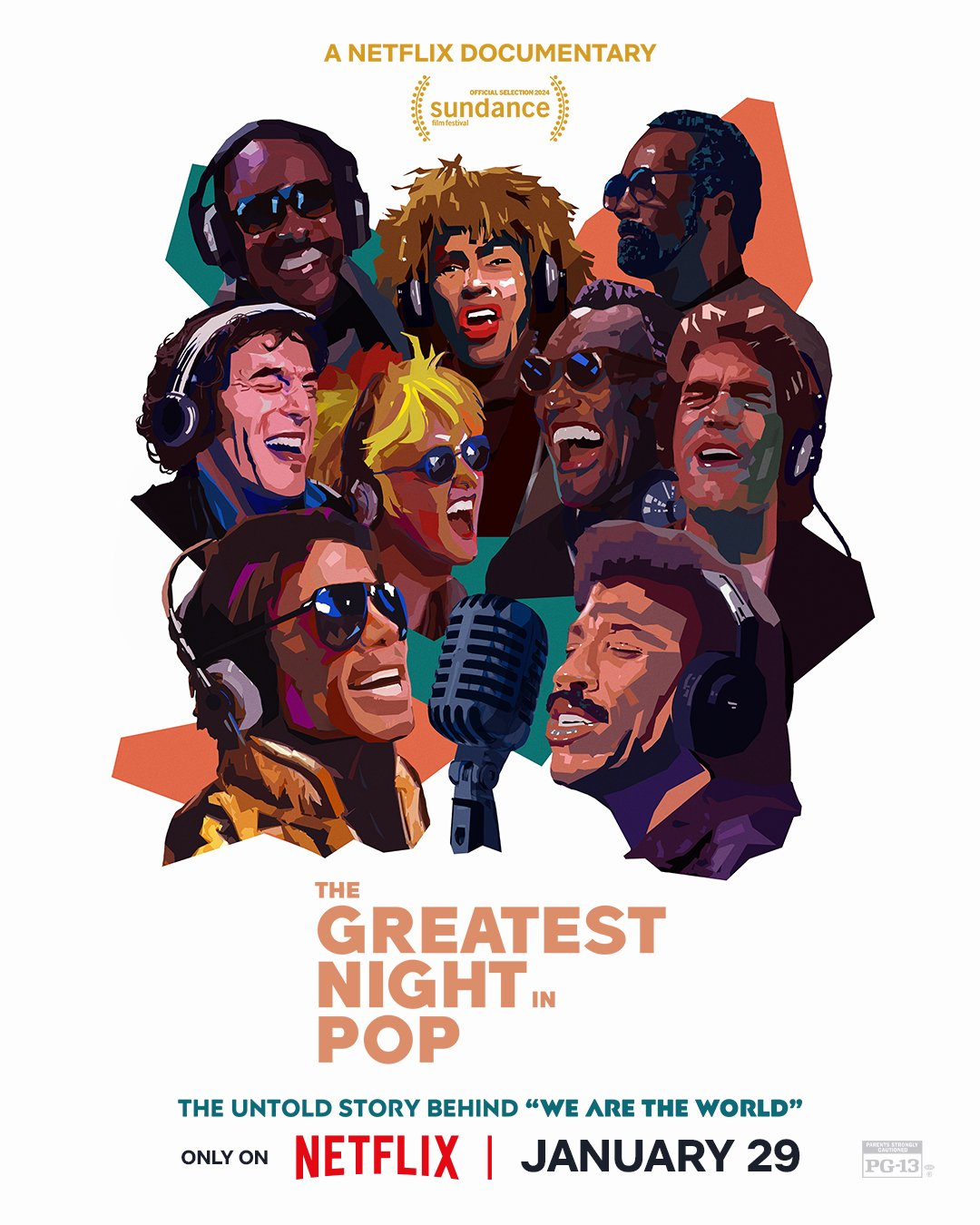
The best part of this documentary is the beginning, where the famine in Ethiopia is juxtaposed with the difficulty of wrangling stars who might alleviate such monumental, global suffering. But it must be done the night of The American Music Awards, because, you know, they all have busy schedules.

That, and when someone observes that had Michael Jackson not participated, it would have been “one of the biggest mistakes of his career.”  Well sure. One of them.

Also, Cyndi Lauper almost bails because “I was so punch drunk tired” after the awards show. Oh, and her boyfriend didn’t think it was a hit.

This is, unknowingly, pretty funny, clueless shit.

There are, however, some genuinely cool moments that aren’t fully mockable.

I liked how Kenny Rogers drove his own shitty car to the studio amidst the fleet of limos.

I liked how Steve Wonder wanted to sing a made-up Swahili line and Waylon Jennings just split.

I liked how Bob Geldof saved the project, torpedoing Wonder’s stupid idea by explaining that the song was not for Africans, as they would likely not be hearing it, but rather, eating because of it, and further, Ethiopians don’t speak Swahili.

I liked Bob Dylan on whatever drug he was on looking like a dude who does not know what portal he fell through to be amongst these people. And it was very sweet to see how Quincy Jones and Wonder got this addled fool thru his part.

I liked how Kim Carnes’ solo was reduced to two lines in favor of a Huey Lewis harmony, which she handled better than Sheila E, who sussed out that she was only invited as Prince bait, whereupon Sheila pulled a Waylon.

But, ultimately, as perhaps preordained, this documentary must fail, because it does not explain the presence of Dan Ackroyd.   He is inexplicably back there in certain scenes, doing absolutely nothing. Like Bigfoot.

On Netflix.

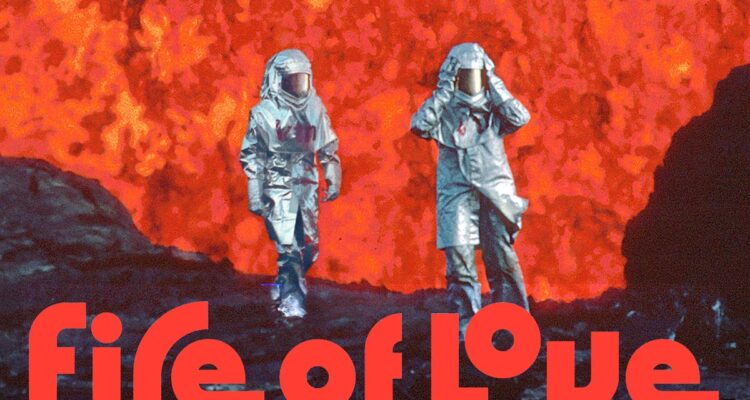
Katia and Maurice Krafft were world-famous scientists who started studying active volcanos up close and personal in the late 60s. She was a meticulous geologist. He was a daredevil who dreamed of riding a lava flow on his own boat. They grew up in the same town, and as depicted by writer-director Sara Dosa, they were in a multi-decade menage-a-trois with the fiery, fracturing earth. “Once you see an eruption, you can’t live without it because it’s so grandiose, it’s so strong,” says Katia. And you believe her. 

The footage shot by the Kraffts is incredible. They have no reticence and little fear, often camping for weeks in active volcanos, so they are right up close to everything, two kindred souls in thrall. Their story is lovingly rendered by Dosa, who shows us a union fueled by adventure and enhanced in its last years by a commitment to governmental evacuation plans. 

I was reminded of Grizzly Man in terms of access to the dangers of nature. And indeed, the protagonists of both movies eventually press their luck and nature exacts its toll. But where Tim Treadwell’s immersion in the world of bears seemed fraught with an almost messianic hubris and his own narcissism, the Kraffts seem noble in their bravery and grounded in their devotion to the science. Beautiful and haunting.

On Hulu and Disney and nominated for an Oscar as Best Documentary.

I love Anthony Bourdain. And by that, I mean I love his books and shows, because it is the only way I knew the man. The essence of a successful food and travel host is not only to be a great guide but an entertaining, engaging companion, and Bourdain was that and more.

Roadrunner, naturally, offers to give greater insight and attempts to do so through the remembrances of his friends, loves and/or colleagues. But also, through the film of Bourdain himself, which I assume there is quite a lot of, given his long run on TV.

Too bad for him. In a lot of ways, the documentary offered the man behind the curtain, and for the most part, other than demonstrating a frenetic pace, a little benign soul-searching and some introspective gallows humor, the footage is of no real moment. Likewise, his friends confirmed he was fun, obsessive, controlling and a little dark at times.

Regardless, the entire endeavor was such an exercise in post-mortem narcissism, with laser-like focus on the why (did he kill himself?) and the who (was he really, deep inside?), they never got to the best part, the what (impact did he have on others and the world around him?) They have so much footage of Bourdain waxing introspectively just to pass the time, but it lacks verisimilitude and gravitas. And how much can anyone take of a man talking about himself, followed by friends who don’t so much talk about him but about his psyche and his end, in the manner of adults playing Clue?

I was surprised about how bored I became. This is a man whose legacy is what he did at all moments before his end and its impact, and yet, Roadrunner spends itself on why he did it, and the impact of that last impetuous act on the interviewees (newsflash – they were very sad).  Lost is his life as a chef, his impact on others here and abroad (Where is his daughter? Who cares? Let’s devote more time to how confused, rootless and exhausted Bourdain was made by excessive travel!) and the joy he gave people. My God, there is one scene where an interviewee provides us the meanest thing Bourdain said to him and then starts bawling. So very, very small.

Three other problems. The documentarians did not interview his last girlfriend yet posited that his obsession with her was contributory if not dispositive to his undoing. She, Asia Argento, is a loon, but still, not quite cricket to condemn and then omit her. They also computer-generated Bourdain’s voice briefly, with the director saying his widow told him Bourdain would have been “cool” with it. She denies any such coolness and as brief as the gambit was, it is a stain. Finally, there are many references to Bourdain’s heroin addiction but little explanation as to how he overcame it or how it influenced or altered his existence. It’s like saying Patton was a veteran and leaving it that.

On HBO Max.

Peter Jackson Reveals How Paul and Ringo Feel About 'Get Back' - Variety

Peter Jackson’s Get Back on Apple TV is a fastidious, thorough, fascinating look at how the band worked and communicated. Apart from being a monumental technical achievement, this 7+ hour flick is a gift to hard-core Beatles fans and maybe fans of pop music, in terms of seeing how the sausage is made by the greats. For everyone else, I suspect it will be Sominex with a laudanum chaser, but I’m a Beatles fan, so I totally dug it.

There is not much more to be said about the documentary, save for the live-blogging of the first two episodes (third to follow) by Xmastime blogspot, which is the funniest, most engaging thing I’ve read all year.

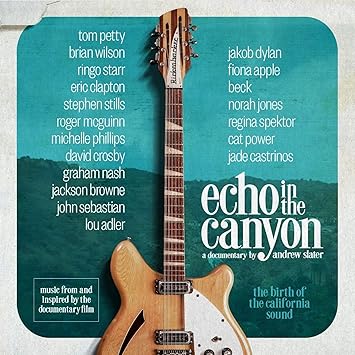
Image result for Echo in the canyon

Jakob Dylan’s enterprise (re-recording a lot of Laurel Canyon, jangly folk rock and putting on a show) is the heart of this documentary, which also features Dylan quietly listening to the usual suspects (David Crosby, Tom Petty, Roger McGuinn, Jackson Brown and many more) go on about what made the Laurel Canyon sound and scene what they were.  For the most part, the interviewees seem to have no idea, but man, they sure dug the vibe.

The documentary is pretty pedestrian, Dylan being a particularly inapt choice for interviewer (there are times he looks like he fell asleep, which is hard to do in front of the Gary Busey-esque Stephen Stills).  The narrative is also a bit of a mess – is this about the sound, the place or why The Byrds broke up?  is it the film of a tribute record/show?  or is it about Dylan’s seemingly excellent directional skills as he drives around LA?

The picture follows no line very long and when “old friends” like Michelle Phillips or Brian Wilson drop by the studio as Dylan works on their tunes, well . . . “awkward” would be understatement.  Wilson’s snippet in particular underscores the problem.  Hailed as a master of a golden age, when he comes in to see how Dylan is faring with one of his tunes, the only usable footage is Wilson asking what key they’re playing the song in.  Hoo boy.

It’s as if the musicians have been asked so often about “their time” that the answers are rote. All the pulp has been squeezed out, they realize it, and so they compensate with content-less emotion.  Such is their banality, the film uses up footage of Dylan driving in LA, or we get the obligatory Petty and Dylan walking into a guitar store, or Dylan strolling into a record store and appearing like a man looking for directions.

And the movie is only 1 hour 22 minutes.

The best parts are the snippets of song for the show, which includes Beck, Fiona Apple, Nora Jones, Jade Castrinos, Cat Power and others.   But, to be even more of a curmudgeon, Dylan is such a musical barbiturate, even those numbers feel a little lackluster.

Currently streaming on Netflix.

p15073018_v_v8_aa

From Lauren Greenfield, the writer/director of The Queen of Versailles, this documentary tries to be both an anthropological study and photo-journalistic essay of wealth. We are introduced to rich people in LA who get cosmetic surgery for their dogs, rappers in Atlanta who litter strip clubs with currency, porn stars who hope to emulate Kim Kardashian, escorts and limo company execs who sell the veneer of being rich for an evening or an assignation, and a whole host of ostentatious sellers and buyers.

The stories aren’t necessarily new. Excess is a strong component of who we are and coupled with the desire to judge, the sneering at folks who are the most brazen and gosh while we engage in miniaturized versions of their sins is damn near a national past time.

The director’s own revelation of being a small part of it, a gawky teen at a tony LA high school dropped off a block from school so her peers wouldn’t see the car her father drove (and he’s a doctor!), suggests we should trust her as a narrator.  But Greenfield can’t hold a line. She eventually muddles the message, at one point, confusing excess with being a workaholic, a cheap and errant way to shoehorn her own story into the feature.  It’s a bad fit, and her interrogation of her ambitious mother and bright son in the service of the subject is off-putting.

Still, the film eventually crashes when it morphs from a broad review of wealth culture to wild individual stories followed by a “where are they now?” coda that feels every bit as exploitative as the society the director is attempting to depict.

The documentary is also peppered by lofty, laughable socio-political commentary from Chris Hedges, a dummy extraordinaire whose platitudes are in stark contrast to the film’s more understated tenor. The picture is best in presentation, not catechism.

Hedges, however, does scratch an itch: “It’s kind of like the end of Rome . . . Societies accrue their greatest wealth at the time of their death.”

We shall see!  On Amazon.

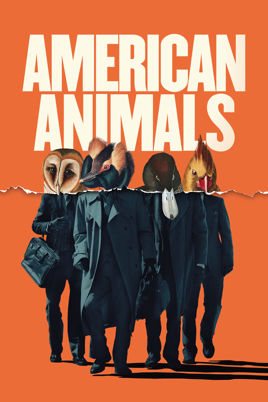
Image result for American Animals

First time feature writer/director Bart Layton’s true story of four Kentucky college kids who decide to steal rare books from the archives of Transylvania University is a gem.  At root, it’s a heist picture, but this is no Oceans 4.  Layton hilariously juxtaposes the theft in the minds of the boys with the much less smooth, cool and seamless aborted and actual boosts.  Layton also captures the ennui and disassociation of the kids, which has them yearning not so much for the money but for an authentic experience, a stamp.  He does not sugarcoat their selfishness, or make “woe to the disaffected suburban affluent” excuses.  Instead, he makes what seems rather incredible understandable, if perplexing.

Layton’s approach is phlegmatic and innovative without being showy.  His vision of the inertia and isolation of the boys melds perfectly with their amenability to the caper.  He films their surroundings darkly, sparsely and uninviting.  While everyone else seems to be communing just fine, they are off-kilter, uncomfortable.

I can’t believe Layton doesn’t have a promising future in Hollywood.  I only hope he isn’t immediately jammed into The Avengers: Super Mega-Explosion.  My only nit is the failure to properly account for the motivations of two of the four conspirators, most egregiously, with the last addition to the group.  The short-shrift given the characters was noticeable and a little distracting.

The film owes a debt to Richard Linklater’s Bernie in its use of interviews of the actual participants, but rather than high comic recollections from the would-be thieves and gentle reproaches from their family and friends, he captures the criminals as reflective, remorseful and even grasping to explain how they got to their deed.  As for the families, they are disheartened and confused, not enamored of their band of merry kids now that time has passed.

Layton saves his best interview for last, that of the librarian who is most directly and viscerally affected by the robbery.  You can interpret her state of mind in many ways, but she has been affected by the experience, and in what is the film’s best message, her pain seems permanently etched on the faces of the quartet.

Image result for Obit movie

A charming, old-fashioned documentary about the obituary writers who work for The New York Times, the picture is a tight and compelling look at a particular craft, revealed in interviews with the craftsmen.

I love obituaries from the Times, and there is a certain sadness in watching picture documenting an art form whose biological clock is ticking.  Their work is substantial, and it is a treat to see them tell us about what they do and how they go about it.  But it is bittersweet, because the dusk approaches.

I only had one criticism.  While the obit writers freely regale us with their worst errors, the tricks of the trade, and the challenges of an often-time sensitive endeavor, director Vanessa Gould never inquires too deeply.  For example, we hear about the conflict of deaths (Farrah Fawcett passing the same day as Michael Jackson) but nary a word as to how these writers deal with figures with controversial pasts (I would love to have had the obit writer discuss the decisions he made with Jackson’s piece).  Also missing is whether famous folks who die have pressure exerted on their behalf by their handlers and/or family.

Still, a fascinating documentary.  Available on DVD (I still get one a month from Netflix).


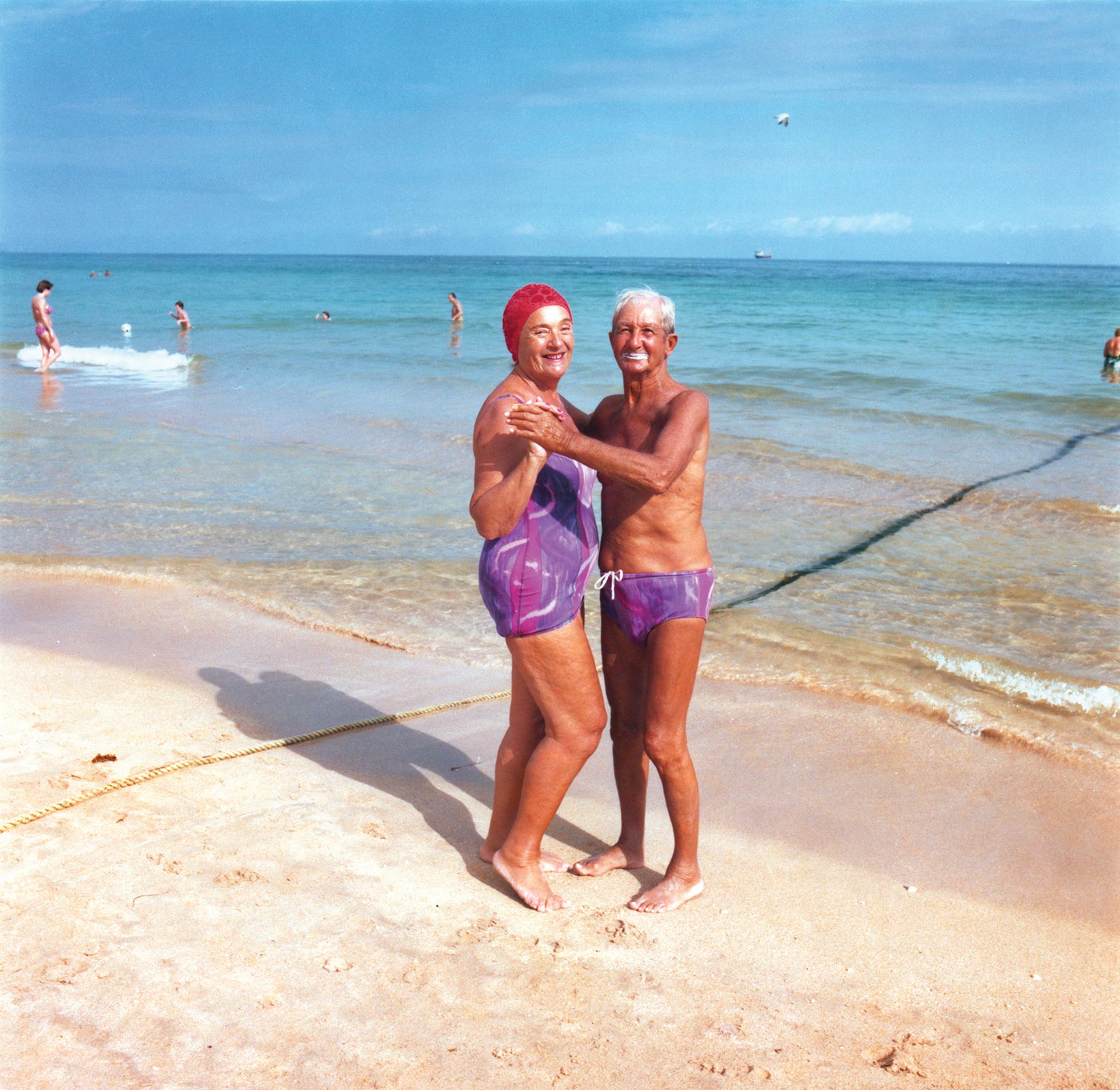
Image result for Andrew Sweet photography miami

A retrospective of Miami Beach partially through the lens of photographers Andrew Sweet and Gary Monroe. This documentary is an interesting and economical time capsule of post war life there, as it became the haven for elderly Jews, eventually giving way to the Mariel influx, the drug wars and accompanying crime, with gentrification delivering the coup de grace. Joyous, poignant and a little depressing. A little uneven but definitely worthwhile.

On Netflix.