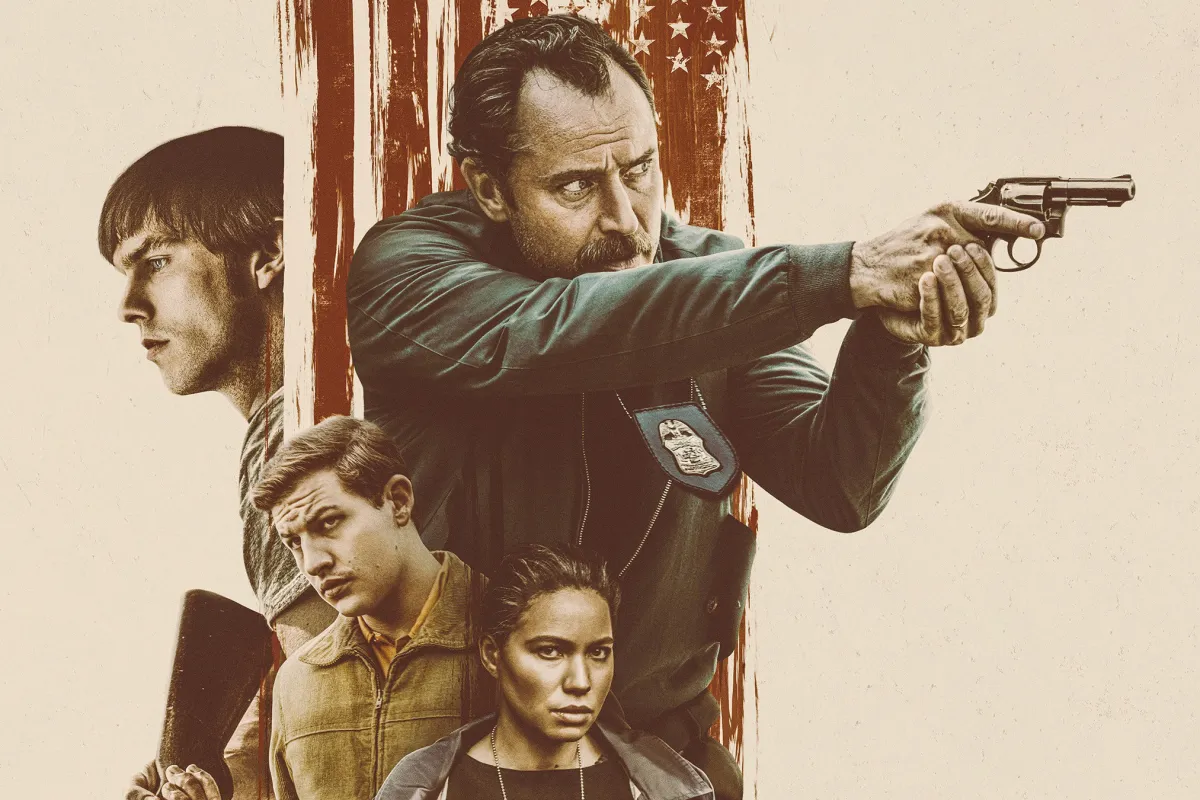
Writer-director Jeremy Saulnier’s Blue Ruin, an earthy, dark meditation on the messy and corroding influence of family blood oath and violence in rural Virginia, was such an assured debut, I was blown away. He followed up with the canny, creepy Green Room – where a band gets the worst gig ever playing for skinheads in the Upper Northwest – a commercial failure, perhaps because it was such a grounded horror film. No unstoppable evil or chop-licking psychos, just nasty, human, unregulated criminals with Swastikas and 12 packs who dig punk rock and live in the deep, deep woods.
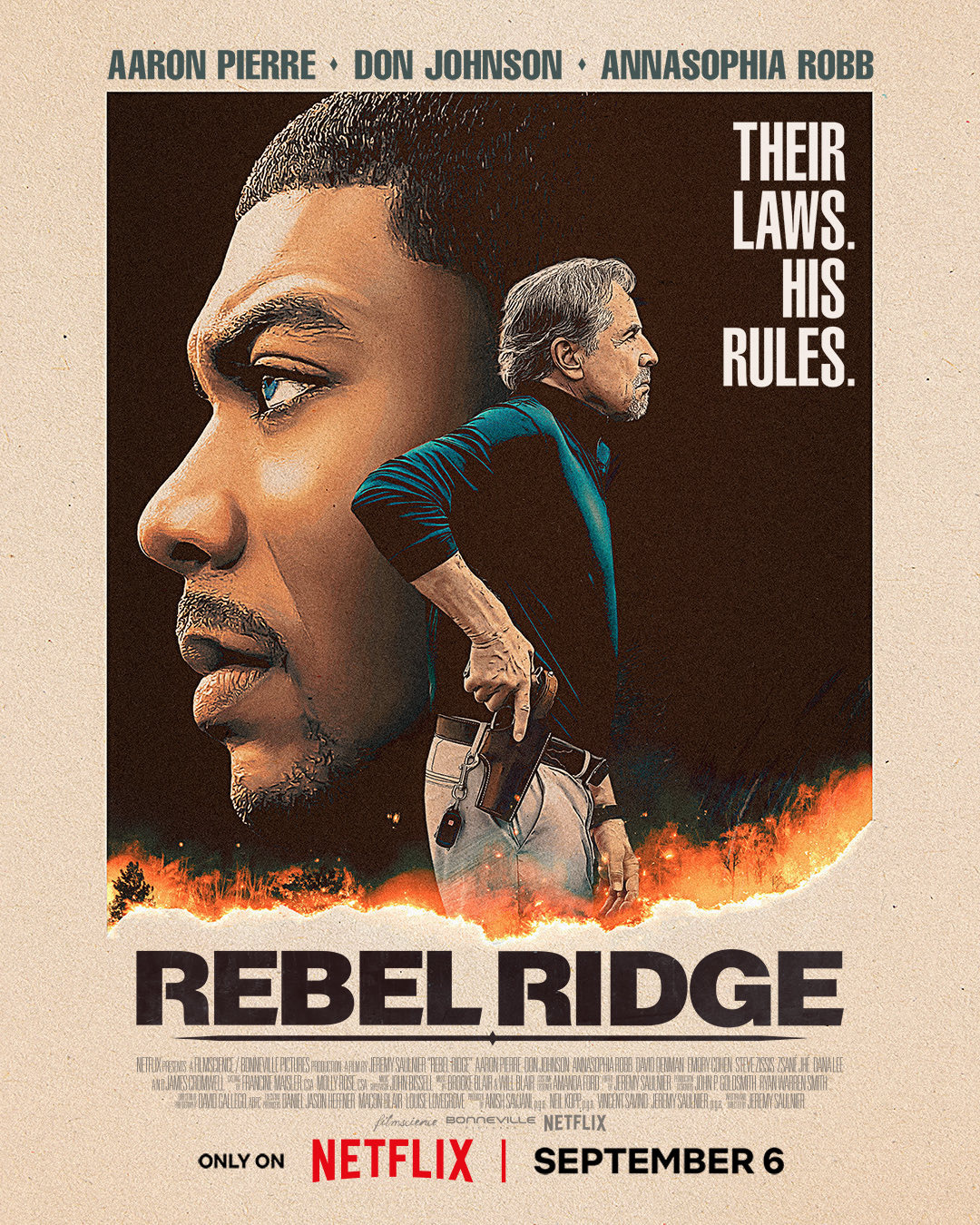
Rebel Ridge again showcases the director’s dead-on familiarity with small town America. No Chevy Truck “backbone of the USA” schmaltz or easy tropes of the rural downtrodden being done in by “the man’s system.” Saulnier understands that most people are in some form or fashion paid by “the man’s system” and that system is what keeps mortgages current, power boats afloat, and Carnival cruises filled. In the small Southern hamlet that is our setting, graft, skimming, and railroading drifters end up just being part of the fabric, the next logical step for a speed trap town.
What follows is a gripping, subtle melange of liberal fear of cops and conservative “power of the deep state” fear of the government, good old fashioned small town Walking Tall corruption via asset forfeiture and … Rambo: First Blood.
No preening, no speeches, a lot of surprises, and a boffo, visceral, satisfying revenge fantasy ending, powered by Aaron Pierce’s reserved, steely leading turn.
In spots, a bit ragged for Saulnier, and there is an underdeveloped relationship between Pierce and a plucky court clerk (AnnaSophia Robb), but those are nits.
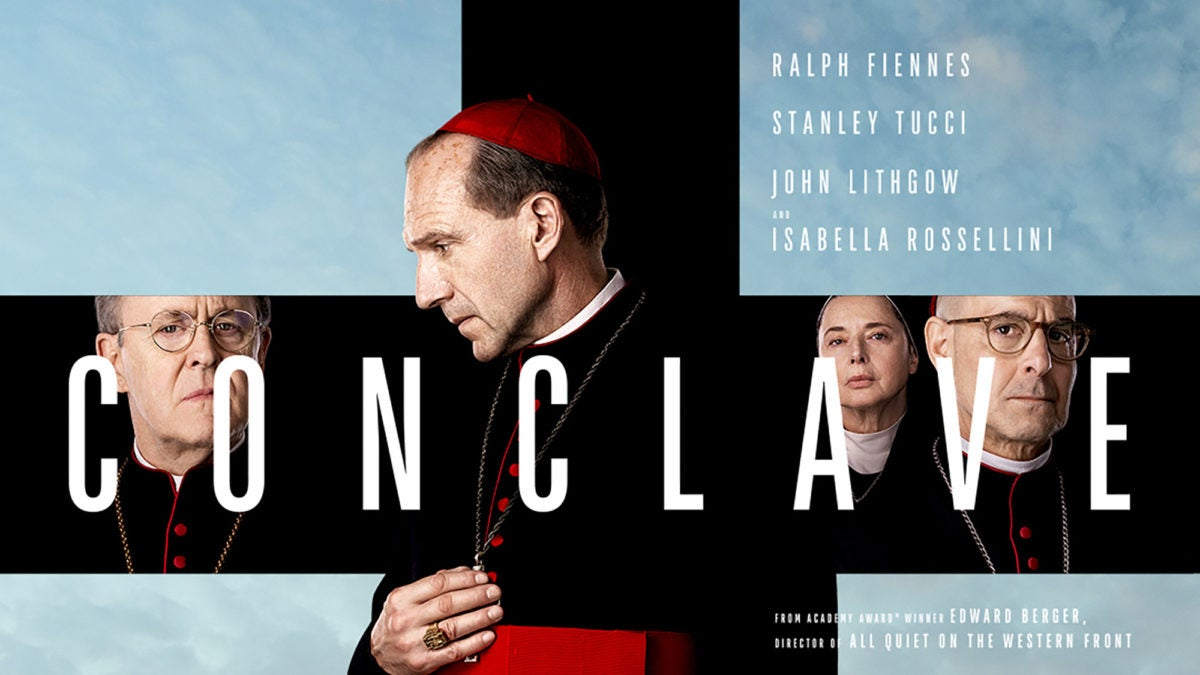
A movie that works beautifully on several levels. First, if you ever wanted an “inside” look at how a pope is selected, someone did their homework. Just like William Peter Blatty’s research into the ritual seemed so authentic in The Exorcist, and the hierarchy of a late 60s parochial school was nailed by John Patrick Shanley in Doubt, the convening of the cardinals to pick the next pontiff exudes legitimacy. Based on a Robert Harris novel, screenwriter Peter Straughn has a solid feel that comes from some religious experience and curiosity (“It was a world I was interested in. I was brought up Catholic. I was an altar boy, and I went to a Catholic school, so, in some ways it felt like home territory, even though I’m no longer a believer. I had one foot in the world and one foot out, so that interested me”).
Second, and I can’t write much on this, there is a satisfying Sixth Sensian reveal that is confident enough to leave it at that, without delving into the machinations of the ultimate selection. I was concerned we’d recap with a Murder on the Orient Express flashback diagram, but the picture is less about how we got to the selection than what it meant to get there and what it means. Better, the end is the kind of reveal that could have been wielded like a sledgehammer, but Straughn and Director Edward Berger (All Quiet on the Western Front) celebrate subtlety over all else.
Third, the film is a feast for the actors. Ralph Fiennes is masterful in his portrayal of the manager of the conclave, fighting his own ambition and anger at his designation as a mere facilitator rather than a spiritual leader. Fiennes is ably supported by John Lithgow, Stanley Tucci, Lucian Msamati, Sergio Castellitto, and Carlos Diehz, who represent different future paths for the papacy while vying for the top slot. Isabella Rossellini plays her own game as the sister who, for lack of better title, is the site manager for the election. Her hand may be well hidden and guiding, but given her near vow of silence in the world of men, even though her face tells so much more by necessity, nothing is confirmed. Nominations will be accorded generously and she is a shoo-in.
Last, the Catholic Church comes out well in this. In and of itself, not necessarily a recommendation, but the movie offers a different view of an institution so maligned of late that another broadside would just feel hackneyed. Sure, there are shenanigans and skullduggery, but there is also great deference to the awesomeness of the task, the mysticism and seriousness of the process, and the weight placed on the jurors. The debate between the “new” and more traditional Church is also given a fair airing and ultimately, without taking a side, the picture elevates a philosophical point to a logical, if arguably heretical conclusion.
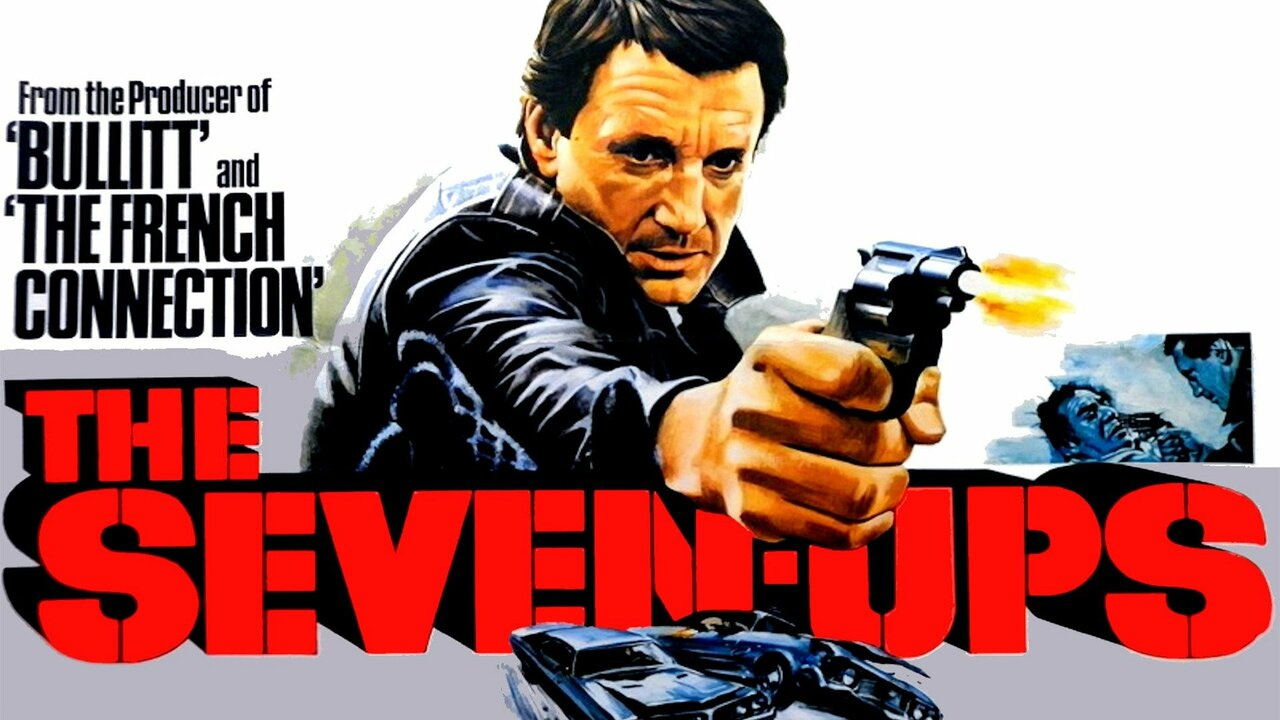
Director Phil D’Antoni produced The French Connection, and he struck while the iron was hot in this gritty, noir follow-up. The pictures seem familiar, sometimes distractingly so. There is no Gene Hackman as Popeye Doyle, but in his stead is Doyle’s partner, Roy Scheider, a New York City detective heading up a specialized team, untethered from bureaucracy, with its sights on the mob. Scheider has a mole (Tony LoBianco), a connected guy and childhood pal, who gives him tips. We see some stakeouts and takedowns, a lot of steamy subway grates and bleak streets, the Big Apple as hellscape.
D’Antoni also produced Bullitt, and stayed true to what he knows again, inserting a boffo car chase very reminiscent of McQueen’s ride through and to the outskirts of San Francisco.
But Scheider is no McQueen or Hackman. McQueen had the gravitas that told you everything you needed to know and more about his character, even as he wordlessly dined with the stunning Jackie Bisset or loaded up on TV dinners at the corner market. He had depth and heft. Hackman as Doyle was even more fleshed out, a driven, bigoted, brutal thug, the kind of guy who doesn’t stop chasing you even after he accidentally shoots a cop.
Here, Scheider just isn’t given anything. His relationship with LoBianco is seminal, but we learn little through their clandestine meets. D’Antoni must have realized the problem, as he has a scene of Scheider walking through his old neighborhood, but it feels perfunctory. We don’t know who he is or what makes him tick and that’s a problem.
But not an insurmountable one. Solid, no-nonsense, brisk flick, good nostalgia.
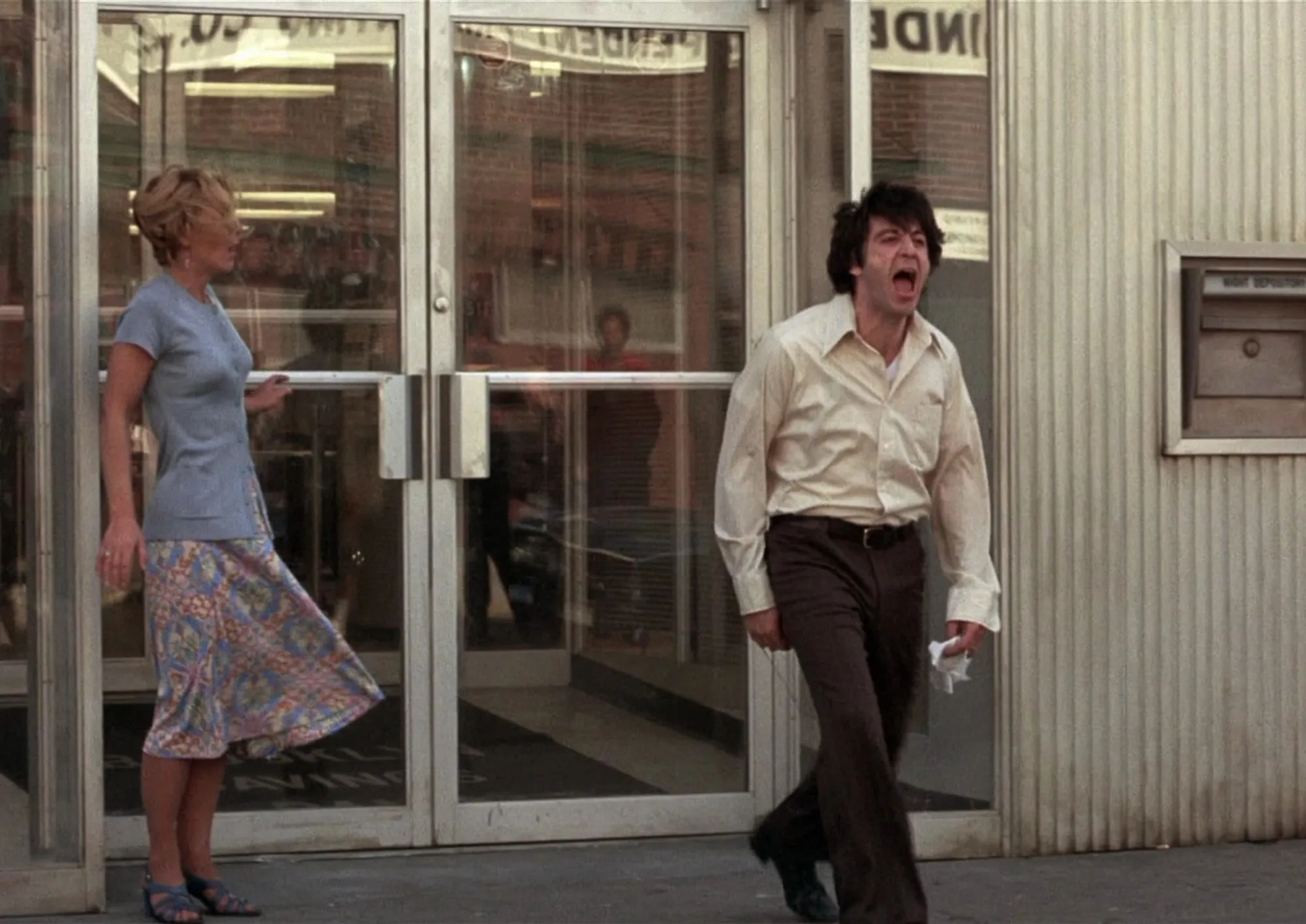
I took my cat to the vet yesterday and had that strange interregnum – too late to go back to work and too early to have a drink. So I flipped on the TV and lo and behold, Dog Day Afternoon was starting.
“Prescient” doesn’t even begin to capture Sidney Lumet’s masterpiece. Sonny (Al Pacino) and Sal (John Cazale) rob a bank in Brooklyn and before you know it, everything goes to shit, it’s a hostage situation, and they are surrounded by 100 cops, led by the overmatched and harried Charles Durning.
This is one of those 70s “New York City seems like hell” flicks. The robbery occurs on a sweltering summer day, and the police seem itching to gun down Pacino if only to get out of the heat. But soon, the TV cameras roll in, the crowds arrive, and before you know it, Pacino is a street-performer, not negotiating so much as whipping everyone up, screaming, “Attica! Attica!” and otherwise savoring the moment and, for lack of a better phrase, sticking it to “the Man.” His rage and theatrics are infectious. The crowd bays, bystanders want “in”, the hostages (plucky New Yorkers all) play-act and become featured cast members, and soon, the cops are the ones being led by the nose. Everybody has their 15 minutes.
But Sonny’s ride must end. Sal is a dimwit (when Pacino asks him what country they should fly to in escape, Cazale responds, “Wyoming”). The origins of the heist – to get money for Sonny’s boyfriend Chris Sarandon’s sex change – become public when Sarandon is sprung from a suicide attempt at Bellevue to come talk some sense into Pacino. The hostages start to lose the fun of it as well, and Cazale’s biggest worry becomes the fact that the networks are reporting “two homosexuals” in the bank. When Pacino is put on the line with his wife, you can see how he could be driven to such extremes and also what an awful person he has been to her. His mantra is, “I’m dying.” He is, in front of us, in slo-motion, but we sense we’ve missed a lot of the decline.
There is a great scene where the manager, having suffered a diabetic episode, is tended to by a doctor, gets his shot and chooses to stay with his employees:
As Sonny grabs him to try to help him up, Mulvaney wrenches
away. A little physical here.
SONNY
Hey! I’m tryin’ to help you.
MULVANEY
I stay here. Damn it. I just neededthe insulin. I’m used to it.
Go on. Go on.
SONNY
(to Doctor)
You tell me. Is he endangering his
health, because if you tell me he
is, I’ll get him out.
MULVANEY
I’ll be God damned if you will.
SONNY
Oh, Jesus! You want to be a martyr
or a hero or what?
MULVANEY
I don’t wanta be either, I just want
to be left alone. You understand
that? I wish the fuck you never
came in my bank, that’s all, don’t
try to act like you’re some angel of
human kindness!
You can see Pacino’s hurt. As if maybe he really thought this would work out and that he is a good man.
But soon, the FBI take over, and they are helluva lot more together than poor Durning and company.
Pacino is riveting, alternately electric and doomed, eliciting your scorn and then sympathy. He’s all furtive energy minus the excess and “hoo ah!” You know this had to go bad, and so does he, and it’s depressing to see him hope, just for a minute, and then know he’s a loser and finished. Sarandon is fantastic (he was nominated for supporting actor), ridiculous and yet, affecting in his affectations, as if he knows he’s absurd but can’t shake the affliction.
It won an Oscar for Frank Pierson’s (Presumed Innocent, Cool Hand Luke) original screenplay, which doesn’t have a false note in it.
Crisp and taut work by the reliable Alan Pakula (Klute,The Parallax View, All the President’s Men), expert enough that you don’t think about the silliness of it all until the end.
And boy is it silly.
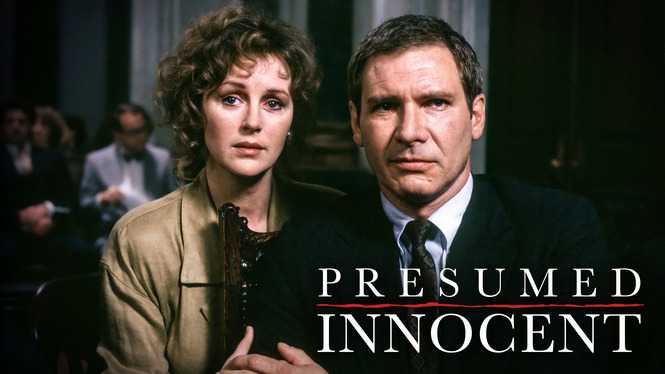
Harrison Ford, with a bad haircut, plays a deputy prosecutor (Rusty Sabich) who has an affair with a subordinate colleague, Greta Shacchi. She is young, exciting, a risk taker, and sexually promiscuous/irresistible.
Rusty, however, is a family man with a loving Plain Jane wife (Bonnie Bedelia), a nice suburban brick house, and a lot to lose. When Scacchi is brutally murdered, Rusty is given the task of prosecuting the killer. But the evidence implicates Ford and soon, he is fighting for his life, enlisting top flight defense lawyer Sandy Stern (Raoul Julia) to defend him. Turns out Scacchi slept with pretty much everybody in the entire judiciary system. Rusty just wasn’t all that special and she was no wide-eyed ingenue, despite his own obsession with his young charge.
Then the twist. [SPOILERS ON A 34 YEAR OLD MOVIE FOLLOW]
Bedelia, sensing the younger woman’s threat to her own family, is the killer! But it’s not enough for her to eliminate the competition, she must teach Rusty a lesson, tame him. So she not only killed his lover, but, per Wikipedia, “left enough evidence for Rusty to know that she committed the crime but did not anticipate him being charged.”
How?
She secreted Rusty’s semen and put it in the dead woman!
Jiminey Christmas! That’ll teach him.
[Side note – how depressing – Rusty and wife are clearly past child-bearing age and what, they’re still using condoms? I mean, I supposed she could have saved it another way, but that seems even more diabolically comical].
Thankfully, for Rusty, Stern is a capable defense attorney, the coroner misplaced the semen sample, a mug with Rusty’s prints found at the scene was disappeared by his investigator pal and even better, Scacchi also slept with the judge (Paul Winfield), for whom she was soliciting bribes.
Case Dismissed.
Maybe one of the dumbest whodunnits ever, the flick came on the heels of Fatal Attraction, the lesson of both being, “Don’t cheat on your wife. Seriously. Don’t.”
Still, it was plenty entertaining as long as you didn’t think too much about it.
Or perhaps think about it at all.
They just released a remake of this on Apple with Jake Gyllenhaal playing the role of Ford. We tuned in for the first episode, which was not good. Gyllenhaal is too young, too emotional, and borderline oafish, and the set-up is wearyingly predictable. Plus, the key to Scott Turow’s novel and the first picture is that Rusty is kind of ordinary schlub entranced by a sexpot. Jake Gyllenhaal is no ordinary schlub and can’t play one. Worse, Gyllenhaal’s Rusty is so into the Scacchi character, even post-mortem, he’s in therapy. Which we get to see. Which sucks.
If it is any consolation, apparently, they have taken care of any import of slut-shaming the Scaachi character. Which is kind of dumb, because Scaachi wasn’t slut-shamed in the original. Rather, she was just breezily promiscuous, manipulative, ambitious, and corrupt. Per Vanity Fair, now, she “cares” for Rusty – blech – a fact I don’t have the time or inclination to confirm.
I recently devoured Quentin Tarantino‘s Cinema Speculations, wherein he recounts his childhood and the succession of films his mother’s boyfriends would take him to see when he was a kid. Most of the films he discusses are ones you probably shouldn’t take a kid to see.
When my mother and father got divorced, I was six years old and my father was supposed to take us every other weekend for two nights. That arrangement became a little less frequent over the years, and by later grade school, he was taking me and my brother on a Saturday day and an overnight. We would spend the weekend with him at his apartment and pretty much do the same thing every time: go shopping, do his errands, look for stereo equipment, maybe spend an hour or two at his law office, go Putt Putt golfing, and then to Shakey’s Pizza in Rockville or The Charcoal Grille in Bethesda. Dinner was from Swanson’s, so you got a entree’, two sides, and a dessert.
And movies. We went out to the movies a lot. Or, we stayed in Dad’s apartment, where he had a special key that was hooked up to some kind of internal cable system, and we could watch close to first-run movies there instead of going out. Or just catch what was on TV.
My father loved movies, he loved to talk about movies, he lived for movies. So much so that he would go through a certain kabuki with me where he would let me take a look at The Washington Post and ask what I wanted to see. I would pick a Herbie the Love Bug and he would say, “Nah. I heard about this good movie.” And then, like Quentin Tarantino with his mother’s boyfriends, you went to see a lot of dark, heavy, violent flicks, like The Laughing Policeman, The Silent Partner, Death Wish, or The Taking of of Pelham One Two Three. Or the remake of Farewell My Lovely, Night Moves, or The Eiger Sanction.
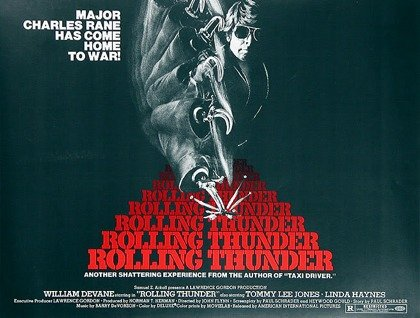
And Rolling Thunder. Which I noticed was available, and, as I couldn’t sleep anyway, I watched last night
Tarantino’s book has an entire chapter on the film, one of Paul Schrader’s first screenplays after Taxi Driver. Major Charlie Rane (William Devane) and Sergeant Johnny Vohden (Tommy Lee Jones) return to Texas after seven years of brutal captivity in a North Vietnamese prison camp. The adjustment is fraught, and even greater tortures are brought to bear on Devane, who is being treated by an Air Force psychiatrist (the just recently deceased Dabney Coleman) in his attempt to readjust. Tragedy ensues. Devane snaps. What follows is a classic 70s revenge flick.
The film travels wonderfully. There is a crisp foreboding to Devane’s return. While San Antonio welcomes him with marching bands and celebrations, and he is reunited with his long suffering and loving wife and the son who he last saw as a baby, Devane is damaged, and beneath the cheery gleam of a welcoming Texas, there is rot and danger. His son has anxiety issues. His wife has found another man (Devane says to her evenly, “you’re not wearing a brassiere” to which she replies, “oh, no one wears them anymore”). He cannot sleep in the house, preferring a cot in the garage.
So much is done well in the lead-up to the Death Wish-ian payoff, it goes unnoticed because, after all, this is a shoot ’em up, just desserts pic. Per Tarantino: ““This opening thirty minutes is a grippingly detailed character study, and by the time it’s over the audience doesn’t just sympathize with Charlie Rane, we really do understand him. Apparently better than anybody else in the film. It’s a much deeper depiction of the casualties of war than the [other movies of that era].”
I remember watching the film with my father. It is engrossing, both subtle and visceral, like a lot of pictures we saw together. It is also wildly inappropriate, also like a lot of pictures we saw together. I had trouble wrapping my head around something horrible that happens to Devane; not a spinning, vomiting Linda Blair kind of visual, but a brutality so smartly connected to a mundane part of the household, it just traveled with me, and probably not in a good way. Even last night, I fast-forwarded.
But on Sundays, when we were dropped off, I would not tell my mother about any of these movies, because I felt me and my Dad had this thing, this bond, and it was cemented in our little secret, Jujufruits and Junior Mints in hand. And perhaps we did, although I’m probably mythologizing it. After all, my father needed to have something to talk to me about. Or at a minimum, just a two hour break from my babbling.
The picture is currently on Amazon Prime. Nostalgic for me but it really holds up.
A man falls from a window and dies. Was he pushed?
Like HBO’s The Staircase, this is a courtroom drama about one spouse accused of murdering the other, but this film is like nothing you’ve likely ever seen before, simply because half of it is in a French courtroom, where as near as I can tell, a criminal trial is-
Nothing but a series of closing arguments between the prosecutor and defense counsel.
A venue where they let anything in as evidence, including absolute, groundless conjecture.
A therapy session.
As someone steeped in both American and British procedurals, the picture is fascinating. Think about a prosecutor who elicits, “Well, I think she did it because I was the victim’s therapist” from a witness, and then the prosecutor turns to the defendant and basically says, “Well??? What say you to that!” And all other witnesses get to hang out and watch.
Also, if there were ever a cautionary tale that French and German people should not marry, this is the one.
This is edge of your seat stuff, a film that jams in a flashback of a fight between the spouses on the day before the murder, an exchange that far eclipses the tension of the courtroom.
I am somewhat burdened by the “whodunnit?” aspect of the picture to get deep into analysis, so I’ll focus on the performances, which are stellar. Sandra Huller has the misfortune of coming up against Lily Gladstone (Killers of the Flower Moon) and Emma Stone (Poor Things), so, no chance. But her turn as the accused is riveting.
It’s a bit long, and ambiguity has its limits, but a great picture nonetheless.
David Fincher could grippingly film a Frosted Flakes commercial.
Fortunately, he has more to work with here, with Michael Fassbender as a lonely, meditative, assassin embarking on his own city-to-city retribution against his employers and their henchpeople.
We learn about the business, a grim primer without the dark humor of Grosse Pointe Blank, the panache of the John Wickfranchise, or the earnestness of The Accountant. The work is drudgery and rote, until it isn’t, and things go tits up. Even then, though, there is no glamour. Just the racking up of air miles that cannot be utilized, the eating of fast food on stakeouts of dumps, and boring trips to any number of storage units.
Fincher’s picture is very easy and assured, occasionally inventive, never stalling, and yet, the endeavor feels beneath his gifts. The comedy is often too dark to resonate. Though the ending is refreshingly, thought-provokingly anticlimactic.
I took my 93 year old mother to see this flick, thinking it was up her alley. As it stands, the picture is beautiful, the presentation slick, and the intrigue, such as it is, acceptable. But the acting is very weak. In the end, for an Agatha Christie, you know the “reveal” is in the offing and it may or may not be ingenious. It is the dramatization getting to the reveal that is most of the fun.
As Poirot, Kenneth Branagh is overly reliant of the gravitas of the character as played by others. As played (and directed) by him, he’s bored, even diffident. If Poirot doesn’t seem roused or energized, why should I be?
As an Agatha Christie mystery writer on the downslope, Tina Fey is her normal self – blasé’, genderless, and snarky. Liz Lemon and “Weekend Update” were her pinnacles.
As for the rest of the cast, they all seem to be straining for airtime, each more bombastic than the next when given the baton. Jamie Dornan and Kyle Allen take the cake in histrionics.
At its worst, the acting is community theatre-esque. At best, it is tolerable.
I asked Mom if she liked it after a week (we are unscientifically testing her memory). She said she had no real recollection of the picture, so the results are inconclusive.
A WWII thriller and a staple on the Channel 7 four o’clock movie growing up, Steven Spielberg once named it as his all-time favorite war movie. I don’t know about that, but as a kid, I was pretty jazzed.
Richard Burton and Clint Eastwood lead a group of commandos dropped behind enemy lines in Bavaria – where the barmaids are buxom and the enemy plentiful – to kill an American general who has been captured by the Nazis. They must get to the general before the Germans extract critical information from him.
The picture is more than competent (though overlong at nearly 2.5 hours; in the 70s, on TV, it was cut to 90 minutes, and did not suffer for it). The movie is also smart, as much a whodunit as war thriller, and uber-violent to boot.
One major problem, however, is the setup. The American general is held in a castle fortress accessible only by cable car. Putting aside the suspension of belief necessary to accept ingress and egress, which is right and proper, the castle also houses hundreds of soldiers, heavy equipment, a barracks, a helicopter pad, a radio room, and enough ammo and explosives to blow itself up. All, of which, apparently, was ferried up in two cable cars that hold 8 people a piece.
Another problem is just a terrible cheat. In The Dirty Dozen, Lee Marvin and Charles Bronson, dressed as German officers, must mingle with the Nazis in the chateau they plan to blow up. The fact that only Bronson knows how to speak German amps up the dread, leaving Marvin to play it stern and taciturn whenever a real Nazi speaks to him at a pre-all-hell-breaks-loose soiree’. Quentin Tarantino does the same thing with Brad Pitt at the film premiere in Inglorious Basterds , though he plays a bit more comic. But Tarantino also utilizes the speaking of German, or, rather, the sign language of a German, to brilliant, suspenseful effect, when Michael Fassbender makes a critical error and is thus found out, which was presaged in The Great Escape:
But I digress.
Here, as Burton and Eastwood approach a checkpoint, where their papers are to be reviewed, you wonder which one is going to speak German. I assumed Burton. Then again, I never assumed Eastwood would sing in a musical, but Lord Almighty, that’s him singing Gold Fever in Paint Your Wagon:
So, who knows, right? Well, it turns out, neither of them speak German. Instead, they speak English LOUDLY, and the guards figure they don’t want to interrupt two German officers speaking loudly. Translated? Neither actor wanted to learn a little German, so we are left to believe that the guards heard German, even though we did not. Very lame.
On the plus side, Eastwood is Eastwood cool and he conservatively, single-handedly, kills at least 100 Nazis. At 10 years of age, I was sold. There’s also a fair amount on double-crosses (the picture is written by Alistair MacLean), and while I can’t prove it, I suspect Tarantino saw the picture and it informed his unparalleled French cellar bar shootout in Basterds.
On HBO Max.
P.S. After writing my suspicions about Tarantino, I Googled a bit and now claim semi-vindication. Tarantino has lauded the picture on numerous occasions, particularly during his promotion of Basterds.